🚀 Introduction
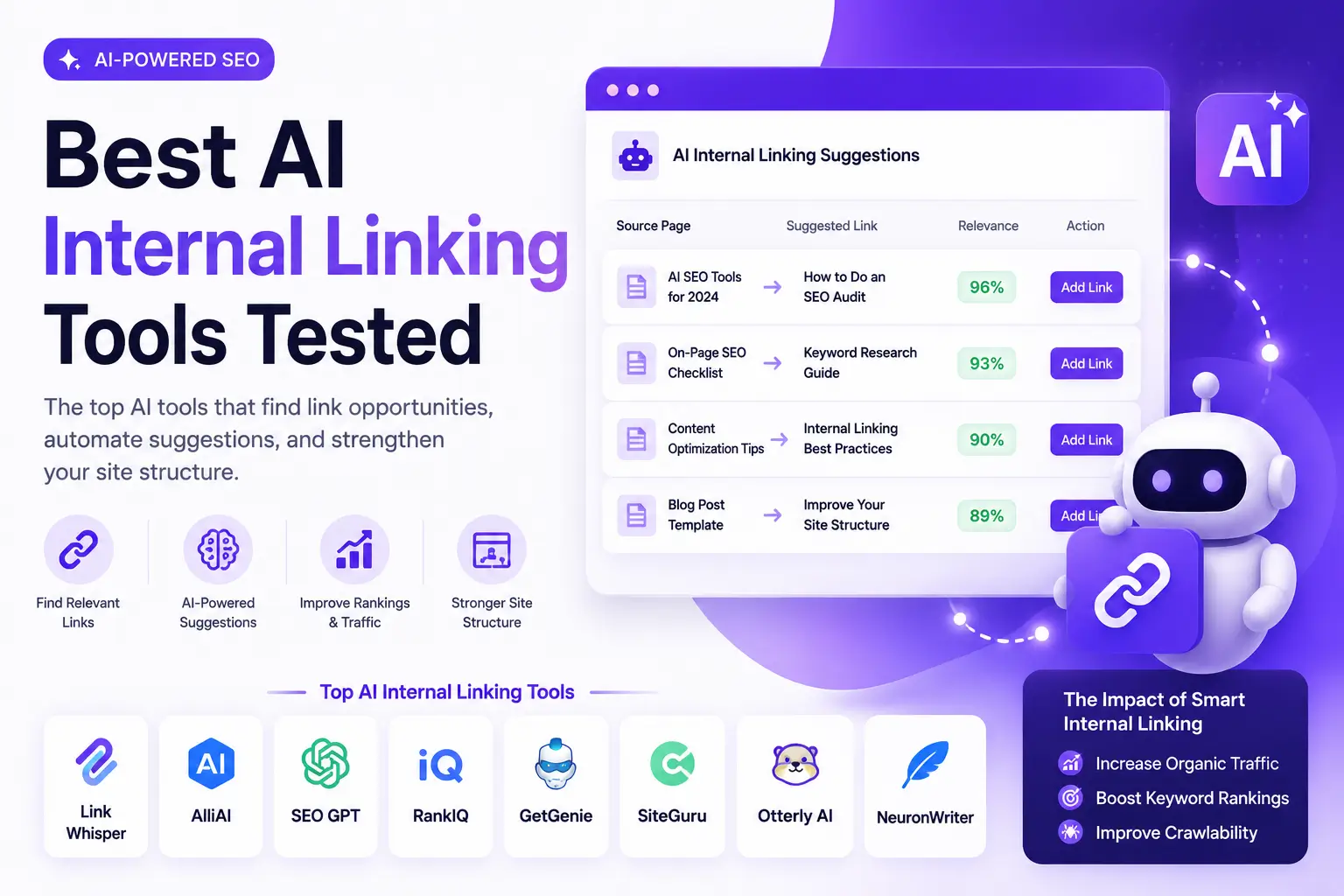
The best AI internal linking tools are Link Whisper for WordPress, LinkStorm for multi-platform semantic analysis, InLinks for entity-based linking, Internal Link Juicer for rule-based automation, Rank Math AI Link Genius for integrated WordPress SEO, and Search Atlas OTTO for agencies and large-scale SEO automation.
These tools do not all solve the same problem.
Some use natural language processing to suggest contextual links while you edit a page. Others identify entities and build a knowledge graph before creating links. Rule-based plugins insert links whenever approved phrases appear, while enterprise platforms analyze entire websites and deploy changes at scale.
Choosing the wrong automation model can create:
- Irrelevant links.
- Repetitive anchor text.
- Excessive links to commercial pages.
- Confusing topical clusters.
- Database or performance overhead.
- Links that disappear when a SaaS subscription ends.
- Over-optimized sitewide patterns.
The best internal linking tool is therefore not the one that adds the largest number of links.
It is the tool that finds useful page relationships, gives you enough control, fits your CMS, and lets you review high-impact changes before publication.
This guide compares the leading tools based on:
- Contextual relevance.
- Semantic and entity analysis.
- Anchor text quality.
- Orphan-page detection.
- Incoming and outgoing link reports.
- Automation controls.
- CMS compatibility.
- Deployment method.
- Scalability.
- Pricing and ROI.
- Potential performance impact.
- Human-review requirements.
⚡ Quick Verdict
Link Whisper is the best overall AI internal linking tool for most WordPress publishers because it combines contextual suggestions, orphan-page discovery, link reports, automatic rules, and editorial approval.
LinkStorm is better for mixed-CMS sites. InLinks is stronger for entity SEO. Internal Link Juicer is best for predictable keyword automation, while Search Atlas OTTO suits agencies wanting internal links inside a broader automated SEO platform.
| Tool | Best For | Automation Philosophy | Main Limitation |
|---|---|---|---|
| Link Whisper | WordPress publishers | NLP-assisted contextual suggestions with optional automation | Suggestions still need human review |
| LinkStorm | Multi-platform and larger sites | Cloud crawl, semantic similarity, content matching, and deployment | Adds an external SaaS layer |
| InLinks | Entity and semantic SEO | Knowledge graph and entity-based automation | More complex than a basic linking plugin |
| Internal Link Juicer | Rule-based WordPress automation | Predefined keyword and anchor rules | Can misunderstand ambiguous phrases |
| Rank Math AI Link Genius | Existing Rank Math users | AI recommendations, reports, and smart rules | Tied to a wider premium SEO plugin |
| AIOSEO Link Assistant | Existing AIOSEO users | Sitewide opportunities with one-click approval | Best value mainly for AIOSEO customers |
| Search Atlas OTTO | Agencies and large SEO operations | AI recommendations and automated deployment | Broader and more expensive than a dedicated tool |
| LinkStorm | Large mixed-CMS sites | Semantic crawler with GSC-based prioritization | Requires structured implementation controls |
Best Tool by Use Case
| Your Main Need | Best Choice |
|---|---|
| Best overall for WordPress | Link Whisper |
| Best for semantic analysis across any CMS | LinkStorm |
| Best for entity-based linking | InLinks |
| Best for set-and-forget rules | Internal Link Juicer |
| Best for Rank Math users | AI Link Genius |
| Best for AIOSEO users | Link Assistant |
| Best for enterprise SEO automation | Search Atlas OTTO |
| Best for a small WordPress site | Link Whisper Free or Rank Math suggestions |
| Best for agencies managing several CMS platforms | LinkStorm |
| Best for knowledge-rich sites | InLinks |
The clearest takeaway is this: use AI to discover and prioritize links, but keep a human in the loop whenever relevance, anchor text, conversion pages, or site architecture matter.
📚 Recommended Reads
- How to Build Internal Links with AI
- Best AI Tools Tested for Internal Linking
- Link Whisper Review: Is This Internal Linking Tool Worth It?
- Best AI SEO Tools Tested This Year: Practical Tools for Better Rankings, Content Quality, and AI Visibility
- Semrush Alternatives: Best SEO Tools by Use Case This Year
📌 In This Guide
1. 🧠 What Is an AI Internal Linking Tool?
2. 🧪 How These Tools Were Evaluated
3. ⚙️ The Main Internal Linking Automation Models
4. 📊 Best AI Internal Linking Tools Compared
5. 🏆 Best AI Internal Linking Tools
6. 🧬 Best Entity-Based Internal Linking Tools
7. ✍️ Best WordPress Internal Linking Plugins
8. 🤖 Best Fully Automated Internal Linking Tools
9. 🏢 Best Tools for Large and Enterprise Websites
10. ⚓ Anchor Text Quality and Relevance
11. 👻 Orphan Pages and Link Audits
12. ⚡ Performance and Database Considerations
13. 🛡️ How to Prevent Over-Optimization
14. 💰 Pricing and ROI
15. 🧩 How to Choose the Right Tool
16. 📊 Real-World Evidence: What External Sources Show
17. ⚠️ Common Internal Linking Tool Mistakes
18. ❓ FAQ
19. 🏁 Final Verdict
20. 📚 Recommended Next Reads
🧠 What Is an AI Internal Linking Tool?
An AI internal linking tool analyzes website pages and recommends or creates links between contextually related content. Better tools consider page meaning, entities, search intent, existing links, anchor text, and site architecture rather than relying only on exact keyword matches.
Internal linking tools typically help with:
- Finding relevant source pages.
- Identifying suitable destination pages.
- Suggesting anchor text.
- Finding orphaned pages.
- Measuring incoming links.
- Measuring outgoing links.
- Detecting broken links.
- Detecting redirected internal links.
- Building topic clusters.
- Automating approved relationships.
- Prioritizing important pages.
- Auditing site architecture.
Traditional vs AI Internal Linking
| Traditional Linking | AI-Assisted Linking |
|---|---|
| Searches exact phrases | Analyzes context and meaning |
| Depends on the writer’s memory | Reviews the entire content library |
| Finds obvious matches | Can discover semantically related pages |
| Requires manual anchor creation | Suggests anchor variations |
| Becomes difficult at scale | Processes hundreds or thousands of pages |
| Often ignores orphan pages | Highlights weakly connected content |
| Usually lacks prioritization | Can combine links with performance data |
AI does not automatically make every recommendation correct.
A human editor still understands:
- Business priorities.
- Conversion paths.
- Content quality.
- Brand voice.
- Sensitive topics.
- Keyword cannibalization.
- Which pages should be merged or removed?
🧪 How These Tools Were Evaluated
The tools were evaluated using a standardized internal linking framework rather than ranked by the size of their feature lists.
Evaluation Criteria
| Test Area | What Was Evaluated |
|---|---|
| Contextual relevance | Whether source and destination pages genuinely match |
| Semantic depth | Whether suggestions go beyond exact keyword matching |
| Entity recognition | Whether tools understand concepts and knowledge relationships |
| Anchor quality | Whether anchors are natural, editable, and descriptive |
| Orphan-page detection | Whether pages with few or no incoming links are identified |
| Incoming-link workflow | Whether old pages can be found to support newer content |
| Automation controls | Limits, exclusions, rules, approvals, and undo options |
| CMS support | WordPress-only or multi-platform |
| Reporting | Link counts, broken URLs, redirects, and anchor reports |
| Scalability | Suitability for dozens, hundreds, or thousands of pages |
| Deployment | CMS-native, JavaScript, API, or plugin insertion |
| Performance | Possible server, database, frontend, or crawl implications |
| Pricing | Cost relative to website size and labor saved |
| Safety | Ability to prevent irrelevant or excessive linking |
What “Tested” Does Not Mean
This article does not claim that every platform was installed on the same production website with identical:
- Hosting.
- Page count.
- Content quality.
- CMS.
- Server resources.
- Page builders.
- Plugin stack.
- Search visibility.
- Cache configuration.
- Database size.
It also does not invent:
- scan speed
- ranking increases
- indexing gains
- traffic percentages
- page-speed changes
When controlled evidence is unavailable.
The evaluation uses current product workflows, official documentation, accessible versions, external testing, and a consistent editorial decision framework.
⚙️ The Main Internal Linking Automation Models
AI internal linking tools use different technical approaches. The best choice depends on whether you need suggestions, entity analysis, deterministic rules, or broad automated deployment.
1. Entity-Based Tools
Entity-based tools identify people, products, organizations, places, topics, and concepts before deciding which pages should connect.
Example: InLinks.
These tools can understand that:
- Google Business Profile
- GBP
- Google Maps business listing
refer to the same entity or closely related concepts.
Best For
- Semantic SEO.
- Knowledge-rich websites.
- Topic hubs.
- Large educational sites.
- Publishers with complex content relationships.
- Sites targeting AI-search understanding.
Main Risk
The workflow may be unnecessarily complex for a small blog that only needs basic link suggestions.
2. Smart CMS Plugins
These plugins work inside WordPress or another CMS and provide contextual suggestions during writing or editing.
Examples: Link Whisper, Rank Math AI Link Genius, and AIOSEO Link Assistant.
Best For
- Bloggers.
- Affiliate publishers.
- WordPress agencies.
- Editorial teams.
- Sites publishing content regularly.
- Users who want direct CMS control.
Main Risk
CMS plugins may add:
- Database tables.
- Background scans.
- Admin processing.
- Cron jobs.
- Compatibility requirements.
- Additional maintenance.
3. Rule-Based Automation Plugins
These tools create links when configured words or phrases appear.
Example: Internal Link Juicer.
Best For
- Glossaries.
- Product names.
- Stable service pages.
- Category hubs.
- Predictable anchors.
- Set-and-forget workflows.
Main Risk
Keyword rules may misinterpret context.
The word “Apple” may refer to the company, fruit, product, or a comparison.
4. Cloud-Based Semantic Crawlers
Cloud tools crawl the site, analyze page meaning, find linking opportunities, and may deploy links across different CMS platforms.
Example: LinkStorm.
Best For
- Shopify.
- Webflow.
- Custom CMS platforms.
- WordPress portfolios.
- JavaScript-heavy sites.
- Agencies managing different technologies.
Main Risk
Users need to understand:
- How changes are deployed.
- Whether links are present in rendered HTML.
- What happens after cancellation?
- Whether external scripts are required.
- How links can be reversed.
5. Enterprise SEO Automation Platforms
Enterprise platforms treat internal linking as one part of a broader SEO system.
Example: Search Atlas OTTO.
They may combine internal links with:
- Metadata.
- Schema.
- Technical fixes.
- Content optimization.
- Indexation.
- Redirects.
- Reporting.
- Rank tracking.
- AI visibility.
- CMS deployment.
Best For
- Agencies.
- Multi-site operations.
- Large brands.
- Standardized SEO workflows.
- Teams wanting automated deployment.
Main Risk
The platform may be excessive when internal linking is the only problem.
📊 Best AI Internal Linking Tools Compared
| Tool | Type | Platform | Contextual Analysis | Auto-Linking | Orphan Pages | Best For |
|---|---|---|---|---|---|---|
| Link Whisper | CMS plugin | WordPress | Strong | Optional | Yes | WordPress publishers |
| LinkStorm | Cloud semantic crawler | Multi-platform | Strong | Yes | Yes | Agencies and mixed CMS sites |
| InLinks | Entity SEO SaaS | Multi-platform | Entity-based | Yes | Audit-based | Semantic and knowledge-graph SEO |
| Internal Link Juicer | Rule-based plugin | WordPress | Rule-based | Yes | Limited | Predictable automation |
| Rank Math AI Link Genius | Integrated SEO plugin | WordPress | AI-assisted | Yes | Yes | Rank Math users |
| AIOSEO Link Assistant | Integrated SEO plugin | WordPress | Smart suggestions | Approval-based | Yes | AIOSEO users |
| Search Atlas OTTO | SEO automation platform | Multi-platform | AI-assisted | Yes | Site-audit based | Agencies and large sites |
| Rank Math Link Suggestions | Basic editorial assistant | WordPress | Basic topical logic | No | Limited | Smaller WordPress sites |
🏆 Best AI Internal Linking Tools
1. Link Whisper: Best Overall AI Internal Linking Tool for WordPress
Link Whisper is the best overall choice for WordPress publishers because it combines contextual suggestions, incoming-link opportunities, orphan-page detection, anchor reports, broken-link reports, bulk linking, and optional automation while preserving editorial approval.
How Link Whisper Works
Link Whisper analyzes WordPress content and surfaces link opportunities directly inside the editor.
It can provide:
- Outgoing link suggestions.
- Incoming link suggestions.
- Orphan-page reports.
- Link counts.
- Anchor text reports.
- Broken-link reports.
- Automatic link rules.
- Bulk link insertion.
- Target-keyword support.
- Search Console integration.
- AI-powered suggested sentences on supported plans.
The biggest advantage is workflow convenience.
Writers do not need to export the site or move between several tools before adding a link.
Contextual Accuracy
Link Whisper’s suggestions are usually more useful than exact keyword replacement because it analyzes page content.
However, a semantic match can still be wrong.
Review suggestions when:
- The source and target serve different search intents.
- The destination is outdated.
- A stronger pillar page exists.
- The paragraph is already link-heavy.
- The proposed anchor is too vague.
- The link would create cannibalization.
- The relationship is technically related but not useful to the reader.
Anchor Text
The tool can use phrases already present in the content, which helps links feel more natural.
Editors should still check:
- Repeated exact-match anchors.
- Generic phrases.
- Overly long anchors.
- Anchors that misrepresent the destination.
- Several links are placed too closely together.
Performance Considerations
Link Whisper is a WordPress plugin and needs to scan and index content.
Potential considerations include:
- Database growth.
- Background processing.
- Admin performance.
- Compatibility with page builders.
- Custom post types.
- Custom fields.
- Large content libraries.
The frontend impact may be limited when links are saved directly into content, but users should test the plugin on their own hosting and database environment.
Pros
- Strong WordPress integration.
- Contextual suggestions.
- Incoming-link opportunities.
- Orphan-page detection.
- Broken-link reports.
- Anchor reports.
- Bulk workflows.
- Automatic rules.
- Editorial approval.
- Free version available.
Cons
- Primarily WordPress-focused.
- Suggestions are not always strategically important.
- Large sites require careful review.
- Automatic rules can over-link broad phrases.
- Adds another plugin and database workload.
- Does not replace site architecture planning.
Independent Editorial Verdict
Choose Link Whisper if WordPress is the center of your publishing workflow and you want the strongest balance between automation and control.
Do not approve every link simply because the tool found a relationship.
Best for: WordPress blogs, affiliate sites, publishers, and content agencies.
2. LinkStorm: Best for Multi-Platform Semantic Internal Linking
LinkStorm is the best option for agencies and publishers managing WordPress, Shopify, Webflow, custom CMS platforms, or several website technologies. It crawls site content, finds semantic link opportunities, integrates Search Console data, and supports direct deployment.
How LinkStorm Works
LinkStorm crawls website pages and builds a complete view of the existing link architecture.
It can analyze:
- Existing internal links.
- Broken links.
- Redirects.
- Nofollow links.
- Anchor text.
- Incoming-link counts.
- Outgoing-link counts.
- Semantic similarity.
- Content matching.
- Search Console impressions.
- Clicks.
- CTR.
- Average ranking position.
This gives it an advantage over plugins that only see data inside one CMS.
Semantic Analysis
LinkStorm can identify pages that are related in meaning even when they do not use identical keywords.
This is useful when:
- Terminology varies.
- The website covers several related subtopics.
- Product and informational pages use different language.
- Several CMS platforms share the same content strategy.
- The site has thousands of URLs.
Deployment
Cloud-based deployment can reduce manual CMS work.
However, users should verify:
- Whether links appear in server-rendered or rendered HTML.
- How integrations work.
- Whether links remain after cancellation.
- Whether changes can be exported.
- Whether scripts affect frontend behavior.
- How can links be removed?
Pros
- Works across several CMS platforms.
- Semantic similarity analysis.
- Content-matching analysis.
- Search Console integration.
- Anchor text reports.
- Broken-link detection.
- Redirect detection.
- JavaScript rendering support.
- Direct link placement.
- Suitable for agencies and larger websites.
Cons
- External SaaS dependency.
- Deployment requires technical understanding.
- Costs rise with site requirements.
- Suggestions still require editorial review.
- Cloud crawl results may differ from CMS-native records.
- More complex than a basic plugin.
Independent Editorial Verdict
Choose LinkStorm if you manage different website platforms or need a crawler-first approach with performance data.
Choose Link Whisper when WordPress integration matters more than platform flexibility.
Best for: agencies, ecommerce sites, Webflow sites, publishers, and multi-CMS portfolios.
3. InLinks: Best Entity-Based Internal Linking Tool
InLinks is the best internal linking platform for entity SEO because it analyzes content through recognized entities, creates a knowledge graph, automates internal links, and supports structured data and semantic content optimization.
How InLinks Works
InLinks identifies entities such as:
- People.
- Organizations.
- Products.
- Places.
- Events.
- Services.
- Technical concepts.
- Subject categories.
It then builds relationships between those entities and the pages discussing them.
This is different from exact keyword matching.
A page may discuss “GBP optimization” while another uses “Google Business Profile management.” An entity-aware system can recognize the conceptual relationship.
Knowledge Graph Value
A site-level knowledge graph can help clarify:
- Which pages define each entity?
- Which pages provide supporting context?
- Which pages should link to central definitions?
- How related concepts connect.
- Where semantic coverage is weak.
- Which schema relationships can be added?
This makes InLinks relevant for websites targeting topical and entity authority.
Deployment Considerations
InLinks may deploy automation through its platform and scripts.
Users should confirm:
- How links are rendered.
- Whether anchors can be edited.
- How pages are excluded.
- Whether entity recognition is accurate.
- How the system handles multilingual content.
- What happens when the platform is removed?
Pros
- Entity-based semantic analysis.
- Knowledge-graph creation.
- Automated internal links.
- Semantic schema.
- Content optimization.
- Topic relationships.
- Useful for complex knowledge domains.
- Supports AI-search-oriented information architecture.
Cons
- Higher learning curve.
- More complex than a WordPress plugin.
- Entity recognition may require corrections.
- Smaller sites may not need the full workflow.
- Automation requires technical governance.
- Semantic relationships are not always editorial priorities.
Independent Editorial Verdict
Choose InLinks when internal linking is part of an entity SEO and knowledge-graph strategy.
Choose a simpler plugin when the goal is only to find orphaned blog posts.
Best for: semantic SEO teams, publishers, agencies, and knowledge-rich websites.
4. Internal Link Juicer: Best Rule-Based Automation Plugin
Internal Link Juicer is the best WordPress option for deterministic internal-link automation. Users assign keywords and anchor variations to destination pages, and the plugin creates links automatically when those phrases appear under approved conditions.
How the Internal Link Juicer Works
The user defines:
- Destination page.
- Target keywords.
- Anchor variations.
- Category rules.
- Link-frequency limits.
- Blacklisted pages.
- Whitelisted sections.
- Silo restrictions.
- Maximum link counts.
- Placement rules.
This gives the user predictable control.
It is not the same as broad semantic reasoning.
Best Use Cases
Internal Link Juicer works well for:
- Glossary terms.
- Product names.
- Service pages.
- Category hubs.
- Affiliate sites.
- Stable evergreen topics.
- Repeatable sitewide relationships.
Context Risk
The biggest risk is ambiguity.
A keyword may appear in a sentence where the destination does not fit.
For example:
- “Java” may refer to programming, coffee, or an island.
- “Rank” may refer to SEO, position, or classification.
- “Local” may refer to local SEO, local storage, or a local business.
Broad phrases require strict exclusions and variations.
Pros
- Predictable automation.
- Anchor variation.
- Link-frequency controls.
- Blacklists and whitelists.
- Silo support.
- WordPress integration.
- Useful for recurring terms.
- Low daily maintenance.
- Team controls.
- Strong deterministic rules.
Cons
- Depends heavily on configured keywords.
- Does not understand every context.
- Setup takes time.
- Broad phrases can create irrelevant links.
- Rules may become difficult to maintain at scale.
- Database behavior should be monitored.
- Less effective at discovering unexpected semantic connections.
Independent Editorial Verdict
Choose Internal Link Juicer when predictable automation matters more than open-ended AI suggestions.
Avoid short or ambiguous keyword rules without careful exclusions.
Best for: WordPress publishers, affiliate sites, glossaries, and service websites.
5. Rank Math AI Link Genius: Best for Existing Rank Math Users
Rank Math AI Link Genius is the most convenient option for websites already using Rank Math PRO. It combines AI-powered recommendations, orphan-page analysis, link reports, smart automation rules, and bulk actions inside the existing WordPress SEO workflow.
How It Works
AI Link Genius can support:
- Link opportunity discovery.
- Incoming-link analysis.
- Outgoing-link analysis.
- Orphan-page identification.
- Suggested anchors.
- Bulk link actions.
- Automatic linking rules.
- Pillar-page prioritization.
- Link architecture reports.
- Integration with Rank Math SEO data.
The strongest advantage is consolidation.
Users may avoid adding a separate specialist linking plugin.
Pros
- Integrated with Rank Math.
- AI recommendations.
- Orphan-page reports.
- Smart automatic rules.
- Bulk workflows.
- Pillar-content alignment.
- Fewer separate dashboards.
- Suitable for WordPress.
- Connected to broader SEO data.
- Convenient for existing customers.
Cons
- Best value mainly for Rank Math PRO users.
- Part of a broader SEO plugin.
- Newer specialist features may have less independent history.
- Recommendations still need review.
- Page-builder and custom-field behavior should be tested.
- Does not replace strategic site architecture planning.
Independent Editorial Verdict
Choose AI Link Genius when Rank Math already manages your SEO, and you want integrated linking without another plugin.
Choose Link Whisper when you prefer a dedicated internal linking platform.
Best for: Rank Math PRO users, bloggers, agencies, and WordPress businesses.
6. AIOSEO Link Assistant: Best for AIOSEO Customers
AIOSEO Link Assistant is the best integrated internal linking workflow for users already paying for AIOSEO. It scans WordPress content, identifies orphaned pages, shows inbound and outbound links, and recommends new connections that can be approved without editing every page manually.
How It Works
The Link Assistant report can show:
- Posts crawled.
- Orphaned posts.
- Internal links.
- External links.
- Affiliate links.
- Inbound link counts.
- Outbound link counts.
- Link opportunities.
- Suggested anchors.
- Page-level reports.
Pros
- Built into AIOSEO.
- Orphan-page detection.
- Sitewide link report.
- One-click link approval.
- Suggested anchors.
- Affiliate-link reporting.
- Post-type controls.
- WooCommerce suitability.
- Convenient central dashboard.
- No separate linking plugin for existing users.
Cons
- Requires an eligible paid AIOSEO plan.
- Poor value when another SEO plugin is already installed.
- Suggestions do not replace the topic-cluster strategy.
- Large scans may require processing time.
- Anchors still need editorial review.
- Installing overlapping SEO plugins is risky.
Independent Editorial Verdict
Use AIOSEO Link Assistant when AIOSEO is already part of the website stack.
Do not buy an entire SEO suite solely for internal links before comparing dedicated alternatives.
Best for: AIOSEO customers, WooCommerce sites, small businesses, and WordPress publishers.
7. Search Atlas OTTO: Best Enterprise SEO Automation Platform
Search Atlas OTTO is the best choice for agencies and larger teams that want internal linking inside a wider AI SEO automation platform. It connects link recommendations with technical fixes, metadata, schema, indexing, content optimization, and CMS deployment.
How Search Atlas OTTO Works
OTTO SEO analyzes websites and recommends changes across:
- Internal links.
- Metadata.
- Schema.
- Canonicals.
- Redirects.
- Broken links.
- Headings.
- Alt text.
- Indexing.
- Content.
- Technical issues.
- On-page optimization.
Approved changes can then be deployed through the platform’s implementation layer.
Enterprise Value
The biggest advantage is not one internal linking report.
It is standardizing SEO work across:
- Several websites.
- Many clients.
- Multiple teams.
- Repeated audits.
- Technical and content workflows.
- White-label reports.
- Automated deployments.
PageRank and Site Architecture
Enterprise internal linking should consider:
- Page authority.
- Existing incoming links.
- Crawl depth.
- Commercial value.
- Topic relationships.
- Traffic potential.
- Conversion value.
- Cannibalization.
- Link equity distribution.
- Architecture stability.
A broad platform can connect more of these inputs than a simple auto-linker.
Pros
- Broad SEO automation.
- Intlinking is tied to technical SEO.
- Multi-site workflows.
- Agency reporting.
- Automated deployment.
- On-page optimization.
- Site audit integration.
- Useful for larger operations.
- AI and traditional search workflows.
- Reduces repetitive implementation tasks.
Cons
- Higher price than dedicated tools.
- Steeper learning curve.
- Internal linking is one component of a large platform.
- Automated changes require governance.
- The deployment method should be understood.
- May be excessive for small websites.
- More platform dependency.
Independent Editorial Verdict
Choose Search Atlas OTTO when you need broad SEO automation across several sites.
Choose a dedicated internal linking tool when link discovery is the only major problem.
Best for: agencies, multi-site businesses, larger brands, and SEO operations teams.
8. Rank Math Link Suggestions: Best Basic Option for Small Sites
Rank Math’s standard Link Suggestions feature is a practical starting point for smaller WordPress sites that want lightweight editorial reminders related to pillar pages without adopting advanced automation.
How It Works
Users mark important pages as pillar content.
Rank Math can then suggest relevant content during the editing workflow.
This is simpler than:
- Sitewide semantic crawling.
- Bulk automatic linking.
- Anchor reports.
- Complex orphan analysis.
- Enterprise deployment.
Pros
- Simple workflow.
- Integrated with Rank Math.
- Pillar-page support.
- Useful during content creation.
- No separate specialist plugin.
- Suitable for small websites.
Cons
- Limited sitewide depth.
- Basic compared with AI Link Genius.
- Limited bulk workflows.
- Less useful for thousands of pages.
- Does not provide advanced anchor management.
- Suggestions depend on site organization.
Independent Editorial Verdict
Use basic Rank Math suggestions while the site remains small and manual review is easy.
Upgrade when the content library becomes difficult to manage.
Best for: new blogs, small WordPress sites, and early-stage publishers.
🧬 Best Entity-Based Internal Linking Tools
InLinks is the strongest entity-first platform, while LinkStorm is better for general semantic similarity across different CMS platforms. Link Whisper offers a simpler context-based approach for WordPress publishers.
| Tool | Analysis Philosophy | Best Use |
|---|---|---|
| InLinks | Entities and knowledge graph | Complex semantic architecture |
| LinkStorm | Semantic similarity and content matching | Multi-platform contextual links |
| Link Whisper | NLP-assisted content relationships | WordPress editorial linking |
| Search Atlas | AI recommendations combined with SEO data | Agency and enterprise workflows |
| Internal Link Juicer | User-defined keywords | Stable deterministic rules |
Why Entity-Based Linking Matters
Entity analysis can connect pages that use different terminology.
For example:
- internal link equity
- internal PageRank
- authority distribution
- link juice
May belong to the same conceptual area.
Keyword matching may miss those relationships.
Why Entity Matching Is Not Enough
An entity connection does not automatically justify a link.
A good link must also satisfy:
- Reader relevance.
- Correct destination intent.
- Strategic priority.
- Natural anchor placement.
- Page quality.
- No duplicate nearby link.
- No cannibalization risk.
✍️ Best WordPress Internal Linking Plugins
Link Whisper is the strongest dedicated WordPress plugin. Rank Math AI Link Genius and AIOSEO Link Assistant are better for users already committed to those SEO suites, while Internal Link Juicer is strongest for deterministic automatic rules.
| WordPress Tool | Best For | Approval Level |
|---|---|---|
| Link Whisper | Dedicated contextual linking | Suggestions plus optional automation |
| Internal Link Juicer | Keyword-based automation | Rule controlled |
| Rank Math AI Link Genius | Integrated Rank Math workflow | Smart rules and bulk approval |
| AIOSEO Link Assistant | Existing AIOSEO customers | One-click approval |
| Rank Math Link Suggestions | Small sites | Manual editorial use |
Plugin Selection Rule
Use a dedicated plugin when:
- Internal linking is a major workflow.
- The site has hundreds of articles.
- Orphan pages are common.
- Anchor reporting matters.
- Frequent bulk updates are required.
Use an integrated SEO plugin when:
- The site is smaller.
- The current SEO suite already provides enough functionality.
- Reducing plugin count matters.
- Advanced automation is unnecessary.
🤖 Best Fully Automated Internal Linking Tools
Internal Link Juicer offers the strongest rule-based automation. LinkStorm supports semantic deployment across different CMS platforms, while Search Atlas OTTO handles internal links as part of a larger automated SEO system.
| Tool | Automation Type | Main Control | Main Risk |
|---|---|---|---|
| Internal Link Juicer | Keyword-triggered | Limits, exclusions, anchor variations | Context mismatch |
| LinkStorm | Semantic opportunity and deployment | Approve or reject suggestions | SaaS implementation dependency |
| Search Atlas OTTO | AI recommendations and deployment | Platform approvals | Broad automated changes |
| Link Whisper | Rules and bulk insertion | WordPress editorial controls | Excessive rules |
| AI Link Genius | Smart linking rules | Integrated WordPress settings | Over-reliance on automation |
Safe Automation Candidates
Automation works best for:
- Named products.
- Unambiguous entities.
- Glossary terms.
- Stable category hubs.
- Evergreen service pages.
- Clearly defined concepts.
Unsafe Automation Candidates
Avoid broad automation for:
- One-word phrases.
- Terms with several meanings.
- Legal or medical content.
- Quotations.
- Headings.
- Conversion-sensitive copy.
- Pages with overlapping intent.
- Frequently changing destinations.
🏢 Best Tools for Large and Enterprise Websites
Large websites need full crawls, prioritization, bulk controls, semantic analysis, link equity assessment, broken-link detection, anchor monitoring, and repeatable deployment processes.
Best Enterprise Directions
| Tool | Why It Fits Larger Sites |
|---|---|
| LinkStorm | Multi-platform crawl, semantic matching, GSC data, and deployment |
| Search Atlas OTTO | Multi-site SEO automation and implementation |
| InLinks | Entity architecture and knowledge graph |
| Link Whisper | Large WordPress content libraries |
| AIOSEO Link Assistant | Existing AIOSEO enterprise-style WordPress workflows |
What Large Sites Should Measure
- Orphan pages.
- Crawl depth.
- Incoming links per priority page.
- Outgoing links per template.
- Anchor diversity.
- Broken internal links.
- Redirected links.
- Links to noindex pages.
- Cluster connectivity.
- Internal authority distribution.
- Conversion paths.
- Search performance.
PageRank Distribution
Large sites should not simply add links equally.
Priority should consider:
- Commercial value.
- Topical importance.
- Current authority.
- Ranking potential.
- Existing link support.
- Crawl accessibility.
- User journey.
- Content quality.
AI can score candidate relationships.
The final allocation should reflect business and editorial strategy.
⚓ Anchor Text Quality and Relevance
The best AI internal linking tools suggest concise, descriptive anchors that fit naturally inside the source sentence. Anchor text should explain the destination without repeating the same exact-match keyword across the entire website.
Healthy Anchor Types
- Descriptive partial match.
- Semantic variation.
- Product name.
- Brand name.
- Page title.
- Contextual long-tail phrase.
- Entity name.
- Occasional exact match.
Warning Signs
- The same exact-match anchor appears everywhere.
- Generic anchors dominate.
- Anchors are unnaturally long.
- The linked page does not fulfill the anchor promise.
- Several links appear in one sentence.
- Automation inserts links into headings.
- Different destination pages use identical anchors.
- Commercial pages receive every link.
Human Review Checklist
Before approving a suggestion, ask:
- Would a reader benefit from clicking?
- Is this the strongest destination?
- Does the anchor describe the page accurately?
- Is the page already linked nearby?
- Is the anchor overused?
- Could the link confuse search intent?
- Does it improve the content without SEO considerations?
👻 Orphan Pages and Link Audits
AI tools can find orphaned pages, but every orphan should not automatically receive links. Some pages need updating, consolidation, redirection, noindexing, or deletion.
Orphan-Page Decision Table
| Page Condition | Best Action |
|---|---|
| High-quality and relevant | Add contextual links |
| Useful but outdated | Update, then link |
| Duplicate intent | Merge or redirect |
| Thin content | Improve or remove |
| Expired page | Redirect or noindex |
| Strong impressions, few links | Prioritize |
| No strategic role | Do not force links |
| Important conversion page | Add links from relevant journeys |
What a Good Audit Includes
- Orphan pages.
- Weakly linked pages.
- Broken links.
- Redirect chai
- No-follow internal links.
- Generic anchors.
- Exact-match repetition.
- Excessive outgoing links.
- Links to noindex pages.
- Deeply buried pages.
- Cluster gaps.
- Duplicate destinations.
⚡ Performance and Database Considerations
WordPress plugins may add database tables, link indexes, background scans, cron jobs, and admin processing. Cloud platforms may reduce local workload but introduce external crawling, scripts, APIs, and deployment dependencies.
Plugin-Side Risks
Potential issues include:
- Database growth.
- Slow admin pages.
- Long sitewide scans.
- Page-builder conflicts.
- Custom-field limitations.
- Cache inconsistencies.
- Migration problems.
- Backup size.
- Plugin conflicts.
- Unintended link placement.
Cloud-Side Risks
Potential issues include:
- External scripts.
- Rendered rather than stored links.
- Subscription dependency.
- API failures.
- Integration conflicts.
- Deployment reversal.
- Data privacy concerns.
- Search crawler rendering differences.
Testing Checklist
- Create a backup.
- Test on staging.
- Scan a limited content group.
- Measure admin performance.
- Measure frontend performance.
- Check database size.
- Inspect rendered HTML.
- Crawl the changed pages.
- Disable the service temporarily.
- Confirm what happens to deployed links.
- Check mobile pages.
- Maintain an undo process.
🛡️ How to Prevent Over-Optimization
The safest internal linking system uses AI to generate candidates and humans to approve high-impact links. Full sitewide automation should use narrow rules, diversified anchors, page exclusions, link limits, and staged deployment.
Human-in-the-Loop Workflow
- AI crawls the site.
- AI identifies candidates.
- The tool scores relationships.
- An editor checks relevance.
- The editor adjusts the anchor.
- Approved links are deployed.
- The site is crawled again.
- Results are monitored.
- Weak rules are removed.
Set Automation Limits
Configure:
- Maximum links per page.
- Maximum links to one destination.
- Minimum distance between links.
- Excluded categories.
- Excluded page types.
- Excluded headings.
- Anchor variations.
- Existing-link detection.
- First-occurrence rules.
- Manual approval for money pages.
Signs of Over-Optimization
- Every paragraph contains links.
- Exact-match anchors repeat sitewide.
- All links point to commercial pages.
- Links appear in unrelated sentences.
- Several destination pages compete for the same anchor.
- Automated anchors read unnaturally.
- Pages link to each other only because they share one word.
- User navigation becomes harder.
Why Human Review Matters
Recent graph-based internal linking research suggests that fully automatic link selection may improve authority redistribution while creating larger semantic-coherence costs. Expert-assisted selection can preserve contextual meaning more effectively.
This supports a balanced workflow:
AI discovery → metric-based prioritization → expert review → staged deployment
💰 Pricing and ROI
The best internal linking tool is the one that saves more editorial and audit time than it costs without lowering link quality.
Current Pricing Position
| Tool | Pricing Position | Best Value Scenario |
|---|---|---|
| Link Whisper | Starts around $97 annually for one site | Active WordPress publisher |
| LinkStorm | Tiered SaaS pricing by website needs | Agencies and larger sites |
| InLinks | Tiered monthly entity SEO plans | Semantic SEO teams |
| Internal Link Juicer | Free and premium WordPress options | Rule-based automation |
| Rank Math AI Link Genius | Included with eligible Rank Math PRO access | Existing Rank Math users |
| AIOSEO Link Assistant | Included in eligible paid AIOSEO plans | Existing AIOSEO users |
| Search Atlas OTTO | Broader platform pricing from Growth tiers upward | Agencies using several SEO modules |
Prices and limits can change. Always confirm the official pricing page before subscribing.
ROI Formula
Use:
Monthly labor saved + value of improved workflow − software and review cost
Example
| Item | Monthly Value |
|---|---|
| Five hours of manual link research saved | $250 |
| Software cost | −$50 |
| Editorial review time | −$75 |
| Operational value | $125 |
This does not prove ranking gains.
It measures whether the workflow saves time.
Best Value by Site Type
| Website Type | Best Direction |
|---|---|
| Small WordPress blog | Link Whisper Free or Rank Math suggestions |
| Growing publisher | Link Whisper |
| Affiliate site with stable anchors | Internal Link Juicer |
| Shopify or Webflow site | LinkStorm |
| Semantic content publisher | InLinks |
| Existing Rank Math customer | AI Link Genius |
| Existing AIOSEO customer | Link Assistant |
| Agency portfolio | LinkStorm or Search Atlas OTTO |
🧩 How to Choose the Right Tool
Choose based on CMS, site size, automation tolerance, technical resources, and whether you need keyword rules, contextual analysis, entities, or enterprise deployment.
Choose Link Whisper If:
- The site runs on WordPress.
- You publish frequently.
- You need incoming and outgoing suggestions.
- You want orphan-page reports.
- Human approval matters.
Choose LinkStorm If:
- You manage several CMS platforms.
- You need semantic crawling.
- Search Console data should guide priorities.
- Direct deployment matters.
- The site is large or technically varied.
Choose InLinks If:
- Entity SEO is central.
- You want a knowledge graph.
- The website covers complex topics.
- Schema automation matters.
- You have technical SEO experience.
Choose Internal Link Juicer If:
- The destination relationships are predictable.
- You want automatic keyword rules.
- The site contains recurring entities.
- You can configure exclusions carefully.
- You do not need open-ended semantic discovery.
Choose AI Link Genius If:
- You already use Rank Math PRO.
- You want one SEO plugin.
- Smart rules and bulk workflows matter.
- You prefer integrated reports.
- Adding another plugin is undesirable.
Choose AIOSEO Link Assistant If:
- You already use AIOSEO.
- You want one-click opportunities.
- You need orphan-page reports.
- The site is WordPress or WooCommerce.
- You prefer an integrated suite.
Choose Search Atlas OTTO If:
- You manage many websites.
- Internal links are part of broader SEO automation.
- Technical deployment matters.
- Agency reports are required.
- The budget supports a full SEO platform.
📊 Real-World Evidence: What External Sources Show
Official product documentation confirms that these tools use meaningfully different approaches.
Link Whisper positions itself as an AI-powered WordPress internal linking plugin with contextual suggestions, orphan-page discovery, bulk link building, broken-link detection, and optional automation.
LinkStorm positions itself as a cloud-based semantic crawler that analyzes content, combines internal-link data with Google Search Console metrics, identifies issues, and supports direct placement.
InLinks describes its system as entity-based semantic SEO powered by a proprietary semantic analyzer and knowledge graph. Its workflow includes internal-link automation, content optimization, and semantic schema.
Search Atlas positions OTTO as an automated SEO system rather than a dedicated internal-linking tool. Internal links sit inside a wider platform covering technical, on-page, content, and deployment work.
External comparisons generally place Link Whisper between manual and fully automated workflows because users can accept or reject individual suggestions. LinkStorm is often positioned as a stronger option for platform independence and sitewide semantic crawling.
Evidence Summary
| Evidence Pattern | Practical Meaning |
|---|---|
| Link Whisper works inside WordPress | Strong editorial convenience |
| LinkStorm crawls across platforms | Better for mixed CMS environments |
| InLinks builds entity relationships | Better for semantic architecture |
| Rule-based plugins provide deterministic automation | Easier to control but weaker in ambiguous contexts |
| Search Atlas automates broader SEO work | Better for agency-scale operations |
| Automated links can redistribute authority | Poor choices may reduce semantic coherence |
| Expert review preserves context | Human approval remains important |
What External Evidence Does Not Prove
No available source proves that one internal linking tool will always:
- Increase rankings by a fixed percentage.
- Index every orphan page.
- Improve traffic within a set period.
- Avoid all plugin conflicts.
- Generate perfect anchors.
- Understand every page’s business value.
- Replace an experienced SEO strategist.
The most defensible conclusion is:
AI tools reduce discovery and implementation time, but editorial relevance determines whether the links improve the site.
⚠️ Common Internal Linking Tool Mistakes
1. Choosing by Feature Count
The biggest platform may be unnecessary for a small website.
2. Approving Every Suggestion
AI can detect similarity without understanding the reader’s value.
3. Using One Anchor Everywhere
Vary anchors naturally.
4. Linking Every Keyword Occurrence
One strong contextual link is often enough.
5. Sending All Links to Money Pages
Support information architecture and reader journeys.
6. Ignoring Orphan-Page Quality
Some orphaned pages should be removed or merged.
7. Automating Ambiguous Terms
Broad terms can create irrelevant links.
8. Ignoring Database and Performance Impact
Test plugin behavior on your actual hosting environment.
9. Deploying Sitewide Changes Immediately
Begin with one cluster or a limited set of pages.
10. Measuring Link Count Instead of Outcomes
Track crawl depth, visibility, navigation, and conversions.
❓ FAQ
1. What is the best AI internal linking tool?
Link Whisper is the best overall tool for most WordPress publishers. LinkStorm is better for multiple CMS platforms, while InLinks is stronger for entity-based semantic linking.
2. What is the best free AI internal linking tool?
Link Whisper offers a free WordPress version. Rank Math also includes basic link suggestions, while some other platforms provide trials or limited free access.
3. Can AI add internal links automatically?
Yes. Internal Link Juicer, Link Whisper, LinkStorm, Rank Math AI Link Genius, and Search Atlas OTTO can automate internal-link tasks. Human review is still recommended.
4. Is Link Whisper better than LinkStorm?
Link Whisper is better for WordPress-native editorial workflows. LinkStorm is better for multi-platform sites, semantic crawling, and Search Console-based prioritization.
5. Is InLinks better for entity SEO?
Yes. InLinks focuses specifically on entities, knowledge graphs, semantic relationships, internal-link automation, and structured data.
6. What is the best internal linking plugin for WordPress?
Link Whisper is the strongest dedicated option. AI Link Genius and AIOSEO Link Assistant are practical for users already using Rank Math or AIOSEO.
7. Can internal linking plugins slow WordPress?
They can add database scans, background processes, tables, and admin workload. Actual impact depends on the plugin, site size, hosting, and configuration.
8. Can automated internal links hurt SEO?
Poor automation can create irrelevant links, repetitive anchors, excessive linking, and confusing architecture. Use exclusions, limits, diverse anchors, and manual approval.
9. Which internal linking tool is best for large websites?
LinkStorm and Search Atlas OTTO are strong for large or multi-platform operations. InLinks is valuable for entity-rich sites, while Link Whisper remains suitable for large WordPress publishers.
10. How many internal links should a page contain?
There is no universal number. Add links when they help readers find relevant information or clarify the site structure.
11. Should I automate links to orphan pages?
Use AI to find orphan pages, then assess their quality. Update, merge, redirect, noindex, or remove weak pages rather than automatically linking to all of them.
12. What is the safest internal linking workflow?
Use AI to generate opportunities, review source-target relevance, adjust anchors, deploy links in small batches, crawl the site, and monitor performance.
🏁 Final Verdict
The best AI internal linking tool depends on how the website publishes content and how much automation the team can safely manage.
Choose Link Whisper if WordPress is your primary CMS and you want contextual suggestions, orphan-page detection, reports, bulk linking, and editorial control.
Choose LinkStorm if you manage Shopify, Webflow, custom CMS platforms, or several website technologies and need a cloud-based semantic crawler.
Choose InLinks if entity relationships, knowledge graphs, semantic schema, and topical architecture are central to the strategy.
Choose Internal Link Juicer if you prefer predictable keyword rules and can carefully configure anchors, exclusions, and link limits.
Choose Rank Math AI Link Genius if Rank Math PRO already manages the site and you want internal linking in the same plugin.
Choose AIOSEO Link Assistant if you already use AIOSEO and need sitewide reports and one-click suggestions.
Choose Search Atlas OTTO if internal linking is one part of a larger agency automation workflow covering technical, on-page, content, and deployment tasks.
My recommendation for most Searchmora readers is simple:
- Use Link Whisper for a WordPress content site.
- Use LinkStorm for mixed CMS platforms.
- Use InLinks for advanced entity SEO.
- Use Internal Link Juicer for narrow, predictable rules.
- Use Search Atlas OTTO when a broader agency platform is justified.
The clearest takeaway is this: the best AI internal linking tool is not the one that creates the most links. It is the one that discovers relevant relationships, supports natural anchors, fits your technical stack, and lets you prevent harmful automation.
📚 Recommended Next Reads
- How to Build Internal Links with AI
- Best AI Tools Tested for Internal Linking
- Link Whisper Review: Is This Internal Linking Tool Worth It?
- Best AI SEO Tools Tested This Year: Practical Tools for Better Rankings, Content Quality, and AI Visibility
- Semrush Alternatives: Best SEO Tools by Use Case This Year
Comments 4