How to Optimize for AI Search
AI search optimization means making your content easier for tools like ChatGPT, Google AI Overviews, Perplexity, Gemini, and Copilot to understand, summarize, cite, and recommend. The goal is not to write for robots. The goal is to create clearer, more useful, better-structured content that answers real user questions directly.
✨ Introduction
Search is no longer limited to traditional blue links.
People still use Google, but they also ask AI tools for answers, summaries, comparisons, product recommendations, and step-by-step advice. This means your content now has to work in more than one discovery environment.
Traditional SEO helps your pages rank in search results. AI search optimization helps your content become easier for AI systems to understand, extract, reference, and include in generated answers.
That does not mean you should abandon SEO. It means your SEO strategy needs a second layer.
The strongest approach combines helpful content, clear structure, entity optimization, topical authority, original examples, and answer-friendly formatting. When done well, this can improve your chances of being mentioned in AI answers, cited in AI search tools, and discovered by users who may never scroll through a traditional search results page.
This guide explains how to optimize for AI search in a practical, people-first way.
📚 Recommended Next Reads
- What Is AI Visibility?
- What Is GEO?
- What Is AEO?
- Best AI Visibility Tools Tested
- AI SEO vs Traditional SEO
⚡ Quick Verdict
Optimizing for AI search means making your content clear, useful, structured, and trustworthy enough to be understood and referenced by AI-powered search tools.
The best strategy is not to chase AI mentions with generic content. The best strategy is to create pages that answer real questions better than competing pages.
| Question | Quick Answer |
|---|---|
| What does AI search optimization mean? | Improving your content so AI search tools can understand, summarize, and reference it. |
| Is AI search optimization the same as SEO? | No. It overlaps with SEO, but it also focuses on citations, entities, answer structure, and AI visibility. |
| What is the best starting point? | Answer the main question clearly in the first 40–50 words. |
| What matters most? | Helpful content, clear structure, topical authority, brand/entity signals, and trustworthy information. |
| Can you guarantee AI citations? | No. You can improve your chances, but no strategy can guarantee AI mentions or citations. |
My practical recommendation: do not abandon traditional SEO. Build on it.
The strongest AI search strategy starts with helpful SEO content, then improves clarity, structure, entity signals, and answer-focused formatting.
📌 In This Guide
1. 🔍 What AI Search Optimization Means
A clear explanation of what it means to optimize content for AI search tools and answer engines.
2. 🧠 Why AI Search Optimization Matters
Why brands, bloggers, SaaS companies, agencies, and affiliate sites should care about visibility in AI-generated answers.
3. 🔄 AI Search Optimization vs Traditional SEO
How AI search optimization differs from ranking in standard Google search results.
4. 🧩 How AI Search Tools Understand Content
The main signals that help AI systems understand, summarize, and reference your content.
5. 🚀 How to Optimize Content for AI Search
Practical steps to improve your chances of being mentioned, cited, or used in AI-generated answers.
6. 📊 How to Structure Content for AI Answers
How to use headings, definitions, tables, FAQs, and short answer blocks to make content easier to extract.
7. 🧱 AI Search Optimization Checklist
A simple checklist to use before publishing or updating content.
8. ⚠️ Common AI Search Optimization Mistakes
Numbered mistakes to avoid when optimizing for ChatGPT, Google AI, Perplexity, and other AI search tools.
9. ❓ FAQ
Short answers to common questions about AI search optimization, GEO, AEO, AI visibility, and AI Overviews.
🔍 What AI Search Optimization Means
AI search optimization is the process of improving your content so AI-powered search systems can understand it, summarize it, cite it, and use it to answer user questions.
It is closely connected to SEO, but it is not the same.
Traditional SEO usually focuses on ranking in search results. AI search optimization focuses on being visible inside AI-generated answers.
That visibility can happen in different ways:
- Your page is cited as a source.
- Your brand is mentioned in an answer.
- Your product is recommended in a comparison.
- Your definition is used to explain a concept.
- Your content helps shape the answer even when the user does not click.
- Your site appears as a trusted reference for a topic.
For example, if someone asks:
“What are the best AI SEO tools for small businesses?”
AI search optimization improves your chances of being included in that answer if your content is clear, relevant, useful, and trusted.
The clearest way to understand it is this:
SEO helps you rank in search results. AI search optimization helps your content appear inside AI-generated answers.
🧠 Why AI Search Optimization Matters
AI search optimization matters because user behavior is changing.
People no longer search only by typing short keywords into Google. They now ask full questions inside AI tools and expect direct answers.
A user might ask:
- “What is the best tool for this?”
- “Which option should I choose?”
- “Explain this topic simply.”
- “Compare these platforms.”
- “What are the pros and cons?”
- “Give me a step-by-step plan.”
- “What should I buy?”
- “Which software is best for my situation?”
These are not casual searches. Many of them are high-intent questions.
If your brand or content is absent from AI-generated answers, you may lose visibility before users ever reach a traditional search result.
AI Search Can Influence Decisions
AI-generated answers often summarize options, compare products, and recommend next steps.
That means AI search can influence:
- Brand awareness
- Product discovery
- Trust
- Content visibility
- Buying decisions
- Research behavior
- Competitor comparisons
A user may not always click a website immediately, but an AI mention can still shape what they believe, remember, and consider.
AI Search Changes the Role of Content
In traditional SEO, the goal is often to rank and earn the click.
In AI search, the answer itself may become the main experience. Your content needs to be strong enough to influence that answer.
That means your pages should be:
- Clear
- Helpful
- Accurate
- Easy to summarize
- Well structured
- Trustworthy
- Specific
- Better than generic AI output
The biggest mistake is thinking AI search optimization is only about technical tricks. It is not.
It starts with useful content.
🔄 AI Search Optimization vs Traditional SEO
AI search optimization and traditional SEO are connected, but they focus on different outcomes.
| Area | Traditional SEO | AI Search Optimization |
|---|---|---|
| Main goal | Rank in search results | Appear in AI-generated answers |
| Main format | Blue links, snippets, SERP features | Summaries, citations, recommendations, comparisons |
| User behavior | Search, scan, click | Ask, read, refine, compare |
| Content need | Helpful and optimized pages | Clear, extractable, trustworthy answers |
| Measurement | Rankings, clicks, impressions | Mentions, citations, sentiment, share of answer |
| Main risk | Low ranking | Being absent from AI answers |
| Best content format | Search-intent-focused pages | Search-intent + answer-friendly pages |
Traditional SEO still matters.
AI search systems often depend on content that is crawlable, trusted, well-structured, and clearly connected to a topic. Those are also SEO fundamentals.
But AI search adds another layer.
You now need to ask:
- Can AI systems understand what this page is about?
- Is the main answer clear?
- Are the entities easy to identify?
- Is the content easy to summarize?
- Does the article include enough context?
- Is the brand or author trustworthy?
- Does the page deserve to be cited?
The best strategy is not SEO or AI search optimization.
It is SEO plus AI visibility.
🧩 How AI Search Tools Understand Content
AI search tools do not read content exactly like humans, but they still need clear signals to understand what a page is about.
They may look at patterns such as topic clarity, entity relationships, source quality, answer structure, citations, content consistency, and how clearly a brand or website is described across the web.
A strong AI-search-friendly page usually makes these signals easy to understand.
| Signal | Why It Matters |
|---|---|
| Clear topic focus | Helps AI systems understand the main purpose of the page |
| Direct definitions | Makes the content easier to summarize |
| Entity clarity | Helps connect your brand, product, or website to the right category |
| Structured headings | Makes sections easier to extract and reuse |
| Helpful examples | Adds context that generic content often lacks |
| Updated information | Improves trust and usefulness |
| Internal links | Helps connect related topics across your site |
| External authority | Can support brand and topic trust |
| Original insight | Gives AI systems and readers a reason to prefer your page |
| FAQ sections | Help answer specific follow-up questions clearly |
The clearest signal is simple:
Your page should answer the searcher’s question better than a generic AI-generated summary.
Entity Clarity Matters
AI tools need to understand entities.
An entity can be a person, company, tool, concept, product, category, place, or website.
For example, “Searchmora” should not only be a name on a page. The site should clearly explain what Searchmora is, who it helps, and what topics it covers.
A strong entity description might look like this:
“Searchmora helps website owners, bloggers, and marketers improve AI visibility, optimize for Google, and grow smarter with AI SEO tools.”
This is clearer than saying:
“We help you grow online.”
Specificity helps both users and AI systems.
Answer Structure Matters
AI tools often need to extract short, useful answers.
That means your content should not hide the main point under long introductions.
Use:
- Clear definitions
- Short paragraphs
- Direct answers
- Descriptive H2 and H3 headings
- Tables
- Step-by-step lists
- FAQs
- Examples
- Summary sections
This does not mean making content robotic. It means making it easier to read and easier to understand.
🚀 How to Optimize Content for AI Search
Optimizing for AI search is not one action. It is a content workflow.
The goal is to create pages that are helpful for readers and easy for AI systems to interpret.
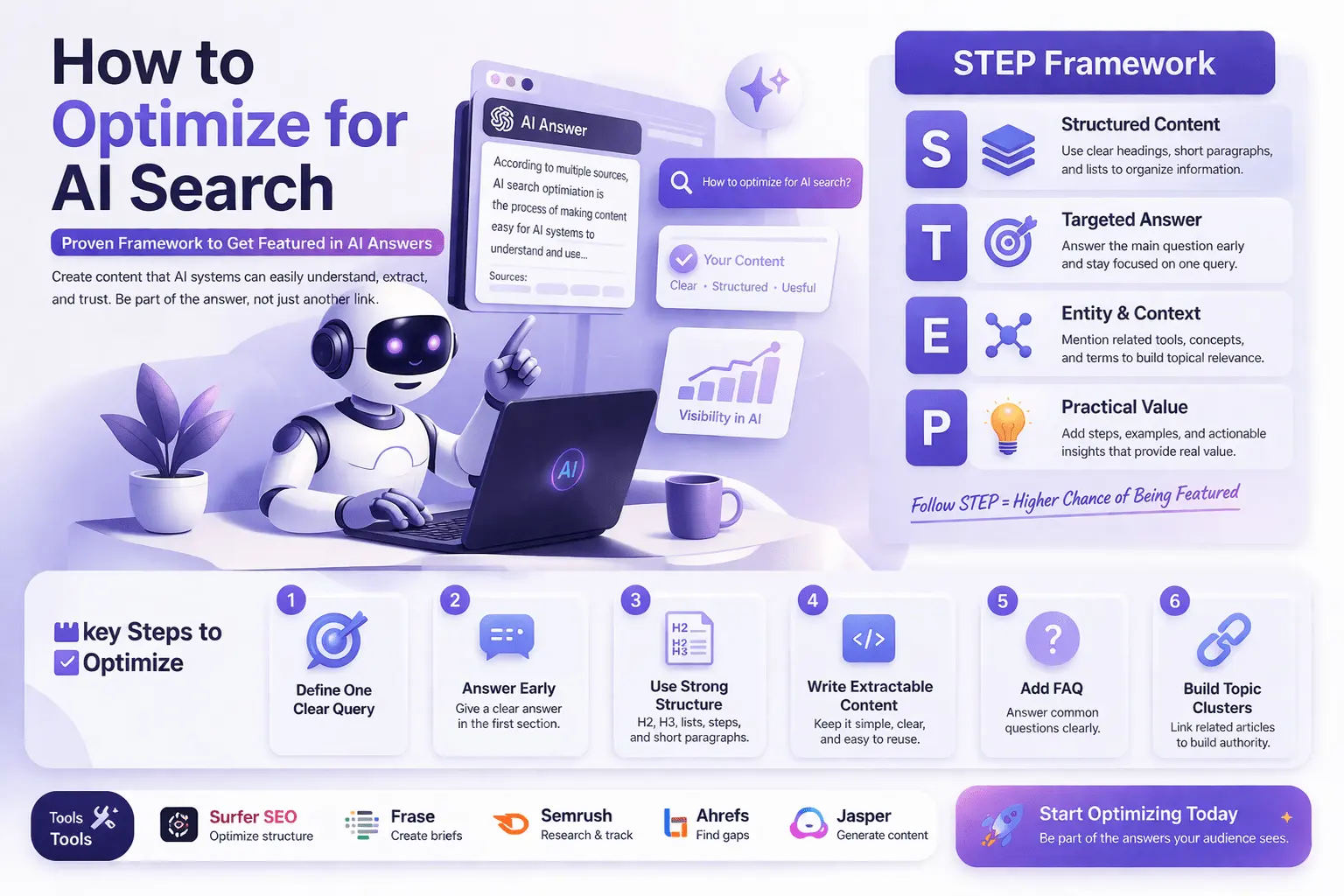
1. Answer the Main Question Early
Every important informational article should answer the main question near the beginning.
Do not force readers to scroll through a long introduction before they understand the topic.
For example, if the article is about AI visibility, define AI visibility in the first paragraph.
If the article is about AI search optimization, explain what it means immediately.
A strong opening answer should be:
- Direct
- Clear
- Simple
- Useful
- Around 40–50 words when possible
This helps readers, and it also supports answer-focused formatting.
2. Use Clear H2 and H3 Headings
Headings should explain the structure of the page.
Avoid vague headings like:
- Overview
- More Details
- Final Thoughts
- Things to Know
Use descriptive headings like:
- What AI Search Optimization Means
- How AI Search Tools Understand Content
- How to Optimize Content for AI Search
- Common AI Search Optimization Mistakes
Good headings help readers scan the article and help AI systems understand the relationship between sections.
3. Add Direct Definitions
Definitions are especially important for AI search.
If your page explains a topic, include a concise definition near the top and repeat the concept naturally in relevant sections.
For example:
“Generative engine optimization, or GEO, is the practice of improving your content and brand signals so generative AI systems can understand, reference, and recommend your content in AI-generated answers.”
Definitions should be clear enough for beginners.
4. Build Topic Clusters
One article is rarely enough to build visibility around a topic.
If you want to be visible for AI search topics, create a cluster of related content.
| Main Topic | Supporting Articles |
|---|---|
| AI Search Optimization | How to Optimize for AI Search, AI Search vs SEO, AI Search Ranking Factors |
| AI Visibility | What Is AI Visibility?, Best AI Visibility Tools, How to Track AI Visibility |
| GEO | What Is GEO?, Best GEO Tools, GEO vs SEO |
| AEO | What Is AEO?, Best AEO Tools, AEO vs SEO |
| AI SEO Tools | Best AI SEO Tools, AI SEO vs Traditional SEO, AI Content Optimization Tools |
Topic clusters help search engines and AI systems understand that your site covers a subject deeply.
5. Make Content Easy to Extract
Extraction-friendly content is content that is easy to summarize.
Use:
- Short paragraphs
- Simple definitions
- Step-by-step instructions
- Tables
- Bullets were useful
- FAQ sections
- Clear examples
- Concise summary sentences
Avoid long, dense blocks of text.
A human reader should be able to scan your page and quickly understand the answer. If a human struggles, AI systems may struggle too.
6. Strengthen Brand and Author Signals
AI search optimization is not only about the article itself.
Your website should clearly explain:
- Who publishes the content
- What the website covers
- Who the content is for
- Why the reader should trust it
- How content is reviewed
- How to contact the brand
Helpful supporting pages include:
- About page
- Contact page
- Author pages
- Editorial policy
- Review methodology
- Privacy policy
- Category pages
- Tool review pages
These pages strengthen trust and entity clarity.
7. Use Tables for Comparisons
AI search tools often answer comparison-style questions.
Tables can make your content easier to understand and summarize.
Use tables for:
- Tool comparisons
- SEO vs AI search differences
- Pros and cons
- Use cases
- Pricing summaries
- Feature breakdowns
- Checklists
- Step-by-step frameworks
Tables should help the reader, not just decorate the article.
8. Add Practical Examples
Generic advice is weak.
AI search optimization becomes stronger when your content includes examples, scenarios, and practical recommendations.
Instead of saying:
“Create helpful content.”
Say:
“If you are writing a tool review, include who the tool is best for, who should avoid it, pricing notes, pros and cons, a comparison table, and a clear final recommendation.”
Specific examples make content more useful.
9. Keep Content Updated
AI search changes quickly.
Update your articles when:
- Tools change features
- Google changes AI search experiences
- New competitors appear
- Pricing changes
- Your recommendations change
- New data becomes available
- Search intent shifts
Do not update only to change dates. Update to improve usefulness.
10. Add Internal Links to Related Topics
Internal links help users and search systems understand your site structure.
If you write about AI search optimization, you should naturally link to related articles such as:
- What Is AI Visibility?
- What Is GEO?
- What Is AEO?
- Best AI Visibility Tools
- AI SEO vs Traditional SEO
- How to Track AI Visibility
Internal links help build topical authority and guide readers to the next useful page.
📊 How to Structure Content for AI Answers
AI-friendly content is usually well structured, but not over-engineered.
The goal is not to make every article look like a machine-readable document. The goal is to make the article easy to scan, understand, and trust.
Use a Strong Opening Answer
Start with a direct answer.
For example:
“AI search optimization is the process of making your content easier for AI-powered tools to understand, summarize, cite, and recommend.”
Then expand with context.
Use Short Paragraphs
Short paragraphs improve readability.
They also make it easier for users to find important points quickly.
A good rule is to keep most paragraphs between one and four sentences.
Use Summary Tables
Tables are useful when readers need to compare ideas quickly.
For example:
| Content Element | Why It Helps AI Search |
|---|---|
| Direct answer | Makes the main idea easy to understand |
| Clear H2 headings | Organizes the page into logical sections |
| FAQ section | Answers specific follow-up questions |
| Tables | Makes comparisons easier to extract |
| Internal links | Connects related entities and topics |
| Examples | Adds context and originality |
| Author information | Supports trust and accountability |
Use FAQ Sections
FAQ sections are useful because they match how people ask AI tools questions.
A strong FAQ should include direct answers to real questions, not filler.
Good FAQ questions might include:
- What is AI search optimization?
- Is AI search optimization the same as SEO?
- How do I optimize for ChatGPT?
- How do I appear in Google AI Overviews?
- What is GEO?
- What is AEO?
- Can AI search optimization guarantee citations?
Use “Best For” and “Use Case” Sections
For tool reviews, comparisons, and product articles, include sections like:
- Best for beginners
- Best for agencies
- Best for SaaS teams
- I would use it if you need
- I would not use it if you need
- Pros and cons
- Final verdict
These sections help users make decisions and help AI systems understand recommendation context.
🧱 AI Search Optimization Checklist
Use this checklist before publishing or updating any article for AI search visibility.
| Checklist Item | Status |
|---|---|
| The article answers the main question in the first 40–50 words | ☐ |
| The article includes a clear definition of the topic | The content includes examples, not only generic explanations. |
| H2 and H3 headings are descriptive and easy to scan | ☐ |
| The article uses tables where comparison helps the reader. | ☐ |
| The content avoids keyword stuffing. | ☐ |
| The page includes related entities and concepts naturally. | ☐ |
| The article has useful internal links to related pages. | ☐ |
| The content is reviewed and edited before publishing. | ☐ |
| The content is reviewed and edited before publishing | ☐ |
| The page gives readers a clear next step | ☐ |
| The article includes FAQ questions when useful | ☐ |
| The article is updated when information changes | ☐ |
This checklist does not guarantee AI citations, but it makes your content clearer, more useful, and easier for both people and AI systems to understand.
🧭 Practical AI Search Optimization Framework
A strong AI search strategy can be built around four layers.
1. Content Clarity
Make every important page easy to understand.
Ask:
- Is the main topic clear?
- Is the main answer easy to find?
- Are the headings descriptive?
- Are the examples useful?
- Would a beginner understand this page?
2. Entity Strength
Make your brand, topics, products, and authors easy to identify.
Ask:
- Is the brand clearly described?
- Is the author or publisher clear?
- Are related concepts connected?
- Does the page explain who it helps?
- Is the site consistent across pages and profiles?
3. Topical Authority
Build depth around your core topics.
Ask:
- Do we have supporting articles?
- Are related pages internally linked?
- Do we cover beginner and advanced questions?
- Are we answering comparison and use-case queries?
- Are we building a recognizable niche?
4. Trust and Usefulness
Make the content worth referencing.
Ask:
- Is the information accurate?
- Is the content updated?
- Does it include practical advice?
- Does it include the original value?
- Would I trust this page if I found it on Google?
The strongest AI search content usually performs well across all four layers.
🧠 GEO, AEO, and AI Visibility: How They Fit Together
AI search optimization includes several related concepts.
The terms can feel confusing, but they are easy to understand when you separate them.
| Term | Meaning |
|---|---|
| AI Visibility | Generative engine optimization: optimizing for generative AI answer systems |
| GEO | Answer engine optimization: making content easier for answer systems to use |
| AEO | Answer engine optimization; making content easier for answer systems to use |
| AI SEO | Using AI and SEO strategies to improve search visibility |
| AI Search Optimization | A broader process of preparing content for AI-powered search experiences |
These terms overlap.
For example, a page optimized for AEO may answer questions clearly. A page optimized for GEO may be easier for generative AI systems to reference. A strong AI visibility strategy tracks whether your brand appears in AI answers.
You do not need to obsess over labels.
The practical goal is simple:
Create content that is useful for humans, clear for search engines, and easy for AI systems to understand.
⚠️ Common AI Search Optimization Mistakes
1. Writing Only for AI Tools
Do not write robotic content just because you want to appear in AI answers.
AI search optimization should still be people-first. Your content needs to help real readers first, then support AI understanding through structure and clarity.
2. Hiding the Main Answer Too Deep
Many articles take too long to answer the main question.
For AI search, this is a problem. Start with a clear answer, then expand with examples, steps, and details.
3. Publishing Generic AI Content
Generic AI content is unlikely to stand out.
If your article says the same thing as every competing page, there is no strong reason for AI systems or users to prefer it.
Add original examples, practical advice, comparisons, and editorial judgment.
4. Ignoring Entity Signals
AI systems need to understand who you are, what your website covers, and why your content is relevant.
Make your brand, author, topic, category, and audience clear across your site.
5. Forgetting Traditional SEO
AI search optimization does not replace SEO.
Technical SEO, crawlability, internal links, page speed, helpful content, and topical authority still matter.
6. Chasing AI Mentions Instead of Usefulness
The goal is not just to be mentioned by AI tools.
The real goal is to create content that deserves to be cited, trusted, and recommended because it is genuinely useful.
7. Ignoring Competitors
AI answers often mention multiple brands, tools, or sources.
If competitors appear and you do not, study why. Look at their content structure, topical coverage, external mentions, product positioning, and clarity.
8. Measuring Only Clicks
AI visibility may influence brand awareness before a click happens.
You should still track traffic, but also monitor mentions, citations, sentiment, and competitor presence in AI-generated answers.
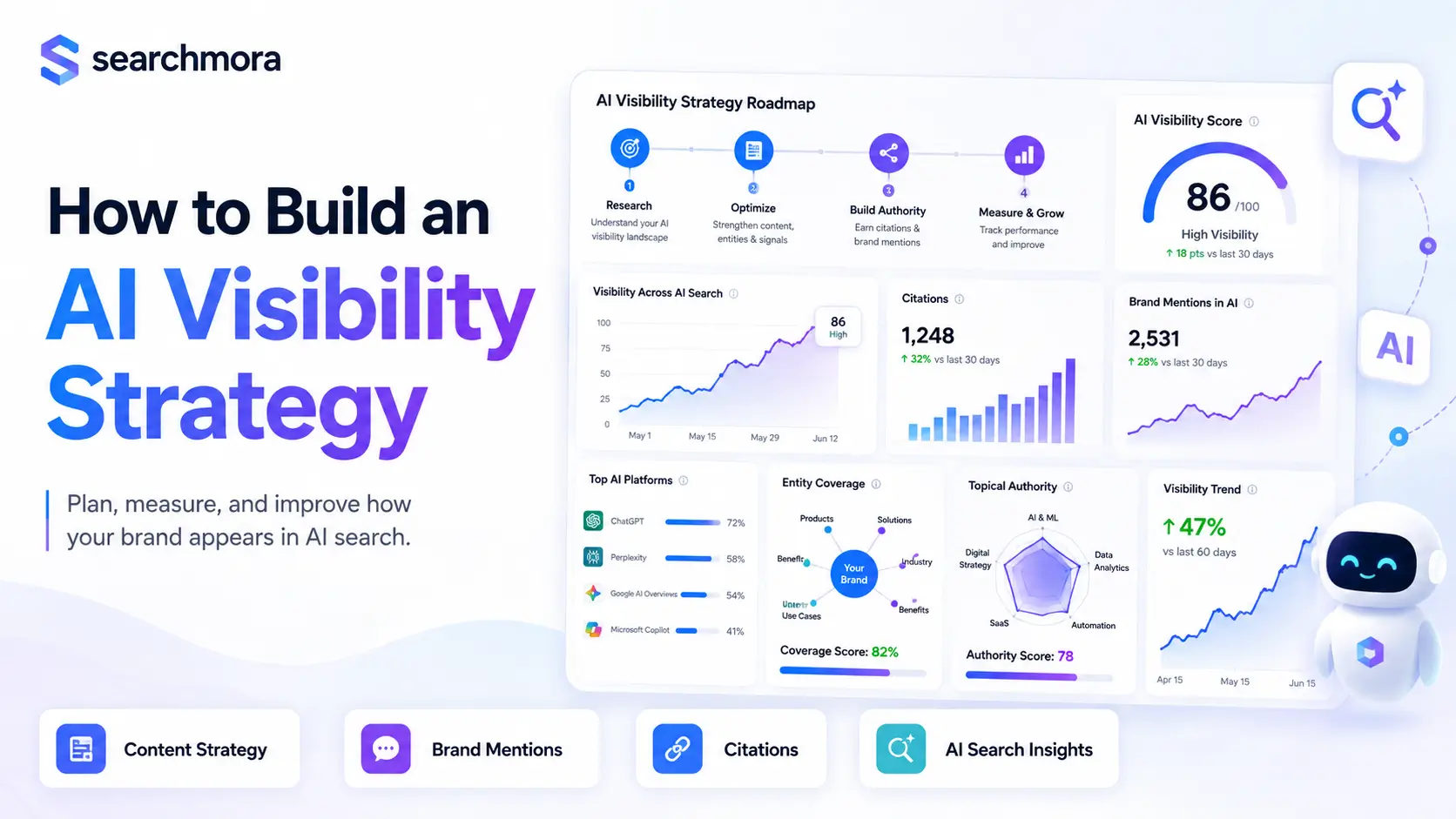
📊 How to Measure AI Search Visibility
AI search visibility is harder to measure than traditional rankings, but it can still be tracked.
You can measure:
- Brand mentions
- Website citations
- Competitor mentions
- Prompt coverage
- Source URLs
- Sentiment
- Share of answer
- Accuracy of brand descriptions
- AI answer changes over time
Simple Manual Tracking Method
Start with a spreadsheet.
Track:
| Field | Example |
|---|---|
| Prompt | What are the best AI SEO tools? |
| AI tool | ChatGPT, Perplexity, Gemini, Google AI |
| Brand mentioned? | Yes / No |
| Competitors mentioned | Semrush, Ahrefs, Surfer |
| Website cited? | Yes / No |
| Sentiment | Positive / Neutral / Negative |
| Notes | Missing feature, wrong description, competitor cited |
Manual tracking is not perfect, but it helps you understand the category before investing in paid AI visibility tools.
Prompt Types to Track
| Prompt Type | Example |
|---|---|
| Informational | What is AI visibility? |
| Comparison | GEO vs SEO |
| Best tools | Best AI visibility tools |
| Problem-based | How do I optimize for AI search? |
| Brand-specific | Is Searchmora a good AI SEO resource? |
| Alternative | Best alternatives to Surfer SEO |
| Buyer-intent | Best AI SEO software for agencies |
The best prompts are the ones your real audience might ask.
❓ FAQ
1. What is AI search optimization?
AI search optimization is the process of improving your content so AI-powered search tools can understand, summarize, cite, and recommend it in AI-generated answers.
2. Is AI search optimization the same as SEO?
No. AI search optimization overlaps with SEO, but it focuses more on answer structure, entity clarity, citations, brand mentions, and visibility inside AI-generated answers.
3. How do I optimize content for ChatGPT?
To optimize for ChatGPT, create clear and helpful content, answer questions directly, build topical authority, strengthen brand signals, and publish content that explains your topic better than generic summaries.
4. How do I optimize for Google AI Overviews?
To improve your chances in Google AI Overviews, focus on helpful content, clear structure, accurate information, strong topical relevance, and pages that answer specific search intent clearly.
5. What is GEO?
GEO stands for generative engine optimization. It is the practice of optimizing content and brand signals so generative AI systems can understand, reference, and recommend your content.
6. What is AEO?
AEO stands for answer engine optimization. It focuses on making content easier for answer engines to understand and use when responding to user questions.
7. Can AI search optimization guarantee citations?
No. No strategy can guarantee AI citations, mentions, or recommendations. You can improve your chances by creating useful, clear, trustworthy, and well-structured content.
8. Do keywords still matter for AI search?
Yes, but they are not enough. Keywords still help with topic relevance, but AI search also depends on entities, context, authority, structure, and usefulness.
9. Should small websites care about AI search optimization?
Yes. Small websites can benefit by focusing on niche topics, answering specific questions clearly, and building strong topical authority in a focused area.
✅ Final Verdict
Optimizing for AI search is not about tricking ChatGPT, Google AI Overviews, Perplexity, or other AI tools.
It is about making your content clearer, more useful, more structured, and easier to trust.
The strongest approach is to combine traditional SEO with AI visibility principles:
- Answer the main question early.
- Use clear H2 and H3 headings.
- Add direct definitions.
- Build topical authority.
- Strengthen brand and entity signals.
- Include examples and practical steps.
- Use tables and summaries where helpful.
- Keep content updated and people-first.
AI search is changing how users discover information, but the core principle is still the same:
The best content wins when it helps people better than the alternatives.
📚 Recommended Next Reads
- What Is AI Visibility?
- What Is GEO?
- What Is AEO?
- Best AI Visibility Tools Tested
- AI SEO vs Traditional SEO
Comments 4