🚀 Introduction
Local Falcon is worth it for agencies and local businesses that depend on Google Maps visibility and need accurate geo-grid tracking. Its flexible scan radius, ARP, ATRP, Share of Local Voice, competitor reports, and Falcon AI provide deeper location-level insights, but credit-based pricing requires careful scan planning.
A traditional rank tracker may tell you that a business ranks fourth for “emergency plumber.”
That number can be misleading.
The same business may rank:
- First, near its office.
- Third in the surrounding neighborhood.
- Ninth three miles away.
- Outside the visible local results in another part of the city.
Local Falcon is designed to expose this geographic variation.
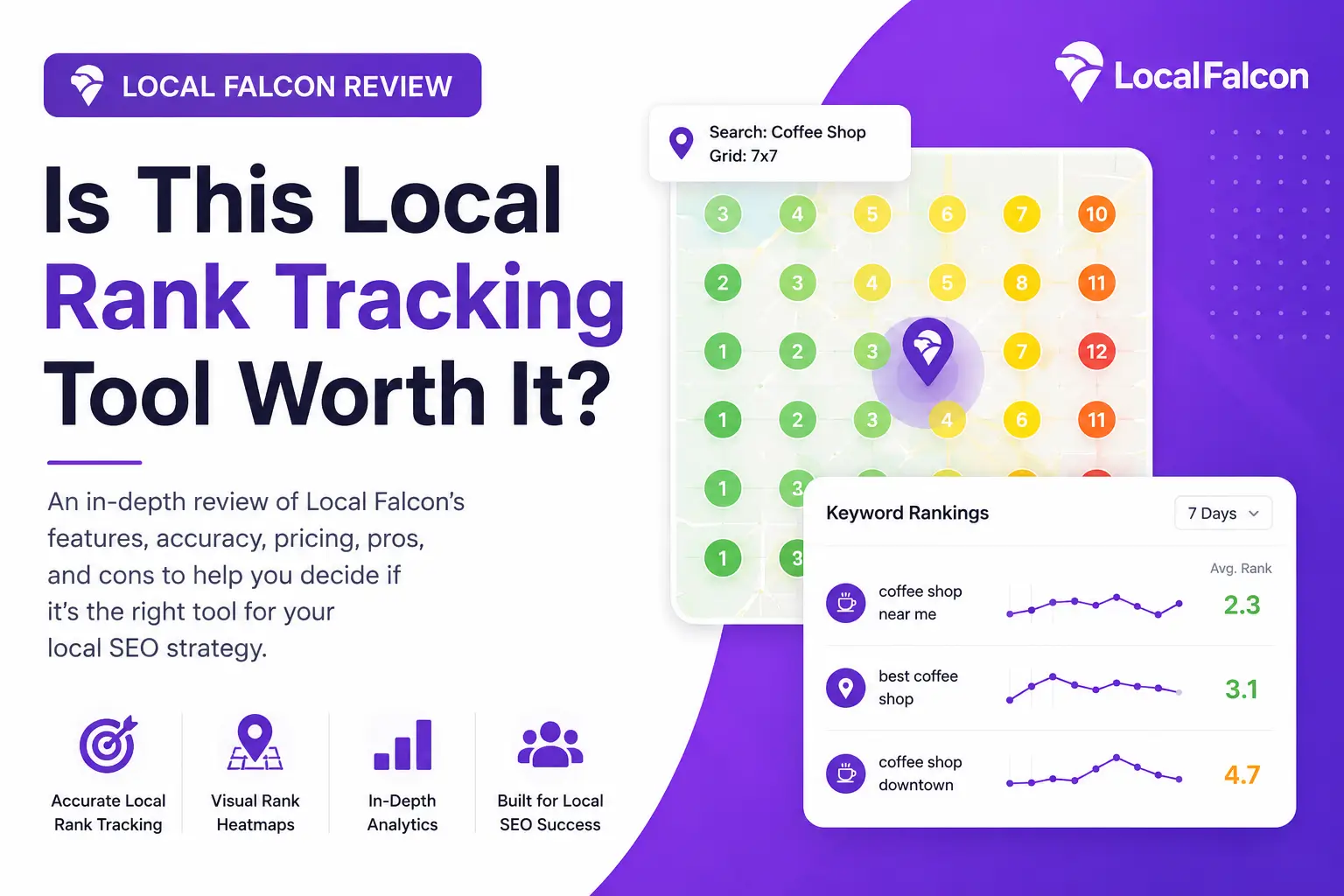
Instead of checking a keyword from one assumed location, it places multiple scan points across a map and checks how the business ranks at each one.
The result is a visual geo-grid that shows where visibility is strong, weak, improving, or declining.
This Local Falcon review examines whether that extra geographic detail creates enough practical value to justify:
- the subscription
- the credit system
- The time required to interpret the report,
- the cost of tracking multiple locations and keywords
The platform is evaluated based on the questions that matter most:
- How accurately can it represent neighborhood-level visibility?
- How flexible are the grid and radius controls?
- Do ARP and ATRP provide useful trend information?
- Does Falcon AI turn data into actionable recommendations?
- Is credit-based pricing efficient for agencies?
- How does Local Falcon compare with BrightLocal, Localo, and other local SEO tools?
- Can the data support Local GEO and AI-search visibility?
- When is the platform unnecessary?
⚡ Quick Verdict
Yes, Local Falcon is worth the investment for agencies and businesses that rely heavily on Google Business Profile and Google Maps leads. It provides detailed geo-grid reports, flexible scan controls, trend metrics, competitor analysis, and AI guidance. However, high-frequency tracking across many keywords and locations can consume credits quickly.
| Question | Quick Answer |
|---|---|
| Best for | Local SEO agencies, consultants, multi-location businesses, and map-dependent local companies |
| Strongest feature | Flexible hyper-local geo-grid rank tracking |
| Best metric | ATRP for understanding weighted visibility across a scan area |
| Best supporting feature | Falcon AI analysis |
| Main advantage | Shows how rankings change from one location to another |
| Main limitation | Credit usage increases with grid size, keyword count, and scan frequency |
| Starting plan | $24.99 per month for 7,500 monthly credits |
| Free access | New accounts receive promotional credits without requiring a card |
| Best alternatives | Localo, BrightLocal, Whitespark, and other local rank grid platforms |
| Final verdict | Excellent specialist tracker when map visibility directly affects revenue |
ROI Verdict by User Type
| User Type | Likely Value | Why |
|---|---|---|
| Single-location service business | High when Maps generates leads | Reveals exactly where local visibility drops |
| Local SEO consultant | High | Supports audits, competitor reports, and recurring client work |
| Small agency | High with planned scans | Makes neighborhood-level progress visible to clients |
| Multi-location agency | Mixed to high | Powerful, but credits must be budgeted carefully |
| Enterprise location brand | High with enterprise workflows | Useful for large-scale visibility intelligence |
| Online-only business | Low | Hyper-local Maps rankings may not affect acquisition |
| Small business tracking one keyword occasionally | Moderate | A simpler or cheaper tool may be sufficient |
The clearest takeaway is this: Local Falcon provides the strongest ROI when ranking differences across neighborhoods change real business decisions.
📚 Recommended Reads
- Localo Review: Is This Local SEO Tool Worth It?
- BrightLocal Review: Is This Local SEO Platform Worth It?
- Best AI Tools Tested for Local SEO
- How to Improve Local SEO with AI?
- Semrush Alternatives: Best SEO Tools by Use Case This Year
📌 In This Guide
1. 🧠 What Is Local Falcon?
2. 🗺️ How Geo-Grid Rank Tracking Works
3. 📍 Scan Radius, Grid Size, and Hyper-Local Accuracy
4. 📊 ARP, ATRP, and Share of Local Voice
5. 🤖 Falcon AI and Actionable Recommendations
6. 🥊 Competitor Analysis
7. 📈 Trend Reports and Campaign Scans
8. 🌐 Local Falcon and Local GEO
9. 💰 Pricing, Credits, and ROI
10. ⚖️ Local Falcon vs Localo, BrightLocal, and Other Alternatives
11. 🏢 Local Falcon for Agencies and Multiple Locations
12. ✅ Local Falcon Pros and Cons
13. 🧪 A Practical Local Falcon Workflow
14. 📊 Real-World Evidence and Product Limitations
15. ⚠️ Common Local Falcon Mistakes
16. ❓ FAQ
17. 🏁 Final Verdict: Is Local Falcon Worth It?
18. 📚 Recommended Next Reads
🧠 What Is Local Falcon?
Local Falcon is a local rank tracking and AI visibility platform that measures how businesses appear across Google Maps, Apple Maps, local search results, and emerging AI-search environments.
Its best-known feature is the geo-grid Map Scan.
A Map Scan places multiple virtual search points around a business location.
At each point, Local Falcon checks how the selected business ranks for a specific keyword.
This produces a grid showing:
- ranking position at each location
- areas where the business enters the local market
- areas where competitors dominate
- How quickly rankings decline with distance
- whether optimization changes visibility over time
The platform now extends beyond basic map scanning.
Its broader workflow includes:
- Google Maps rank tracking.
- Apple Maps visibility.
- Scheduled Campaign Scans.
- Competitor tracking.
- ARP and ATRP metrics.
- Share of Local Voice.
- Falcon AI.
- AI-search visibility monitoring.
- Review analysis.
- Sentiment analysis.
- Google Business Profile automation.
- Profile protection.
- Reporting and exports.
- API access on qualifying plans.
- Multi-location workflows.
Local Falcon is primarily a specialist visibility platform.
It does not replace:
- A full citation management service.
- Technical website auditing.
- Link building.
- Complete reputation management.
- Content production.
- Enterprise listings distribution.
- Google Business Profile strategy.
Its main job is to show where a business appears and help users interpret the pattern.
🗺️ How Geo-Grid Rank Tracking Works
Geo-grid tracking measures a business from many search locations instead of reducing local performance to one average ranking.
This matters because local results are highly dependent on location.
Google Maps may show different businesses based on:
- Searcher proximity.
- Business relevance.
- Business prominence.
- Local competition.
- Query wording.
- Categories.
- Reviews.
- Website signals.
- Local links.
- Search context.
Example
Imagine a physical therapy clinic in the center of a city.
A standard tracker might report:
Average position: 5
That does not tell the full story.
The geo-grid might show:
| Area | Ranking |
|---|---|
| Same street | 1 |
| One kilometer north | 2 |
| Two kilometers east | 4 |
| Three kilometers south | 9 |
| Outer suburb | 17 |
| Competitor’s neighborhood | 20+ |
The practical response is different in each area.
The clinic may need:
- a stronger nearby service page
- more reviews mentioning a service
- better category alignment
- local links
- stronger visibility around an important neighborhood
- realistic acceptance that distant areas are unlikely to convert
What a Geo-Grid Can Reveal
- The true geographic footprint of a ranking.
- Strong and weak neighborhoods.
- Competitor strongholds.
- Visibility decays with distance.
- Whether a ranking change affects the whole area or only one point.
- Whether a new location is competing effectively.
- Whether a local SEO campaign improves coverage.
- Whether the selected radius is too wide or too narrow.
The visual report is one of Local Falcon’s biggest advantages.
It makes local ranking variation easier to explain to non-technical clients.
📍 Scan Radius, Grid Size, and Hyper-Local Accuracy
Local Falcon allows users to adjust the scan radius and the number of grid points so the report matches the business’s real service area. Larger grids provide more detail, but every additional data point uses more credits.
What Scan Radius Means
The scan radius defines how far the map extends from the business in all directions.
A small urban business may need a tight radius.
A rural service provider may need a much wider one.
Examples:
| Business Type | Reasonable Starting Direction |
|---|---|
| City-center café | Tight radius around walkable areas |
| Urban dentist | Small-to-moderate radius around neighborhoods |
| Emergency plumber | Wider service radius |
| Rural contractor | Large radius across nearby towns |
| Hotel | Radius focused on tourist and transport areas |
| Multi-location retailer | Separate radius for each branch |
The correct radius should reflect:
- Population density.
- Customer travel behavior.
- Service delivery distance.
- Business category.
- Competitor density.
- Urban or rural conditions.
- Actual service boundaries.
Grid Size
Grid size controls how many scan points are used.
Common examples include:
- 3 × 3 = 9 points
- 5 × 5 = 25 points
- 7 × 7 = 49 points
- 9 × 9 = 81 points
- 11 × 11 = 121 points
- 15 × 15 = 225 points
- 21 × 21 = 441 points
A larger grid provides:
- More spatial detail.
- More reliable area-wide averages.
- Better visibility of ranking transitions.
- More competitor data.
- More expensive scans.
How Credits Change the Decision
A 7 × 7 grid uses 49 location points.
A 15 × 15 grid uses 225.
If one data point consumes one scan credit, the larger scan uses more than four times as many credits before accounting for additional keywords, platforms, or locations.
That means the most detailed scan is not always the best business decision.
When to Use a Smaller Grid
Use a smaller grid when:
- Running a baseline test.
- Monitoring many locations.
- Tracking many keywords.
- Budget is limited.
- The service area is small.
- Frequent scans matter more than high detail.
- The market is not highly competitive.
When to Use a Larger Grid
Use a larger grid when:
- Auditing a competitive city.
- Studying precise neighborhood variation.
- Preparing a client strategy.
- Comparing several strong competitors.
- Establishing a detailed baseline.
- Evaluating a new location.
- Measuring a major local SEO campaign.
Disabling Irrelevant Points
Some grid points may fall over:
- water
- parks
- industrial land
- unpopulated areas
- locations outside the service area
Disabling those points can reduce credit waste and improve the relevance of the average metrics.
Hyper-Local Accuracy Verdict
Local Falcon’s accuracy is most useful when the scan design reflects how customers actually search.
A large, visually impressive map with irrelevant points can be less useful than a carefully planned smaller grid.
📊 ARP, ATRP, and Share of Local Voice
ARP, ATRP, and Share of Local Voice help summarize a map scan without requiring users to examine every grid point individually.
What Is ARP?
ARP stands for Average Rank Position.
It represents the average ranking across the measured grid points.
A lower ARP generally indicates stronger average visibility.
Example:
| Grid Point Rankings | ARP |
|---|---|
| 1, 2, 3, 4, 5 | 3 |
| 1, 1, 2, 2, 3 | 1.8 |
| 3, 7, 10, 15, 20 | 11 |
ARP can help compare:
- One scan compared with an earlier scan.
- One keyword with another.
- One location with another.
- A business with a competitor.
ARP Limitation
An average can hide important differences.
Two businesses may have the same ARP.
Business A may rank consistently fifth everywhere.
Business B may rank first nearby and disappear farther away.
The average is similar, but the practical pattern is different.
The full grid should always be reviewed alongside ARP.
What Is ATRP?
ATRP stands for Average Total Rank Position.
It is designed to provide a weighted or broader view of visibility across all scan points, including points where the business is not strongly visible.
ATRP can make weak or missing rankings more visible in the final score.
That makes it useful for evaluating the true strength of geographic coverage.
ARP vs ATRP
| Metric | Best Use |
|---|---|
| ARP | Quick average of visible ranking positions |
| ATRP | A broader view that reflects total scan-area performance |
| Grid map | Exact geographic pattern |
| Trend report | Change over time |
| Share of Local Voice | Frequency of top-three visibility |
What Is Share of Local Voice?
Share of Local Voice measures how often a business appears in the top local positions across the grid.
This can be more meaningful than average rank when the main commercial goal is appearing inside the local pack.
A business with a strong Share of Local Voice:
- Appears frequently in high-visibility positions.
- Maintains broader geographic coverage.
- Competes more consistently across the target market.
How to Use the Metrics Together
Do not use one metric alone.
A stronger process is:
- Review the map.
- Check ARP.
- Check ATRP.
- Check Share of Local Voice.
- Compare previous scans.
- Compare competitors.
- Connect changes to actual business actions.
Trend Interpretation Example
| Metric | Previous Scan | Current Scan | Likely Interpretation |
|---|---|---|---|
| ARP | 8.4 | 6.7 | Average ranking improved |
| ATRP | 13.2 | 9.8 | Wider-area visibility improved |
| Share of Local Voice | 22% | 35% | More points entered the top three positions |
| Calls | 40 | 43 | Small business improvement |
| Bookings | 12 | 15 | Possible commercial gain |
The ranking metrics indicate visibility.
Calls and bookings indicate whether the visibility creates value.
🤖 Falcon AI and Actionable Recommendations
Falcon AI analyzes existing Local Falcon scan reports and compares the business with nearby competitors to identify ranking patterns, weaknesses, and possible optimization opportunities.
The important question is not whether Falcon AI produces text.
The important question is whether it shortens the path from:
“The map is red in this area”
to:
“What should we investigate or change?”
What Falcon AI Can Help Analyze
- Ranking weaknesses.
- Strong and weak scan areas.
- Competitor performance.
- Google Business Profile differences.
- Review signals.
- Category differences.
- Visibility trends.
- Potential optimization priorities.
- Local market conditions.
- Changes between scan reports.
What a Useful Recommendation Looks Like
A weak AI recommendation would say:
Improve your Google Business Profile.
A stronger recommendation would identify a specific issue, such as:
- A competitor uses a more relevant primary category.
- The business lacks an important service.
- Competitors have stronger review volume.
- A target area has weak website relevance.
- Visibility declines sharply beyond a certain distance.
- Competitors consistently dominate one section of the grid.
Can Falcon AI Explain Why Competitors Win?
It can compare available scans and business data to highlight differences.
However, users should be careful with causal claims.
A competitor may rank better because of a combination of:
- Distance.
- Category selection.
- Review quantity.
- Review quality.
- Website authority.
- Local links.
- Business age.
- Citations.
- User behavior.
- Google’s internal systems.
The fact that a competitor’s reviews mention a keyword more often does not prove that the phrase caused the ranking difference.
Falcon AI should be used to form hypotheses.
Those hypotheses still require human investigation.
Practical Value of Falcon AI
Falcon AI can provide a strong return when:
- The user does not know how to interpret heatmaps.
- An agency needs faster report summaries.
- Many locations must be reviewed.
- Competitor patterns are complex.
- The team needs a prioritized starting point.
Its value is lower when:
- The user already has deep local SEO expertise.
- The scan contains too little data.
- The recommendations are accepted without verification.
- The business cannot implement the suggested changes.
Falcon AI Verdict
Falcon AI makes Local Falcon more useful than a visual map generator.
It does not replace an experienced local SEO strategist, but it can reduce analysis time and identify questions worth investigating.
🥊 Competitor Analysis
Local Falcon’s competitor analysis shows which businesses dominate specific grid points, helping agencies and local companies understand where competitors are stronger and whether their visibility is concentrated or widespread.
What Competitor Maps Can Reveal
- Which competitor dominates the business’s immediate area?
- Which competitor has the widest geographic footprint?
- Which businesses appear only in limited neighborhoods?
- Whether a competitor’s advantage is based mainly on proximity.
- Which locations are realistically contestable?
- Which keywords attract different competitor groups?
- Whether one competitor consistently controls the local pack.
Competitor Analysis Questions
A useful analysis should ask:
- Which categories do the strongest competitors use?
- How many reviews do they have?
- How recent are the reviews?
- Which services are listed?
- How complete are their profiles?
- What local pages support their profiles?
- Which third-party sites mention them?
- Where are their physical locations?
- Do they dominate every keyword or only one?
- Does their visibility extend beyond normal proximity?
Competitor Analysis and Reviews
Reviews can reveal how customers describe the business.
That language can help identify:
- Important services.
- Customer priorities.
- Local terminology.
- Problems competitors solve.
- Brand perceptions.
- Reasons customers choose one business over another.
This is useful for content and service positioning.
It should not become an excuse to stuff keywords into review responses.
Competitor Analysis Verdict
The feature is most valuable when it changes strategy.
It has little value if the user only downloads a colorful competitor map for a monthly report.
📈 Trend Reports and Campaign Scans
Trend reports and scheduled Campaign Scans help users measure whether local visibility improves, declines, or remains stable across repeated scans.
A single scan is a snapshot.
A campaign is a timeline.
Why Trends Matter
Local rankings can change because of:
- Profile updates.
- New reviews.
- Competitor changes.
- Algorithm updates.
- Website improvements.
- Local links.
- Business category changes.
- New locations.
- Seasonal demand.
- Search behavior.
Repeated scans make it easier to distinguish:
- a temporary fluctuation
- a lasting improvement
- a geographic shift
- a competitor gaining ground
- an optimization that had no visible effect
Recommended Scan Frequency
More frequent scanning is not always better.
A practical schedule may be:
| Situation | Suggested Direction |
|---|---|
| Baseline audit | Run initial controlled scans |
| Active local SEO campaign | Weekly or biweekly |
| Stable local business | Monthly |
| Major profile change | Before and after change |
| Competitive agency client | Weekly |
| Large multi-location portfolio | Frequency based on credit budget |
| Daily tracking | Usually unnecessary except for special cases |
Why Daily Scans Can Waste Credits
Local SEO changes often take time.
Daily scans may:
- Consume credits quickly.
- Produce noise.
- Encourage overreaction.
- Create unnecessary reports.
- Increase analysis workload.
The best frequency is the lowest frequency that still supports a decision.
Trend Report Verdict
Trend reports are more valuable than isolated maps because they show direction.
The platform becomes easier to justify when a client can see:
- ARP improving.
- ATRP improving.
- The share of Local Voice is increasing.
- Weak areas turning stronger.
- competitors losing visibility.
🌐 Local Falcon and Local GEO
Local Falcon can support Local GEO by showing how a business performs across local search and AI-search environments, identifying which competitors and sources appear, and revealing the geographic weaknesses that may affect local recommendations.
Local GEO refers to improving how a local business is understood, selected, and recommended by generative search systems.
Users increasingly ask questions such as:
- What is the best restaurant near me?
- Which dentist has the strongest reviews?
- Recommend a reliable mechanic nearby.
- Which hotel is best for business travelers?
- Where can I find an emergency plumber?
AI systems may use information from:
- Google Maps.
- Local packs.
- Business websites.
- Reviews.
- Directories.
- News sources.
- Local lists.
- Structured data.
- Third-party recommendations.
- Search result pages.
How Local Falcon Supports Local GEO
Local Falcon can help users:
- Understand map visibility.
- Identify dominant competitors.
- Track AI-search visibility.
- Study sources used in AI results.
- Compare brand visibility.
- Find weak geographic areas.
- Analyze local reputation.
- Monitor AI sentiment.
- Improve Google Business Profile data.
- Connect traditional local rankings with AI visibility.
What Local Falcon Cannot Guarantee
Local Falcon cannot guarantee that:
- ChatGPT recommends the business.
- Google AI Overviews cites the website.
- Gemini chooses the brand.
- Perplexity mentions the location.
- A review phrase directly increases AI visibility.
- A higher grid score creates more revenue.
The platform provides intelligence.
The business still needs:
- Accurate information.
- Strong services.
- Useful local pages.
- Good reviews.
- Trusted citations.
- Third-party mentions.
- Structured data.
- A clear local brand entity.
Local GEO Practical Workflow
- Track map visibility.
- Track AI visibility.
- Identify recurring competitors.
- Review which sources AI systems use.
- Improve incomplete business information.
- Strengthen service and location pages.
- Earn credible local mentions.
- Improve review quality and freshness.
- Monitor change over time.
- Compare visibility with real leads and revenue.
The clearest Local GEO lesson is this: Local Falcon can show where the business is invisible, but it still takes broader entity, reputation, content, and citation work to become recommendable.
💰 Pricing, Credits, and ROI
Local Falcon starts at $24.99 per month for 7,500 credits. Its credit model can be economical for carefully planned scans, but grid size, keywords, locations, platforms, and scan frequency can make costs rise quickly.
Current Monthly Plans
| Plan | Monthly Price | Monthly Credits | Best For |
|---|---|---|---|
| Starter | $24.99 | 7,500 | Single businesses and light use |
| Basic | $49.99 | 15,150 | Consultants and small portfolios |
| Pro | $99.99 | 31,250 | Active agencies |
| Premium | $199.99 | 63,150 | Larger portfolios |
| Enterprise | From $499 | Higher-volume packages | Multi-location and enterprise teams |
Annual plans provide yearly credit pools rather than resetting credits every month.
Pay-as-you-go credits are also available and do not expire.
Pricing can change, so users should confirm current details before purchasing.
How Credits Are Consumed
Credit use depends on:
- Grid size.
- Number of keywords.
- Number of locations.
- Scan frequency.
- Search platform.
- AI reports.
- Additional actions.
Example Credit Planning
Assume one grid point uses one base scan credit.
| Scan | Points per Keyword |
|---|---|
| 3 × 3 | 9 |
| 5 × 5 | 25 |
| 7 × 7 | 49 |
| 9 × 9 | 81 |
| 11 × 11 | 121 |
| 15 × 15 | 225 |
If an agency tracks:
- 10 locations
- 10 keywords
- 11 × 11 grids
- weekly scans
The usage becomes significant.
The agency must calculate before choosing a plan.
Credit Model vs Fixed Subscription
| Credit-Based Model | Fixed-Access Model |
|---|---|
| Users pay based on scan consumption | Users pay for a defined feature or location allowance |
| Flexible for irregular audits | Easier to budget for routine usage |
| Efficient when scans are planned | Better when heavy usage is included |
| Can become expensive at scale | May include limits in other forms |
| Encourages careful scan design | Encourages more frequent use |
Is Credit Pricing Better Than Localo?
The platforms solve different problems.
Local Falcon charges around scan capacity and data usage.
Localo focuses more on connected Google Business Profiles and recurring optimization workflows.
Choose Local Falcon when the primary need is:
- Detailed geo-grid tracking.
- Competitor visibility.
- AI visibility intelligence.
- Flexible scan configurations.
Choose Localo when the primary need is:
- Weekly optimization tasks.
- GBP content.
- Review workflows.
- Guided local SEO actions.
Is Credit Pricing Better Than BrightLocal?
BrightLocal uses a broader subscription model around local SEO features, locations, audits, citations, reviews, and local rank tracking.
Local Falcon can be more attractive when heatmaps are the central need.
BrightLocal may provide better total value when the business also needs:
- Citation work.
- Reputation management.
- Broader local audits.
- Agency reporting.
- A wider local SEO toolkit.
ROI Formula
Use this basic formula:
Value of leads influenced + hours saved − subscription and labor cost
ROI Example
A local agency charges $500 monthly for a Maps campaign.
If Local Falcon costs the agency $20 in allocated credits and saves two hours of manual checking, the software may create strong operational ROI.
A single business paying $24.99 per month needs only a modest commercial gain if one new customer is worth several hundred dollars.
When Local Falcon Is Worth the Price
- Google Maps generates real leads.
- The business operates in a competitive local market.
- Clients need visual reports.
- The agency tracks geographic changes.
- Competitor maps influence strategy.
- One new customer covers the subscription.
- The team uses trend reports consistently.
- AI-search visibility matters.
When It May Not Be Worth It
- The business does not rely on local search.
- Only one occasional ranking check is needed.
- The team will not interpret the reports.
- Scan credits are used without a plan.
- The site needs citation cleanup more than rank tracking.
- The business needs complete GBP management.
- The map reports will not influence decisions.
⚖️ Local Falcon vs Localo, BrightLocal, and Other Alternatives
Local Falcon is the strongest specialist option for flexible geo-grid tracking and local visibility intelligence. Localo is better for guided GBP optimization, while BrightLocal provides a broader combination of rankings, citations, audits, reviews, and agency reporting.
| Tool | Best For | Strongest Advantage | Main Trade-Off |
|---|---|---|---|
| Local Falcon | Hyper-local geo-grid tracking | Flexible grids, ARP, ATRP, SoLV, Falcon AI, and AI visibility | Credits require careful planning |
| Localo | Guided GBP optimization | Clear tasks, posts, reviews, and profile workflows | Less focused on advanced grid analysis |
| BrightLocal | Broad local SEO management | Rankings, citations, audits, reviews, and reports | Broader and potentially more complex |
| Whitespark | Citation specialists | Citation discovery, cleanup, and local SEO services | More modular than unified |
| Semrush Local | Existing Semrush customers | Local tools inside a wider SEO platform | Broader platform cost |
| SE Ranking | General SEO plus local tracking | Combines rankings, audits, reports, and local SEO | Less specialized in geo-grid intelligence |
Local Falcon vs Localo
Choose Local Falcon if you need:
- Flexible map grids.
- Detailed scan radii.
- ARP and ATRP.
- Share of Local Voice.
- Competitor heatmaps.
- AI visibility tracking.
- Scan-level reporting.
Choose Localo if you need:
- GBP optimization tasks.
- AI-assisted posts.
- Review management.
- Guided weekly actions.
- A simpler business-owner workflow.
Local Falcon vs BrightLocal
Choose Local Falcon if heatmaps and geographic rank intelligence are the primary needs.
Choose BrightLocal if the business also requires:
- Citation building.
- Citation cleanup.
- Local audits.
- Review management.
- Broader agency reporting.
- A more complete local SEO stack.
Local Falcon vs Whitespark
Choose Local Falcon for:
- map visibility
- grid reports
- competitor coverage
- AI visibility
Choose Whitespark for:
- citation research
- citation cleanup
- local listing services
- reputation tools
- specialist local SEO support
Which Tool Offers the Best Value?
| User | Better Starting Point |
|---|---|
| Business owner wanting guided improvements | Localo |
| Consultant selling map audits | Local Falcon |
| Agency needing a full local SEO toolkit | BrightLocal |
| Citation specialist | Whitespark |
| Semrush user | Semrush Local |
| General SEO agency | SE Ranking |
🏢 Local Falcon for Agencies and Multiple Locations
Local Falcon is especially useful for agencies because geo-grid reports make invisible ranking variation easy to show in client reports. Its campaign scheduling, competitor analysis, API access, and higher credit tiers support recurring and multi-location workflows.
Agency Use Cases
- Prospecting audits.
- Client onboarding.
- Baseline scans.
- Monthly reporting.
- Competitor comparison.
- New-location assessment.
- Local SEO campaign measurement.
- Territory analysis.
- AI visibility reporting.
- Renewal and retention presentations.
Why Clients Understand Heatmaps
A client may not understand:
- citation consistency
- schema
- entity relationships
- PageRank distribution
But clients understand:
- green areas
- red areas
- competitor maps
- progress over time
That makes Local Falcon useful as a communication tool.
Agency Credit Planning
Before selecting a plan, calculate:
- Number of active clients.
- Locations per client.
- Keywords per location.
- Grid size.
- Scan frequency.
- Competitor scans.
- AI reports.
- Sales audits.
- Seasonal scans.
- Buffer for unexpected usage.
Agency ROI Risk
The credit model becomes inefficient when:
- Every client receives unnecessarily large grids.
- Too many low-value keywords are tracked.
- Daily scans are scheduled.
- Sales teams run excessive free audits.
- Irrelevant points remain active.
- Reports are generated but not interpreted.
Agency Verdict
Local Falcon can be highly profitable for agencies that package the data into:
- strategy
- implementation
- reporting
- competitor research
- client communication
It provides less value when the agency sells screenshots without actionable local SEO work.
✅ Local Falcon Pros and Cons
✅ Pros
| Advantage | Practical Value |
|---|---|
| Flexible geo-grids | Matches different markets and service areas |
| Hyper-local visibility | Shows ranking changes from one location to another |
| ARP and ATRP | Summarize area-wide performance |
| Share of Local Voice | Shows top-three visibility frequency |
| Falcon AI | Helps interpret scans and competitor patterns |
| Competitor tracking | Reveals local strongholds |
| Trend reports | Measures progress over time |
| Campaign scans | Automates recurring tracking |
| AI visibility tools | Connects local Maps data with AI-search monitoring |
| Free promotional credits | Allows testing without immediate payment |
| Pay-as-you-go option | Useful for irregular scans |
| API and integrations | Valuable for agencies and larger operations |
| White-label reporting | Supports client presentations |
| Point disabling | Reduces waste in irrelevant areas |
❌ Cons
| Limitation | Why It Matters |
|---|---|
| Credit-based pricing | Heavy use becomes expensive |
| Larger grids cost more | Detail and budget must be balanced |
| Data requires interpretation | Heatmaps alone do not create strategy |
| Not a citation platform | Other tools may still be needed |
| Not a complete GBP manager | Localo may offer a more guided workflow |
| Ranking data does not prove causation | Competitor differences require investigation |
| AI advice requires verification | Recommendations may oversimplify ranking factors |
| Frequent scans can create noise | Daily tracking is often unnecessary |
| A multi-tool stack may be required | Local Falcon specializes in visibility intelligence |
| No rank tracker guarantees leads | Business outcomes still require measurement |
🧪 A Practical Local Falcon Workflow
The safest workflow begins with one business goal, a carefully designed baseline scan, and a limited set of high-value keywords.
Step 1: Define the Commercial Goal
Choose a goal such as:
- More phone calls.
- More bookings.
- More directions.
- More store visits.
- More quote requests.
- More visibility around a target neighborhood.
Step 2: Select High-Value Keywords
Use terms linked to actual services.
Examples:
- emergency plumber
- dental implants
- family lawyer
- AC repair
- Italian restaurant
- car mechanic
- storage units
- local accountant
Avoid tracking many low-intent variations.
Step 3: Choose the Radius
Base the radius on:
- Customer travel behavior.
- Service boundaries.
- Population density.
- Competitor locations.
- Revenue potential.
Step 4: Choose the Grid
Start with a manageable grid.
Use larger grids when the added detail changes a decision.
Step 5: Disable Irrelevant Points
Remove points over:
- water
- parks
- inaccessible areas
- locations outside the market
- areas customers do not use
Step 6: Run the Baseline Scan
Record:
- ARP.
- ATRP.
- Share of Local Voice.
- strongest areas.
- Weakest areas.
- Competitor winners.
- Top-three coverage.
- Visibility drop-off.
Step 7: Use Falcon AI
Ask the AI analysis to summarize:
- The main weaknesses.
- Competitor patterns.
- Possible profile gaps.
- Review differences.
- Areas requiring investigation.
- Priority actions.
Verify every recommendation.
Step 8: Improve the Business’s Local Signals
Potential actions include:
- Fixing categories.
- Adding services.
- Improving location pages.
- Earning reviews.
- Improving review responses.
- Adding local content.
- Fixing citations.
- Building local links.
- Updating photos.
- Strengthening structured data.
Step 9: Schedule a Trend Scan
Use weekly, biweekly, or monthly tracking based on:
- campaign intensity
- market volatility
- client reporting
- credit budget
Step 10: Compare Rankings With Business Results
Measure:
- Calls.
- Website clicks.
- Directions.
- Bookings.
- Revenue.
- Lead quality.
- Conversion rate.
A stronger heatmap is useful.
A stronger heatmap that produces no customer impact may need a different strategy.
📊 Real-World Evidence and Product Limitations
Local Falcon’s official platform documentation confirms that its core value is based on geo-grid local rank tracking, flexible scan settings, ARP, ATRP, Share of Local Voice, Falcon AI, competitor intelligence, recurring scans, and expanding AI-search visibility tools.
The product’s official guidance recommends selecting the radius based on local population density and customer travel behavior. It also states that larger grids provide more detailed information but consume more credits.
Local Falcon identifies the 11 × 11 grid as a popular balance between detail and cost. However, that does not make it the correct grid for every business.
The platform also recommends weekly or biweekly campaign scans as a practical balance between frequency and credit consumption, while noting that daily scans are rarely necessary.
Its pricing model is transparent in one important respect:
The cost of a scan is tied to the number of points and other selected parameters, and the credit cost is shown before the action is executed.
Local Falcon now extends beyond Google Maps by tracking visibility across Apple Maps and AI-search platforms. Its current AI tools are positioned around:
- Brand visibility.
- Competitor visibility.
- AI-source analysis.
- Reviews.
- Sentiment.
- Google Business Profile automation.
- AI-assisted local optimization.
Important Evidence Limitation
Most detailed case studies about Local Falcon are published by Local Falcon itself.
Vendor case studies can demonstrate possible workflows and outcomes, but they do not prove that every business will achieve:
- A specific ranking gain.
- More calls.
- More revenue.
- Faster indexing.
- Better AI recommendations.
- A fixed improvement period.
What the Evidence Supports
| Evidence | Reasonable Conclusion |
|---|---|
| Flexible grid controls | Useful for different local markets |
| Larger grids provide more points | More spatial detail, but higher credit cost |
| ARP and ATRP summarize scans | Easier trend comparison |
| Campaign Scans automate tracking | Valuable for recurring agency reports |
| Falcon AI analyzes reports | Can reduce interpretation time |
| AI visibility tools track emerging platforms | Useful for broader Local GEO monitoring |
| Credit plans scale by usage | Requires workload planning |
What the Evidence Does Not Prove
- That Local Falcon is always the most accurate tool.
- That one grid size is best for every market.
- That reviews containing a keyword cause higher rankings.
- That Falcon AI can identify Google’s exact ranking reasons.
- That improved ARP creates revenue automatically.
- That frequent scanning improves SEO.
The most defensible conclusion is:
Local Falcon is a strong measurement and analysis platform, but the user remains responsible for strategy, implementation, and business attribution.
⚠️ Common Local Falcon Mistakes
1. Choosing the Largest Grid Automatically
More points create more detail, but not always more useful insight.
2. Using an Unrealistic Radius
A restaurant and a mobile contractor should not use the same scan area.
3. Tracking Too Many Keywords
Prioritize terms with real customer value.
4. Running Daily Scans Without a Decision Need
Frequent scans increase cost and noise.
5. Treating ARP as the Whole Story
Always review the full grid, ATRP, and Share of Local Voice.
6. Assuming Competitor Correlation Is Causation
A competitor’s categories or reviews may correlate with ranking without being the only cause.
7. Trusting Every Falcon AI Recommendation
AI should prioritize investigation, not replace professional judgment.
8. Ignoring Irrelevant Grid Points
Water, parks, and non-service areas waste credits and distort averages.
9. Reporting Rankings Without Leads
Connect visibility to calls, directions, bookings, and revenue.
10. Expecting the Tool to Perform Local SEO
Local Falcon measures and interprets visibility.
The user must still improve the profile, website, reviews, citations, and authority.
❓ FAQ
1. What is Local Falcon?
Local Falcon is a local rank tracking and AI visibility platform that uses geo-grid scans to show how a business ranks across Google Maps, Apple Maps, and different geographic search points.
2. Is Local Falcon worth it?
Yes, Local Falcon is worth it for agencies and businesses that depend on Google Maps visibility. It is less valuable for companies that do not rely on local search or only need occasional basic rank checks.
3. How much does Local Falcon cost?
Local Falcon currently starts at $24.99 per month for 7,500 credits. Higher plans provide more credits, API access, integrations, and support for heavier agency and enterprise usage.
4. Does Local Falcon offer a free trial?
New accounts receive promotional credits that can be used for several scans and AI reports without requiring a credit card.
5. What is a Local Falcon credit?
Credits are consumed when users run scans and other credit-based actions. The number required depends on grid size, scan settings, and the selected activity.
6. What grid size should I use?
A 7 × 7 or 9 × 9 grid can work for lighter tracking, while 11 × 11 provides more detail. The best size depends on the market, radius, keyword count, and budget.
7. What is ARP in Local Falcon?
ARP means Average Rank Position. It summarizes the average ranking across the scan’s measured grid points.
8. What is ATRP in Local Falcon?
ATRP means Average Total Rank Position. It provides a broader measure of visibility across the complete scan area, including weak or missing ranking points.
9. What is Share of Local Voice?
Share of Local Voice shows how often the business appears in the top local positions across the geo-grid.
10. What does Falcon AI do?
Falcon AI analyzes saved scan reports, compares the business with competitors, and produces AI-assisted explanations and potential optimization opportunities.
11. Is Local Falcon better than Localo?
Local Falcon is better for detailed geo-grid tracking and competitor visibility. Localo is better for guided Google Business Profile optimization, posts, reviews, and weekly tasks.
12. Is Local Falcon better than BrightLocal?
Local Falcon is stronger as a specialist geo-grid and AI visibility platform. BrightLocal offers a broader local SEO suite that includes citations, audits, reviews, rankings, and reports.
13. Does Local Falcon track AI search?
Yes. Local Falcon now includes visibility tracking across AI-search platforms alongside traditional local search and map tracking.
14. Can Local Falcon improve local rankings?
Local Falcon can identify ranking patterns and optimization opportunities. It does not directly guarantee or create ranking improvements without changes to the business profile, website, reviews, citations, and local authority.
🏁 Final Verdict: Is Local Falcon Worth It?
Yes, Local Falcon is worth it for agencies and local businesses that depend on Google Maps, need neighborhood-level rank data, and can turn the reports into real optimization work. Its geo-grid controls, ARP, ATRP, Share of Local Voice, competitor intelligence, and Falcon AI provide stronger geographic insight than a standard rank tracker.
Its biggest advantage is precision.
Local Falcon does not pretend that a local business has one ranking across an entire city.
It shows:
- Where the business ranks.
- Where rankings decline.
- Which competitors dominate?
- How visibility changes over time.
- Whether top-three coverage is expanding.
- How the business appears in emerging AI-search environments.
Its biggest disadvantage is usage economics.
Large grids, many keywords, frequent scans, and multiple locations consume credits quickly.
That means Local Falcon is best used deliberately.
Choose Local Falcon if:
- Geo-grid tracking is the primary need.
- Google Maps generates meaningful leads.
- Clients need visual location-level reports.
- Competitor strongholds matter.
- You want ARP, ATRP, and Share of Local Voice.
- AI visibility is becoming part of the local SEO workflow.
Choose Localo if:
- You need guided GBP tasks.
- Reviews and posts matter more.
- The user is a local SEO beginner.
- You want a simpler optimization workflow.
Choose BrightLocal if:
- You need citations.
- You need broader audits.
- You manage reviews.
- You want an all-around local SEO platform.
Choose Whitespark if:
- Citation research is the main problem.
- You need specialist local SEO services.
- You prefer modular tools.
My recommendation is straightforward:
- A single local business should begin with the promotional credits and run a carefully designed baseline scan.
- A consultant should calculate the credit cost per client before selecting a plan.
- An agency should standardize grid sizes, scan frequency, and keyword limits.
- A multi-location brand should compare enterprise pricing with the labor and reporting time saved.
The clearest takeaway is this: Local Falcon is not valuable because it produces attractive heatmaps. It is valuable when those heatmaps reveal where visibility is lost, why competitors may be winning, and which local SEO actions deserve priority.
Comments 4