🚀 Introduction
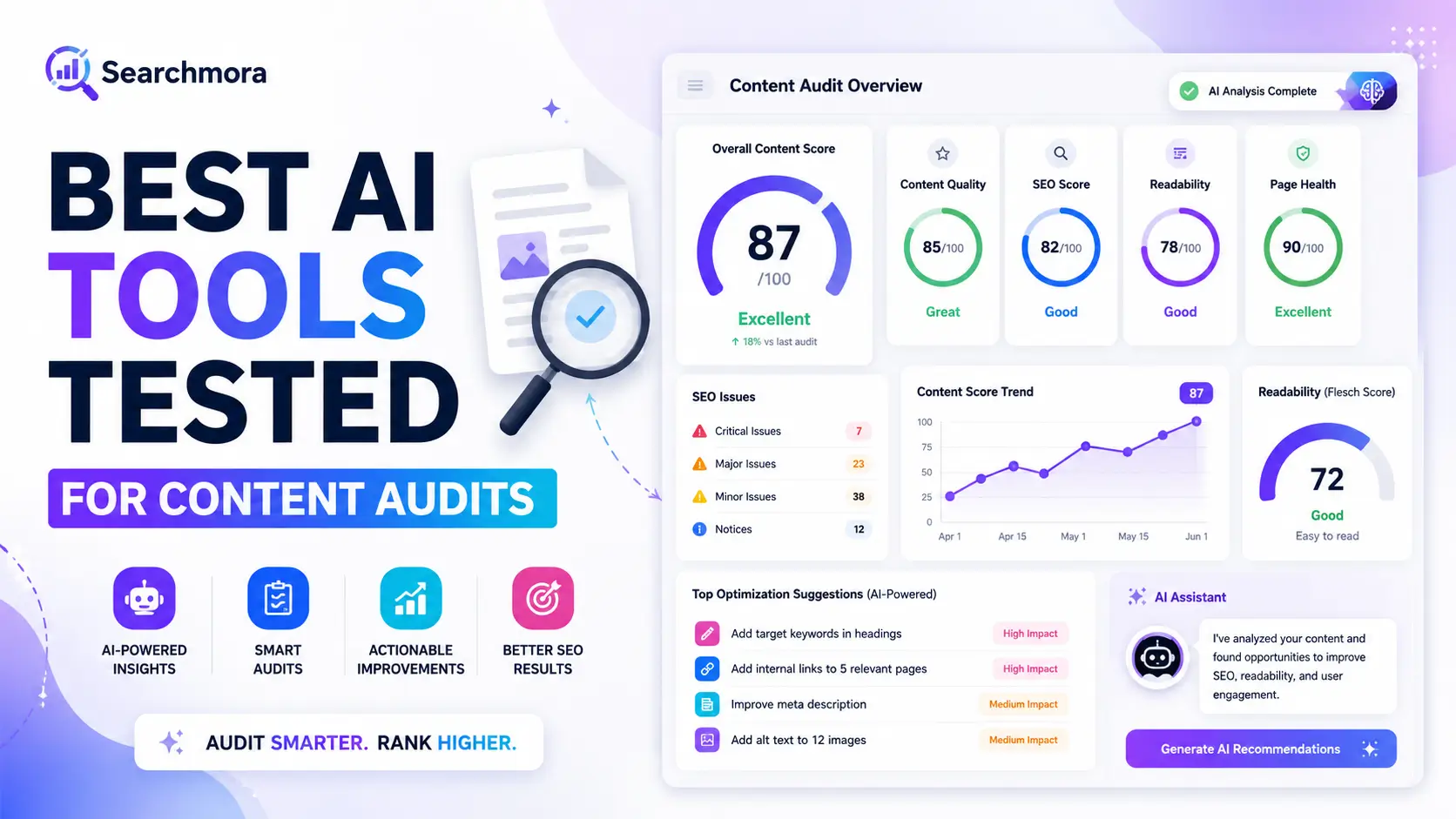
The best AI tools for content audits are Surfer for SERP-based refreshes, Screaming Frog for large technical inventories, Frase for SEO and GEO readiness, MarketMuse for topical authority, Clearscope for content monitoring, NeuronWriter for affordable semantic audits, Search Atlas for automated execution, and Originality.ai for quality checks.
A useful content audit should not merely tell you that a page is old or underperforming.
It should help you decide whether to:
- Keep it unchanged.
- Update facts and examples.
- Improve semantic coverage.
- Rewrite the introduction.
- Add missing entities.
- Merge it with another page.
- Redirect it.
- Remove it.
- Improve its AI citation readiness.
- Protect a page that still performs well.
That decision requires several different types of data.
A SERP optimizer compares the page with today’s competitors. A crawler inventories thousands of URLs. Search Console and analytics reveal whether people still find and use the page. An AI-quality tool can flag weak structure, repetition, readability, or generic language.
No single score can replace all of those signals.
This guide compares the leading AI content audit tools based on:
- Semantic and SERP analysis.
- Content inventory depth.
- Search Console and analytics integration.
- Content-decay detection.
- Update, merge, redirect, and delete decisions.
- AI search and GEO readiness.
- Content-quality analysis.
- Ease of implementation.
- Automation and approval controls.
- Cost and suitability by website size.
What “Tested” Means in This Guide
“Tested” means that each tool was evaluated using the same practical content-audit framework, current product documentation, available workflows, accessible interfaces, and verifiable external evidence.
It does not mean that every platform was connected to the same production website or that invented processing times, API bills, ranking gains, or error rates were used.
Where controlled first-party measurements were unavailable, this guide states that limitation rather than creating artificial evidence.
⚡ Quick Verdict
Surfer is the best tool for refreshing individual pages against current search competitors. Screaming Frog is the strongest option for large, customizable inventories, while Frase is the clearest choice for combining SEO audits with GEO and AI-search readiness.
MarketMuse is best for topical authority decisions. Clearscope is stronger for ongoing content monitoring, NeuronWriter offers better value for smaller teams, Search Atlas supports wider implementation, and Originality.ai adds a useful editorial-quality layer.
| Tool | Best For | Primary Audit Decision | Main Limitation |
|---|---|---|---|
| Surfer | SERP-based page refreshes | What is missing compared with current competitors? | Not a complete enterprise inventory system |
| Screaming Frog | Large and technical site inventories | Keep, investigate, update, merge, redirect, or remove | Requires configuration and expertise |
| Frase | SEO and GEO content audits | Which pages need fixes for search and AI visibility? | The newer site-audit workflow has less independent history |
| MarketMuse | Topical authority and strategy | Which topics should be improved or expanded? | Expensive or excessive for small sites |
| Clearscope | Content decay monitoring | Which published pages are losing relevance or performance? | Premium pricing |
| NeuronWriter | Affordable semantic audits | Which topics and entities are missing from a page? | Less suited to full enterprise inventory management |
| Search Atlas | Audit plus automated SEO execution | Which technical and content issues can be prioritized and fixed? | Broader and more complex than a content-only tool |
| Originality.ai | Quality and editorial checks | Does the content read clearly and provide sufficient quality? | Cannot make a complete SEO pruning decision alone |
Best Tool by Audit Type
| Audit Requirement | Best Direction |
|---|---|
| Refresh one declining article | Surfer |
| Compare an old page with current SERPs | Surfer or NeuronWriter |
| Audit thousands of URLs | Screaming Frog |
| Combine crawl data with AI prompts | Screaming Frog |
| Audit SEO and AI citation readiness | Frase |
| Find topical authority gaps | MarketMuse |
| Monitor content decay continuously | Clearscope |
| Automate broader SEO fixes | Search Atlas |
| Check readability and generic quality | Originality.ai |
| Low-cost semantic content review | NeuronWriter |
The clearest takeaway is this: use crawl and performance data to decide which pages deserve attention, then use semantic and AI-quality tools to decide how each selected page should change.
📚 Recommended Reads
- Best AI SEO Tools Tested This Year: Practical Tools for Better Rankings, Content Quality, and AI Visibility
- Best Alternatives to Writesonic for SEO Writing
- NeuronWriter Review: Is This Budget-Friendly SEO Content Optimizer Worth It?
- Frase Review: Is It the Best AI SEO Tool for Content Optimization and AI Visibility?
- Search Atlas Review: Is This AI SEO Platform Worth It?
📌 In This Guide
1. 🧠 What Is an AI Content Audit?
2. 🧪 How the Tools Were Evaluated
3. ⚙️ The Main Types of AI Content Audit Tools
4. 📊 Best AI Content Audit Tools Compared
5. 🏆 Best AI Tools Tested for Content Audits
6. 🔎 Best Tools for Semantic and SERP Audits
7. 🏢 Best Tools for Enterprise Content Inventories
8. ✍️ Best Tools for E-E-A-T and Content Quality
9. 🌐 How to Audit Content for GEO and AI Citations
10. 🧭 Build an Update, Merge, Redirect, or Delete Matrix
11. 💻 Using Screaming Frog with AI APIs
12. 💰 API Costs and Processing-Time Reality
13. ⚠️ How AI Makes Incorrect Content Decisions
14. 🧩 A Practical AI Content Audit Workflow
15. 📈 How to Measure Content Audit Results
16. 🛡️ Content Audit Safety Rules
17. 📊 Real-World Evidence and Product Limitations
18. ❓ FAQ
19. 🏁 Final Verdict
20. 📚 Recommended Next Reads
🧠 What Is an AI Content Audit?
An AI content audit analyzes published pages using search performance, technical data, competitor coverage, semantic relevance, content quality, and AI-search readiness. Its goal is to prioritize pages and recommend whether each one should be updated, consolidated, protected, redirected, or removed.
Traditional content audits are usually built in spreadsheets.
A content manager exports:
- URLs.
- Titles.
- Traffic.
- clicks.
- rankings.
- backlinks.
- dates.
- Word counts.
- conversions.
- indexation status.
The manager then reviews every page manually.
AI can accelerate several parts of that process:
- Summarizing each page.
- Identifying search intent.
- Grouping similar pages.
- Finding duplicate topics.
- Comparing content with competitors.
- Detecting missing entities.
- Classifying page quality.
- Flagging weak introductions.
- Identifying outdated claims.
- Recommending the next action.
What AI Should Not Decide Alone
AI should not independently delete or redirect pages based only on:
- Low traffic.
- Low word count.
- An old publication date.
- An optimization score.
- AI-detection probability.
- Readability.
- One month of ranking decline.
- A generic quality score.
A page with low organic traffic may still:
- generate conversions
- support another page
- earn backlinks
- answer an important customer question
- rank seasonally
- serve existing customers
- receive referral traffic
- help sales teams
- support entity authority
AI should recommend an investigation.
A human should approve destructive actions.
🧪 How the Tools Were Evaluated
The tools were evaluated against the same content-audit decision framework rather than ranked by how many dashboards they provide.
| Audit Area | What Was Evaluated |
|---|---|
| Inventory depth | Ability to collect and organize many URLs |
| SERP comparison | Comparison with currently ranking content |
| Semantic analysis | Topics, entities, concepts, and intent coverage |
| Performance data | Search Console, analytics, rankings, and traffic |
| Technical data | Indexation, canonicals, redirects, crawl depth, and errors |
| Content decay | Ability to detect declining or outdated pages |
| Content quality | Clarity, readability, originality, and useful structure |
| GEO readiness | Direct answers, facts, entities, sources, and citation structure |
| Decision support | Keep, update, merge, redirect, remove, or protect |
| Automation | Whether recommendations can be implemented directly |
| Human control | Review, approval, exclusion, and rollback options |
| Scalability | Suitability for dozens or thousands of pages |
| Cost | Subscription, API, crawl, and labor requirements |
A Credible “Tested” Methodology
A defensible tool evaluation should document:
- The type of site.
- Number of eligible URLs.
- Data sources connected.
- Crawl settings.
- Model or API used.
- Prompt structure.
- Pages reviewed manually.
- Incorrect recommendations.
- Actions implemented.
- Measurement period.
Without those details, a precise claim such as “the tool made only 4% incorrect decisions” is not credible.
This article therefore avoids fake precision.
⚙️ The Main Types of AI Content Audit Tools
Content audit tools fall into different categories based on the data they analyze and the decisions they are designed to support.
1. Semantic and SERP Audit Tools
These tools compare an existing page with currently ranking competitors.
Examples: Surfer and NeuronWriter.
They help answer:
- Which topics are missing?
- Which entities are underrepresented?
- Has search intent changed?
- Is the structure weaker than competing pages?
- Does the introduction answer the query quickly?
- Are important subtopics missing?
- Is the page over-optimized?
Best For
- individual page refreshes
- declining articles
- commercial pages
- content optimization
- search-intent realignment
Main Risk
Writers may copy the average SERP rather than add original value.
2. Enterprise Inventory and Crawl Tools
These tools scan many URLs and combine technical, content, and performance data.
Examples: Screaming Frog and Search Atlas.
They help answer:
- Which pages are indexable?
- Which pages receive no clicks?
- Which URLs overlap?
- Which pages have weak internal links?
- Which content is outdated?
- Which URLs should be reviewed first?
- Which pages have technical barriers?
- Which pages consume crawl resources without value?
Best For
- large websites
- migrations
- enterprise content libraries
- ecommerce
- agencies
- programmatic auditing
Main Risk
A crawler can identify patterns but cannot understand every page’s commercial or editorial value.
3. Content Inventory and Strategy Platforms
These platforms maintain ongoing inventories and prioritize content by authority, opportunity, decay, or strategic value.
Examples: MarketMuse and Clearscope.
They help answer:
- Where does the site already have authority?
- Which topics are weak?
- Which pages are decaying?
- Which pages have striking-distance potential?
- Which content should be updated first?
- Which topic clusters are incomplete?
Best For
- established publishers
- SaaS websites
- editorial teams
- topical-authority planning
- ongoing content governance
Main Risk
The subscription may be difficult to justify for a small site.
4. GEO and AI-Readiness Audit Tools
These tools evaluate whether content is structured and complete enough to be reused or cited in generative answers.
Example: Frase.
They may inspect:
- Direct answers.
- Entity coverage.
- factual density.
- citations.
- structure.
- AI-search visibility.
- Content gaps.
- brand mentions.
- Source coverage.
- Answer readiness.
Best For
- AI search programs
- AEO
- GEO
- agencies selling AI visibility
- content refreshes for citation potential
Main Risk
No GEO score guarantees that an AI platform will cite a page.
5. AI Quality and Editorial Audit Tools
These tools evaluate readability, generic writing, repetition, plagiarism, or likely content quality.
Example: Originality.ai.
They help answer:
- Is the text readable?
- Does it appear repetitive?
- Is it too generic?
- Does it contain copied language?
- Are sentences too complex?
- Does the page require editorial review?
Best For
- editorial quality control
- outsourced content
- AI-assisted drafts
- large writer teams
- pre-publication checks
Main Risk
AI detection and quality scores cannot prove whether content is helpful or written by a human.
📊 Best AI Content Audit Tools Compared
| Tool | Main Audit Type | Sitewide Inventory | SERP Analysis | GEO Audit | Direct Fixes | Best For |
|---|---|---|---|---|---|---|
| Surfer | Semantic and performance | Yes, within Sites | Strong | AI Search Score and tracking | Auto-Optimize and editor workflow | Refreshing ranking pages |
| Screaming Frog | Technical and custom inventory | Excellent | Through APIs and custom workflows | Custom prompts | Export or custom automation | Large technical audits |
| Frase | SEO, GEO, and content lifecycle | Yes | Strong | Strong | Brief, rewrite, Content Guard | SEO and AI-search teams |
| MarketMuse | Authority and content inventory | Strong | Strong | Indirect | Strategic recommendations | Topical authority |
| Clearscope | Monitoring and content decay | Strong | Strong | AI visibility features | Refresh workflows | Established editorial teams |
| NeuronWriter | Semantic page optimization | Moderate | Strong | AI optimization metrics | Editor and integrations | Budget-focused teams |
| Search Atlas | Technical and on-page automation | Strong | Strong | AI platform features | OTTO deployment | Agencies and larger sites |
| Originality.ai | Quality and editorial review | Limited | Content Optimizer | Limited | Editorial recommendations | Quality assurance |
🏆 Best AI Tools Tested for Content Audits
1. Surfer: Best for SERP-Based Content Refreshes
Surfer is the strongest option for identifying which published pages need re-optimization and comparing them with current search competitors. Its Content Audit combines page performance, content scoring, topical recommendations, and refresh workflows, making it particularly useful for pages that have lost rankings or relevance.
How Surfer Audits Content
Surfer’s Content Audit evaluates pages using:
- Organic performance.
- Impressions.
- Average position.
- Click-through rate.
- Content Score.
- Keyword targeting.
- Competing pages.
- Missing terms.
- Topic coverage.
- Page structure.
Surfer’s Sites workflow can automatically audit a selected set of top-performing pages and prioritize content that may need attention.
Semantic Gap Analysis
The tool compares an existing page with current competitors.
It can help reveal:
- Missing concepts.
- Important entities.
- Weak headings.
- Changed search intent.
- Incomplete explanations.
- New competitor sections.
- Underused supporting terms.
- Excessive or missing topic coverage.
This is valuable because a page that ranked two years ago may now compete with substantially different content.
AI Search Score
Surfer’s newer AI-search scoring evaluates signals such as:
- Facts coverage.
- Entity and concept coverage.
- Upfront intent alignment.
- Clarity of the early answer.
- Suitability for AI-powered search experiences.
This makes Surfer more relevant to GEO audits than older keyword-density tools.
Auto-Optimize
Surfer can help move a page into an optimization workflow and apply recommended improvements through its editor and automation features.
This saves time, but every automated change should be reviewed for:
- Factual accuracy.
- Brand tone.
- duplicated concepts.
- Unsupported claims.
- awkward sentences.
- Unnecessary keyword additions.
Pros
- Strong SERP comparison.
- Page-level semantic analysis.
- Performance-based prioritization.
- Content Score.
- AI Search Score.
- Auto-Optimize.
- Content-decay workflow.
- Useful for refresh campaigns.
- Clear editor experience.
- Integrates traditional SEO with AI-search guidance.
Cons
- Not a full technical enterprise crawler.
- Page scores can encourage formulaic editing.
- Competitor averages do not guarantee helpful content.
- Automated changes require review.
- Pricing may be high for small publishers.
- Sitewide pruning decisions require additional data.
Independent Editorial Verdict
Choose Surfer when the main question is:
What should I add, remove, or restructure to make this specific page competitive again?
Do not use it alone to delete or redirect pages.
Best for: agencies, SEO writers, established blogs, and content-refresh teams.
2. Screaming Frog SEO Spider: Best for Large Custom Content Audits
Screaming Frog is the best option for large, programmable content inventories because it can crawl thousands of URLs, connect with Google Search Console and analytics data, extract page content, and run custom prompts through OpenAI, Gemini, Anthropic, Ollama, or local models.
How Screaming Frog Audits Content
The SEO Spider can collect:
- Status codes.
- Indexability.
- Canonicals.
- Titles.
- descriptions.
- headings.
- Word counts.
- Duplicate content.
- crawl depth.
- Internal links.
- structured data.
- page speed.
- Search Console metrics.
- Analytics metrics.
- Custom extractions.
- AI-generated classifications.
Its paid version removes the free 500-URL crawl limit and unlocks advanced integrations and configuration.
AI Prompt Integration
Screaming Frog can connect directly with:
- OpenAI.
- Gemini.
- Anthropic.
- Ollama.
- Local language models.
Custom prompts can classify each page during the crawl.
Example audit outputs may include:
- Search intent.
- Page summary.
- Content type.
- topic cluster.
- E-E-A-T weaknesses.
- Update recommendation.
- Merge candidate.
- Duplicate intent.
- Outdated entities.
- citation-readiness score.
Update, Merge, or Delete Decisions
A useful custom crawl can combine:
- organic clicks
- impressions
- conversions
- backlinks
- indexability
- content quality
- publication date
- internal links
- semantic similarity
AI can then suggest:
- Keep.
- Update.
- Merge.
- Redirect.
- Review manually.
- Remove.
The result must remain a recommendation.
A page with zero Search Console clicks may still generate:
- email conversions
- direct traffic
- assisted sales
- customer support value
- backlinks
- seasonal demand
Pros
- Excellent scalability.
- Highly customizable.
- Connects technical and content data.
- Search Console integration.
- Analytics integration.
- Custom JavaScript.
- Direct AI API integration.
- Local-model support.
- Semantic similarity workflows.
- Exports detailed datasets.
Cons
- Higher learning curve.
- AI workflows require prompt design.
- API costs are separate.
- Decisions are not automatically correct.
- Desktop resources may limit very large crawls.
- Implementation usually happens elsewhere.
- Poor configuration produces poor recommendations.
Independent Editorial Verdict
Choose Screaming Frog when you need to audit hundreds or thousands of pages and want complete control over the data and AI logic.
It is more powerful than a simple content score, but it requires more expertise.
Best for: technical SEOs, enterprise sites, ecommerce, migrations, and agencies.
3. Frase: Best for Combined SEO and GEO Content Audits
Frase is the strongest option for teams that want to audit entire websites for technical SEO, content quality, and AI-search readiness, then move weak pages directly into a brief, rewrite, optimization, and monitoring workflow.
How Frase Audits Content
Frase’s site audit workflow is designed to:
- Crawl website pages.
- Score technical SEO.
- Evaluate content quality.
- Measure AI-search readiness.
- Prioritize high-impact fixes.
- Identify pages ignored by AI search.
- Convert weak pages into briefs.
- Create replacement drafts.
- Optimize the updated version.
- Monitor future content decay.
This is broader than a traditional page score.
GEO Score and AI Readiness
Frase increasingly separates two questions:
- Is the page optimized for traditional organic search?
- Is the page structured to be reused or cited in AI answers?
A GEO-oriented audit may examine:
- Direct-answer clarity.
- Entity coverage.
- Structured facts.
- Source density.
- tables.
- Concise definitions.
- Topic completeness.
- brand presence.
- citation gaps.
- Content freshness.
Content Guard
Frase’s Content Guard monitors pages after improvements and proposes additional fixes when decay appears.
That creates a closed workflow:
Audit → Rewrite → Optimize → Publish → Monitor → Refresh
Pros
- Sitewide content audit.
- SEO and GEO scoring.
- AI-search readiness.
- Prioritized fixes.
- Content briefs.
- AI writing.
- Content Guard monitoring.
- Agency reporting direction.
- Direct workflow from diagnosis to rewrite.
- Useful for AI visibility programs.
Cons
- Vendor claims require independent validation.
- GEO scores cannot guarantee citations.
- Newer audit functionality has less long-term external evidence.
- Automated rewrites need fact-checking.
- May overlap with existing SEO tools.
- Content removal decisions still require outside performance data.
Independent Editorial Verdict
Choose Frase when the audit must answer:
Which pages need changes for both Google search and generative search?
It is especially useful for teams already using Frase for briefs and optimization.
Best for: agencies, content teams, GEO consultants, and AI-search programs.
4. MarketMuse: Best for Topical Authority and Strategic Content Decisions
MarketMuse is the best content audit platform for deciding where a site has topical authority, which clusters are incomplete, which pages require improvement, and where additional content can create a realistic competitive advantage.
How MarketMuse Audits Content
MarketMuse Inventory can evaluate:
- Existing pages.
- Topic authority.
- Content quality.
- Content gaps.
- Search competition.
- Page relationships.
- Cluster completeness.
- personalized difficulty.
- Potential value.
- Update opportunities.
The focus is strategic rather than purely technical.
Personalized Difficulty
A keyword may be difficult for one website and realistic for another.
MarketMuse evaluates opportunities relative to the site’s existing authority.
That can help distinguish:
- Pages worth updating.
- Topics requiring supporting content.
- Clusters with existing strength.
- Weak pages in strong topic areas.
- Topics the site should avoid.
- Pages that need consolidation.
Content Inventory Value
MarketMuse is useful when a publisher has hundreds or thousands of pages and cannot treat every declining URL equally.
It can support prioritization based on:
- Authority.
- difficulty.
- opportunity.
- topic completeness.
- Content quality.
- Strategic importance.
Pros
- Strong topical-authority analysis.
- Content inventory.
- Personalized difficulty.
- Gap analysis.
- Cluster planning.
- Strategic content briefs.
- Large-site suitability.
- Useful for update prioritization.
- Competitor coverage analysis.
- Strong content-strategy direction.
Cons
- Higher learning curve.
- Premium pricing.
- Not a technical crawler replacement.
- Not designed mainly for immediate CMS fixes.
- Recommendations require strategic interpretation.
- Too complex for many small blogs.
Independent Editorial Verdict
Choose MarketMuse when the audit question is:
Where can this website realistically build or defend topical authority?
Do not choose it merely to improve one article.
Best for: enterprise publishers, SaaS companies, agencies, and content strategists.
5. Clearscope: Best for Content Monitoring and Decay Protection
Clearscope is the best option for established editorial teams that want a centralized inventory connected to Search Console and analytics data, customizable monitoring views, content-health metrics, and structured refresh workflows.
How Clearscope Audits Content
Clearscope Content Inventory can track:
- Content Grade.
- Clicks.
- impressions.
- Average position.
- SEO value.
- monitored queries.
- Content decay.
- Striking-distance pages.
- Page groups.
- annotations.
- Update history.
- Optimization opportunities.
Teams can create Content Views for:
- blog posts
- product pages
- campaigns
- content clusters
- declining pages
- priority refreshes
- high-value assets
Decay Monitoring
A page does not need to collapse completely before it is reviewed.
Clearscope can help identify:
- Gradual ranking decline.
- Traffic loss.
- Deteriorating topic alignment.
- High-potential pages near page one.
- Content requiring a new draft.
- pages that should be protected rather than rewritten.
Analytics and Search Console Integration
Clearscope integrates performance metrics with content-health information.
That allows teams to avoid refreshing pages solely because a score changed.
Pros
- Central content inventory.
- Search Console integration.
- Analytics integration.
- Content-decay monitoring.
- Custom Content Views.
- Content Grade.
- striking-distance analysis.
- Editorial annotations.
- Refresh workflows.
- Strong team usability.
Cons
- Premium price.
- Not a full technical site crawler.
- Smaller sites may not need inventory features.
- Grades can be overemphasized.
- Does not automatically determine deletion safety.
- Requires ongoing editorial use to produce value.
Independent Editorial Verdict
Choose Clearscope when content is a valuable long-term asset and the team needs to detect decay before traffic is lost.
NeuronWriter is more affordable; MarketMuse is more strategic.
Best for: editorial departments, agencies, SaaS sites, and established publishers.
6. NeuronWriter: Best Affordable Semantic Content Audit Tool
NeuronWriter is the best-value option for bloggers and smaller teams that need SERP analysis, NLP recommendations, entity coverage, content scoring, and AI-oriented quality guidance without paying for an enterprise content platform.
How NeuronWriter Audits Content
NeuronWriter can analyze:
- Top-ranking competitors.
- relevant terms.
- entities.
- headings.
- questions.
- topic coverage.
- Content structure.
- Search intent.
- Content competition.
- AI optimization signals.
An existing article can be imported and compared with current search results.
AI Optimization Score
NeuronWriter’s newer AI-oriented metrics consider areas such as:
- Topic coverage.
- Structure.
- clarity.
- Direct conclusions.
- factual density.
- source density.
- Thematic completeness.
These factors overlap with GEO readiness, although a score still cannot prove citability.
Content Pruning and Governance
NeuronWriter publishes content-governance and pruning guidance, but the product’s strongest role remains page-level semantic analysis rather than full technical enterprise inventories.
It should usually be combined with:
- Search Console
- analytics
- a crawler
- backlink data
- conversion data
before making deletion decisions.
Pros
- Affordable pricing.
- Strong SERP analysis.
- NLP recommendations.
- Entity coverage.
- AI optimization metrics.
- Useful for old-page refreshes.
- Supports content planning.
- Accessible to smaller teams.
- Good value for bloggers.
- Useful for individual URL audits.
Cons
- Less complete for enterprise inventories.
- The interface may feel less polished.
- Requires separate performance data.
- Scores can encourage over-optimization.
- Cannot safely decide deletions alone.
- AI recommendations require editorial review.
Independent Editorial Verdict
Choose NeuronWriter when you need affordable answers to:
What is this page missing compared with current competitors?
Pair it with Search Console or Screaming Frog for a complete audit.
Best for: bloggers, affiliate sites, freelancers, and small agencies.
7. Search Atlas: Best for Audit-to-Execution Automation
Search Atlas is the strongest option for agencies that want site auditing, content scoring, technical recommendations, competitor benchmarks, and automated implementation inside one broader SEO platform.
How Search Atlas Audits Content
Search Atlas combines:
- Site crawling.
- Indexability.
- Technical errors.
- Content quality.
- Content scoring.
- competitor benchmarks.
- Recommended terms.
- links.
- Structural elements.
- metadata.
- page-performance factors.
- OTTO SEO automation.
The On-Page Audit tool can send pages to its content assistant for further optimization.
Decision and Execution
Search Atlas differs from tools that only generate reports.
Its broader platform can move from:
Issue detected → recommendation → approval → deployment
That is useful for agencies managing many sites.
OTTO SEO
OTTO can help deploy:
- Metadata changes.
- structured data.
- On-page fixes.
- Internal links.
- Technical recommendations.
- content-related changes.
This improves implementation speed but raises governance requirements.
Pros
- Broad site auditor.
- Technical and content scoring.
- Competitor analysis.
- Recommended fixes.
- Automatic optimization direction.
- OTTO deployment.
- Agency workflows.
- Multi-site suitability.
- Connects audit with implementation.
- Wider SEO platform.
Cons
- More complex than a content-only tool.
- Higher cost.
- Automated fixes require careful review.
- Vendor case studies are not controlled experiments.
- May duplicate existing agency tools.
- Content-pruning decisions still need business data.
- Platform dependency increases.
Independent Editorial Verdict
Choose Search Atlas when the agency’s biggest bottleneck is implementing audit recommendations across many sites.
Choose Screaming Frog when you need maximum custom control over audit logic.
Best for: agencies, multi-site teams, and organizations adopting SEO automation.
8. Originality.ai: Best for AI Quality, Readability, and Editorial Checks
Originality.ai is best used as a supporting editorial-quality layer for content audits. Its quality, readability, plagiarism, and optimization tools can reveal pages that require human review, but they should never determine update, deletion, or ranking decisions independently.
What Originality.ai Can Check
Its toolset can help review:
- Readability.
- Sentence complexity.
- likely content quality.
- plagiarism.
- AI-writing probability.
- keyword-density alignment.
- competitor terms.
- Factual review workflows.
- Repetitive language.
- Editorial weaknesses.
Content Quality Score
The Content Quality Score estimates whether a document is likely to be perceived as low, good, or high quality.
That can help prioritize manual editorial review.
It does not prove:
- Search usefulness.
- expertise.
- first-hand experience.
- factual accuracy.
- Ranking potential.
- Whether a person or AI wrote the text.
AI Detection Warning
AI-detection scores should not be used to punish writers or delete content without evidence.
False positives and false negatives are possible.
A better workflow is:
- Use the score as a review signal.
- Inspect the actual text.
- Verify sources.
- Improve examples.
- Add expert contribution.
- Remove generic repetition.
- Confirm authorship processes.
Pros
- Readability tools.
- Content Quality Score.
- Plagiarism checking.
- AI-detection support.
- Content Optimizer.
- Competitor comparison.
- Useful editorial layer.
- Suitable for outsourced content.
- Helps standardize QA.
- Free supporting tools available.
Cons
- Not a complete SEO audit platform.
- AI detection is probabilistic.
- Quality scores cannot measure true expertise.
- No complete inventory decision system.
- Requires human interpretation.
- Should not determine pruning by itself.
Independent Editorial Verdict
Use Originality.ai after inventory and performance analysis to identify pages that need deeper editorial review.
Do not use an AI-detection result as a deletion rule.
Best for: editorial teams, agencies, content marketplaces, and publishers using AI-assisted writing.
🔎 Best Tools for Semantic and SERP Audits
Surfer is the strongest premium choice for SERP-based refreshes, while NeuronWriter provides better value for smaller teams. Clearscope adds stronger monitoring, and MarketMuse is more useful when the audit must consider site-level authority.
| Tool | Best Semantic Use |
|---|---|
| Surfer | Refreshing a specific declining page |
| NeuronWriter | Affordable entity and NLP analysis |
| Clearscope | Monitoring relevance over time |
| MarketMuse | Evaluating authority and cluster gaps |
| Frase | Combining SERP and GEO readiness |
What a Semantic Audit Should Check
- Has search intent changed?
- Are new entities appearing in top results?
- Are important questions missing?
- Is the article too broad or too shallow?
- Does it answer the main query early?
- Are competitors using stronger evidence?
- Are definitions clear?
- Are old sections still relevant?
- Does the page contain redundant wording?
- Is a different page now competing for the same query?
The Main Semantic Audit Risk
Do not transform every article into a copy of the current top ten.
Competitor analysis should identify expectations.
The refreshed page still needs:
- original experience
- unique examples
- expert opinion
- first-party data
- better organization
- stronger sources
- a clear editorial angle
🏢 Best Tools for Enterprise Content Inventories
Screaming Frog is the best option for customizable large-scale crawling. Search Atlas is stronger for integrated execution, MarketMuse for strategic prioritization, and Clearscope for ongoing monitoring.
| Enterprise Need | Best Tool |
|---|---|
| Maximum crawl customization | Screaming Frog |
| Automated SEO implementation | Search Atlas |
| Topical authority prioritization | MarketMuse |
| Continuous content monitoring | Clearscope |
| SEO and GEO sitewide workflow | Frase |
What an Enterprise Inventory Should Include
| Data Group | Fields |
|---|---|
| Technical | Status, canonical, indexability, crawl depth |
| Search | Impressions, clicks, CTR, position |
| Analytics | Sessions, engagement, conversions |
| Content | Title, intent, cluster, author, date |
| Authority | Backlinks, referring domains, internal links |
| Quality | Readability, freshness, evidence, originality |
| GEO | Direct answer, entities, facts, sources, tables |
| Decision | Keep, update, merge, redirect, remove |
Why Large Audits Fail
Enterprise audits often fail because they produce a spreadsheet with thousands of rows but no prioritization.
A good system should identify:
- High-value pages are losing performance.
- Duplicate pages are competing with each other.
- Weak pages inside strong clusters.
- Strong pages that should not be changed.
- Outdated pages with backlinks.
- No-traffic pages with business value.
- URLs require technical fixes before content work.
- Pages suitable for consolidation.
✍️ Best Tools for E-E-A-T and Content Quality
No tool can fully measure E-E-A-T because experience, expertise, authority, and trust depend on real people, evidence, reputation, and accuracy. AI tools can only identify supporting signals and editorial weaknesses.
What an AI Quality Audit Can Check
- Is the author identified?
- Does the page provide sources?
- Are claims verifiable?
- Are the examples specific?
- Does the article show first-hand experience?
- Are limitations discussed?
- Is the text generic or repetitive?
- Are definitions clear?
- Is the page readable?
- Are dates, prices, and facts current?
What AI Cannot Verify Reliably??
- Whether the author truly used a product.
- Whether a case study is genuine.
- Whether expertise credentials are authentic.
- Whether an anecdote actually happened.
- Whether all sources were interpreted correctly.
- Whether the author deserves authority.
E-E-A-T Audit Checklist
| Signal | Audit Question |
|---|---|
| Experience | Does the page include genuine process details or observations? |
| Expertise | Is the author qualified to explain the topic? |
| Authority | Is the brand recognized or cited by trusted sources? |
| Trust | Are claims accurate, sourced, current, and transparent? |
| Editorial integrity | Are affiliate relationships and limitations disclosed? |
| Accountability | Is there an author bio, contact information, and update date? |
Originality.ai can help with readability and quality signals.
Screaming Frog plus an LLM can check whether author boxes, references, dates, and disclosures appear at scale.
Humans must verify whether those elements are authentic.
🌐 How to Audit Content for GEO and AI Citations
A GEO content audit evaluates whether a page is clear, factual, structured, current, and easy for generative systems to extract and verify. It should inspect direct answers, entities, source quality, tables, data, definitions, and whether the brand is connected to the topic consistently.
What Is a Citatability Audit?
citability audit asks:
- Can an AI system identify the page’s main answer quickly?
- Are factual claims supported?
- Are important entities named clearly?
- Are definitions concise?
- Are statistics current?
- Are tables easy to interpret?
- Does the page add original value?
- Are sources authoritative?
- Is the content structured into extractable blocks?
- Is the article updated?
Citatability Audit Matrix
| Audit Element | Weak Version | Stronger Version |
|---|---|---|
| Main answer | Buried after a long introduction | Direct answer in first 40–50 words |
| Definitions | Vague explanation | Clear one- or two-sentence definition |
| Evidence | Unsupported claims | Primary-source citations and dates |
| Statistics | Old number without context | Current number with source and methodology |
| Tables | Decorative comparison | Specific, labeled decision table |
| Entities | Inconsistent terminology | Stable product, company, and topic names |
| Structure | Long unbroken prose | H2s, lists, steps, and concise paragraphs |
| Experience | Generic advice | Real process details and limitations |
| Freshness | No update information | Reviewed date and updated facts |
| Brand authority | Anonymous article | Credible author and transparent site information |
Tools That Support GEO Audits
| Tool | GEO Contribution |
|---|---|
| Frase | GEO scoring, site audits, AI visibility, citation readiness |
| Surfer | AI Search Score, facts coverage, upfront intent alignment |
| NeuronWriter | AI optimization, topic coverage, clarity, fact and source density |
| Clearscope | AI visibility and ongoing content monitoring |
| Screaming Frog | Custom AI prompts and sitewide extraction |
| Originality.ai | Readability and editorial-quality checks |
Important GEO Limitation
A page can meet every formatting recommendation and still receive no AI citations.
AI systems may prefer another source because it has:
- Greater authority.
- Better external mentions.
- More original data.
- Stronger brand recognition.
- Fresher information.
- Better match to the user’s prompt.
- More trusted third-party validation.
Citatability is a probability, not a guarantee.
🧭 Build an Update, Merge, Redirect, or Delete Matrix
The best content audits combine performance, quality, relevance, links, conversions, and strategic value before recommending an action.
Decision Matrix
| Performance | Quality | Strategic Value | Recommended Direction |
|---|---|---|---|
| Strong | Strong | High | Keep and protect |
| Declining | Strong | High | Refresh and monitor |
| Weak | Strong | High | Improve intent, links, and distribution |
| Weak | Weak | High | Rewrite |
| Weak | Weak | Low | Merge, redirect, or remove |
| Overlapping | Strong | High | Consolidate carefully |
| No traffic | High conversion value | High | Keep and improve discoverability |
| Old but linked externally | Mixed | Medium | Update or redirect carefully |
| Thin and unsupported | Low | Low | Remove or noindex after review |
Update When
- Intent remains valid.
- The URL has authority.
- Competitors have stronger coverage.
- Facts are outdated.
- Rankings are declining.
- The page has conversions.
- Internal links support it.
- The topic remains relevant.
Merge When
- Two pages target the same intent.
- Both are weak separately.
- The information belongs together.
- Cannibalization is visible.
- One stronger URL can retain value.
Redirect When
- A replacement page exists.
- The old URL has backlinks or traffic.
- Content is permanently consolidated.
- The destination is highly relevant.
Delete or Noindex When
- The page has no value.
- The topic is obsolete.
- No relevant replacement exists.
- It duplicates stronger content.
- It creates legal or factual processes.
- It serves no users or business processes.
Never delete in bulk solely because an AI classifier labeled pages “low quality.”
💻 Using Screaming Frog with AI APIs
Screaming Frog can send page data to AI models during a crawl, allowing teams to classify, summarize, and score content at scale.
Possible AI Audit Prompts
- Identify the primary search intent.
- Summarize the page in 30 words.
- Classify the content type.
- Flag outdated dates or entities.
- Identify unsupported claims.
- Score direct-answer quality.
- Identify overlapping URLs.
- Recommend keep, update, merge, or review.
- Check whether the page is cocitability-hand evidence.
- Audit GEO citability.
Example Audit Prompt
Review the supplied page content and metadata. Return:
- Primary search intent
- Main topic and entities
- Content freshness risks
- Missing direct answer
- Evidence and source weaknesses
- Possible duplicate intent
- Recommended action: Keep, Update, Rewrite, Merge, Redirect Review, or Remove Review
- Confidence score
Do not recommend deletion based only on low traffic, word count, or publication age.
Recommended Export Columns
| URL | Clicks | Impressions | Conversions | Backlinks | Intent | AI Recommendation | Confidence |
|---|
Why Confidence Scores Are Not Enough
A model can be confidently wrong.
Use confidence to prioritize review, not approve destructive actions.
💰 API Costs and Processing-Time Reality
The cost of an AI-powered crawl depends on the model, input length, output length, number of pages, prompt complexity, retries, and whether full page content or only selected fields are sent.
It is not responsible to state one universal price per 100 pages.
What Controls API Cost?
- Model selected.
- Tokens sent.
- Tokens generated.
- Full HTML versus cleaned text.
- Number of prompts per URL.
- Page length.
- Retry frequency.
- Cached input.
- Embeddings.
- Parallel processing.
Why Full Pages Become Expensive
Sending an entire article to a premium model is more expensive than sending:
- title
- headings
- summary
- selected paragraphs
- metrics
- extracted entities
A cost-efficient audit may use stages.
Cost-Efficient Three-Stage Workflow
Stage 1: Cheap Filtering
Use crawl and perNoindex rules Duplicate:
- Redirects.
- Noindex pages.
- Duplicate URLs.
- strrelevantpages not requiring review.
- Irrelevant page types.
Stage 2: Lightweight Classification
Send only: KeyKeyL.
- URL.
- title.
- headings.
- Summary.
- Key metrics.
Use AI to classify priority.
Stage 3: Deep Review
Send full content only for high-priority pages.
This can substantially reduce token usage.
Processing Time Variables
Processing depends on the Internet
- Crawl speed.
- API rate limits.
- Internet connection.
- Model latency.
- concurrent requests.
- page rendeRetryRetry
- JavaScript.
- computer resources.
- Retry behavior.
- Website response speed.
Do not compare tools using undocumented speed claims.
⚠️ How AI Makes Incorrect Content Decisions
AI audit tools can recommend harmful actions when they misunderstand business value, seasonality, search intent, conversions, technical data, or the role a page plays within a wider content journey.
Common AI Audit Errors
- Recommending deletion because traffic is low.
- Treating seasonal pages as failures.
- Merging pages with different intent.
- Rewriting a page that already converts well.
- Removing content that attracts backlinks.
- Misclassifying support documentation.
- Treating zero-click informational pages as useless.
- Overvaluing content scores.
- Copying competitor structures too closely.
- Misreading branded or navigational intent.
False Deletion Scenario
A page may receive only 50 organic visits per month.
AI may label it as low value.
However, if it generates five qualified leads worth $500 each, deleting it would be damaging.
False Merge Scenario
Two pages may both mention “local SEO tools.”
One may target:
- a general software comparison
The other may target:
- tools for agencies
Combining them could weaken both intents.
Decision Error Audit
Before approving an AI recommendation, ask:
- Does the page convert?
- Does it have backlinks?
- Does it support customers?
- Is demand seasonal?
- Does it serve a unique intent?
- Is traffic measured correctly?
- Does another page truly replace it?
- Is the recommendation technically reversible?
🧩 A Practical AI Content Audit Workflow
The safest workflow uses crawl and performance data to build the inventory, AI to classify opportunities, specialist tools to diagnose selected pages, and humans to approve final actions.
Step 1: Define the Audit Goal
Choose one primary goal:
- Recover declining traffic.
- Remove outdated content.
- Consolidate duplicate intent.
- Improve topical authority.
- Prepare for AI search.
- Reduce crawl waste.
- Improve conversions.
- Review outsourced content.
Step 2: Build the Inventory
Collect:
- URL.
- stContus.
- indexability.
- canonical.
- titernal.
- Content type.
- author.
- date.
- Internal links.
- backlinks.
- clicks.
- impressions.
- position.
- sessions.
- conversions.
Step 3: Remove TechnicNoindexe
Separate:
- Redirects.
- errors.
- Noindex pages.
- duplicates.
- parameters.
- pagination.
- faceted URLs.
- test content.
Step 4: Segment the Pages
Group pages by:
- Topic cluster.
- Page type.
- Business importance.
- Performance.
- Content age.
- Conversion value.
- Existing authority.
Step 5: Apply Initial Rules
Examples:
- High conversions: protect and review manually.
- Strong backlinks: do not delete automatically.
- Declining rankings: send to semantic audit.
- Duplicate intent: send to consolidation review.
- No visibility and low value: investigate for removal.
- AI citation loss: send to GEO audit.
Step 6: Run Specialist Audits
Use:
- Surfer or NeuronWriter for semantic gaps.
- Frase for GEO readiness.
- Mar scope scopeketMuse for topic strategy.
- Clear scope for recovery and inventory.
- Originality.ai for quality review.
- Search Atlas for broader fixes.
Step 7: Assign an Action
Use:
- Keep.
- Protect.
- Update.
- Expand.
- Rewrite.
- Merge.
- Redirect.
- Remove review.
- Technical fix.
- Manual expert review.
Step 8: Review Destructive Actions
Require human approval for:
- RLargects.
- deletions.
- noindex Merging.
- Large Removals.
- URL changes.
- Changes pages.
- Removal of cited data.
- Changes to high-converting pages.
Step 9: Implement in Batches
Begin with:
- OnOne-pageOne-pagecluster.
- Ten declining pages.
- One-page type.
- One business unit.
Do not update thousands of pages simultaneously.
Step 10: Monitor and Annotate Tool
RToolecord:
- Date.
- URL.Hum
- an.
- reason.
- Tool recommendation.
- hFollow-upFollow-upewer.
- Metrics before change.
- Unexpected date.
- Metrics after change.
- Unexpected effects.
📈 How to Measure Content Audit Results
A content audit should be measured using organic performance, content quality, conversions, inventory health, and AI visibility. Rankings alone do not show whether the audit created business value.
SEO Metrics
- Impressions.
- CliRR
- ankingkingerage position.
- indexed pages.
- ranking keInternal
- organic backlinks
- crawl depth.
- Intentional links.
- Backlinks retained.
- Content decay reversed.
Business Metrics
- Leads.
- sales.
- Associate conversions.
- trial signups.
- Revenue clicks.
- email subscriptions.
- Revenue per landing page.
- Support ticket reduction.
GEO Citedcs
- AI Prompts.
- brand mentSource
- Cited pages.
- competitors.
- Source sentiment.
- Competitor citation share.
- citation frequency.
- platforms citing the page.
Inventory Metrics
- Duplicate pages reduced.
- orphan pBrokeneduced.
- OutdaPagesages updated.
- Broken URLs fixed.
- Pages merged.
- Thin content approved.
- Priority pages refreshed.
- Author and source gaps corrected.
Measurement Warning
When a page improves after an audit, other factors Competitor changed:
- Algorithm updates.
- Competitor changes.
- bacInternal
- seasonality.
- technical fixes.
- Internal links.
- demand.
- brand mentions.
Use annotations and controlled batches where possible.
🛡️ Content Audit Safety Rules
AI should accelerate classification and diagnosis, but humans should approve actions that can remove traffic, authority, revenue, or customer value.
Essential Rules
- Never delete based on traffic alone.
- Never redirect without checking relevance.
- Never merge pages solely because titles are similar.
- Check conversions before removing a URL.
- Check backlinks before consolidation.
- Preserve primary-source evidence.
- Review seasonality.
- Back up content before changes.
- Use staging for automated rewrites.
- Monitor important pages after deployment.
- Maintain an undo process.
- Record the reason for every destructive action.
Human-in-the-Loop Matrix
| AI Recommendation | Required Review Level |
|---|---|
| Add a missing section | Editor review |
| Improve direct answer | Editor review |
| Update the outdated statistic | Source verification |
| Rewrite full page | Senior editorial review |
| Merge two URLs | SEO and editorial approval |
| Redirect | Technical SEO approval |
| Delete | SEO, business, and content approval |
| Change high-converting page | Business-owner approval |
📊 Real-World Evidence and Product Limitations
Official documentation confirms that the platforms in this guide solve different parts of the content-audit process.
Surfer’s Content Audit identifies pages requiring re-optimization using content and performance data. Its Content Score compares pages with competitors, while newer AI-search scoring considers facts coverage and whether the page answers intent early.
Screaming Frog can connect crawl data to OpenAI, Gemini, Anthropic, Ollama, and local models through custom prompts. It can also connect with Google Search Console and process custom page data during the crawl.
Frase’s site auditor is designed to crawl an entire website, score pages for technical SEO, content quality, and AI-search readiness, and prioritize fixes. Its Content Guard monitors pages after changes and proposes further updates.
MarketMuse Inventory provides an on-demand content audit based on topic authority, content gaps, performance, and strategic opportunity.
Clearscope Content Inventory combines content-health metrics with Search Console and analytics data and provides customizable monitoring views for content decay and update opportunities.
Search Atlas combines technical crawling, on-page scoring, competitor analysis, and recommended actions, with OTTO providing a broader implementation layer.
Originality.ai offers content-quality, readability, plagiarism, and optimization tools, but these should be treated as editorial signals rather than complete SEO decisions.
What the Evidence Supports
| Product Capability | Reasonable Conclusion |
|---|---|
| SERP comparison | Useful for identifying topic and intent gaps |
| Search Console integration | Improves prioritization |
| Site crawling | Builds a scalable inventory |
| AI prompts | Accelerate classification |
| GEO scoring | Highlights structural and factual weaknesses |
| Content monitoring | Helps detect decay earlier |
| Quality checks | Identify pages needing editorial review |
| Automated fixes | Reduce implementation time |
What the Evidence Does Not Prove
- That one score predicts rankings.
- That an automated rewrite is better.
- That low-traffic content should be deleted.
- That AI detection proves authorship.
- That a GEO score guarantees a citation.
- That one too. Then safely complete an audit alone.
- The vendor-study results will be repeated on every site.
The safest conclusion is:
Use AI to narrow thousands of pages into a manageable review queue, then make final decisions using human expertise, business data, and technical validation.
❓ FAQ
1. What is the best AI tool for content audits?
Surfer is best for page-level SERP audits, Screaming Frog for large inventories, Frase for SEO and GEO audits, MarketMuse for topical strategy, and Clearscope for ongoing content monitoring.
2. Can AI perform a complete content audit?
AI can crawl, classify, summarize, compare, and recommend actions. It cannot safely make every final update, merge, redirect, or deletion decision without human review.
3. What is the best content audit tool for large websites?
Screaming Frog is the strongest customizable option for large websites. Search Atlas is better when automated SEO implementation is also required.
4. Is Surfer good for content audits?
Yes. Surfer is particularly useful for identifying pages that need re-optimization and comparing old content with current ranking competitors.
5. Can NeuronWriter audit old articles?
Yes. Existing content can be compared with current SERP competitors, NLP terms, entities, questions, and topic coverage.
6. Can Screaming Frog use ChatGPT?
Yes. Screaming Frog can connect crawl data to OpenAI and other AI providers through custom prompts and JavaScript workflows.
7. How much does an AI API content audit cost?
Cost depends on the model, page length, input and output tokens, number of prompts, and whether full content is processed. There is no reliable universal cost per 100 articles.
8. Can AI decide which content to delete?
AI can flag candidates, but deletion should require checks for conversions, backlinks, seasonality, business value, intent, and suitable replacement pages.
9. What is a GEO content audit?
A GEO audit evaluates whether content contains clear answers, useful facts, trusted sources, entities, structured sections, tables, and original value that may improve its chances of being cited in AI answers.
10. Can a GEO score guarantee AI citations?
No. AI citations also depend on authority, freshness, external mentions, prompt relevance, source trust, and platform-specific retrieval systems.
11. Is Originality.ai enough for a content audit?
No. It includes AI detection, readability, plagiarism, AI-detection, and quality checks, but it should be combined with performance, crawl, SERP, and business data.
12. How often should a website run a content audit?
Active publishers may review performance monthly and perform deeper audits quarterly or biannually. Large changes, migrations, traffic losses, or AI-visibility declines may require additional audits.
🏁 Final Verdict
The best AI content audit tool depends on the decision you need to make.
Choose Surfer when you need to refresh a specific article based on current SERPs, topic coverage, performance, and AI-search structure.
Choose Screaming Frog when you need to crawl hundreds or thousands of pages and combine technical, Search Console, analytics, and custom AI classifications.
Choose Frase when the audit must evaluate both traditional SEO and readiness for generative search and AI citations.
Choose MarketMuse when your primary goal is protecting and expanding topical authority across a large content library.
Choose Clearscope when the team needs continuous monitoring, decay alerts, content-health views, and a structured refresh workflow.
Choose NeuronWriter when you need affordable semantic and competitor analysis for individual pages.
Choose Search Atlas when your agency wants audit recommendations connected to wider automated SEO implementation.
Choose Originality.ai when you need an additional editorial-quality layer for readability, plagiarism, generic writing, and content review.
My recommendation for most publishers is to use a stack rather than one tool:
- Use Screaming Frog or another crawler to build the inventory.
- Connect Search Console and analytics data.
- Use AI to classify and prioritize pages.
- Send declining pages to Surfer or NeuronWriter.
- Use Frase to evaluate GEO readiness.
- Use MarketMuse or Clearscope for strategic monitoring.
- Use Originality.ai as an editorial-quality check.
- Require human approval before merging, redirecting, or deleting content.
The clearest takeaway is this: a useful AI content audit does not produce the longest report. It turns a large content library into a prioritized set of safe, evidence-based actions.
📚 Recommended Next Reads
- Best AI SEO Tools Tested This Year: Practical Tools for Better Rankings, Content Quality, and AI Visibility
- Best Alternatives to Writesonic for SEO Writing
- NeuronWriter Review: Is This Budget-Friendly SEO Content Optimizer Worth It?
- Frase Review: Is It the Best AI SEO Tool for Content Optimization and AI Visibility?
- Search Atlas Review: Is This AI SEO Platform Worth It?

Comments 4