Introduction
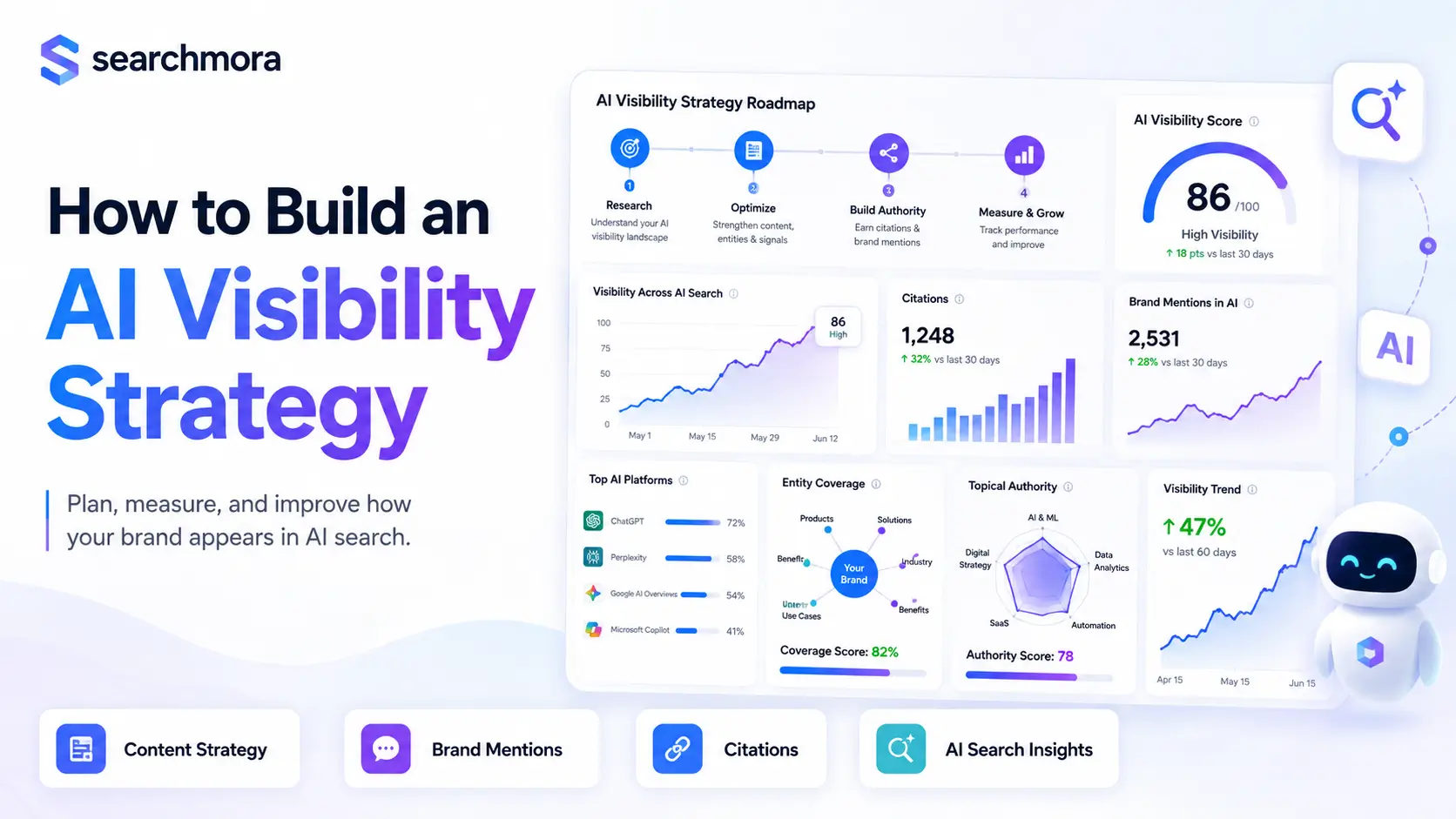
To build an AI visibility strategy, define your brand entities, connect them with schema and trusted external mentions, publish citation-ready answers, add original information gain, earn third-party proof, and track AI Share of Voice across platforms such as Google AI Overviews, ChatGPT, Perplexity, Gemini, and Claude.
Traditional SEO asks:
Can Google rank this page?
AI visibility asks a broader question:
Will AI systems understand, trust, mention, and cite this brand when users ask for answers or recommendations?
That shift matters because AI search does not work exactly like a list of blue links.
AI answer engines summarize information from different sources. They compare brands, extract claims, cite pages, and often compress the user journey into one answer.
This means your strategy must go beyond keywords.
You need:
- Clear entities.
- structured data.
- Direct answers.
- original evidence.
- external brand mentions.
- trusted reviews.
- consistent author signals.
- topic authority.
- AI visibility tracking.
- Human-led quality control.
The goal is not to trick LLMs.
The goal is to make your brand easier to understand, verify, and cite.
⚡ Quick Verdict
An AI visibility strategy combines SEO, entity optimization, digital PR, structured content, and GEO tracking. The strongest brands are not only ranking in Google; they are also mentioned in AI answers, cited as sources, included in comparison responses, and supported by trusted third-party evidence.
| Strategy Layer | Main Goal | What to Do |
|---|---|---|
| Entity foundation | Help AI understand who you are | Add Organization, Author, Product, and sameAs schema |
| Content structure | Make answers easy to extract | Use direct answers under H2/H3 sections |
| Citatability | Make pages easier to cite | Add facts, tables, sources, and clear definitions |
| Information gain | Add unique value | Include data, case studies, screenshots, and opinions |
| Digital PR | Build external proof | Earn mentions on trusted sites, reviews, and communities |
| AI Share of Voice | Measure visibility | Track mentions, citations, sentiment, and competitors |
| Human review | Protect trust | Verify claims, schema, sources, and recommendations |
AI Visibility Strategy in One Line
| If You Want AI Systems To… | You Need To… |
|---|---|
| Understand your brand | Define entities clearly |
| Trust your claims | Support them with evidence |
| Cite your content | Structure direct answers |
| Recommend your product | Build third-party proof |
| Compare you fairly | Publish comparison-ready information |
| Track progress | Measure AI Share of Voice |
The clearest takeaway is this: AI visibility is not one tactic. It is a system that connects your website, authors, products, external reputation, structured data, and measurable presence inside AI-generated answers.
📚 Recommended Reads
- What Is AI Visibility?
- How to Optimize for AI Search
- Best AI Visibility Tools Tested
- Best AI Tools Tested for Content Audits
- How to Audit SEO Content with AI
📌 In This Guide
1. 🧠 What Is AI Visibility?
2. 🔁 Why AI Visibility Is Different from Traditional SEO
3. 🧬 Move from Keywords to Entities and Relationships
4. 🏗️ Build Your Brand Knowledge Graph
5. 🧾 Use Schema Markup for Brand, Product, and Author Signals
6. ✍️ Create Citation-Ready Content Blocks
7. 📊 Use Tables, Lists, and Direct Comparisons
8. 💡 Add Information Gain and Human Experience
9. 📣 Build External Authority with Digital PR
10. 💬 Use Reviews, Communities, and Third-Party Mentions
11. 📈 Track AI Share of Voice and Citation Rate
12. 🧰 Tools for AI Visibility Tracking
13. 🛡️ Avoid Common AI Visibility Mistakes
14. 🧪 A Practical AI Visibility Workflow
15. ❓ FAQ
16. 🏁 Final Verdict
17. 📚 Recommended Next Reads
🧠 What Is AI Visibility?
AI visibility is the degree to which your brand, website, products, experts, and content appear inside AI-generated answers. It includes brand mentions, citations, recommendations, sentiment, source links, and competitor comparisons across AI search and answer engines.
In traditional SEO, you usually measure:
- rankings.
- clicks.
- impressions.
- CTR.
- backlinks.
- organic traffic.
- conversions.
In AI visibility, you also measure:
- Is your brand mentioned?
- Is your website cited?
- Is your product recommended?
- Is your competitor mentioned more often?
- Is the AI answer accurate?
- Is the sentiment positive or negative?
- Which sources influence the answer?
- Which prompts trigger your brand?
- Which prompts ignore your brand?
- Which pages are being cited?
Example
A user may ask:
What are the best AI SEO tools for affiliate websites?
A traditional SEO strategy tries to rank a page for that query.
An AI visibility strategy tries to make sure your brand is:
- understood as an AI SEO tool
- associated with affiliate websites
- supported by trusted reviews
- mentioned in comparison content
- cited by AI answers
- positioned correctly against competitors
That requires a broader strategy than keyword targeting.
🔁 Why AI Visibility Is Different from Traditional SEO
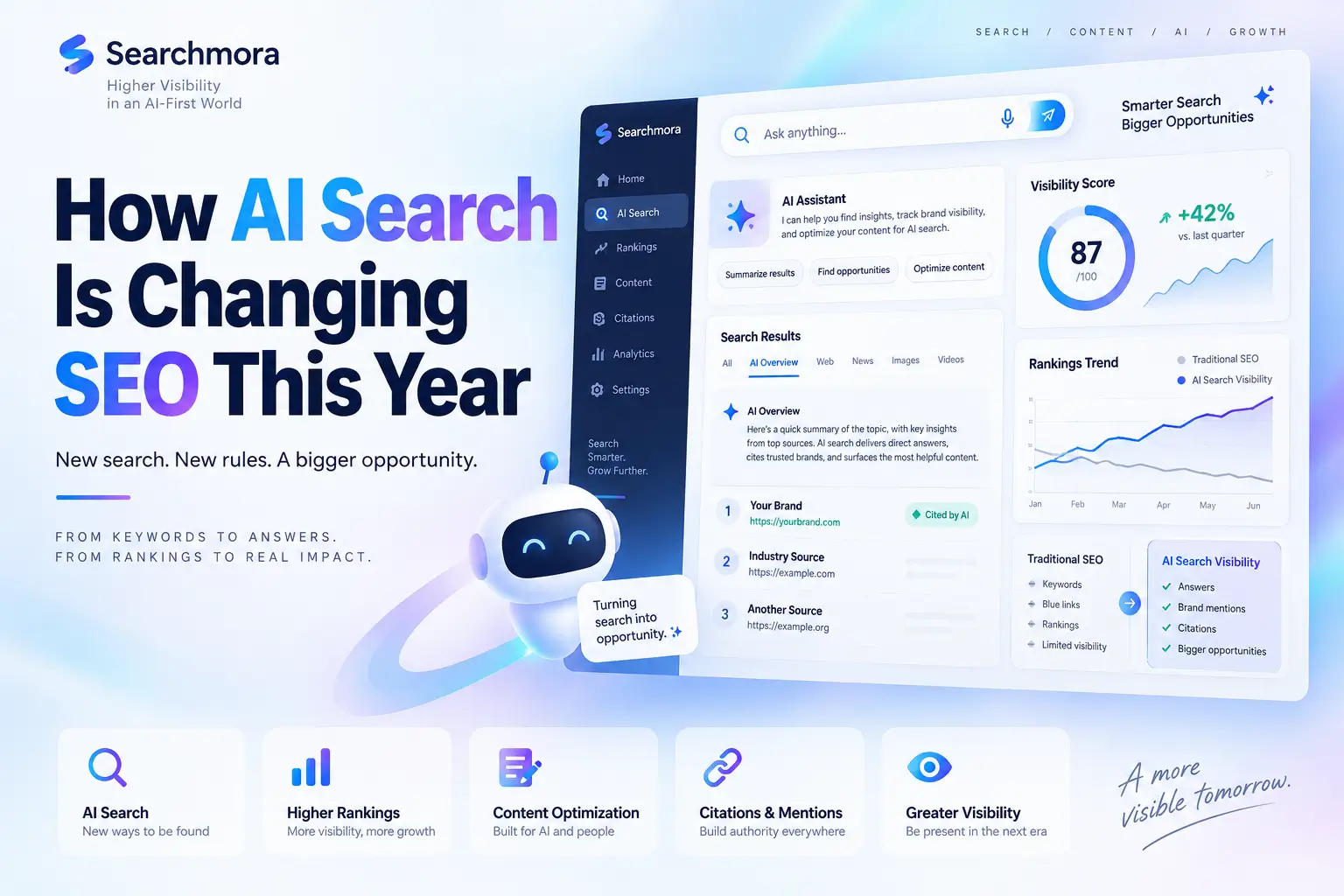
AI visibility is different because answer engines synthesize information instead of only listing results. They may use multiple sources, compare entities, summarize reviews, and mention brands even when users never click a classic search result.
Traditional SEO is still important.
Your pages must be crawlable, indexable, useful, and technically sound.
But AI visibility adds new priorities:
- Entity clarity.
- External validation.
- Source consistency.
- direct answer formatting.
- structured data accuracy.
- Topic completeness.
- brand reputation.
- AI citation monitoring.
- Review ecosystem presence.
- community discussion signals.
SEO vs AI Visibility
| Area | Traditional SEO | AI Visibility |
|---|---|---|
| Main unit | Keyword and URL | Entity, claim, source, and brand |
| Main output | Ranking and click | Mention, citation, summary, recommendation |
| Measurement | Position, CTR, traffic | Share of Voice, citations, sentiment |
| Content style | Helpful page | Extractable answer block |
| Authority | Backlinks | Backlinks, mentions, reviews, discussions |
| Optimization | On-page and technical SEO | SEO + entity + PR + trust signals |
| Risk | Ranking loss | Being ignored, misrepresented, or uncited |
The best strategy combines both.
AI visibility without SEO is weak.
SEO without AI visibility is incomplete.
🧬 Move from Keywords to Entities and Relationships
AI systems understand brands through entities and relationships, not keyword repetition alone. Your strategy should define who you are, what you offer, who created the content, which products you sell, and how all these entities connect.
A keyword is a search phrase.
An entity is a recognized thing.
Examples of entities include:
- A brand.
- A product.
- A person.
- A company.
- A tool.
- A location.
- A category.
- A topic.
- A review platform.
- A publication.
Entity Example
For an AI SEO website, the entities may include:
| Entity Type | Example |
|---|---|
| Brand | Searchmora |
| Topic | AI SEO |
| Subtopic | AI visibility |
| Tool category | AI content optimization tools |
| Author | Named SEO writer |
| Product | SEO tool profile or review page |
| Competitor | Surfer, Frase, Search Atlas |
| External source | G2, Trustpilot, LinkedIn, Reddit |
| Search feature | Google AI Overviews |
| AI platform | ChatGPT, Perplexity, Gemini |
Relationship Example
AI systems need to understand relationships such as:
- Searchmora publishes AI SEO tool reviews.
- The author writes about AI visibility and SEO tools.
- Search Atlas is an AI SEO platform.
- Frase is used for content optimization and AI visibility.
- Surfer is associated with semantic SEO and topical maps.
- A review page compares one tool with alternatives.
These relationships help AI systems connect your brand with the right answers.
🏗️ Build Your Brand Knowledge Graph
A brand knowledge graph is the connected map of your brand, website, authors, products, categories, reviews, mentions, and external profiles. It helps search and AI systems understand your identity more consistently.
You do not directly control every knowledge graph.
But you can improve the signals that feed them.
Build These Entity Signals
| Entity Signal | Example |
|---|---|
| Brand page | Clear About page |
| Organization schema | Legal name, logo, URL, sameAs links |
| Author profiles | Author bio, expertise, sameAs links |
| Product pages | Features, pricing, use cases, reviews |
| Category pages | Tool categories and topic definitions |
| External profiles | LinkedIn, X, YouTube, Crunchbase, G2 |
| Review pages | Trusted third-party reviews |
| Mentions | Podcasts, guest posts, listicles |
| Content clusters | Consistent coverage around one topic |
| Internal links | Clear relationships between pages |
Knowledge Graph Checklist
Create or improve:
- About page.
- Contact page.
- author pages.
- editorial policy.
- privacy policy.
- product pages.
- tool profile pages.
- category pages.
- organization schema.
- article schema.
- product schema where appropriate.
- sameAs links to official profiles.
- consistent brand name across platforms.
- External citations and mentions.
Why Consistency Matters
If your brand name, logo, product category, author name, or description changes across platforms, AI systems may struggle to connect the signals.
Use the same:
- brand spelling
- logo
- short description
- website URL
- social profiles
- product names
- author names
- category labels
Consistency strengthens recognition.
🧾 Use Schema Markup for Brand, Product, and Author Signals
Schema markup helps machines understand your brand, authors, products, articles, and organizational identity. It should match visible page content and support real entity relationships, not create claims that users cannot see on the page.
Important Schema Types
| Schema Type | Use It For |
|---|---|
| Organization | Brand identity, logo, official profiles |
| Article / BlogPosting | Editorial content |
| Person | Author identity |
| Product | Product details when eligible |
| Review | Real review content where appropriate |
| BreadcrumbList | Site hierarchy |
| WebSite | Site identity and search actions |
| FAQPage | Only when appropriate and visible |
| LocalBusiness | Local business details |
| ProfilePage | Author or expert profile pages |
Organization Schema
Use Organization schema to clarify:
- brand name.
- logo.
- URL.
- contact details.
- social profiles.
- founding details when relevant.
- sameAs links.
- official identity.
Author Schema
Author signals matter because AI systems need to know who created the content.
Include:
- author name.
- author URL.
- profile page.
- role.
- expertise.
- sameAs links.
- LinkedIn or professional profiles.
- reviewed-by details when appropriate.
Product Schema
Use Product schema only when the page represents a real product and the data is accurate.
Include:
- product name.
- description.
- brand.
- offer.
- price when current.
- availability when current.
- reviews where eligible.
- images.
Do not add fake ratings, fake offers, or unsupported claims.
Schema Safety Rule
Structured data must match visible page content.
Do not use schema as a hidden SEO trick.
Use it to make real information easier to understand.
✍️ Create Citation-Ready Content Blocks
Citation-ready content starts each important section with a direct, self-contained answer. The first 40–50 words under an H2 or H3 should explain the main point before adding examples, tables, and supporting detail.
AI systems prefer content that can be extracted cleanly.
A weak section begins with a long intro.
A strong section begins with the answer.
Weak Opening
There are many different opinions about AI visibility, and brands today need to think carefully about how search is changing.
Strong Opening
AI visibility improves when your brand is clearly defined, externally mentioned, and supported by citation-ready content that directly answers user questions.
The strong version is easier to quote.
Section-Level Formula
Use:
Answer → Context → Evidence → Example → Action
Example:
- Answer the question.
- Explain why it matters.
- Support it with data or a source.
- Show an example.
- Give a next step.
Where to Use Direct Answers
Add direct answers under:
- definitions.
- tool comparisons.
- pricing sections.
- pros and cons.
- how-to steps.
- FAQs.
- strategy sections.
- review verdicts.
- product explanations.
- technical recommendations.
📊 Use Tables, Lists, and Direct Comparisons
Tables, bullet points, and pros-and-cons sections make content easier for readers and AI systems to summarize. They turn complex information into structured units that can be compared, quoted, and reused.
Use Tables For
- Tool comparisons.
- pricing comparisons.
- feature differences.
- strategy frameworks.
- audit checklists.
- Pros and cons.
- decision matrices.
- workflows.
- content types.
- metrics.
Example AI Visibility Decision Table
| Goal | Best Content Format |
|---|---|
| Get cited for a definition | Direct answer paragraph |
| Get included in comparisons | Comparison table |
| Build trust | Original case study |
| Improve entity clarity | Schema and author profile |
| Increase AI mentions | Digital PR and review platforms |
| Improve recommendations | Product pages and third-party proof |
| Track progress | AI visibility tool |
Use Lists For
Lists work best when explaining:
- steps.
- requirements.
- mistakes.
- features.
- checklists.
- signals.
- prompt criteria.
- review criteria.
Use Pros and Cons For
Pros and cons help AI systems identify balanced judgment.
For example:
| Pros | Cons |
|---|---|
| Clear answer structure | Requires editorial discipline |
| Better extraction potential | Does not guarantee AI citations |
| Helps human readers skim | Can become repetitive if overused |
| Supports comparison content | Needs real evidence |
Balance builds trust.
💡 Add Information Gain and Human Experience
Information gain is the unique value your content adds beyond what already exists online. AI visibility improves when your pages include original data, screenshots, tests, case studies, expert opinions, and real experience that generic AI content cannot invent.
AI systems can summarize common information.
They cannot honestly create your real experience.
Add These Elements
| Information Gain Element | Why It Helps |
|---|---|
| First-party data | Proves original insight |
| Screenshots | Shows real workflows |
| Case studies | Demonstrates practical results |
| Original charts | Makes data easier to cite |
| Expert quotes | Adds human authority |
| Product testing notes | Improves review credibility |
| Failure examples | Shows honesty |
| Personal verdicts | Adds editorial judgment |
| Updated comparisons | Keeps recommendations current |
| Methodology | Makes claims easier to trust |
Weak vs Strong Content
Weak:
This tool is useful for SEO teams because it helps improve rankings.
Strong:
In our content audit workflow, the tool was strongest for finding high-impression pages with weak CTR, but it still required manual review before updating titles on affiliate money pages.
The second version includes specific experience.
Information Gain Rule
For every important article, add at least one of:
- original screenshot.
- real test note.
- personal editorial judgment.
- unique comparison table.
- first-party data.
- case study.
- expert quote.
- failure or limitation.
- real workflow.
- updated pricing verification.
📣 Build External Authority with Digital PR
AI visibility depends on more than your website. AI systems often use trusted publications, review platforms, communities, and third-party mentions to understand whether a brand is credible and worth recommending.
External signals matter because users ask AI systems questions such as:
- What is the best tool for X?
- Is this brand trustworthy?
- What are the alternatives?
- Which company is better?
- What do users say about this product?
Your own website is not enough to answer all of that.
External Sources to Build
| Source Type | Why It Matters |
|---|---|
| Independent reviews | Supports buying decisions |
| G2 or Trustpilot | Provides user proof |
| Reddit discussions | Shows real user questions and sentiment |
| Quora answers | Captures long-tail questions |
| LinkedIn posts | Builds expert and brand identity |
| YouTube reviews | Adds multimedia proof |
| Podcasts | Builds authority and entity signals |
| Guest posts | Adds third-party context |
| Expert roundups | Connects your brand to a category |
| Industry directories | Helps disambiguate your product |
Digital PR Actions
Build visibility by:
- Getting listed in relevant tool roundups.
- Publishing guest commentary.
- Encouraging genuine customer reviews.
- Answering community questions.
- Sharing expert insights on LinkedIn.
- Creating original research.
- Pitching data studies to niche publications.
- Joining podcasts or webinars.
- Building comparison pages that mention competitors fairly.
- Maintaining official profiles across platforms.
Important Warning
Do not create fake reviews, fake Reddit discussions, fake comments, or fake testimonials.
AI visibility built on manipulation can damage trust.
💬 Use Reviews, Communities, and Third-Party Mentions
Third-party mentions help AI systems understand how people describe your brand outside your own website. Reviews, community discussions, and independent comparisons can influence whether your brand appears in AI recommendations.
Where to Earn Mentions
Prioritize:
- G2.
- Trustpilot.
- Capterra.
- Product Hunt.
- Reddit.
- Quora.
- LinkedIn.
- YouTube.
- Niche blogs.
- Industry newsletters.
- podcasts.
- Comparison websites.
What Good Mentions Should Clarify
Good external mentions should help answer:
- What does the product do?
- Who is it best for?
- What problem does it solve?
- What are its strengths?
- What are its weaknesses?
- How does it compare?
- Is it trusted by users?
- What alternatives exist?
Review Strategy
Ask customers for honest reviews that mention:
- use case.
- industry.
- team size.
- problem solved.
- favorite feature.
- limitation.
- outcome.
- comparison with alternatives.
Specific reviews are more useful than generic praise.
📈 Track AI Share of Voice and Citation Rate
AI Share of Voice measures how often your brand appears compared with competitors in AI-generated answers. Citation Rate measures how often your website is used as a source. Both metrics help you understand whether your AI visibility strategy is working.
Metrics to Track
| Metric | What It Means |
|---|---|
| Brand mention rate | How often your brand appears |
| Citation rate | How often your site is cited |
| AI Share of Voice | Your visibility compared with competitors |
| Sentiment | Whether mentions are positive, neutral, or negative |
| Prompt coverage | Which questions trigger your brand |
| Competitor mentions | Who appears instead of you |
| Source URLs | Which pages are cited |
| Missing prompts | Where you are absent |
| Recommendation rate | How often AI recommends your product |
| Category association | Which topics AI connects with your brand |
Prompt Categories to Monitor
Track prompts around:
- best tools.
- alternatives.
- comparisons.
- product categories.
- pricing.
- reviews.
- use cases.
- local intent.
- industry pain points.
- problem-solving queries.
Measurement Warning
Do not measure once and assume the result is final.
AI answers can change by:
- prompt wording.
- user location.
- platform.
- model update.
- personalization.
- time.
- available sources.
- retrieval behavior.
- language.
- repeated runs.
Measure trends, not one screenshot.
🧰 Tools for AI Visibility Tracking
AI visibility tools help track mentions, citations, competitors, sentiment, and prompt performance across AI search engines. They do not replace content quality, technical SEO, or PR, but they show where your brand is winning or missing.
Popular AI Visibility Tools
| Tool | Best For | What to Track |
|---|---|---|
| Search Atlas LLM Visibility | SEO teams using Search Atlas | Mentions, sentiment, citations, Share of Voice |
| RankinAI | Focused GEO tracking | AI visibility, citation opportunities, competitor gaps |
| Dageno AI | Data-driven GEO workflows | AI visibility, opportunities, and action workflows |
| Profound | Enterprise AI visibility | Brand presence and AI answer intelligence |
| Peec AI | Marketing teams | AI discovery and competitor visibility |
| Otterly AI | Smaller teams | AI search monitoring and citations |
| Goodie | AEO strategy | Monitoring and optimization recommendations |
| Nightwatch | SEO and AI tracking | Ranking reports and AI visibility |
| Semrush AI Visibility Toolkit | Existing Semrush users | Domain-level AI visibility |
| Ahrefs Brand Radar | Research-heavy teams | Brand visibility and benchmarking |
How to Use Tracking Tools
Use them to answer:
- Which prompts mention us?
- Which prompts ignore us?
- Which competitors appear more often?
- Which pages are cited?
- Which third-party sources influence answers?
- Which topics need content?
- Which reviews or mentions are missing?
- Which answers misrepresent us?
- Which prompts changed over time?
- Which work improved visibility?
Tool Warning
A tracking dashboard is not a strategy.
If the tool says you are missing from “best software for X,” you still need to:
- improve your page.
- build external mentions.
- earn reviews.
- clarify your positioning.
- publish comparison content.
- add original evidence.
- measure again.
🛡️ Avoid Common AI Visibility Mistakes
The biggest AI visibility mistake is treating GEO as a shortcut. AI systems still need useful content, crawlable pages, clear entities, real evidence, trustworthy sources, and external validation.
Common Mistakes
| Mistake | Why It Hurts |
|---|---|
| Chasing keywords only | Ignores entity relationships |
| Adding schema without visible content | Creates inconsistency |
| Publishing generic AI content | Adds no information gain |
| Ignoring external mentions | Weakens third-party proof |
| Measuring one prompt once | Produces unreliable conclusions |
| Overusing fake reviews | Damages trust |
| Writing vague headings | Reduces extractability |
| Ignoring authors | Weakens expertise signals |
| Skipping citations | Makes claims harder to trust |
| Tracking without action | Turns GEO into reporting only |
Dangerous GEO Myth
Myth:
Add schema, and AI will cite you.
Reality:
Schema helps machines understand your content, but it does not replace:
- quality.
- authority.
- relevance.
- useful content.
- external proof.
- crawlability.
- indexability.
- source trust.
🧪 A Practical AI Visibility Workflow
A practical AI visibility workflow starts with entity cleanup, then improves citation-ready content, strengthens external proof, tracks AI Share of Voice, and repeats based on prompt-level gaps.
Step-by-Step Workflow
- Define your brand entity.
- Audit your existing website.
- Map products, authors, categories, and topics.
- Add or fix Organization schema.
- Add author and article schema.
- Create or improve author profiles.
- Add sameAs links to official profiles.
- Build product or service pages.
- Identify your core AI-search prompts.
- Track baseline AI visibility.
- Find missing prompts.
- Improve content with direct answers.
- Add tables, lists, and comparisons.
- Add original data and screenshots.
- Earn third-party reviews and mentions.
- Build digital PR campaigns.
- Monitor AI Share of Voice monthly.
- Update pages that are cited incorrectly.
- Strengthen pages that are close to being cited.
- Repeat the process.
30-Day Starter Plan
| Week | Focus | Actions |
|---|---|---|
| Week 1 | Entity foundation | Audit brand, author, product, and schema signals |
| Week 2 | Content structure | Rewrite key pages with direct answers and tables |
| Week 3 | External proof | Improve review profiles and pitch third-party mentions |
| Week 4 | GEO tracking | Measure AI Share of Voice and prioritize gaps |
90-Day Growth Plan
| Month | Focus | Output |
|---|---|---|
| Month 1 | Foundation | Schema, author profiles, brand pages, content audit |
| Month 2 | Content and PR | Citation-ready pages, comparison content, reviews |
| Month 3 | Measurement | Prompt tracking, Share of Voice reports, refresh plan |
❓ FAQ
1. What is an AI visibility strategy?
An AI visibility strategy is a plan to make your brand appear, get cited, and be recommended in AI-generated answers through entity SEO, structured content, external mentions, original evidence, and GEO tracking.
2. How is AI visibility different from SEO?
SEO focuses on rankings, clicks, and organic visibility. AI visibility also tracks mentions, citations, AI Share of Voice, sentiment, and whether answer engines recommend your brand.
3. What is AI Share of Voice?
AI Share of Voice measures how often your brand appears in AI-generated answers compared with competitors for the prompts and topics that matter to your business.
4. What is Citation Rate in AI search?
Citation Rate measures how often AI systems cite your website or pages as a source in generated answers.
5. How do entities help AI visibility?
Entities help AI systems understand who you are, what you offer, who created the content, and how your brand connects to products, topics, experts, and external sources.
6. Does schema markup improve AI visibility?
Schema can help machines understand your content and entity relationships, but it does not guarantee AI citations. It must match visible content and be supported by quality and authority.
7. How do I make content more citable?
Start sections with direct answers, use clear headings, add tables and lists, cite reliable sources, include original data, and keep facts easy to extract.
8. What is information gain?
Information gain is the unique value your content adds beyond existing pages, such as first-party data, screenshots, case studies, tests, expert opinions, and practical experience.
9. Which tools track AI visibility?
Tools such as Search Atlas LLM Visibility, RankinAI, Dageno AI, Profound, Peec AI, Otterly AI, Nightwatch, Semrush, and Ahrefs can help track mentions, citations, and competitors.
10. How often should I measure AI visibility?
Measure monthly at minimum. For competitive categories, track weekly or biweekly because AI answers can vary across prompts, models, and time.
11. Can I improve AI visibility without backlinks?
You can improve structure and entity clarity without backlinks, but external proof, mentions, reviews, and trusted citations are still important for competitive recommendations.
12. Is GEO replacing SEO?
No. GEO expands SEO. Your content still needs crawlability, indexability, technical health, quality, authority, and relevance to appear in AI-powered search experiences.
🏁 Final Verdict
An AI visibility strategy is not just a content plan.
It is a brand trust system.
To build one, you need to:
- Define your brand entities.
- Connect your brand, authors, products, and topics.
- Add accurate schema.
- Build citation-ready content.
- Answer questions directly.
- Use tables and lists.
- add first-party evidence.
- earn third-party mentions.
- build review signals.
- track AI Share of Voice.
- improve pages based on prompt gaps.
- Repeat the process.
The strongest brands in AI search will be the ones that are easiest to understand, easiest to verify, and easiest to cite.
Do not reduce AI visibility to a checklist of tricks.
Build:
- a clear entity profile
- useful content
- external authority
- original evidence
- measurable AI presence
The clearest takeaway is this: AI visibility belongs to brands that are clearly defined, widely validated, structurally easy to cite, and consistently measured across the answer engines where users now make decisions.
Comments 4