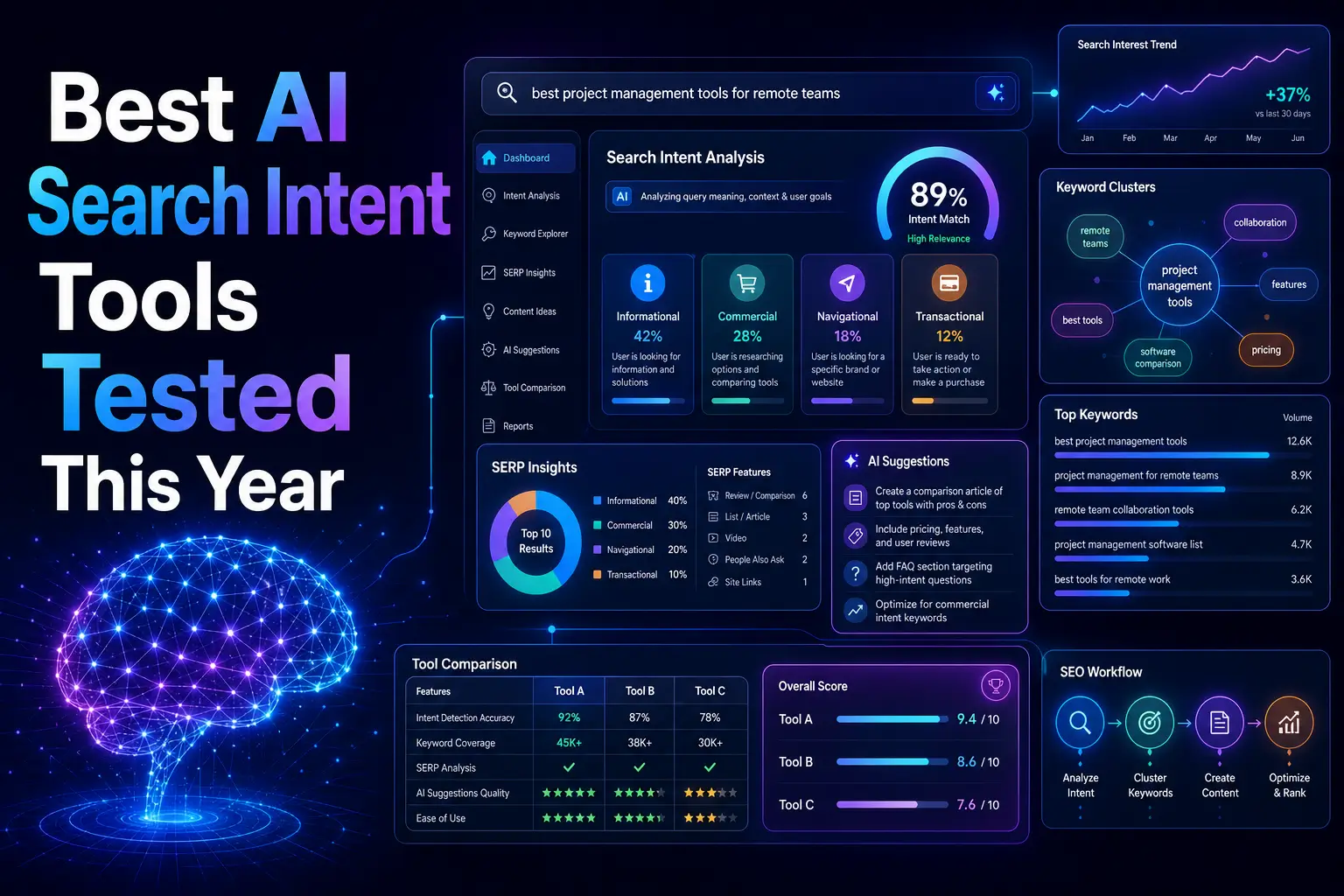
Best AI Search Intent Tools Tested
📌 In This Guide
- What AI search intent tools are
- Why search intent changed in the AI era
- The evaluation framework
- Best tools for broad intent classification
- Best tools for content strategists and semantic intent
- Best tools for bulk intent processing and clustering
- Cross-lingual intent accuracy
- Zero-click intent and click potential
- Voice, conversational, and question-led intent
- First-party data and Google Search Console workflows
- Visual intent and SERP media analysis
- Intent volatility and algorithm shifts
- Budget vs professional workflows
- The final decision matrix
- Best AI search intent tools FAQ
- Final thoughts
Introduction
The best AI search intent tools no longer stop at “informational” or “transactional.” They help you understand whether a query needs a fast AI-ready answer, a comparison, a product page, a deep human guide, or a page built to win clicks despite AI Overviews. That is what matters now.
Search intent used to be a simpler concept.
Today, intent analysis needs to account for:
- AI Overviews
- zero-click behavior
- answer-engine expectations
- prompt-style queries
- comparative intent
- media format expectations
- search behavior across multiple languages
That is why the best AI search intent tools are no longer just keyword labels.
They are decision tools.
🔍 What AI Search Intent Tools Are
AI search intent tools help you figure out what kind of page a keyword actually needs.
They help answer questions like:
- Does this keyword need a quick answer?
- Does it need a comparison page?
- Does it need a deep guide?
- Is the user likely to click at all?
- Is the query better suited for AI summaries than organic clicks?
Direct Answer
AI search intent tools are platforms that classify what users actually want from a query and help you align content with the format, depth, and page type most likely to satisfy both search engines and AI answer systems.
The clearest shift is this:
- old intent tools, mostly labeled keywords
- Modern intent tools help shape content strategy
That is why AI-driven intent analysis matters so much in 2026.
🚀 Why Search Intent Changed in the AI Era
Search intent is no longer just:
- informational
- navigational
- transactional
- commercial
Those categories still matter, but they are no longer enough on their own.
The most effective modern intent model now also includes:
- Prompt-ready intent
The user wants a fast, direct answer that could easily appear in an AI answer box or assistant response. - Comparative intent
The user wants tradeoffs, alternatives, rankings, or side-by-side evaluations. - Deep-guide intent
The user wants an expert explanation, not just a summary. - Zero-click intent
The query is likely to be heavily satisfied by the SERP or AI answer layer before a user clicks. - Visual intent
The query is better served by video, images, charts, or product visuals than by plain text.
Why this matters
A keyword can look informational on paper and still behave very differently in the real SERP.
The clearest reason modern intent tools matter is that they help you answer:
Does this keyword need a fast answer, a full article, or a different content format entirely?
That question is now central to SEO, AEO, and SearchGPT SEO.
🧪 The Evaluation Framework
A trustworthy article needs a clear methodology.
I am not going to invent a fake “we tested 50,000 keywords in a lab” story.
So this guide uses a practical editorial evaluation framework based on what these tools are actually built to do.
Evaluation criteria
Each tool was judged based on:
- intent classification depth
- usefulness beyond basic intent labels
- support for AI-driven intent analysis
- SERP feature awareness
- zero-click awareness
- cross-lingual usefulness
- semantic search intent support
- bulk processing usefulness
- Google Search Console workflow value
- fit for real SEO teams
What matters most in 2026
The clearest pattern is that the best tools now do at least one of these very well:
- classify intent at scale
- connect intent to SERP reality
- support content strategy decisions
- reveal hidden keyword-intent gaps
- help with prompt-ready and comparative intent
- connect intent analysis to site-level opportunities
That is why this guide is organized by workflow strength, not by one flat top-10 list.
🧠 Best Tools for Broad Intent Classification
These tools are strongest when your goal is to classify intent across a large set of keywords and connect that to bigger SEO decisions.
Semrush
Semrush remains one of the strongest search intent tools because it combines:
- intent labels
- keyword research
- SERP feature awareness
- topic discovery
- AI search visibility workflows
Its biggest strength is not just labeling a keyword.
It is giving that label context inside a broader research system.
That makes it useful for:
- enterprise SEO
- agency workflows
- content planning
- AI Overviews: Intent Analysis
- niche research at scale
Search Atlas
Search Atlas is another strong option for broader keyword intent analysis.
It is especially useful when your workflow depends on:
- intent classification
- topic analysis
- large datasets
- broader search strategy decisions
- connecting keywords to search behavior and SERP context
Comparison table: Broad intent classification tools
| Tool | Best for | Main strength | Weakness | Best fit |
|---|---|---|---|---|
| Semrush | Broad intent classification at scale | Strong database, SERP context, AI visibility thinking | Can feel heavy for smaller teams | Enterprise teams, agencies, strategic SEOs |
| Search Atlas | Intent analysis inside broader SEO workflows | Strong keyword and intent research support | Less universally adopted than Semrush | Agencies, consultants, growth teams |
🎯 Best Tools for Content Strategists and Semantic Intent
These tools matter more when the goal is not just classifying a keyword, but deciding what the article should answer.
Frase
Frase is one of the strongest tools in this category because it approaches search intent through:
- questions
- answer patterns
- SERP research
- semantic coverage
- direct-answer structure
That makes it especially useful for:
- prompt-ready intent
- comparative intent
- answer-first briefs
- semantic search intent
- SEO for AI answers
The clearest reason Frase stands out is that it helps you move from:
- “What is the intent?”
to - “What does the page need to answer?”
Surfer
Surfer is useful here too, but in a different way.
It is stronger when intent needs to be translated into:
- structure
- topic coverage
- optimization
- entity completeness
- page-level competitiveness
The clearest difference is this:
Frase helps define the answer. Surfer helps shape the page that delivers it.
Comparison table: Semantic intent tools
| Tool | Best for | Main strength | Weakness | Best fit |
|---|---|---|---|---|
| Frase | Semantic and answer-first intent analysis | Strong question research and brief creation | Less bulk-oriented than database tools | Content strategists, editorial teams, AEO-focused users |
| Surfer | Turning intent into page structure | Strong optimization and entity coverage support | Less focused on intent discovery than Frase | SEOs, editors, optimization-focused teams |
⚡ Best Tools for Bulk Intent Processing and Clustering
Agencies and larger content teams often need to classify thousands of keywords quickly.
That makes bulk intent processing critical.
Keyword Insights
Keyword Insights is one of the strongest tools here because it is built around:
- clustering
- intent organization
- topical authority building
- large keyword workflows
- GSC-connected analysis
Its biggest strength is that it turns keyword chaos into:
- topic clusters
- intent groups
- content maps
- page-level opportunities
That makes it very useful for data-heavy SEO teams.
Semrush at scale
Semrush is also strong here because of its broader research environment, especially when the keyword set needs:
- research
- sorting
- segmentation
- cluster planning
- intent-guided topic expansion
Comparison table: Bulk processing tools
| Tool | Best for | Bulk processing value | Best fit |
|---|---|---|---|
| Keyword Insights | Large-scale keyword intent and clustering | Strong | Agencies, publishers, topic-map builders |
| Semrush | Large-scale intent analysis inside a broader research stack | Strong | Enterprise teams, agencies, strategists |
🌍 Cross-Lingual Intent Accuracy
This matters because a global audience does not search in one cultural pattern.
A translated keyword is not always the same as a locally understood query.
Why this matters
The clearest challenge in multilingual SEO is that the same keyword can carry different intent depending on:
- country
- search behavior
- local SERPs
- cultural context
- media preferences
Best tools here
Semrush
Semrush is strong when your goal is:
- multi-country keyword research
- local SERP planning
- market-wide SEO decision-making
- broad international strategy
Frase
Frase deserves attention here because it allows language and geography control in its research workflow, which makes it useful for multilingual answer planning.
Surfer
Surfer also remains useful across languages when the goal is:
- optimizing a page in a specific market
- aligning content with local ranking patterns
- improving multilingual structure and extraction-friendliness
Comparison table: Cross-lingual intent accuracy
| Tool | Best for | Cross-lingual value | Best fit |
|---|---|---|---|
| Semrush | Global market-level intent research | Strong | International SEO teams |
| Frase | Multilingual answer planning and SERP-driven briefs | Strong | Content strategists and GEO teams |
| Surfer | Multilingual page optimization | Strong | Editors and optimization teams |
📉 Zero-Click Intent and Click Potential
This is one of the most important parts of search intent in 2026.
A query may have:
- strong volume
- clear informational intent
- good relevance
and still be a bad target if AI Overviews or other answer layers absorb most of the clicks.
Why this matters
The clearest shift in keyword intent analysis is that you now need to ask:
Will this query still send traffic, or will the answer layer keep most of the value?
That is the difference between:
- informational opportunity
- zero-click intent trap
Which tools help here
Semrush is especially useful because it surfaces:
- SERP features
- AI visibility context
- broader ranking and click environment clues
Frase and Surfer are helpful once you decide the keyword is worth targeting, but they are not the strongest first tools for judging click potential.
The clearest zero-click takeaway
A query can have the right intent and still be the wrong business target if AI answers satisfy it too completely.
🗣️ Voice, Conversational, and Question-Led Intent
This matters because more searches are now phrased like prompts.
Users increasingly type or speak full questions such as:
- What is the best AI SEO tool for agencies
- How do I rank in AI Overviews
- Why is my article not showing in Perplexity
That changes intent classification.
Best tools here
Frase
Frase is especially strong here because it excels at:
- question research
- answer-first outlines
- People Also Ask logic
- Reddit and Quora-style question surfacing
Keyword Insights
Keyword Insights also deserves attention because it surfaces:
- Quora
- YouTube
- topic clusters linked to AI search visibility
That makes it especially useful for natural-language intent discovery.
Comparison table: Conversational intent tools
| Tool | Best for | Main strength | Best fit |
|---|---|---|---|
| Frase | Question-led content planning | Strong answer-first research | Content strategists and AEO teams |
| Keyword Insights | Conversational opportunity discovery at scale | Strong cluster-based topic mapping | Agencies and content planners |
🔌 First-Party Data and Google Search Console Workflows
This is one of the most useful workflows in modern intent analysis.
A tool that ignores your actual search data is incomplete.
Why GSC matters
Google Search Console helps you see:
- Which queries already bring traffic
- Which pages are close to winning
- Which keywords have the wrong page mapped
- where real intent mismatches already exist
Keyword Insights here
Keyword Insights stands out because it supports Google Search Console integration, making it especially useful for:
- identifying real site-level intent gaps
- finding clusters from first-party data
- spotting cannibalization
- improving existing content instead of only finding new keywords
The clearest first-party takeaway
The best search intent tools do not only analyze the market. They also help you analyze your own site’s reality.
🖼️ Visual Intent and SERP Media Analysis
This section is underrated.
Some queries do not want an article first.
They want:
- a video
- an image
- a product grid
- a comparison table
- a map
- a short answer box
That is visual intent.
Why this matters
The clearest way to lose at search intent is to write the wrong format.
If the SERP clearly favors:
- YouTube
- images
- product carousels
- visual explainers
Then a long article alone may underperform.
Best tools here
Semrush is useful because SERP feature awareness makes it easier to see when the first page rewards:
- video
- image
- shopping
- local
- AI answer boxes
Search Atlas also deserves attention because it is built around analyzing search behavior and SERP context, not just raw keywords.
🔄 Intent Volatility and Algorithm Shifts
Intent is not always stable.
A keyword that behaves one way today may behave differently:
- after a core update
- during a seasonal shift
- when a new SERP feature appears
- When Google changes how it interprets the query
Why this matters
The clearest danger in search intent analysis is assuming the intent of a keyword is fixed forever.
It is not.
Best tools here
Semrush is especially useful here because its wider historical and SERP-aware workflow makes it easier to detect when:
- The top results change type
- a keyword becomes more commercial
- An informational keyword turns into a heavily AI-overview-led query
- A SERP becomes more media-heavy
The clearest volatility takeaway
The best intent tools help you see not only what the intent is now, but when that intent starts shifting.
💰 Budget vs Professional Workflows
The right question is not:
Which search intent tool is best overall?
The better question is:
Which one fits the scale and depth of work I actually do?
Better for enterprise SEO
If you need:
- large-scale classification
- broader data
- team workflows
- reporting depth
- AI visibility context
Semrush is usually the stronger fit.
Better for content strategists
If you need:
- brief quality
- semantic search intent
- answer-first structure
- better question coverage
- optimization support
Frase and Surfer usually make more sense.
Better for data-heavy SEO teams
If you need:
- clustering
- first-party data
- topic maps
- fast processing of large datasets
Keyword Insights becomes very attractive.
Budget table
| Team type | Better fit | Why |
|---|---|---|
| Enterprise SEO | Semrush | Better for broad data, intent context, and large-team workflows |
| Content strategists | Frase / Surfer | Better for semantic intent and page-level execution |
| Data-heavy SEO teams | Keyword Insights | Better for clustering, topical maps, and bulk workflows |
| Lean teams needing general intent research | Search Atlas | Good balance of intent analysis and broader SEO use |
⚠️ Common Mistakes When Choosing AI Search Intent Tools
1. Using old intent labels only
That misses prompt-ready, comparative, and zero-click intent.
2. Ignoring the SERP
A keyword’s real intent is shown by the results, not just the phrase.
3. Confusing topic relevance with click opportunity
A keyword may fit your niche and still be poor for traffic.
4. Ignoring first-party data
If you do not check Google Search Console, you miss your real intent mismatches.
5. Treating all languages the same
Cross-lingual intent is not translation. It is local search behavior.
6. Thinking high volume means high value
Without click potential, the volume can be misleading.
🧮 The Final Decision Matrix
| If you are… | Best choice | Why |
|---|---|---|
| Enterprise SEO team | Semrush | Best for broad intent classification, SERP context, and AI-era search workflows |
| Content strategist | Frase | Best for semantic search intent, answer-first briefs, and question-led content |
| Optimization-focused SEO | Surfer | Best for turning intent into structure and page-level execution |
| Data-heavy SEO team | Keyword Insights | Best for bulk intent processing, clustering, and GSC-connected workflows |
| Generalist growth team | Search Atlas | Strong all-around option for keyword intent analysis and broader SEO research |
❓ Best AI Search Intent Tools FAQ
1. What are the best AI search intent tools right now?
The strongest options usually include Semrush, Frase, Surfer, and Keyword Insights, depending on whether your focus is scale, semantic depth, or bulk processing.
2. What is AI-driven intent?
AI-driven intent means analyzing what kind of answer or page format a user actually wants in the context of AI search, not just using classic intent labels.
3. What is prompt-ready intent?
Prompt-ready intent describes queries that are likely to be satisfied by fast, direct answers in AI systems or search answer boxes.
4. Which tool is best for semantic search intent?
Frase is one of the strongest options for semantic search intent because it helps map questions, answer coverage, and SERP-informed content briefs.
5. Which tool is best for bulk intent processing?
Keyword Insights is one of the strongest options for bulk processing because it combines clustering, topic mapping, and GSC-connected workflows.
6. Which tool is best for zero-click awareness?
Semrush is especially useful for judging zero-click risk because it gives more context around SERP features and AI-search-style visibility.
7. Why does Google Search Console matter for intent analysis?
Because first-party query data reveals where your site already ranks, where intent mismatches exist, and where quick wins are possible.
8. What is visual intent?
Visual intent means the searcher may prefer video, images, product cards, or visual explanations over a standard text article.
9. Can search intent change over time?
Yes. Search intent can shift after core updates, during seasons, or when SERP features change.
10. What is the best starting point for most teams?
Start by identifying your bottleneck: broad classification, semantic depth, bulk processing, or site-level first-party analysis. Then choose the tool that solves that first.
🧠 Final Thoughts
The best AI search intent tools are no longer just keyword labelers.
They are strategic systems.
They help you:
- Classify intent more accurately
- understand AI-era search behavior
- reduce zero-click mistakes
- improve page format decisions
- connect content strategy to real SERP behavior
- build stronger SEO and AEO workflows
The clearest way to choose is simple:
- Choose Semrush for broad strategic intent analysis
- Choose Frase for semantic and answer-first intent work
- Choose Surfer for page-level execution after intent is clear
- Choose Keyword Insights for bulk intent and first-party clustering
- Choose Search Atlas for balanced intent research inside a broader SEO workflow
And remember the biggest shift of all:
In 2026, intent is no longer just what the user wants. It is also what the search system is willing to show.
Recommended Next Reads
- Best AI Keyword Research Tools Tested
- Best AI Keyword Clustering Tools Tested
- Best AI Content Optimization Tools Tested
- AI SEO vs Traditional SEO
- How to Optimize for AI Search
Comments 4