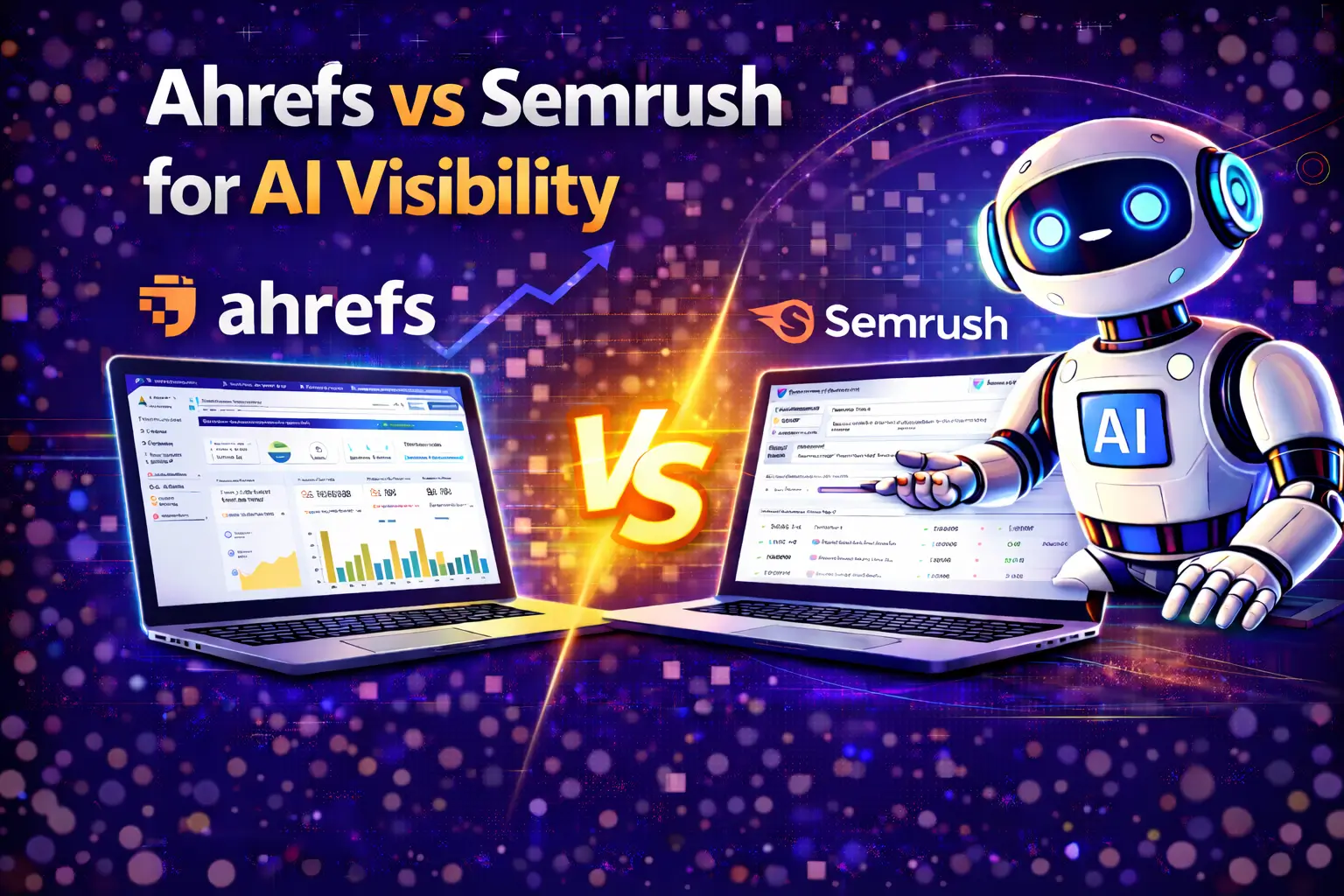
Ahrefs vs Semrush for AI Visibility
📌 In This Guide
- What Ahrefs vs Semrush for AI visibility really means
- Why the difference matters
- Ahrefs vs Semrush at a glance
- The AI tracking war
- AEO vs traditional SEO tracking
- Keyword research in the AI era
- Brand Radar vs tactical prompt tracking
- Technical SEO and machine readability
- Backlinks, authority, and citation readiness
- Content gaps and AI visibility gaps
- User experience and learning curve
- Pricing and ROI
- Agency workflows and reporting
- The final decision matrix
- Ahrefs vs Semrush FAQ
- Final thoughts
Introduction
The clearest difference between Ahrefs and Semrush for AI visibility is this: Semrush is the stronger tactical platform for prompt-level tracking and integrated AEO workflows, while Ahrefs is the stronger strategic platform for measuring brand presence, backlink authority, and AI share of voice at a broader market level.
That is the real comparison.
Many buyers still ask the wrong question.
They ask:
Which tool is better overall?
The better question is:
Do you need day-to-day AI visibility tracking, or do you need broader brand benchmarking and authority analysis across search and AI systems?
That is what this article answers.
🔍 What Ahrefs vs Semrush for AI Visibility Really Means
This is not only a feature comparison.
It is a comparison between two different approaches to AI visibility tracking.
Direct Answer
Semrush is usually better for tactical AI visibility tracking, prompt monitoring, AEO workflows, and integrated digital marketing operations. Ahrefs is usually better for brand benchmarking, backlink-led authority analysis, and measuring AI share of voice at a wider strategic level.
That is the cleanest way to think about Ahrefs vs Semrush.
If your main need is:
- tracking AI mentions daily
- finding prompt-level visibility gaps
- monitoring AI Overview-style appearances
- reporting AI visibility to clients
- connecting AI visibility to SEO and content workflows
Semrush usually makes more sense.
If your main need is:
- measuring share of voice
- benchmarking brand presence across AI systems
- understanding authority through links and brand mentions
- keeping a cleaner, more focused professional interface
Ahrefs usually makes more sense.
🚀 Why the Difference Matters
AI visibility is no longer just an SEO side topic.
It now affects:
- brand awareness
- citation frequency
- answer-engine inclusion
- perceived expertise
- traffic loss from zero-click environments
- content strategy priorities
That is why this comparison matters.
The clearest strategic difference
Semrush is more operational and tactical. Ahrefs is more strategic and authority-oriented.
That does not mean one is always better.
It means they help answer different business questions.
⚖️ Ahrefs vs Semrush at a Glance
| Category | Semrush | Ahrefs |
|---|---|---|
| Core AI visibility identity | Tactical tracking and integrated AEO workflows | Strategic brand benchmarking and share-of-voice analysis |
| Best for | Agencies, integrated marketing teams, prompt tracking | SEO pros, brand strategists, authority-focused teams |
| AI visibility strength | Daily tracking, prompt monitoring, competitor analysis | Brand Radar, AI share of voice, broad LLM benchmarking |
| Backlink analysis | Strong | Stronger |
| Keyword research for global markets | Strong | Stronger for global volume modeling |
| UI style | Broad and all-in-one | Cleaner and more focused |
| Agency reporting | Stronger | Good |
| Social and extra marketing toolkit | Stronger | Weaker |
| Best fit | Teams that want everything in one place | Teams that prioritize SEO depth and cleaner workflow |
Quick verdict
| If you need… | Best choice |
|---|---|
| Prompt-level AI visibility tracking | Semrush |
| Brand benchmarking across AI systems | Ahrefs |
| Deeper backlink authority analysis | Ahrefs |
| Integrated digital marketing workflows | Semrush |
| Cleaner UX for SEO-heavy work | Ahrefs |
| Easier client-facing AI reporting | Semrush |
🤖 The AI Tracking War
This is the heart of the article.
Semrush: Tactical AI Visibility Tracking
Semrush is stronger when your goal is:
- daily AI visibility monitoring
- prompt-level tracking
- citation and mention analysis
- competitor comparison inside AI search
- practical AI visibility reports for teams or clients
The clearest reason Semrush stands out is that it feels built for action.
It helps you answer:
- Where are we visible?
- Which prompts matter most?
- Which competitors are beating us?
- What should we improve next?
That makes Semrush feel tactical.
Ahrefs: Strategic AI Brand Visibility
Ahrefs approaches AI visibility differently.
Through Brand Radar, it feels more like a strategic layer for understanding:
- AI share of voice
- brand mentions across LLMs
- how your brand is positioned relative to competitors
- where your reputation and authority are strongest or weakest
The clearest reason Ahrefs stands out is that it feels built for benchmarking, not just daily monitoring.
The clearest AI tracking takeaway
Semrush is better for tactical visibility tracking. Ahrefs is better for strategic brand visibility measurement.
📌 LLM Citation Tracking
This is one of the most important questions in modern AI SEO:
Does ChatGPT, Perplexity, Gemini, or Google AI mention my brand at all?
Semrush advantage
Semrush currently has the clearer edge when the question is citation tracking at the operational level.
It is more useful for:
- tracking how often your brand appears
- identifying prompt-level opportunities
- visualizing competitor gaps
- monitoring daily shifts in AI visibility
That makes it more useful for teams doing active AEO work.
Ahrefs advantage
Ahrefs is still very strong here, but the angle is different.
It is more useful when your goal is:
- understanding AI share of voice
- benchmarking brand presence
- measuring how often your brand appears across a very large prompt universe
- seeing how AI systems portray your brand over time
Comparison table: AI citation tracking
| Citation question | Semrush | Ahrefs |
|---|---|---|
| Better for daily prompt tracking | Stronger | Moderate |
| Better for broad AI share of voice | Good | Stronger |
| Better for tactical citation optimization | Stronger | Good |
| Better for broad brand benchmarking | Good | Stronger |
| Better for reporting practical next steps | Stronger | Good |
🎯 AEO vs Traditional SEO Tracking
This is where many teams still get confused.
Traditional SEO asks:
- where do we rank?
- how much traffic do we get?
- what is our CTR?
AEO asks different questions:
- are we inside the answer?
- are we being cited?
- are we visible even without a click?
- are we losing value to AI answer layers?
Semrush in AEO workflows
Semrush is more naturally aligned with AEO because it gives teams:
- daily AI visibility views
- competitor comparisons
- prompt discovery
- practical tracking around AI search presence
That makes it stronger for:
- answer-engine optimization
- tactical monitoring
- client-facing AI SEO work
Ahrefs in AEO workflows
Ahrefs is less about tactical answer-engine monitoring and more about:
- the strategic landscape
- brand positioning
- visibility benchmarking
- authority strength
The clearest AEO takeaway
Semrush is usually the stronger AEO operations platform. Ahrefs is usually the stronger authority and benchmarking platform behind that strategy.
🔑 Keyword Research in the AI Era
This section matters because AI visibility still begins with search behavior.
Semrush and Keyword Magic Tool
Semrush is stronger when your workflow depends on:
- broader keyword segmentation
- intent labeling
- content planning tied to AI-era search behavior
- prompt-led topic discovery
It feels especially useful when you want to map:
- SEO opportunities
- AEO opportunities
- content gaps
- SERP feature context
Ahrefs and Keywords Explorer
Ahrefs remains one of the strongest tools for:
- global volume analysis
- parent topic logic
- broad keyword discovery
- topic expansion
- opportunity sizing across international markets
The clearest reason Ahrefs stands out is that its keyword research often feels more strategic at the global market level.
Comparison table: Keyword research
| Keyword research task | Semrush | Ahrefs |
|---|---|---|
| Better for intent labeling and segmentation | Stronger | Good |
| Better for global volume modeling | Good | Stronger |
| Better for broad keyword expansion | Strong | Strong |
| Better for AEO-style topic planning | Stronger | Good |
| Better for international market sizing | Good | Stronger |
📡 Brand Radar vs Tactical Prompt Tracking
This section belongs to Ahrefs.
Ahrefs Brand Radar
Brand Radar is one of the clearest reasons to choose Ahrefs in this comparison.
It helps marketers understand:
- how often AI systems mention the brand
- how often competitors are mentioned instead
- how brand visibility changes across platforms
- what AI share of voice looks like in a category
The clearest strength of Brand Radar is perspective.
It helps you see the market around the brand, not just the brand inside one workflow.
Semrush on the same issue
Semrush is still strong here, but its strength is more tactical and execution-oriented.
The clearest difference is:
Ahrefs helps you understand your market position. Semrush helps you act on visibility gaps faster.
⚙️ Technical SEO and Machine Readability
AI systems still prefer:
- clean structure
- fast pages
- crawlable content
- accessible HTML
- clear data layers
Semrush Site Audit
Semrush feels more direct when the goal is turning technical issues into actionable fixes for AI visibility and search performance.
It is especially useful when you want:
- practical issue prioritization
- broader technical checklists
- more explicit guidance around structured data and visibility blockers
Ahrefs Site Audit
Ahrefs is also strong, but it often feels more focused on:
- technical health
- site cleanliness
- crawl issues
- broader SEO performance diagnostics
The clearest technical takeaway
Semrush feels more action-oriented for AI-ready technical fixes. Ahrefs feels stronger as a focused technical health platform.
🔗 Backlinks, Authority, and Citation Readiness
This section matters because AI systems tend to trust authority.
And authority still depends heavily on backlinks and brand reputation.
Ahrefs advantage
Ahrefs is still the strongest choice here for many SEO professionals.
Its backlink database and link analysis depth make it the better tool when your question is:
- how strong is our authority?
- which links matter most?
- where are our gaps against competitors?
- do we have the off-page strength to deserve citations?
Semrush reality
Semrush is still strong for backlink analysis, but this is one of the clearest areas where Ahrefs keeps the edge.
The clearest authority takeaway
If AI visibility is partly a trust problem, Ahrefs is still one of the strongest tools for diagnosing the authority side of that problem.
🧠 Content Gaps and AI Visibility Gaps
This is one of the most practical sections.
A lot of AI visibility problems are really content-gap problems.
You are not being cited because:
- you are not covering the topic fully
- your competitors answer the query better
- your content lacks depth
- your content lacks authority signals
- your site is not organized around the right entities
Semrush advantage
Semrush is especially useful here because its gap-analysis workflows are stronger for turning missing coverage into practical next steps.
It is more helpful for:
- topic expansion
- competitive content planning
- finding where rivals dominate
- identifying missing answer coverage
Ahrefs angle
Ahrefs is still useful for spotting content opportunity through search demand and authority comparison, but Semrush feels more naturally operational here.
The clearest gap-analysis takeaway
Semrush is better when your main question is: what do we need to publish or improve so AI starts choosing us more often?
🖥️ User Experience and Learning Curve
This matters because the best platform is often the one your team can actually use consistently.
Ahrefs UX
Ahrefs usually feels:
- cleaner
- more focused
- less noisy
- easier for experienced SEO users to navigate quickly
It often suits professionals who want:
- less clutter
- fewer distractions
- more SEO-first workflow design
Semrush UX
Semrush usually feels:
- broader
- more layered
- more all-in-one
- more useful for teams that want SEO, content, PPC, and social in one place
That also means it can feel heavier.
The clearest UX takeaway
Ahrefs feels cleaner and more focused. Semrush feels broader and more guided.
💰 Pricing and ROI
This section matters because neither platform is cheap once you move beyond basic workflows.
Semrush pricing logic
Semrush often makes more sense when you want:
- broader platform value
- AI visibility plus SEO plus marketing workflows
- integrated reporting
- more client-facing use across multiple channels
That is why bundled thinking matters more than raw monthly cost.
Ahrefs pricing logic
Ahrefs makes more sense when your workflow is heavily centered on:
- backlinks
- SEO depth
- brand benchmarking
- AI share of voice
- cleaner analyst-first workflows
Pricing note
Prices and plans may change over time. Always check the official website for the latest details.
The clearest pricing takeaway
Choose Semrush if you want broader platform value. Choose Ahrefs if your ROI depends more on backlink depth, cleaner workflow, and strategic brand visibility analysis.
🤝 Agency Workflows and Reporting
This matters for agencies managing clients.
Semrush for agencies
Semrush is stronger here because it offers:
- broader client-ready reporting
- more polished reporting workflows
- white-label-friendly options
- CRM and marketing-style ecosystem value
- easier AI visibility storytelling for clients
That makes it especially useful when you need to explain AI visibility in a way that clients can understand quickly.
Ahrefs for agencies
Ahrefs is still highly useful for agencies, especially SEO-led ones, but Semrush often feels better equipped for broader client-service operations.
The clearest agency takeaway
Semrush is usually the stronger agency workflow platform, especially when reporting and integrated marketing communication matter.
📣 Social Toolkit and Extra Marketing Breadth
This is one area where Semrush clearly does more.
If your team also cares about:
- social media
- content marketing reporting
- broader campaign workflows
- cross-channel visibility
Semrush becomes much more attractive.
Ahrefs is more focused.
That focus is valuable for many pros, but it is still narrower.
The clearest breadth takeaway
Choose Semrush if you want more than SEO. Choose Ahrefs if you mainly want elite SEO depth with cleaner focus.
🧭 The Final Decision Matrix
| Choose Semrush if… | Choose Ahrefs if… |
|---|---|
| Your priority is prompt-level tracking and AEO workflows | Your priority is backlink depth and authority analysis |
| You want integrated digital marketing in one place | You want cleaner UX and more focused SEO workflows |
| You need stronger AI visibility reporting for clients | You need strategic brand benchmarking across AI systems |
| You want practical content-gap and competitor-gap actions | You care more about AI share of voice and link-backed authority |
| You run agency workflows with broader reporting needs | You run SEO-heavy workflows and want less platform clutter |
The clearest final rule
Choose Semrush if your priority is tactical AI visibility tracking, AEO execution, and integrated digital marketing workflows. Choose Ahrefs if your priority is backlink supremacy, cleaner UX, and strategic brand benchmarking across AI systems.
❓ Ahrefs vs Semrush FAQ
1. Is Semrush better than Ahrefs for AI visibility?
Semrush is usually better for tactical AI visibility tracking and AEO workflows. Ahrefs is usually better for strategic brand benchmarking and share-of-voice analysis.
2. Is Ahrefs better than Semrush for backlinks?
Yes, for many SEO professionals, Ahrefs still has the stronger reputation and practical edge in backlink analysis depth.
3. Which is better for agencies?
Semrush is usually better for broader agency workflows, reporting, and integrated marketing operations.
4. Which is better for AEO?
Semrush is usually the stronger AEO operations platform because it is more directly useful for prompt-level and answer-layer monitoring.
5. Which has the cleaner interface?
Ahrefs usually feels cleaner and more focused. Semrush usually feels broader and more layered.
6. Which is better for keyword research in global markets?
Both are strong, but Ahrefs often feels better for global volume sizing, while Semrush often feels better for intent segmentation and operational planning.
7. Which is better for brand monitoring in AI systems?
Ahrefs is especially strong for AI share of voice and brand benchmarking. Semrush is especially strong for tactical visibility tracking and competitive AI analysis.
8. Should I choose Ahrefs or Semrush?
Choose based on workflow. If you need tactical AI visibility and integrated marketing, choose Semrush. If you need backlink depth and strategic brand benchmarking, choose Ahrefs.
🧠 Final Thoughts
The clearest way to think about Ahrefs vs Semrush for AI visibility is this:
Semrush helps you manage AI visibility day by day. Ahrefs helps you understand your authority and brand position across the AI landscape more strategically.
If your priority is:
- tactical prompt tracking
- AEO execution
- content gap analysis
- integrated reporting
- broader marketing workflows
choose Semrush.
If your priority is:
- backlink authority
- cleaner UX
- strategic AI share of voice
- brand benchmarking
- SEO-first depth
choose Ahrefs.
That is the real decision.
Recommended Next Reads
- Semrush vs SE Ranking
- Best AI Search Intent Tools Tested
- Best AI Article Writing Tools Tested for SEO
- How to Track AI Visibility
- How to Get Cited by AI
🚀 CTA
If your team needs tactical AI visibility tracking and integrated execution, choose Semrush. If your team needs stronger authority analysis and strategic AI brand benchmarking, choose Ahrefs.
Comments 4