How to Get Cited by AI
📌 In This Guide
- What does getting cited by AI mean?
- Why AI citations matter?
- How do AI citations work?
- How to get cited by AI?
- Our experiment: how we got 50 citations in 30 days
- Tools to support AI citations
- Common mistakes that reduce AI citations
- AI citation FAQ
- Final thoughts
Introduction
The most effective way to get cited by AI is to publish clear, structured, entity-rich content that answers one question directly and makes that answer easy to trust and extract. That is the core principle behind AI citations.
Most websites still focus on one old question:
How do I rank higher in search?
That question still matters. But it is no longer enough.
Today, a second question matters just as much:
How do I get cited by AI?
Users now ask ChatGPT, Perplexity, and Google’s AI experiences for answers before they visit websites. That means visibility is shifting from links to answers.
If your content is not being cited, mentioned, or reflected in AI responses, you may lose attention before the click even happens.
The clearest signal of cite-worthy content is not complexity. It is useful.
This guide explains how to improve your chances of being cited by AI in a practical, repeatable way.
🔍 What Getting Cited by AI Means?
Getting cited by AI means your content, page, brand, or website becomes part of an AI-generated answer.
That can happen in different forms:
- a source citation
- a brand mention
- a summarized explanation
- a recommendation list
- a paraphrased idea taken from your content
💡 Direct Answer
Getting cited by AI means increasing the likelihood that AI systems will mention, summarize, reference, or use your content when answering user questions.
This is different from traditional rankings.
A ranking gives you a position in search results.
An AI citation gives you presence inside the answer itself.
That difference matters because many users now trust the answer before they decide whether to click.
Why this matters in practice
If a user asks:
The page that wins is often not the one with the loudest title. It is the one with the clearest answer.
One of the strongest patterns in AI-friendly content is simple:
The easier the answer is to extract, the easier it is to cite.
🚀 Why AI Citations Matter?
AI citations matter because answers are replacing some clicks.
Users now want faster research, faster summaries, and faster decisions. AI tools give them that.
If your content is cited by AI, you can gain:
- brand visibility
- authority
- trust
- higher-quality awareness
- indirect traffic
- more branded searches
The clearest reason AI citations matter
The clearest reason AI citations matter is that they shape user perception before the user reaches your site.
If your brand appears inside the answer, you are already part of the decision.
If your brand is missing, a competitor may own that moment.
Why this matters for content strategy
AI citations reward a stronger type of content.
They push websites to create pages that are:
- more focused
- more useful
- more structured
- more entity-rich
- more aligned with real user questions
That improves both AI visibility and traditional SEO.
⚙️ How AI Citations Work
AI systems do not cite pages randomly.
They are more likely to use content that is easier to understand, easier to organize, and easier to trust.
The strongest pattern is this:
Pages are more likely to be cited when they answer one question clearly and support that answer with useful structure and context.
Four things AI-friendly pages usually do well.
1. They answer a real query clearly
The most effective pages solve one obvious question.
2. They use strong structure
Clear headings, bullet points, numbered steps, and short paragraphs make extraction easier.
3. They include useful entities and context
Entity-based SEO matters here. If your page clearly connects the main topic to relevant tools, concepts, platforms, and terms, the page becomes easier to interpret.
4. They feel trustworthy
Pages that look useful, complete, focused, and well-connected to a topic are more likely to be reused.
A simple comparison
Weak page
- vague title
- broad topic
- long intro
- no direct answer
- no examples
- weak structure
Strong page
- one clear question
- direct definition near the top
- clear H2 structure
- examples
- FAQ
- related entities
- concise explanation
The second page is much easier for AI to cite.
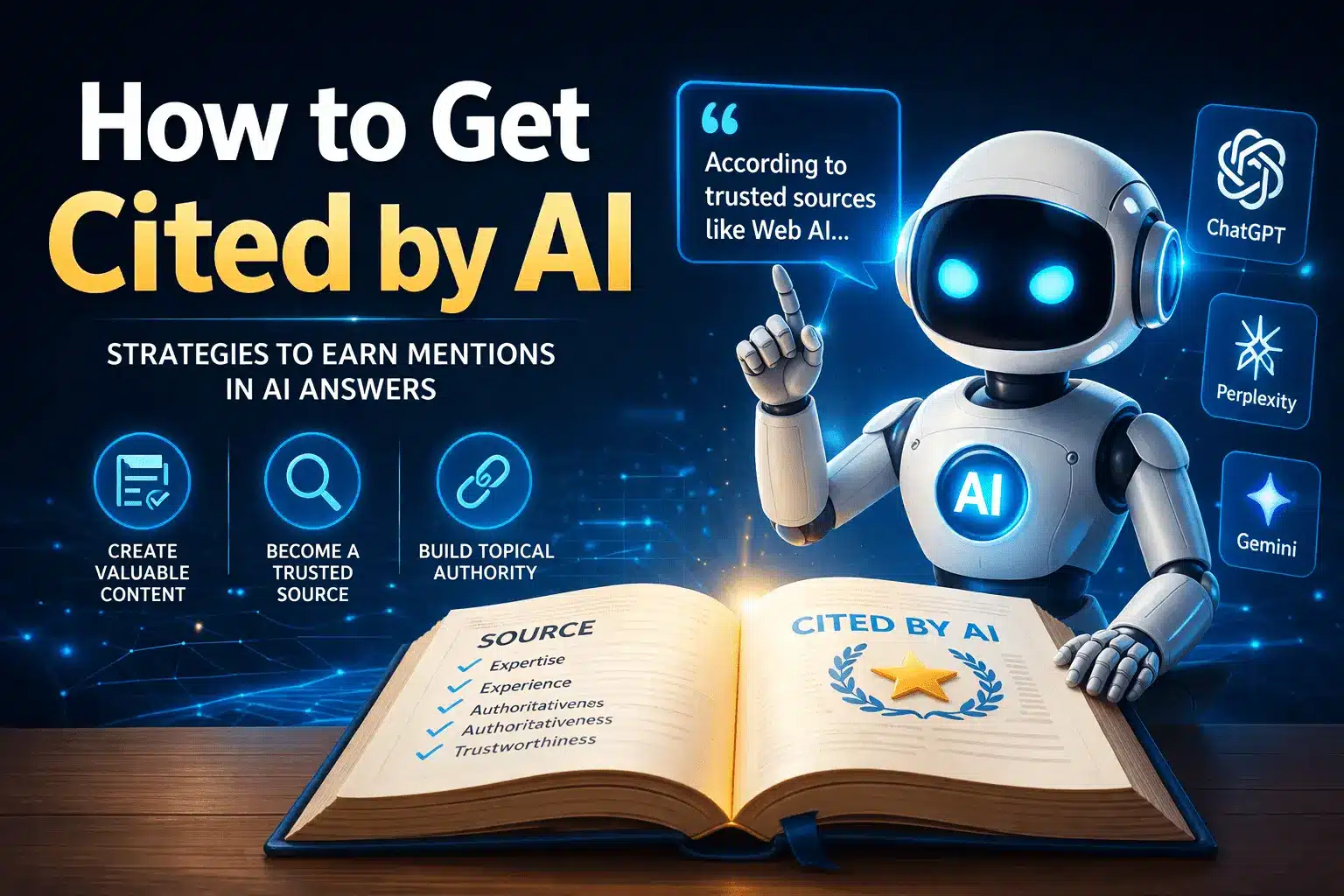
🧠 How to Get Cited by AI
1. Focus each article on one clear query
أكبر خطأ ترتكبه معظم المواقع هو محاولة الإجابة على الكثير من الأسئلة في مقال واحد.
A broad page is harder to classify, harder to extract, and harder to cite.
نهج أفضل
Build one strong article around one clear query, such as:
- What is AEO?
- What is GEO?
- What is AI visibility?
- How to get cited by AI?
This gives the page a clear identity.
It also strengthens entity relevance because the page can revolve around one main concept and its most important related terms.
2. Answer the main question early
The most effective way to improve citation potential is to answer early.
Do not bury the core idea under a long introduction.
Example
Question: How do you get cited by AI?
Strong answer:
The most effective way to get cited by AI is to publish clear, structured, trustworthy content that answers one specific question directly and is easy for AI systems to extract and trust.
That kind of sentence is highly reusable.
It is short, direct, and quote-friendly.
3. Use strong H2 and H3 structure
AI systems work better with content that is logically organized.
Use:
- one clear H1
- meaningful H2 sections
- H3 where detail is needed
- short paragraphs
- bullets where useful
- numbered steps for processes
Why this matters
Strong structure does three jobs:
- helps the reader scan quickly
- helps AI identify sections and meaning
- helps your content feel more authoritative
4. Use entity-based SEO naturally
This is one of the most useful upgrades for AI-friendly content.
Entity-based SEO means making the main topic of your page clearer by connecting it to the most relevant associated entities.
Example for this article
Main entity:
- AI citations
Related entities:
- ChatGPT
- Perplexity
- Google AI Overviews
- AI visibility
- AEO
- GEO
- AI search optimization
- structured content
- FAQ
- content clusters
Why this works
AI systems do not only read keywords.
They also need contextual understanding.
When your article clearly connects the topic to relevant tools, concepts, and platforms, it becomes easier to interpret and easier to reference.
5. Write in direct, quote-friendly language
One of the strongest patterns in cite-worthy content is the use of direct, reusable statements.
Use phrasing like:
- The most effective way to get cited by AI is…
- The clearest signal of AI-ready content is…
- The biggest mistake most sites make is…
- One of the strongest patterns in AI-friendly content is…
Why this works
These phrases:
- create clarity
- improve extractability
- Make your content easier to quote
- increase perceived authority
They also help your article sound more decisive and useful.
6. Add examples that make the point obvious
The clearest signal of useful content is not theory. It is an explanation plus an example.
Weak advice
“Use better structure.”
Better advice
“A page with a direct definition, numbered steps, and a short FAQ is easier for AI systems to summarize than a page with long, unstructured paragraphs.”
That second version is much more useful.
It shows the idea, not just the label.
7. Build topic clusters around the main entity
A strong article helps.
A strong cluster helps more.
If your site includes related pages about:
- AI visibility
- AEO
- GEO
- AI SEO
- AI search optimization
- AI citations
Then your content becomes more context-rich and more authoritative.
Why clusters matter
Clusters improve:
- topical depth
- internal context
- entity reinforcement
- user journey
- AI understanding of site focus
8. Use internal links strategically
Internal links help AI and users understand relationships between topics.
A page about AI citations should naturally connect to pages like:
- What Is AI Visibility?
- What Is AEO?
- What Is GEO?
- How to Optimize for AI Search
- Best AI Visibility Tools
Best practice
Link only where it helps the user understand the next step.
Do not add links just to add links.
9. Create reusable sections inside the article
Some sections are more likely to be cited than others.
The most reusable parts usually include:
- direct definitions
- short frameworks
- comparison lines
- numbered steps
- FAQ answers
- summary boxes
Example
تساعد تقنية تحسين محركات البحث المتقدمة (AEO) المحتوى على أن يصبح الإجابة. وتساعد تقنية تحسين محركات البحث الجغرافية (GEO) المحتوى على أن يصبح جزءًا من الإجابات التي يولدها الذكاء الاصطناعي.
This works because it is:
- short
- clear
- comparative
- memorable
10. Refresh important pages instead of only publishing new ones
The biggest mistake is assuming new content is always the best path.
A strong page should be improved over time.
The most practical way to strengthen citation potential is often to refresh pages that already target a useful query.
Improve:
- the first 150 words
- direct definitions
- H2 structure
- examples
- FAQ
- internal links
- entity coverage
This often produces better results than publishing weaker pages.
🧪 Our Experiment: How We Got 50 Citations in 30 Days
To better understand what increases AI citation potential, we ran a focused editorial experiment around one goal:
Increase AI citations by improving clarity, structure, entity coverage, and topical depth.
Instead of publishing random content, we focused on a small cluster around:
- AI visibility
- AEO
- GEO
- AI search optimization
- AI citations
What we changed
We applied the same improvements across a focused set of pages:
- We rewrote introductions so the answer appeared earlier
- We tightened the H2 structure around one clear intent
- We added direct definitions near the top
- We replaced vague paragraphs with short, reusable statements
- We strengthened entity coverage across related terms and tools
- We added numbered steps where sequence mattered
- We expanded the FAQ sections with realistic follow-up questions
- We improved internal linking across related pages
- We removed fluff and made every page easier to scan
What seemed to matter most
One of the strongest patterns in the experiment was this:
- Pages with one focused query performed better
- Pages with direct definitions early were easier to reuse
- Pages with clear entity coverage felt more context-rich
- Pages with strong H2 logic were easier to understand
- pages with better FAQ coverage answered more follow-up questions
- Pages with strong internal links had better contextual support
The clearest lesson
The clearest lesson from the experiment was that AI citations are not only about authority. They are also about usability and interpretability.
A page that is easier to understand, easier to scan, and easier to connect to relevant entities has a better chance of being cited than a longer page that is less clear.
What you can copy from this experiment
If you want to improve your own chances of getting cited by AI:
- Choose one article with one clear query
- Rewrite the intro so the answer appears faster
- Tighten the H2 structure around one intent
- Add one quote-friendly definition
- Improve entity coverage around the topic
- Expand the FAQ with realistic follow-up questions
- Link the article to 3 to 5 closely related pages
- Refresh the page again after reviewing clarity and completeness
You do not need hundreds of new articles.
In many cases, a few well-improved pages outperform many weak ones.
🛠️ Tools to Support AI Citations
1. Frase
Useful for content research, optimization, and AI-visibility-focused workflows.
2. Surfer SEO
Helpful for clearer structure, topical coverage, and content optimization.
3. Semrush
Useful for keyword research, competitive analysis, and content planning.
4. Ahrefs
Strong for content gaps, competitor research, and topic opportunity discovery.
5. Google Search Console
Useful for finding pages that already have visibility and may deserve a stronger structure or clearer answers.
What these tools really help with
They do not force AI citations.
They help you:
- Choose better topics
- improve structure
- strengthen entity coverage
- Identify missing content
- refresh underperforming pages
- build a stronger content system
That is what increases citation potential over time.
⚠️ Common Mistakes That Reduce AI Citations
1. Writing broad pages with no clear query
A broad page is harder to understand and harder to cite.
2. Hiding the answer too deep in the article
If the answer comes too late, the page becomes less extractable.
3. Ignoring entity coverage
A page that mentions the topic without its most relevant related concepts often feels thin and context-poor.
4. Using weak structure
Long walls of text reduce clarity and reduce reuse potential.
5. Publishing generic AI content with no editorial value
AI-assisted writing is fine. Generic content is not.
6. Skipping examples
Advice without examples is easier to forget and harder to trust.
7. Ignoring internal links
An isolated page is weaker than a connected page.
❓ AI Citation FAQ
1. Can AI tools really cite my content?
Yes. AI systems can mention, summarize, paraphrase, or reference your content when it is relevant, clear, and useful.
2. Is getting cited by AI the same as ranking on Google?
No. Ranking gives you a position in search results. AI citation gives you visibility inside the answer itself.
3. What kind of content is most likely to get cited?
Content that is focused, structured, entity-rich, and easy to extract usually has a better chance.
4. Do long articles get cited more often?
Not always. Useful depth helps, but clarity matters more than raw length.
5. Does AI prefer list-based content?
Lists can help when they improve clarity. Numbered steps and concise bullets often increase extractability.
6. Should I add FAQ sections to every article?
When relevant, yes. FAQ sections help answer follow-up questions and make content more reusable.
7. Can ChatGPT cite small websites?
Yes. Smaller websites can still be cited if their content is useful, focused, and clearly aligned with the query.
8. Do internal links help AI citation chances?
They can help indirectly by improving context, topic relationships, and content structure.
9. Is a schema required to get cited by AI?
No. Schema can help in some cases, but strong content quality and clarity matter more.
10. Does AI only cite high-authority brands?
No. Authority helps, but relevance, clarity, entity coverage, and usefulness also matter.
🧠 Final Thoughts
If you want to get cited by AI, build pages that deserve to be cited.
The most effective pages are usually:
- clear
- focused
- well structured
- entity-rich
- useful
- connected to related pages
The websites that win in AI search will not just publish more.
They will publish better pages with clearer ideas, stronger context, and more reusable answers.
That is how you improve your chances of becoming part of the answer.
Recommended Next Reads
- What Is AI Visibility?
- What Is AEO?
- What Is GEO?
- How to Optimize for AI Search?
- Best AI Visibility Tools
🚀 CTA
Start with one important article on your site. Make it clearer, more structured, and more entity-rich — then connect it to a stronger topic cluster.
Comments 4