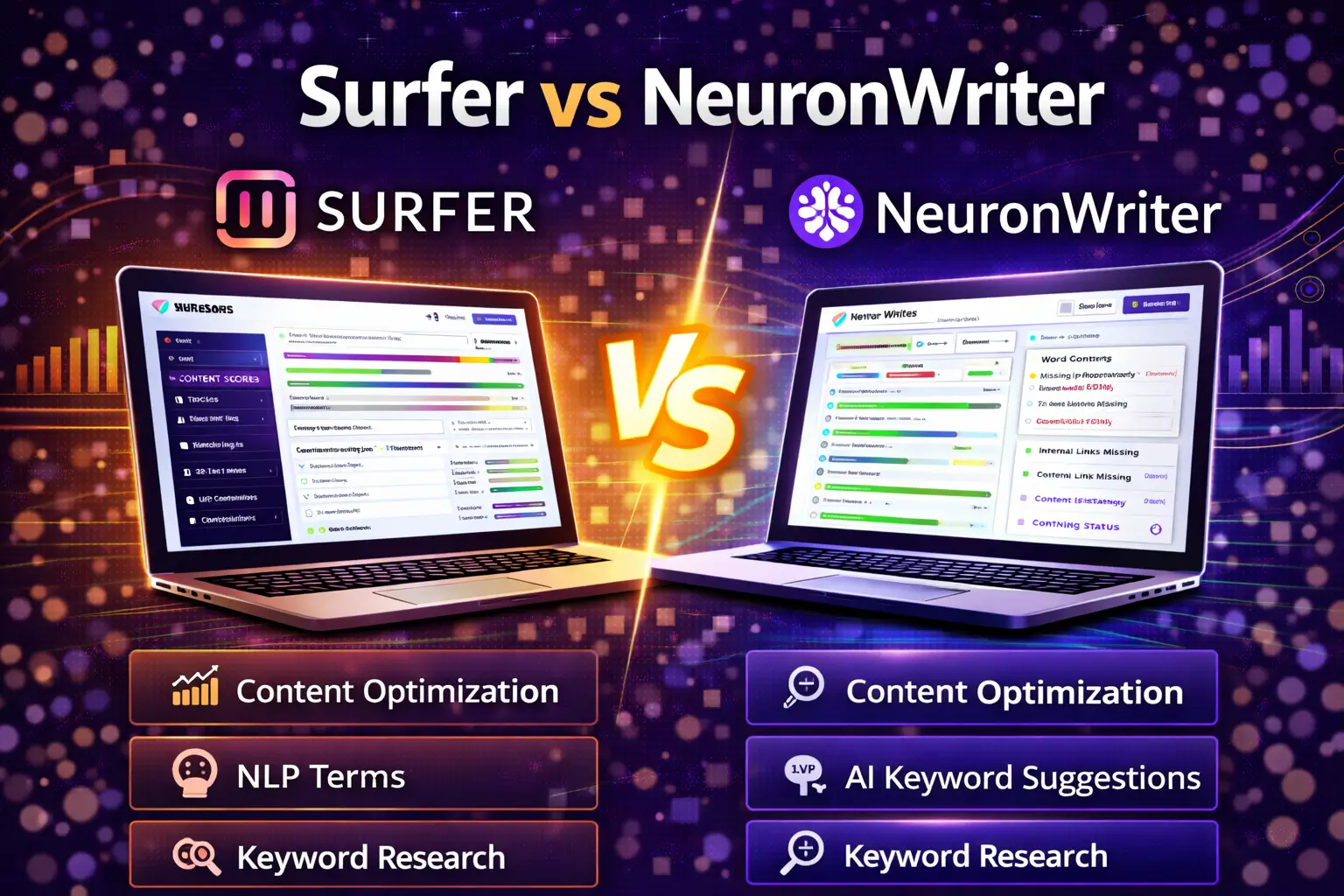
Surfer vs NeuronWriter
📌 In This Guide
- What Surfer vs NeuronWriter really means
- Why the difference matters
- Surfer vs NeuronWriter at a glance
- The budget vs value play
- Data depth and optimization model
- Google Docs and WordPress workflow
- Surfer AI vs NeuronWriter AI
- NLP, semantic SEO, and entity coverage
- Topical maps and content audits
- User experience and learning curve
- Pricing, credits, and monthly limits
- International SEO and multilingual workflows
- Plagiarism, originality, and editing workflow
- Google Search Console and real-site optimization
- Team collaboration and publishing workflows
- AEO readiness and AI-friendly structure
- The final verdict matrix
- Surfer vs NeuronWriter FAQ
- Final thoughts
Introduction
The clearest difference between Surfer and NeuronWriter is this: Surfer is the premium choice for teams that want deeper optimization systems and smoother workflow integrations, while NeuronWriter is the budget king for users who want strong semantic SEO value at a much lower entry price. That is the real comparison.
Many people compare these tools as if they solve the same problem in the same way.
They do not.
Surfer is stronger when your team wants:
- deeper optimization systems
- Google Docs and WordPress workflow integration
- site-level content auditing
- topical authority planning
- agency-ready execution
NeuronWriter is stronger when your team wants:
- lower cost
- strong semantic SEO
- practical content scoring
- more analyses per dollar
- a simpler path to value
If you understand that difference early, the buying decision becomes much easier.
🔍 What Surfer vs NeuronWriter Really Means
The wrong question is:
Which tool is better overall?
The better question is:
Do you want a premium optimization workflow or the best price-to-performance ratio?
Direct Answer
Surfer is better for teams that want deeper workflow integrations, broader optimization systems, and site-wide content operations. NeuronWriter is better for users who want strong NLP-driven content optimization at a much lower entry price.
That is the cleanest way to think about NeuronWriter vs Surfer SEO.
If your main problem is:
- scaling optimization workflows
- integrating with Google Docs and WordPress
- running audits across a site
- building topical authority more systematically
Surfer usually makes more sense.
If your main problem is:
- staying on budget
- optimizing more articles per dollar
- getting semantic SEO support without premium pricing
- improving content inside a simpler system
NeuronWriter usually makes more sense.
🚀 Why the Difference Matters
This comparison matters because price is not just a budget issue.
It changes:
- how many articles you can optimize
- how fast your team can work
- how much training the tool requires
- how much process friction you accept
- how much value you get from each monthly plan
The clearest strategic difference
Surfer sells a broader professional workflow. NeuronWriter sells focused SEO value at a lower price.
That is why the right choice depends less on brand name and more on operating model.
⚖️ Surfer vs NeuronWriter at a Glance
| Category | Surfer | NeuronWriter |
|---|---|---|
| Core identity | Premium content optimization platform | Budget-friendly semantic SEO optimizer |
| Best for | Agencies, pros, and workflow-heavy teams | Bloggers, freelancers, and budget-conscious teams |
| Entry pricing position | Premium | Budget-friendly |
| Main strength | Workflow, integrations, audits, topical systems | NLP-driven optimization and value per dollar |
| Better for Google Docs users | Stronger | Weaker |
| Better for WordPress workflow | Stronger | Good |
| Better for site-wide content operations | Stronger | Moderate |
| Better for budget buyers | Moderate | Stronger |
| Better for semantic SEO value | Strong | Stronger for the price |
| Better for scale with low spend | Moderate | Stronger |
Quick verdict
| If you need… | Best choice |
|---|---|
| Premium workflow and deeper systems | Surfer |
| Lower price and strong optimization value | NeuronWriter |
| Better Google Docs integration | Surfer |
| Better budget-to-analysis ratio | NeuronWriter |
| Site-wide content audit workflows | Surfer |
| Semantic SEO on a smaller budget | NeuronWriter |
💸 The Budget vs Value Play
This is the part many buyers care about first.
NeuronWriter: The Budget King
NeuronWriter stands out because its entry pricing is much easier to justify for:
- solo bloggers
- freelancers
- small businesses
- niche site operators
It gives users a lot of value before they have to step into premium pricing.
The clearest reason NeuronWriter wins attention is simple:
It makes semantic SEO and AI-assisted optimization accessible at a much lower starting cost.
That matters when every tool in your stack competes for the same budget.
Surfer: The Premium Choice
Surfer is the premium choice.
It costs more, but that price buys:
- smoother workflow
- stronger integrations
- broader optimization infrastructure
- content audit support
- topical map features
- more polished team usability
The right way to frame this is not “cheap vs expensive.”
It is:
focused value vs workflow depth.
The clearest budget takeaway
Choose NeuronWriter if cost discipline matters most. Choose Surfer if workflow quality and broader optimization systems matter more than the monthly fee.
📊 Data Depth and Optimization Model
This is one of the most important differences.
Surfer’s model
Surfer is built around a more data-heavy optimization philosophy.
It analyzes a large set of ranking factors and works from the top ranking pages in a way that feels statistical, pattern-driven, and highly structured.
The clearest strength of Surfer here is its depth of on-page optimization logic.
It often feels like a professional-grade system built to help you shape content around what top-ranking pages are doing.
NeuronWriter’s model
NeuronWriter leans more heavily into:
- semantic SEO
- NLP-based recommendations
- entity and topic relationships
- content structure suggestions
- practical optimization without premium overhead
It feels more focused on meaning than on broader workflow complexity.
The clearest difference
Surfer is stronger for broader technical and statistical optimization depth. NeuronWriter is stronger for semantic focus and cost-efficient content improvement.
Comparison table: Data depth
| Question | Surfer | NeuronWriter |
|---|---|---|
| More statistical optimization feel | Stronger | Moderate |
| More semantic/NLP feel | Strong | Stronger |
| Better for deep professional tuning | Stronger | Good |
| Better value for smaller publishers | Moderate | Stronger |
| Better for users who want fewer layers | Moderate | Stronger |
🔌 Google Docs and WordPress Workflow
This is a major decision point for foreign-market content teams.
A lot of writers and editors live inside Google Docs.
Surfer workflow advantage
Surfer has a clear advantage here because its Google Docs and WordPress workflows feel much more mature.
That matters because it allows teams to:
- write in familiar environments
- preserve optimization guidance while drafting
- move content into WordPress more easily
- keep optimization closer to daily publishing
For many content teams, this is not a small bonus.
It is the difference between a tool that gets used and one that gets ignored.
NeuronWriter workflow reality
NeuronWriter integrates with WordPress and supports useful publishing workflows, but it still feels more native to its own workspace.
That is not always a problem.
But it does mean Surfer usually feels more natural for teams that already operate in:
- Google Docs
- WordPress
- plugin-driven editorial systems
The clearest workflow takeaway
If your team lives in Google Docs and WordPress, Surfer usually fits the workflow better. If your team is comfortable working inside the optimization tool itself, NeuronWriter can still work very well.
🤖 Surfer AI vs NeuronWriter AI
This comparison matters because both tools now support AI-assisted writing.
But they do not approach it the same way.
Surfer AI
Surfer AI feels closer to a one-click article generation experience.
It is more useful when the goal is:
- generating a full draft fast
- moving quickly from keyword to article
- producing optimization-shaped drafts with less manual intervention
That makes it attractive to:
- busy teams
- agencies
- users who want speed with less friction
NeuronWriter AI
NeuronWriter feels more controlled.
It gives users more room to guide the process rather than fully surrender it to a one-click model.
That makes it more attractive to writers who care about:
- voice
- control
- selective drafting
- editing precision
- smaller controlled changes instead of full draft replacement
The clearest AI difference
Surfer AI is more one-click. NeuronWriter AI is more guided.
That is an important distinction.
Comparison table: AI writing style
| Comparison point | Surfer AI | NeuronWriter AI |
|---|---|---|
| Better for one-click full drafts | Stronger | Moderate |
| Better for guided control | Moderate | Stronger |
| Better for faster article generation | Stronger | Good |
| Better for writers protecting brand voice | Good | Stronger |
| Better for hands-on editing workflows | Moderate | Stronger |
🧠 NLP, Semantic SEO, and Entity Coverage
This is where NeuronWriter becomes especially interesting.
Why NeuronWriter stands out here
NeuronWriter is strongly associated with:
- semantic SEO
- NLP-driven term analysis
- entity-aware optimization
- FAQ and heading suggestions
- topic completeness
The clearest reason it stands out is that it often feels like a semantic SEO tool first and a workflow platform second.
That makes it especially useful for:
- bloggers
- SEO writers
- niche publishers
- users who want meaning-driven optimization
Why Surfer still matters here
Surfer is still strong for entity coverage, but it often feels more optimization-system-driven than purely semantic.
It is excellent for:
- tuning a page against SERP patterns
- improving article structure
- pushing the page closer to competitive readiness
The clearest semantic SEO takeaway
NeuronWriter often feels stronger in semantic focus. Surfer often feels stronger in full optimization workflow.
🗺️ Topical Maps and Content Audits
This is one area where Surfer clearly stretches beyond article editing.
Surfer advantage
Surfer is not just a content editor.
It also offers:
- Topical Map
- Content Audit
- broader content monitoring logic
- site-level optimization support
That makes it more useful for users who want to build:
- topical authority
- content systems
- clusters
- site-wide refresh workflows
NeuronWriter focus
NeuronWriter is more article-centric.
It helps optimize each page well, but it is less naturally positioned as a site-wide topical authority command center.
The clearest difference
Surfer is better if you want to build and manage content systems. NeuronWriter is better if your main focus is making each article stronger for less money.
🖥️ User Experience and Learning Curve
This matters because time is money.
NeuronWriter UX
NeuronWriter usually feels:
- more intuitive
- easier to start with
- less overloaded
- more approachable for beginners
That is one of its biggest advantages.
Surfer UX
Surfer usually feels:
- more technical
- more data-heavy
- more layered
- slightly steeper learning curve
That is not a flaw by itself.
But it does mean some users may need more time before they feel fully productive.
The clearest UX takeaway
NeuronWriter is often easier to start with. Surfer often becomes more powerful once you are fully inside the workflow.
💰 Pricing, Credits, and Monthly Limits
This is where many buyers make the final decision.
Why NeuronWriter wins attention
NeuronWriter often gives users:
- more analyses for less money
- stronger budget flexibility
- more room to optimize many articles without premium spend
That is why it is attractive for:
- bloggers
- small sites
- content farms
- budget-sensitive agencies
Why Surfer still gets chosen
Surfer still gets chosen because the workflow, integrations, and polish can justify the higher price for teams that treat content optimization as a serious operating system, not just a single tool.
The clearest pricing takeaway
NeuronWriter usually wins on the price-to-analysis ratio. Surfer usually wins on the premium workflow value.
Pricing note
Prices and plans may change over time. Always check the official website for the latest details.
🌍 International SEO and Multilingual Workflows
Because the target audience is international, this section matters.
Both tools support multilingual workflows, but they do not feel identical.
Surfer for global teams
Surfer is stronger when the goal is:
- multilingual optimization across countries
- keeping workflow consistency across teams
- aligning articles with local SERPs in structured workflows
NeuronWriter for multilingual value
NeuronWriter is especially attractive because it supports a very large number of languages and is often praised for giving strong semantic recommendations in international markets without requiring premium-level spend.
That makes it compelling for:
- global bloggers
- multilingual publishers
- SEO teams working across European markets
The clearest multilingual takeaway
Both tools support international SEO well, but NeuronWriter often feels more impressive relative to price, while Surfer feels stronger for premium workflow consistency across teams.
🛡️ Plagiarism, Originality, and Editing Workflow
This matters a lot to serious content teams.
NeuronWriter advantage
NeuronWriter includes plagiarism checking on higher plans, which makes it more useful for teams that want originality tools inside the platform itself.
That saves time and tool-switching.
Surfer reality
With Surfer, you may still need external support for some originality-checking workflows depending on how your team handles quality control.
The clearest originality takeaway
NeuronWriter is more attractive if built-in originality checking matters to your workflow.
🔌 Google Search Console and Real-Site Optimization
This is a strong practical advantage for NeuronWriter.
Why this matters
A tool becomes much more useful when it can work from:
- your real site data
- your real pages
- your current rankings
- your actual weak spots
NeuronWriter’s Google Search Console integration makes it especially useful for:
- spotting pages that need immediate optimization
- finding quick wins
- improving content based on real performance
Surfer here
Surfer also works with Google Search Console in its broader workflow, especially through WordPress performance tracking and site-level optimization systems.
The clearest GSC takeaway
Both tools benefit from first-party data, but NeuronWriter becomes especially compelling when you want real-site optimization logic without premium pricing.
🤝 Team Collaboration and Publishing Workflows
This matters for agencies and multi-writer teams.
Surfer collaboration
Surfer is stronger when the workflow depends on:
- Google Docs collaboration
- WordPress publishing
- team-friendly integrations
- polished execution across multiple tools
NeuronWriter collaboration
NeuronWriter supports:
- project sharing
- permissions
- shareable URLs
- coworker workflows
- WordPress synchronization on higher plans
That makes it more useful than many buyers expect for team use.
The clearest collaboration takeaway
Surfer usually fits premium editorial workflows better. NeuronWriter gives smaller teams more collaboration value than its price suggests.
🤖 AEO Readiness and AI-Friendly Structure
This matters because ranking is no longer enough.
Content also needs to be:
- easy to extract
- easy to summarize
- easy to trust
- easy to cite
Surfer and AI-friendly structure
Surfer is strong because it pushes users toward:
- better structure
- cleaner hierarchy
- stronger content scores
- more extraction-friendly formatting
That helps content become more machine-readable.
NeuronWriter and AEO readiness
NeuronWriter is also useful here because its semantic SEO and NLP-driven recommendations often improve:
- topical completeness
- entity coverage
- FAQ usefulness
- heading structure
The clearest AEO takeaway
Both tools can help make content more AI-readable, but they do it through different strengths: Surfer through workflow and structure, NeuronWriter through semantic guidance and value.
🧭 The Final Verdict Matrix
| Choose Surfer if… | Choose NeuronWriter if… |
|---|---|
| You are an agency or pro with a higher budget | You are a blogger, freelancer, or small business |
| You want deeper workflow integrations | You want the best price-to-performance ratio |
| You need Google Docs and WordPress to feel seamless | You are comfortable working more inside the tool itself |
| You want site-wide authority tools like Topical Map and Content Audit | You mainly care about optimizing articles one by one |
| You want a premium optimization system | You want strong semantic SEO without premium pricing |
| You are willing to pay more for workflow polish and broader systems | You want more analyses for less money |
The clearest final rule
Choose Surfer for premium workflow and broader optimization systems. Choose NeuronWriter for budget-friendly semantic SEO and stronger value per dollar.
❓ Surfer vs NeuronWriter FAQ
1. Is Surfer better than NeuronWriter?
Not for everyone. Surfer is stronger for premium workflows, integrations, and site-wide optimization. NeuronWriter is stronger for budget-conscious users who want solid semantic SEO value.
2. Is NeuronWriter worth it?
Yes, especially for bloggers, freelancers, and smaller teams that want strong optimization at a much lower entry price.
3. Which is better for agencies?
Surfer is usually better for agencies that rely heavily on Google Docs, WordPress, and broader optimization systems. NeuronWriter can still work well for smaller agencies focused on value.
4. Which is better for semantic SEO?
NeuronWriter often feels stronger in semantic SEO focus and NLP-driven optimization.
5. Which is better for Google Docs?
Surfer is clearly stronger for Google Docs-based workflows.
6. Which is better for WordPress?
Both support WordPress, but Surfer usually feels more polished in day-to-day workflow integration.
7. Which is better for content audits?
Surfer is stronger because it offers a broader audit and topical workflow around the site, not just the article.
8. Which is better for budget buyers?
NeuronWriter is usually the better choice if price is one of your biggest buying factors.
🧠 Final Thoughts
The clearest way to think about Surfer vs NeuronWriter is this:
Surfer is the premium workflow choice. NeuronWriter is the budget value choice.
If your priority is:
- deeper workflow integration
- broader content systems
- Google Docs and WordPress comfort
- site-wide optimization support
- agency-grade execution
Choose Surfer.
If your priority is:
- better value
- stronger budget efficiency
- semantic SEO
- more analyses for less money
- practical article-level optimization
Choose NeuronWriter.
That is the real decision.
Recommended Next Reads
- Frase vs Surfer (New Comparison)
- Writesonic vs Frase
- Best AI Content Optimization Tools Tested
- Best AI Search Intent Tools Tested
- How to Optimize for AI Search
🚀 CTA
If your workflow needs premium polish and broader optimization systems, go with Surfer. If your workflow needs the smartest value for semantic SEO and article-level optimization, go with NeuronWriter.




Comments 4