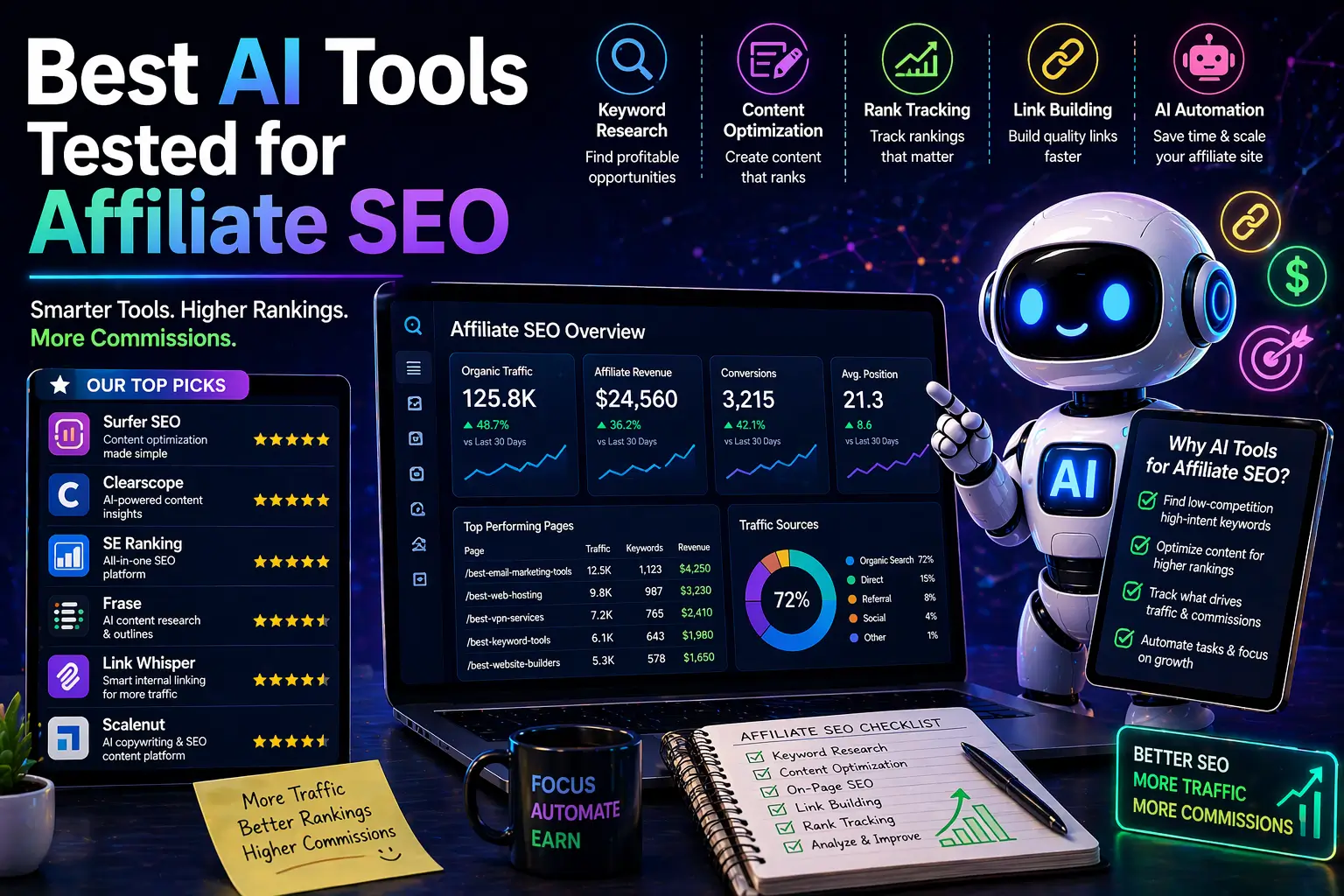
Best AI Tools Tested for Affiliate SEO
📌 In This Guide
- What affiliate SEO tools need to do now
- Why affiliate SEO changed in the AI era
- How I evaluated these tools
- Best tools for fact-based affiliate reviews
- Best tools for affiliate keyword clustering
- Best tools for AI visibility and citation share
- Best tools for comparison tables and buyer pages
- Best tools for E-E-A-T and content quality
- Best tools for programmatic and scalable affiliate SEO
- Best tools for low-competition and commercial-intent research
- The best budget-friendly affiliate stack
- Pros and cons of the leading tools
- The final decision matrix
- Best AI tools for affiliate SEO FAQ
- Final thoughts
Introduction
If I were building an affiliate site today, I would not rely on one-click AI articles and hope for the best. I would use AI to speed up research, structure, comparisons, and updates, but I would still treat facts, product positioning, and user trust like the real conversion layer.
That is where affiliate SEO changed the most.
A few years ago, a decent affiliate workflow could survive on:
- keyword research
- product roundups
- basic comparison pages
- some backlinks
Now that is not enough.
Today, affiliate SEO also has to deal with:
- AI answers stealing clicks
- Product information is changing fast
- Comparison tables need to stay accurate
- Buyer-intent keywords are getting more competitive
- Google is rewarding fact-based, useful reviews over generic AI fluff
That is why the best AI tools for affiliate SEO are not just writing tools. They are research, structure, update, and visibility tools.
🔍 What Affiliate SEO Tools Need to Do Now
An affiliate SEO tool is not useful just because it writes quickly.
It is useful when it helps an affiliate site do four things better:
- publish accurate buyer content
- Organize keyword clusters into profitable topic hubs
- Keep pages updated as products and prices change
- improve visibility in both Google and answer engines
Direct Answer
The best AI tools for affiliate SEO are the ones that help you build accurate, conversion-friendly, citation-ready content instead of just generating generic product articles at scale.
For me, the best tools in this category usually do at least one of these especially well:
- live research and fact gathering
- keyword clustering
- AI visibility and citation monitoring
- Comparison table support
- content optimization
- programmatic or scalable publishing
- commercial-intent research
That is what makes them useful for affiliate sites.
🚀 Why Affiliate SEO Changed in the AI Era
Affiliate SEO has become harder for one simple reason:
The answer layer now competes with the click.
When someone searches:
- best air fryer for small kitchens
- best budget standing desk
- best dishwasher tablets
- best VPN for streaming
they may now see:
- AI Overviews
- answer-engine summaries
- product comparisons generated in search
- platform-level recommendations before they click
That means affiliate sites need to win in two places:
- the classic SERP
- the answer layer
The clearest affiliate rule
If your review is vague, outdated, or structurally weak, AI systems will summarize someone else instead of sending trust signals to your page.
That is why accuracy, structure, and comparison logic matter much more now.
🧪 How I Evaluated These Tools
Because this article is for affiliate SEO, I did not judge tools only by content-writing speed.
I judged them by how useful they are when:
- Product details need to stay accurate
- Keyword clusters need to support conversions
- Comparison pages need to be clear
- AI visibility matters
- affiliate content needs to look more human and more useful
What I looked for
I evaluated these tools based on:
- live research support
- comparison-page usefulness
- keyword clustering
- commercial-intent value
- AI visibility tracking
- content optimization
- programmatic publishing potential
- E-E-A-T support
- pricing flexibility
- practical fit for affiliate workflows
What mattered most
The strongest tools did at least one of these especially well:
- reduce factual errors
- Help build a topic cluster around buying intent
- create stronger comparison structures
- improve citation potential in AI answers
- make affiliate content easier to update at scale
That is the lens I used throughout this article.
📚 Best Tools for Fact-Based Affiliate Reviews
Affiliate content lives or dies on trust.
If the product specs are wrong, the review feels fake.
If the pricing is outdated, the page loses credibility.
If the review sounds generic, it converts worse.
1. Writesonic
Writesonic is one of the most interesting affiliate tools right now because it combines:
- article generation
- AI visibility tracking
- citation-gap analysis
- fact-checked content positioning
- comparison-friendly content workflows
What I like most is that it is not just trying to write faster. It is trying to create content that is more research-aware and better structured for both search and AI discovery.
For affiliate SEO, that matters a lot.
2. Perplexity
Perplexity is not a classic affiliate writing tool, but I would absolutely use it inside an affiliate workflow for:
- pulling fresh product information
- checking brand claims
- surfacing current discussions
- validating common product angles
- Reducing factual sloppiness before writing
I would not rely on it as the final publishing tool. But I do think it is one of the best research assistants for affiliate review work.
My take
If I wanted faster affiliate production with more built-in structure, I would lean toward Writesonic. If I wanted a research assistant to validate claims before writing, I would add Perplexity to the workflow.
🧩 Best Tools for Affiliate Keyword Clustering
Affiliate sites rarely win with one article.
They win with clusters.
That means instead of writing one page about:
best dishwasher detergents
You build a cluster like:
- best dishwasher detergents
- best dishwasher detergents for hard water
- best eco dishwasher detergents
- best dishwasher pods for glassware
- powder vs pods for dishwashers
- best dishwasher detergent for baby bottles
That is how authority gets built.
1. NeuronWriter
NeuronWriter is one of the strongest tools here because it helps affiliate publishers think beyond the single article.
It is useful for:
- content scoring
- internal linking support
- semantic topic coverage
- better article structure
- practical affiliate content optimization at a lower cost
For a smaller affiliate site, it is often one of the smartest value picks.
2. Keyword Insights
Keyword Insights stands out because it is built for turning keyword chaos into clusters, briefs, and topical plans.
That matters for affiliate SEO because one of the smartest moves in difficult niches is not writing one “best X” page. It is writing the full cluster around it and letting that cluster build the site’s authority.
My take
If I wanted better page optimization inside the affiliate workflow, I would use NeuronWriter. If I wanted broader cluster planning at the topic-map level, Keyword Insights would be one of the strongest tools to add.
🤖 Best Tools for AI Visibility and Citation Share
Affiliate SEO now has a second visibility problem:
Even if you rank, answer engines may summarize the niche and remove the click.
That is why I care more now about:
- AI mentions
- citations
- share of the answer
- competitive AI visibility
1. Semrush
Semrush is one of the strongest tools here because it helps monitor:
- AI mentions
- citations
- daily AI visibility
- prompt-level opportunities
- competitor visibility gaps
For affiliate sites, this matters because you need to know:
- Which pages are citation-ready
- which competitors dominate “best product” prompts
- where the answer layer is weakening the click value
2. Ahrefs Brand Radar
Ahrefs Brand Radar is especially useful when the question becomes:
Which brands or publishers dominate the answer layer in this commercial niche?
That is powerful for affiliate SEO because your biggest AI competitor may not be the same site that outranks you in classic search.
My take
If I wanted a tactical AI-visibility workflow tied to SEO action, I would lean toward Semrush. If I wanted broader share-of-answer and AI-brand benchmarking, Ahrefs Brand Radar becomes extremely useful.
📊 Best Tools for Comparison Tables and Buyer Pages
Comparison tables still drive conversions.
In fact, I think they matter even more now because:
- Users want decisions faster
- AI systems extract structured product comparisons more easily
- Comparison blocks help both CTR and conversion rate
1. Writesonic
Writesonic deserves another mention here because its article system supports review, comparison, and product-oriented structures especially well.
That makes it useful for:
- pros and cons sections
- feature tables
- comparison pages
- roundup article frameworks
- conversion-friendly content scaffolding
2. NeuronWriter
NeuronWriter is less of a “table generator” by identity, but it is still useful for making the final affiliate page stronger by improving:
- structure
- completeness
- readability
- semantic coverage
- on-page commercial depth
My take
If I wanted help structuring high-conversion comparison pages, Writesonic would be the more natural first choice. If I wanted to refine and strengthen those pages afterward, NeuronWriter would be a smart second layer.
✅ Best Tools for E-E-A-T and Content Quality
This is where most weak affiliate content fails.
It is not always because the keyword is wrong.
It is often because the page feels:
- generic
- thin
- too AI-written
- too detached from real buyer questions
- too similar to every other affiliate page
1. NeuronWriter
NeuronWriter is valuable here because it helps make affiliate content more complete and more structured, which gives you better places to add:
- personal insights
- testing notes
- screenshots
- decision criteria
- use-case-based recommendations
2. Originality.ai
Originality.ai matters because affiliate sites publishing at scale need a quality control layer.
It is useful for:
- checking originality
- catching overly synthetic content patterns
- adding a final control step before publishing at scale
My take
If I cared about making affiliate content stronger before publishing, I would use NeuronWriter. If I cared about an extra quality-control step on large content batches, Originality.ai would be a smart addition.
🏗️ Best Tools for Programmatic and Scalable Affiliate SEO
Some affiliate niches reward handcrafted reviews.
Others” reward scale.
That is especially true in niches like:
- software alternatives
- hosting comparisons
- travel comparisons
- product variation pages
- local commerce pages
- feature-by-feature roundups
1. Writesonic
Writesonic is one of the better options here because it supports high-output content workflows while also trying to connect writing to SEO and AI visibility.
That makes it more useful than a plain AI writer if you want scale without going fully blind.
2. Keyword Insights
Keyword Insights matters here because programmatic affiliate SEO fails fast if the topic architecture is weak.
The clustering and briefing layer is what keeps scale from turning into thin duplication.
My take
If I wanted scalable affiliate publishing, I would not rely on a writing engine alone. I would pair a production tool like Writesonic with a clustering layer like Keyword Insights.
💸 Best Tools for Low-Competition and Commercial-Intent Research
Not every affiliate site should fight for giant “best X” keywords.
Smaller sites usually do better with:
- lower competition
- clearer buyer intent
- subcategory product terms
- easier clusters with weaker SERPs
1. LowFruits
LowFruits is one of the best tools in this category because it helps find weaker SERPs and easier opportunities.
That makes it especially useful for affiliate sites trying to find:
- easier review terms
- long-tail buyer queries
- under-served commercial pages
- realistic cluster entry points
2. Mangools
Mangools is still one of the easiest keyword suites for smaller affiliate sites because it keeps keyword research clean and practical instead of burying you in enterprise-level noise.
My take
If I wanted the clearest low-competition edge, I would use LowFruits. If I wanted a broader but still affordable keyword workflow, Mangools would be a very solid pick.
💡 The Best Budget-Friendly Affiliate Stack
If I wanted a practical affiliate stack without overcomplicating things, I would keep it simple.
1. LowFruits
Use it for:
- low-competition opportunities
- commercial long-tail discovery
- easier affiliate clusters
2. NeuronWriter
Use it for:
- content scoring
- article quality
- stronger affiliate page structure
- better topical support
3. Ahrefs Webmaster Tools
Use it for:
- free technical audits
- site health
- issue monitoring
Why this stack works
It covers the basics most small affiliate sites actually need:
- realistic keyword targets
- stronger content
- better technical control
without pretending to be an agency stack.
✅ Pros and Cons of the Leading Tools
1. Writesonic
Pros
- Strong for affiliate article generation
- Useful for comparison-style content
- Good AI visibility and citation-oriented positioning
- Better than plain AI writers for structured buyer content
Cons
- Still needs human review for facts and positioning
- Better when paired with a stronger editing and research process
2. NeuronWriter
Pros
- Strong value for affiliate content optimization
- Good semantic support
- Helpful for article refinement and internal linking
- More affordable than many premium optimization tools
Cons
- Less of a pure research engine
- Works best when you already know the topic or keyword cluster
3. Keyword Insights
Pros
- Excellent for topic clustering
- Strong for affiliate content planning
- Great for building authority around buyer niches
Cons
- More of a planning layer than a full publishing layer
- Usually needs a separate writing or optimization workflow
4. Semrush
Pros
- Strong AI visibility tracking
- Good prompt-level and citation-style reporting
- Useful for affiliate GEO and AI-answer monitoring
Cons
- More expensive than lighter tools
- More platform than many smaller affiliate sites need at the start
5. Ahrefs Brand Radar
Pros
- Strong share-of-answer and AI mention analysis
- Great for seeing who dominates “best product” conversations
- Strong strategic competitor lens
Cons
- More strategic than operational
- Works best with a broader content workflow around it
6. LowFruits
Pros
- Great for low-competition discovery
- Strong fit for smaller affiliate sites
- Helps avoid impossible head terms
Cons
- More specialized than an all-in-one suite
- Best as part of a stack, not the whole stack
7. Mangools
Pros
- Affordable and clean
- Easy for affiliate keyword research
- Good for smaller sites and lean workflows
Cons
- Less enterprise depth
- Not the strongest choice for advanced backlink analysis
8. Originality.ai
Pros
- Good quality-control layer
- Useful for scale publishing workflows
- Helps reduce careless AI-output publishing
Cons
- Not a content optimizer
- Best as a finishing layer, not the core affiliate tool
🧭 The Final Decision Matrix
| Best fit | Recommended tool | Why |
|---|---|---|
| Best for fact-based affiliate content | Writesonic | Strong content engine, better comparison workflow, and AI-visibility-aware positioning |
| Best for affiliate content optimization | NeuronWriter | Strong value, great page refinement, and better structure for smaller affiliate sites |
| Best for affiliate keyword clusters | Keyword Insights | Strong topical clustering and authority-building support |
| Best for low-competition affiliate keywords | LowFruits | Great for smaller sites that need realistic keyword wins |
| Best for AI visibility and answer-share tracking | Semrush / Ahrefs Brand Radar | Strong visibility, citation, and answer-layer monitoring |
My simpler buying advice
- Choose Writesonic if your biggest problem is producing structured affiliate content faster
- Choose NeuronWriter if your biggest problem is making affiliate pages stronger and more credible
- Choose Keyword Insights if your biggest problem is cluster planning
- Choose LowFruits if your site needs easier buyer keywords
- Choose Semrush if you want tactical AI visibility monitoring
- Choose Ahrefs Brand Radar if you want to see who owns the answer layer in your niche
❓ Best AI Tools for Affiliate SEO FAQ
1. What is the best AI tool for affiliate SEO?
It depends on the bottleneck. Writesonic is strong for content production, NeuronWriter is strong for optimization, and Keyword Insights is strong for clustering.
2. What is the best keyword clustering tool for affiliate SEO?
Keyword Insights is one of the strongest options because it helps turn a buyer niche into a full content cluster rather than a single article.
3. What is the best budget-friendly affiliate SEO tool?
For many smaller affiliate sites, NeuronWriter, LowFruits, and Mangools are among the strongest value picks.
4. Do affiliate sites need AI visibility tools already?
Yes, especially for “best product” and comparison queries where AI answers can reduce clicks and reshape brand discovery.
5. What is the best tool for affiliate comparison pages?
Writesonic is one of the stronger options because it supports product-review and comparison-style content structures especially well.
6. What matters more for affiliate SEO now: rankings or citation share?
Both matter, but citation share is becoming more important because answer engines can influence the buying decision before the click happens.
7. Is one-click affiliate content safe?
Not by itself. The best results usually come from combining AI drafting with fact-checking, human editing, screenshots, and stronger E-E-A-T signals.
8. What is the smartest starting stack for a smaller affiliate site?
A practical starting stack is often LowFruits + NeuronWriter + Ahrefs Webmaster Tools because it covers keywords, content quality, and site health without overspending.
🏁 Final Thoughts
When I think about the best AI tools for affiliate SEO, I do not think first about who writes the fastest.
I think about who helps the affiliate site publish:
- more accurate reviews
- better clusters
- stronger comparison pages
- more citation-friendly content
- more useful buyer pages
If I had to reduce the whole article to one idea, it would be this:
In affiliate SEO, AI should help you become more useful, more structured, and more trustworthy — not just faster.
Recommended Next Reads
- Best AI Keyword Clustering Tools
- Best AI Search Intent Tools Tested
- Best GEO Tools Tested
- Best AI Overviews Tracking Tools Tested


Comments 4