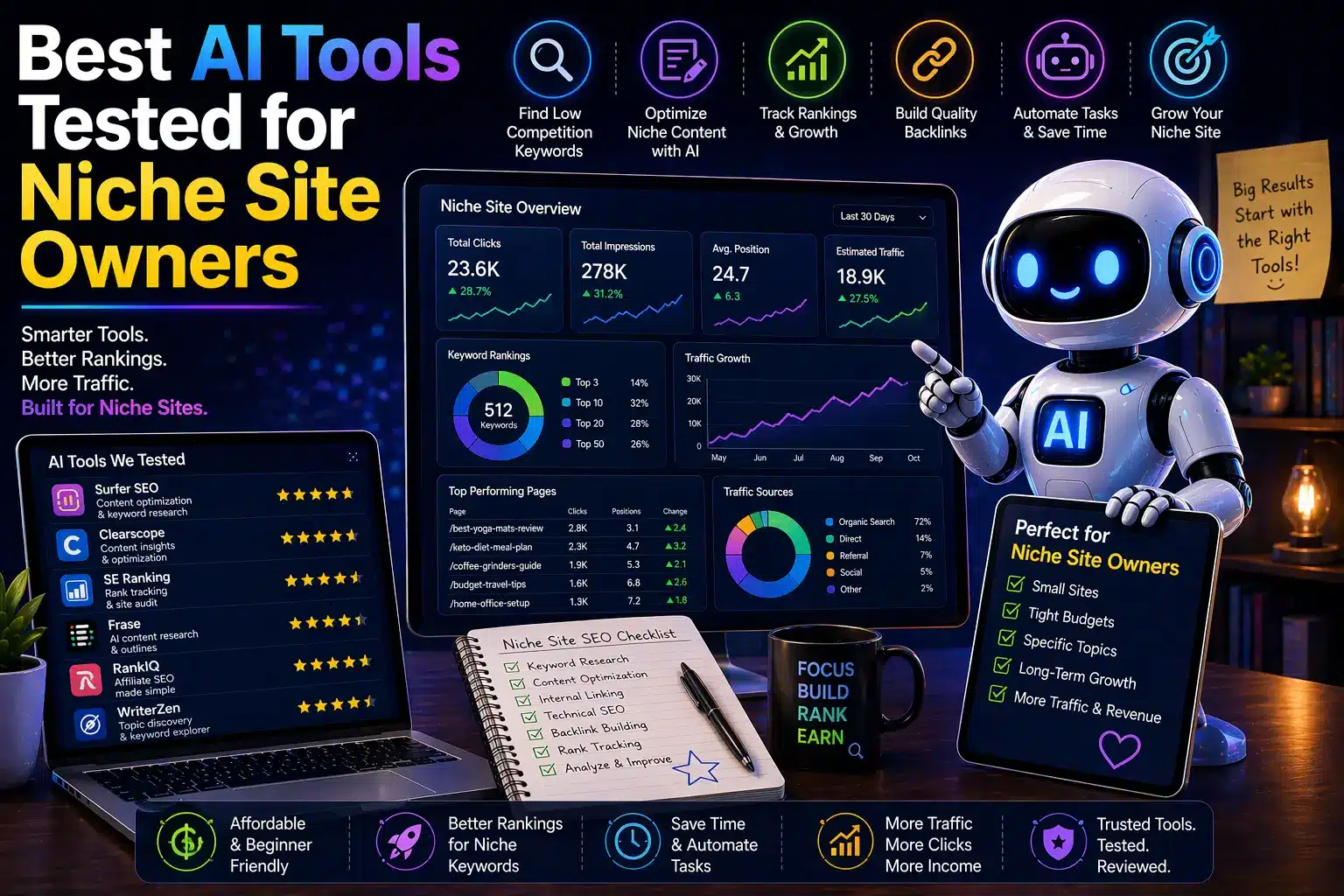
Best AI Tools Tested for Niche Site Owners
📌 In This Guide
- What niche site owners need from AI tools now
- Why citation share matters more than rankings alone
- How I evaluated these tools
- Best tools for citation share and AI visibility
- Best tools for sentiment and AI brand interpretation
- Best tools for GEO and AEO optimization
- Best tools for guided SEO and beginner workflows
- Best tools for internal linking and topical authority
- Best tools for content quality, humanization, and fact-checking
- Best tools for entity gap analysis and machine understanding
- Best tools for privacy, automation, and one-click fixes
- Pros and cons of the leading tools
- The decision matrix
- Best AI tools for niche site owners FAQ
- Final thoughts
Introduction
If I were building a niche site today, I would not judge success only by rankings. I would want to know whether AI systems mention my pages, whether my content is easy to extract, and whether my site is building enough topical authority to become part of the answer layer.
That is the bigger shift.
A niche site used to win mostly by:
- finding easier keywords
- publishing enough content
- building internal links
- earning a few backlinks
That still matters.
But now I also want tools that help me understand:
- citation share
- AI visibility
- sentiment in AI answers
- entity coverage
- machine readability
- content quality at scale
That is why the best AI tools for niche site owners are no longer just “SEO tools.” They are visibility, structure, and trust tools.
🔍 What Niche Site Owners Need from AI Tools Now
A niche site owner usually needs tools to solve five practical problems:
- finding realistic opportunities
- creating better content faster
- linking content intelligently
- monitoring AI visibility
- fixing SEO issues without heavy technical work
Direct Answer
The best AI tools for niche site owners are the ones that help smaller publishers improve citation visibility, strengthen topical authority, simplify execution, and keep content useful enough to survive both Google and AI answer engines.
For me, the best tools in this category usually do at least one of these especially well:
- track AI mentions and citations
- simplify SEO into clear tasks
- improve internal linking
- strengthen entity coverage
- make content more human and more trustworthy
- automate fixes without a developer
That is what makes them practical for niche site owners.
🚀 Why Citation Share Matters More Than Rankings Alone
A niche site can still rank reasonably well and lose value if AI systems summarize the topic without sending the click.
That is why I care more now about:
- citation share
- answer-engine visibility
- mention frequency
- competitor presence inside AI answers
The clearest niche-site rule
A ranking is still useful, but a citation inside an answer engine can shape trust before the click even happens.
That matters especially in niche publishing where:
- Authority is still growing
- Traffic is fragile
- Buyer decisions are influenced before the visit
- A few strongly cited pages can outperform a much larger archive of weak content
🧪 How I Evaluated These Tools
Because this article is for niche site owners, I did not judge tools only by how many features they had.
I judged them by how useful they are when:
- The site is small or mid-sized
- Time is limited
- Content output matters
- AI visibility is increasingly important
- Technical help is limited or unavailable
What I looked for
I evaluated these tools based on:
- AI visibility and citation tracking
- sentiment analysis
- GEO and AEO usefulness
- guided SEO support
- Internal linking helps
- content quality controls
- entity gap analysis
- First-party data usefulness
- automation and no-code execution
- privacy and business readiness
What mattered most
The strongest tools did at least one of these especially well:
- showed where the site appears in AI answers
- simplified SEO into actions instead of raw reports
- made content easier for machines to interpret
- improved topical authority through linking and structure
- reduced risk from thin, generic, AI-heavy publishing
That is the standard I used here.
🤖 Best Tools for Citation Share and AI Visibility
This is one of the most important categories for niche site owners now.
I want to know:
- whether my pages are being mentioned
- which prompts trigger citations
- whether competitors are taking the answer layer
- Which answer engines are surfacing my site at all
1. Nightwatch
Nightwatch is one of the strongest tools here because it combines traditional rank tracking with AI visibility monitoring in one place. Its official AI tracking pages highlight AI visibility, share of voice, citation analysis, and sentiment analysis across ChatGPT, Claude, Gemini, Google AI, and more.
What I like most is that it gives niche site owners a clearer view of:
- AI share of voice
- citation patterns
- sentiment in AI answers
- cross-platform visibility
2. Knowatoa
Knowatoa is also worth serious attention because its official site emphasizes citation analysis, sentiment tracking, feature mentions, ranking position, competitor mentions, API access, and daily updates across ChatGPT, Gemini, Claude, Google AI, and more.
That makes it useful for niche publishers who want:
- AI brand monitoring
- daily visibility data
- citation-level reporting
- reporting-stack compatibility
My take
If I wanted the strongest mix of classic SEO plus AI visibility in one platform, I would look hard at Nightwatch. If I wanted a more specialized AI visibility and citation-tracking layer, Knowatoa is one of the more interesting choices.
😊 Best Tools for Sentiment and AI Brand Interpretation
Being mentioned is not enough.
I also want to know how AI systems describe the site.
Do they frame it as:
- authoritative
- beginner-friendly
- trustworthy
- shallow
- generic
- better or worse than competitors
1. Nightwatch
Nightwatch belongs here again because its AI tracking product explicitly includes sentiment analysis and source-level visibility context.
2. Knowatoa
Knowatoa also belongs here because its official feature set includes sentiment tracking and competitor mentions, which is exactly what I would want if I were trying to understand how AI systems talk about a niche brand.
My take
If brand framing matters to the site’s growth, these tools are more useful than they first appear. They help answer not just “am I visible?” but “what story is AI telling about my site?”
🧩 Best Tools for GEO and AEO Optimization
A niche site that wants long-term visibility now needs content that machines can parse quickly, trust more easily, and cite more often.
1. Scrunch
Scrunch is one of the clearest GEO and AEO tools in this article because it is built around:
- monitoring brand presence in AI search
- analyzing and optimizing websites for AI agents
- serving machine-readable content through its AXP layer
- improving citations and inclusion in AI answers
Its own product pages make that positioning very explicit.
2. WordLift
WordLift belongs here because it helps publishers improve machine-readable structure through:
- entity enrichment
- schema support
- knowledge-graph style relationships
- entity gap analysis
- Google Search Console-connected workflows in its newer tooling
That makes it especially useful when the site needs better semantic clarity, not just more content.
My take
If I wanted to make a niche site more understandable to search engines, I would start with Scrunch for AI-facing visibility and WordLift for semantic and entity structure.
🧭 Best Tools for Guided SEO and Beginner Workflows
A lot of niche site owners are still solo operators.
That means a tool that says:
“Here is what to fix next”It
is often more useful than a tool with a hundred reports.
1. Semrush Copilot
Semrush Copilot is one of the best examples of guided SEO because it provides AI-powered recommendations, alerts, and prioritized next steps based on multiple Semrush reports. Semrush’s own knowledge base and product pages describe it as an AI-powered dashboard assistant that surfaces personalized recommendations and alerts. (Semrush)
2. diib
diib remains a very practical beginner-friendly option because its Daily Health Score is built to summarize site health in a simpler way. Its official site and knowledge base describe the Daily Health Score as an easy-to-understand overview of website performance. (Diib Knowledge Base)
My take
If I wanted a larger platform I could grow into, I would lean toward Semrush Copilot. If I wanted a simpler day-to-day SEO pulse for a niche site, Diib is still very compelling.
🔗 Best Tools for Internal Linking and Topical Authority
Internal links are still one of the easiest ways for a niche site to build topical authority without spending money on backlinks.
1. Link Whisper
Link Whisper is one of the clearest internal-linking tools in this category. Its official site and product pages emphasize AI-powered internal link suggestions, orphan page finding, broken link detection, semantic linking support, AI Sitemap, and bulk link workflows.
What I like most is that it helps turn a growing niche archive into:
- a stronger topical network
- fewer orphan pages
- more consistent contextual linking
- easier site-wide structure
My take
If internal linking is the biggest missed opportunity on a niche site, Link Whisper is one of the easiest wins in this whole article.
✍️ Best Tools for Content Quality, Humanization, and Fact Checking
This matters because a lot of niche sites publish too much AI content too quickly and then wonder why the pages feel weak.
I do not think the answer is “do not use AI.”
I think the answer is:
- Use AI for speed
- add human judgment
- check facts
- improve readability
- avoid thin content patterns
1. Originality.ai
Originality.ai is useful here because it combines AI checking, plagiarism checking, fact checking, readability, and grammar-related quality layers in one product. Its official site and fact-checker pages make those capabilities explicit.
2. Jasper
Jasper matters here for a different reason. It is especially relevant for privacy-conscious teams and for sites that care about brand consistency. Jasper’s enterprise and security pages state that customer data stays with the customer and is not used for training, while also highlighting SOC 2 and GDPR compliance. (Jasper)
My take
If I wanted a content-quality control layer, Originality.ai is a strong choice. If I cared more about privacy and controlled brand workflows, Jasper would become more attractive.
🎙️ Best Tools for Turning Video and Audio into SEO Articles
Niche site owners often already have useful knowledge locked inside:
- YouTube videos
- podcast episodes
- interviews
- recorded reviews
That content can become SEO pages if the workflow is good enough.
1. Castmagic
Castmagic is a strong choice here because its official product pages say it can turn YouTube videos and audio into blog posts, newsletters, social content, and other repurposed formats. Its YouTube transcription and content-repurposing pages make that use case very clear. (castmagic.io)
My take
If I already had niche expertise in video or audio form, Castmagic would be one of the first tools I would test for turning that expertise into indexable content faster.
🧬 Best Tools for Entity Gap Analysis and Machine Understanding
Search systems and answer engines do not think only in keywords.
They also think in:
- entities
- relationships
- concepts
- topical networks
That is why entity gap analysis matters more than many site owners realize.
1. WordLift
WordLift is still the strongest fit here because it explicitly supports:
- entity extraction
- entity linking
- entity gap analysis
- structured-data analysis
- knowledge graph workflows
Its official documentation and education pages support all of that directly.
My take
If a niche site already has content but still feels semantically thin, WordLift can be one of the best tools for closing that gap.
⚙️ Best Tools for Privacy, Automation, and One-Click Fixes
Sometimes the most valuable tool is the one that removes technical friction.
1. Alli AI
Alli AI is one of the most practical automation tools in this article because its official pages emphasize:
- bulk deployment automation
- automated SEO deployment
- AI crawler enablement
- server-side rendering for AI crawlers
- automated on-page and technical changes
That is especially useful for niche site owners who do not want to wait on a developer for every fix.
2. Jasper
Jasper belongs here again because privacy matters more as AI workflows get deeper. Jasper’s official enterprise and security materials say customer data stays yours and is not used to train their models, while also highlighting SOC 2 and GDPR compliance. (Jasper)
My take
If the bottleneck is execution, Alli AI is more important. If the bottleneck is privacy and governance, Jasper matters more.
✅ Pros and Cons of the Leading Tools
1. Nightwatch
Pros
- Combines classic rank tracking with AI visibility
- Includes AI share of voice and sentiment analysis
- Supports daily tracking and enterprise real-time refreshes
Cons
- Broader than some niche site owners need at the start
- More valuable once AI visibility becomes a regular KPI
2. Knowatoa
Pros
- Strong citation analysis and sentiment tracking
- Good multi-model AI visibility coverage
- API and reporting-stack compatibility are useful
Cons
- More specialized than a standard SEO suite
- Best when AI visibility is already a real priority
3. Scrunch
Pros
- Strong AEO and GEO positioning
- Focuses on machine-readable content for AI agents
- Good fit for AI-first visibility work
Cons
- More specialized than classic SEO tools
- Better for advanced visibility work than beginner SEO alone
4. Semrush Copilot
Pros
- Strongly guided recommendations
- Helpful daily alerts and prioritization
- Good for turning data into next actions
Cons
- Still sits inside a broader, more complex platform
- Better once the site owner is ready for a bigger ecosystem
5. diib
Pros
- Very easy to understand
- Daily Health Score is beginner-friendly
- Good for simplified day-to-day monitoring
Cons
- Less depth than broader SEO platforms
- Better for guidance than advanced diagnosis
6. Link Whisper
Pros
- Strong internal-linking automation
- Helpful AI suggestions while writing
- Useful for topical authority and orphan-page cleanup
Cons
- Mostly focused on WordPress workflows
- Solves linking better than a broader SEO strategy
7. WordLift
Pros
- Strong entity and schema workflows
- Excellent for semantic clarity and knowledge-graph style SEO
- Useful for entity gap analysis and machine understanding
Cons
- More specialized than an all-in-one SEO suite
- Best as part of a wider strategy, not the whole stack alone
8. Originality.ai
Pros
- Strong AI checking and plagiarism support
- Adds fact-checking and readability layers
- Good quality-control step for scaled publishing
Cons
- Not a ranking or visibility platform
- Best used as a control layer, not the main SEO engine
9. Castmagic
Pros
- Useful for repurposing YouTube and audio into SEO content
- Strong for extracting value from existing expert media
- Speeds up multimedia-to-article workflows
Cons
- Still needs editorial cleanup
- Better for repurposing than full SEO planning
10. Alli AI
Pros
- Strong no-code and bulk SEO execution
- Helpful for technical fixes and AI crawler access
- Saves time on repetitive implementation work
Cons
- More operational than educational
- Best when the site owner already knows what to automate
🧭 The Decision Matrix
| Tool | Price position | Strongest advantage | Best for |
|---|---|---|---|
| Nightwatch | Mid to premium | AI visibility, sentiment, and share of voice | Site owners who want classic SEO + AI monitoring together |
| Knowatoa | Specialized | Citation and sentiment tracking across AI search | Niche brands focused on AI visibility |
| Scrunch | Premium/specialized | GEO/AEO optimization and machine-readable delivery | Advanced publishers optimizing for AI agents |
| Semrush Copilot | Premium platform | Guided SEO recommendations and alerts | Niche site owners who want a bigger SEO platform |
| diib | Entry to mid | Simple health monitoring and guidance | Beginners and solo niche publishers |
| Link Whisper | Affordable | Internal linking automation | WordPress-heavy content sites |
| WordLift | Specialized | Entity SEO and structured data workflows | Publishers focused on semantic authority |
| Originality.ai | Affordable to mid | AI checking, fact checking, readability | Sites publishing content at scale |
| Castmagic | Mid | Video/audio to article repurposing | Creators with strong media archives |
| Alli AI | Mid to premium | One-click fixes and automation | Owners who want no-code SEO execution |
My simpler buying advice
- Choose Nightwatch if you want one of the best blends of AI visibility and classic rank tracking
- Choose Knowatoa if you care most about AI mentions, citations, and sentiment
- Choose Scrunch if your priority is GEO and machine-readable optimization
- Choose Semrush Copilot if you want guided SEO inside a larger platform
- Choose Diib if you want simple SEO direction without dashboard fatigue
- Choose Link Whisper if internal linking is your biggest missed opportunity
- Choose WordLift if your site needs stronger semantic and entity depth
- Choose Originality.ai if you publish at scale and want stronger quality control
- Choose Castmagic if your niche expertise already lives in video or audio
- Choose Alli AI if you want faster no-code implementation
❓ Best AI Tools for Niche Site Owners FAQ
1. What is the best AI visibility tool for a niche site owner?
For a combined SEO and AI-monitoring workflow, Nightwatch is very strong. For more specialized AI visibility and sentiment analysis, Knowatoa is one of the more interesting options.
2. What is the best guided SEO tool for a niche site beginner?
Semrush Copilot is strong if you want a bigger ecosystem, while diib is better if you want a simpler daily-health-and-tasks workflow.
3. What is the best internal-linking AI tool for niche sites?
Link Whisper is one of the clearest tools for internal-linking automation and topical-authority building, especially for WordPress publishers.
4. What is the best tool for entity SEO?
WordLift is one of the strongest choices for entity enrichment, schema, and semantic understanding.
5. Do niche site owners need GEO or AEO tools already?
Yes, especially if AI answers are affecting discovery in your niche. Even modest citation visibility can matter when answer engines reshape clicks.
6. What is the best tool for checking whether AI content feels too synthetic?
Originality.ai is one of the strongest options if you want an added layer of AI checking, plagiarism control, fact checking, and readability review.
7. What is the best no-code SEO automation tool for niche site owners?
Alli AI is one of the most practical choices because it automates on-page and technical changes without requiring direct code edits.
8. What is the best way to turn YouTube or podcast expertise into SEO pages?
Castmagic is a strong option because it can repurpose video and audio into blog posts and other written content formats quickly.
🏁 Final Thoughts
When I think about the best AI tools for niche site owners, I do not think first about who has the biggest dashboard.
I think about who helps a smaller publisher become:
- more visible
- more citeable
- more organized
- more trustworthy
- easier for machines to understand
If I had to reduce the whole article to one idea, it would be this:
For niche sites, the real edge now is not just publishing more. It is becoming easier for answer engines to trust, extract, and repeat.
Recommended Next Reads
- Best AEO Tools Tested
- Best GEO Tools Tested
- Best AI Overviews Tracking Tools Tested
- Best AI SEO Tools for Beginners
- Best AI SEO Tools Tested for Small Business
Comments 4