Introduction
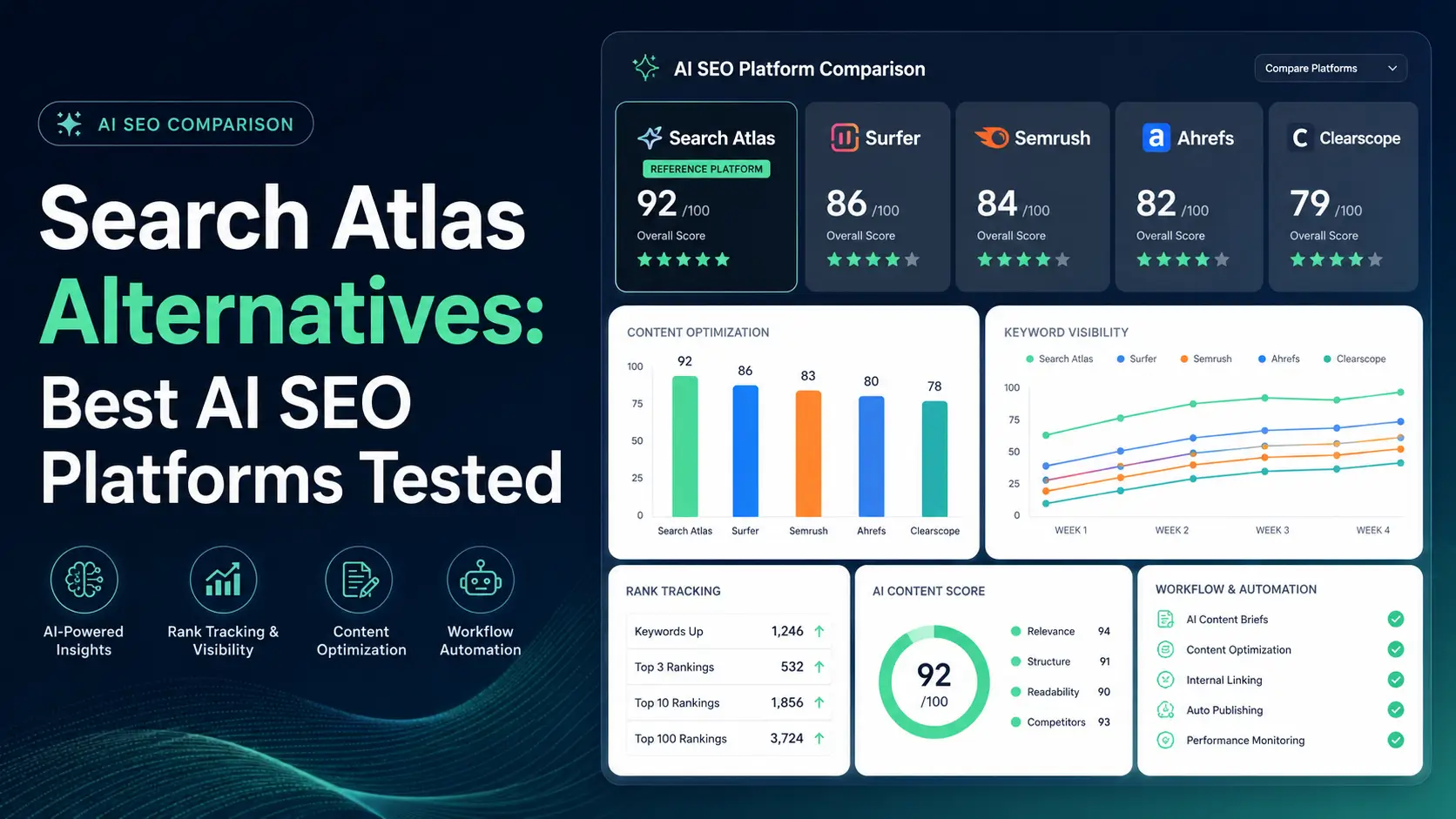
The best Search Atlas alternatives are ClickRank for OTTO-style automation, Scalenut for affordable AI content workflows, Frase and Writesonic for GEO tracking, RankinAI for focused AI visibility, Surfer for semantic optimization, NeuronWriter for budget NLP, and SE Ranking for agency SEO management.
Search Atlas is not easy to replace with one tool.
It combines:
- OTTO SEO automation.
- Technical audits.
- Internal link automation.
- Content Genius.
- Topical maps.
- Rank tracking.
- Local SEO.
- LLM Visibility.
- AI content workflows.
- Agency reporting.
That means the right alternative depends on which Search Atlas feature you actually use.
If you mainly want technical automation, ClickRank is more relevant than Surfer. If your priority is AI visibility, Frase, Writesonic, or RankinAI make more sense. If Content Genius and topical maps are the reason you considered Search Atlas, Surfer or NeuronWriter may be better fits.
This comparison breaks down the alternatives by the specific Search Atlas strength they replace.
⚡ Quick Verdict
Search Atlas is strongest when you need automation, content planning, technical SEO, internal links, and AI visibility in one platform. The best alternative depends on your main workflow: ClickRank for automation, Frase or Writesonic for GEO, Surfer for semantic SEO, NeuronWriter for budget content optimization, and SE Ranking for agencies.
| Search Atlas Feature | Best Alternative | Why |
|---|---|---|
| OTTO SEO automation | ClickRank | Focused on AI on-page and technical optimization |
| Lower-cost AI content workflow | Scalenut | Stronger fit for startups and content teams |
| LLM Visibility | Frase | Tracks AI visibility and connects it to content work |
| Enterprise GEO monitoring | Writesonic | Broader AI engine coverage on advanced plans |
| Simple AI visibility tracker | RankinAI | Focused on AI mentions, citations, and prompt visibility |
| Content Genius | Surfer | Strong SERP, NLP, and topical map workflows |
| Affordable semantic SEO | NeuronWriter | Strong NLP optimization at a lower cost |
| Agency SEO platform | SE Ranking | More traditional SEO toolkit with reporting |
Best Choice by Use Case
| Use Case | Best Tool |
|---|---|
| Replace OTTO SEO | ClickRank |
| Replace Content Genius | Surfer |
| Track ChatGPT and Perplexity visibility | Frase |
| Start GEO tracking on a lighter budget | RankinAI |
| Build topical maps and optimize pages | Surfer |
| Optimize content affordably | NeuronWriter |
| Manage clients, rankings, audits, and reports | SE Ranking |
| Publish and optimize AI content at scale | Scalenut |
The clearest takeaway is this: do not replace Search Atlas feature by feature. Replace the one workflow that creates the most value for your website or agency.
📚 Recommended Reads
- Search Atlas Review: Is This AI SEO Platform Worth It?
- Best AI SEO Tools Tested This Year
- Best AI Tools Tested for Content Audits
- Frase Alternatives: Best AI SEO Tools Tested
- Surfer Alternatives: Best AI SEO Tools Tested
📌 In This Guide
1. 🧠 Why Look for a Search Atlas Alternative?
2. 🧪 How These Alternatives Were Tested
3. 📊 Search Atlas Alternatives Compared
4. 🤖 Best Alternative for AI Automation: ClickRank
5. ✍️ Best Alternative for Affordable AI Content Workflows: Scalenut
6. 👀 Best Alternative for GEO Tracking: Frase
7. 🌐 Best Enterprise GEO Alternative: Writesonic
8. 📡 Best Focused AI Visibility Tracker: RankinAI
9. 🧬 Best Alternative for Semantic SEO: Surfer
10. 💸 Best Budget NLP Alternative: NeuronWriter
11. 🏢 Best Agency SEO Alternative: SE Ranking
12. 🔌 Integration and Deployment Comparison
13. ⚠️ Technical Weakness Matrix
14. 💰 Pricing and Value Comparison
15. 🛡️ How to Avoid AI Automation Mistakes
16. ❓ FAQ
17. 🏁 Final Verdict
18. 📚 Recommended Next Reads
🧠 Why Look for a Search Atlas Alternative?
Search Atlas is worth replacing when you do not need the whole platform, find OTTO automation too risky, want a lower entry price, or prefer specialist tools for GEO tracking, content optimization, rank tracking, or semantic SEO.
Search Atlas can be valuable, but it may be too much for:
- Small websites.
- New affiliate blogs.
- Teams that only need content optimization.
- Brands that only want AI visibility tracking.
- Users who already have rank tracking and audits.
- Startups that need lighter pricing.
- Teams uncomfortable with broad automation.
- Agencies that prefer manual technical control.
When Search Atlas Still Makes Sense
Search Atlas may still be the better choice when:
- You actively use OTTO SEO.
- You manage several sites.
- You need LLM Visibility and traditional SEO together.
- You want direct implementation.
- You use Content Genius regularly.
- You need agency reporting.
- You want fewer separate tools.
- Your team can review automated changes safely.
A cheaper alternative is not always cheaper if you need three or four tools to replace one platform.
🧪 How These Alternatives Were Tested
These alternatives were evaluated using a structured editorial framework based on current product capabilities, public pricing, official documentation, feature depth, workflow fit, CMS integration, automation controls, and realistic use cases.
Tested Criteria
| Test Area | What Was Reviewed |
|---|---|
| AI automation | Can the tool prepare or deploy SEO changes? |
| Internal links | Does it suggest or automate contextual internal links? |
| GEO tracking | Does it track AI engines, citations, mentions, or share of voice? |
| Semantic SEO | Does it analyze entities, NLP terms, SERP gaps, and intent? |
| Topical maps | Can it organize clusters and reduce cannibalization? |
| CMS integration | Does it connect with WordPress, Shopify, or other CMS platforms? |
| Ease of use | Can a non-enterprise team use it without heavy setup? |
| Pricing gap | How does the entry cost compare with Search Atlas? |
| Agency use | Does it support reports, clients, projects, and team workflows? |
| Technical risk | What can go wrong if automation is used poorly? |
What “Tested” Does Not Mean
This article does not claim that every platform was installed on the same production website with identical:
- Hosting.
- CMS.
- Plugin stack.
- Content volume.
- Search traffic.
- AI visibility baseline.
- Technical problems.
- Conversion data.
It also does not invent:
- 92% accuracy scores.
- Fixed automation error rates.
- Guaranteed ranking gains.
- Exact indexing improvements.
- Fake API costs.
- Fake internal testing screenshots.
AI SEO tools behave differently depending on the site. Any automated change should be tested on a limited page group before wider deployment.
📊 Search Atlas Alternatives Compared
| Tool | Best Replacement For | Strength | Main Weakness |
|---|---|---|---|
| ClickRank | OTTO SEO automation | Focused AI technical and on-page fixes | Narrower SEO ecosystem |
| Scalenut | AI content workflows | Content, GEO, audits, internal links, publishing | Less technical than OTTO |
| Frase | LLM visibility and content audits | AI tracking plus content action workflow | Not a full technical SEO suite |
| Writesonic | Enterprise GEO tracking | Broad AI engine visibility and citations | Advanced plans can be expensive |
| RankinAI | Focused AI visibility | Simple tracking across AI engines | Not a full SEO platform |
| Surfer | Content Genius and topical maps | SERP, NLP, entities, topical maps | Limited technical deployment |
| NeuronWriter | Affordable NLP optimization | Strong semantic content analysis | Limited automation and agency features |
| SE Ranking | Agency SEO workflows | Rank tracking, audits, reports, clients | Less autonomous than OTTO |
🤖 Best Alternative for AI Automation: ClickRank
ClickRank
ClickRank is the closest Search Atlas alternative for OTTO-style automation because it focuses on AI-powered SEO fixes such as metadata, schema, image optimization, and internal link automation. It is better for teams that want implementation help without adopting a large SEO ecosystem.
ClickRank’s strongest use case is simple:
Find on-page SEO issues and prepare fixes quickly.
It is not trying to be a full Semrush-style research suite or a complete content strategy platform.
What It Can Replace
ClickRank can replace parts of OTTO SEO related to:
- Meta title optimization.
- Meta description optimization.
- Schema markup.
- Image SEO.
- Internal link automation.
- On-page recommendations.
- Google Search Console-based optimization.
- AI-assisted deployment.
Where It Beats Search Atlas
ClickRank may be easier to justify when:
- You only need automation.
- You do not need rank tracking.
- You do not need backlink research.
- You do not need a broad agency dashboard.
- You want a narrower tool with less platform complexity.
Integration
ClickRank offers WordPress integration through a plugin and cloud-based optimization workflows. This is simpler than custom development for many site owners.
Before connecting it, check:
- Does it overwrite metadata from Rank Math or AIOSEO?
- Are schema changes stored or injected?
- Can changes be reversed?
- Does it work with your page builder?
- Can high-value pages be excluded?
- What happens after cancellation?
Technical Weakness
ClickRank’s main weakness is breadth. It is not a full replacement for Search Atlas’s keyword research, Content Genius, rank tracking, backlink tools, local SEO, and LLM Visibility.
Best For
- Startups.
- WordPress websites.
- Medium-sized sites.
- Teams wanting AI implementation.
- Users who find Search Atlas too expensive or complex.
Verdict
Choose ClickRank when OTTO SEO is the Search Atlas feature you care about most. Avoid it when you need a complete SEO operating system.
✍️ Best Alternative for Affordable AI Content Workflows: Scalenut
Scalenut
Scalenut is a better Search Atlas alternative for teams that care more about content creation, GEO planning, internal linking, topic gaps, audits, and publishing than deep technical automation. It offers a broader content workflow at a more accessible entry point for many teams.
Scalenut is strongest when the work is:
- Plan content.
- Build clusters.
- Write articles.
- Optimize pages.
- Add internal links.
- Publish to a CMS.
- Monitor AI visibility.
What It Can Replace
Scalenut can replace parts of:
- Content Genius.
- Topical planning.
- Content audits.
- Internal linking workflows.
- GEO content creation.
- WordPress and Shopify publishing.
- Content optimization.
Where It Beats Search Atlas
Scalenut can be a better fit when:
- Content production is the main workflow.
- You publish many SEO articles.
- You want a lower starting cost.
- You do not need advanced technical automation.
- Your team needs a simpler editorial workflow.
Integration
Scalenut supports content workflows that can connect with WordPress and Shopify publishing. That makes it practical for ecommerce and content teams.
Check plan limits carefully because advanced content audits, internal linking, topic gaps, and auto-publishing may depend on the selected plan.
Technical Weakness
Scalenut is weaker than Search Atlas for full OTTO-style technical deployment. It helps with content and GEO workflows, but it is not the same as a broad automated technical SEO agent.
Best For
- Content teams.
- Startups.
- Bloggers.
- Shopify content workflows.
- Agencies focused on content delivery.
- Teams prioritizing GEO and publishing.
Verdict
Choose Scalenut when Search Atlas feels too technical and expensive for your main goal: producing, optimizing, and publishing better AI-assisted content.
👀 Best Alternative for GEO Tracking: Frase
Frase
Frase is one of the strongest Search Atlas alternatives for GEO tracking because it monitors prompts across AI engines, tracks competitors, keeps historical visibility data, logs AI bot activity, and connects visibility gaps to content workflows.
Frase is useful because it connects two questions:
- Where is my brand missing in AI answers?
- What content should I improve to fix that gap?
What It Can Replace
Frase can replace parts of Search Atlas related to:
- LLM Visibility.
- AI prompt tracking.
- Competitor visibility.
- AI citation opportunities.
- Content audits.
- Content briefs.
- Content optimization.
- Content decay monitoring.
Where It Beats Search Atlas
Frase may be better when:
- GEO is the main goal.
- You do not need OTTO.
- You want a lighter entry point.
- Your team already has other technical SEO tools.
- Content improvement matters more than automated technical fixes.
Integration
Frase is primarily a content and AI visibility workflow. It is easier to use for editorial teams than a broad technical platform.
However, technical SEO fixes, schema deployment, and large site automation may require other tools.
Technical Weakness
Frase’s main weakness is that it is not a full technical SEO automation platform. It can identify content and AI visibility gaps, but it does not replace OTTO’s broad implementation layer.
Best For
- GEO consultants.
- Content teams.
- Agencies offering AI visibility services.
- SaaS companies.
- Brands tracking prompts and citations.
Verdict
Choose Frase when AI visibility and content improvement are more important than sitewide technical automation.
🌐 Best Enterprise GEO Alternative: Writesonic
Writesonic
Writesonic is a strong Search Atlas alternative for teams that need advanced AI visibility tracking across many answer engines, including ChatGPT, Perplexity, Gemini, Claude, Copilot, Google AI Overviews, Google AI Mode, Grok, DeepSeek, and Meta AI.
Writesonic is not just an AI writer anymore.
Its GEO platform focuses on:
- Brand mentions.
- AI citations.
- Prompt tracking.
- Competitor visibility.
- Sentiment.
- Action recommendations.
- Content and SEO workflows.
What It Can Replace
Writesonic can replace Search Atlas features related to:
- LLM Visibility.
- GEO tracking.
- AI content creation.
- Brand visibility monitoring.
- Competitor prompt analysis.
- AI answer optimization.
- SEO and GEO workflows.
Where It Beats Search Atlas
Writesonic may be stronger when:
- You track many AI engines.
- AI visibility is a core acquisition channel.
- You need citation and sentiment monitoring.
- Your team wants GEO and content creation together.
- You manage prompts across regions or languages.
Integration
Writesonic supports content and SEO workflows, but advanced GEO monitoring depends on plan level and limits.
Check:
- Number of tracked prompts.
- Number of projects.
- Supported AI engines.
- Citation tracking access.
- Sentiment analysis access.
- Action Center availability.
- Reporting limits.
Technical Weakness
Writesonic’s main weakness is cost at scale. The more serious GEO features can sit in higher plans, which may become more expensive than Search Atlas for some teams.
Best For
- Enterprise GEO teams.
- AI visibility agencies.
- SaaS brands.
- Multi-region content teams.
- Companies tracking AI citations seriously.
Verdict
Choose Writesonic when AI visibility is the main workflow. Keep Search Atlas when OTTO-style technical automation is equally important.
📡 Best Focused AI Visibility Tracker: RankinAI
RankinAI
RankinAI is the best focused Search Atlas alternative for users who only need to track how their brand appears across AI engines such as ChatGPT, Google AI Mode, Gemini, and Perplexity without paying for a full SEO platform.
RankinAI is useful when the goal is narrow:
Track brand visibility in AI answers.
It is not built to replace a complete SEO suite.
What It Can Replace
RankinAI can replace the AI visibility part of Search Atlas for:
- Brand mention tracking.
- AI prompt visibility.
- Citation rate checks.
- Platform-level visibility.
- Competitor comparison.
- AI search performance baselines.
Where It Beats Search Atlas
RankinAI may be better when:
- You only need GEO tracking.
- You want a free or low-risk starting point.
- You already use other SEO tools.
- You do not want technical automation.
- You need a simple AI visibility dashboard.
Integration
RankinAI is a monitoring tool more than an implementation platform.
It tells you where your brand appears or is missing. It does not replace tools for:
- content optimization
- technical auditing
- schema
- internal linking
- rank tracking
- backlinks
- CMS publishing
Technical Weakness
RankinAI’s weakness is narrow scope. It needs to be paired with a content optimizer, crawler, or SEO suite if you want to act on the findings.
Best For
- GEO beginners.
- Small brands.
- Consultants.
- Startups.
- Teams validating AI visibility demand.
Verdict
Choose RankinAI when Search Atlas LLM Visibility is the only feature you need. Do not choose it as a full Search Atlas replacement.
🧬 Best Alternative for Semantic SEO: Surfer
Surfer
Surfer is the strongest Search Atlas alternative for semantic optimization, SERP audits, topical maps, content structure, NLP terms, internal linking guidance, and AI visibility. It is best when Content Genius matters more than OTTO SEO.
Surfer’s strength is content precision.
It helps writers and SEO teams understand:
- What current competitors cover.
- Which entities and terms matter.
- How the article should be structured.
- Which topics are missing.
- Which pages may fit a topical map.
- How content performs in traditional and AI search.
What It Can Replace
Surfer can replace Search Atlas features related to:
- Content Genius.
- SERP-based optimization.
- Topical maps.
- Content audits.
- Semantic SEO.
- Internal linking recommendations.
- AI visibility tracking.
- Content refresh workflows.
Where It Beats Search Atlas
Surfer may be better when:
- Writers need a focused editor.
- Semantic optimization is central.
- Topical authority is the goal.
- Content refreshes matter more than technical fixes.
- The team wants less platform complexity.
Integration
Surfer works well in editorial workflows and can connect with content production processes.
However, it does not replace:
- OTTO-style deployment.
- Canonical fixes.
- sitewide schema automation.
- Deep backlink research.
- Local SEO management.
- Broad agency dashboards.
Technical Weakness
Surfer’s main weakness is implementation depth. It gives strong content recommendations but does not provide the same broad technical deployment system as Search Atlas.
Best For
- Content teams.
- Bloggers.
- SEO agencies.
- Affiliate sites.
- SaaS websites.
- Publishers building topical authority.
Verdict
Choose Surfer when you want the best replacement for Content Genius and topical maps. Choose Search Atlas when automated technical SEO is equally important.
💸 Best Budget NLP Alternative: NeuronWriter
NeuronWriter
NeuronWriter is the best budget-friendly Search Atlas alternative for NLP content optimization, SERP analysis, entity coverage, content scoring, and AI-readable structure. It is ideal for smaller teams that want semantic guidance without paying for a larger SEO platform.
NeuronWriter is strongest at page-level optimization.
It helps answer:
- What topics are missing?
- What entities should be covered?
- How do competitors structure the page?
- Which questions should be answered?
- How can the article become clearer for Google and AI answers?
What It Can Replace
NeuronWriter can replace parts of:
- Content Genius.
- Semantic optimization.
- NLP recommendations.
- Competitor content analysis.
- AI-readability checks.
- Content scoring.
Where It Beats Search Atlas
NeuronWriter may be better when:
- Budget is limited.
- You optimize articles one by one.
- You do not need automation.
- You want content guidance, not a full platform.
- You run a blog or affiliate site.
Integration
NeuronWriter offers integrations and supports content workflows, but it is not a direct technical deployment tool like OTTO.
It should usually be paired with:
- Google Search Console.
- A crawler.
- WordPress SEO plugin.
- Internal linking tool.
- Rank tracker.
Technical Weakness
NeuronWriter’s weakness is platform breadth. It does not replace Search Atlas for technical audits, automated implementation, LLM Visibility at scale, backlinks, local SEO, or agency reporting.
Best For
- Bloggers.
- Affiliate sites.
- Freelancers.
- Small agencies.
- Budget-conscious content teams.
Verdict
Choose NeuronWriter when you need affordable semantic SEO. Do not choose it when you need OTTO, LLM Visibility, or agency-scale automation.
🏢 Best Agency SEO Alternative: SE Ranking
SE Ranking
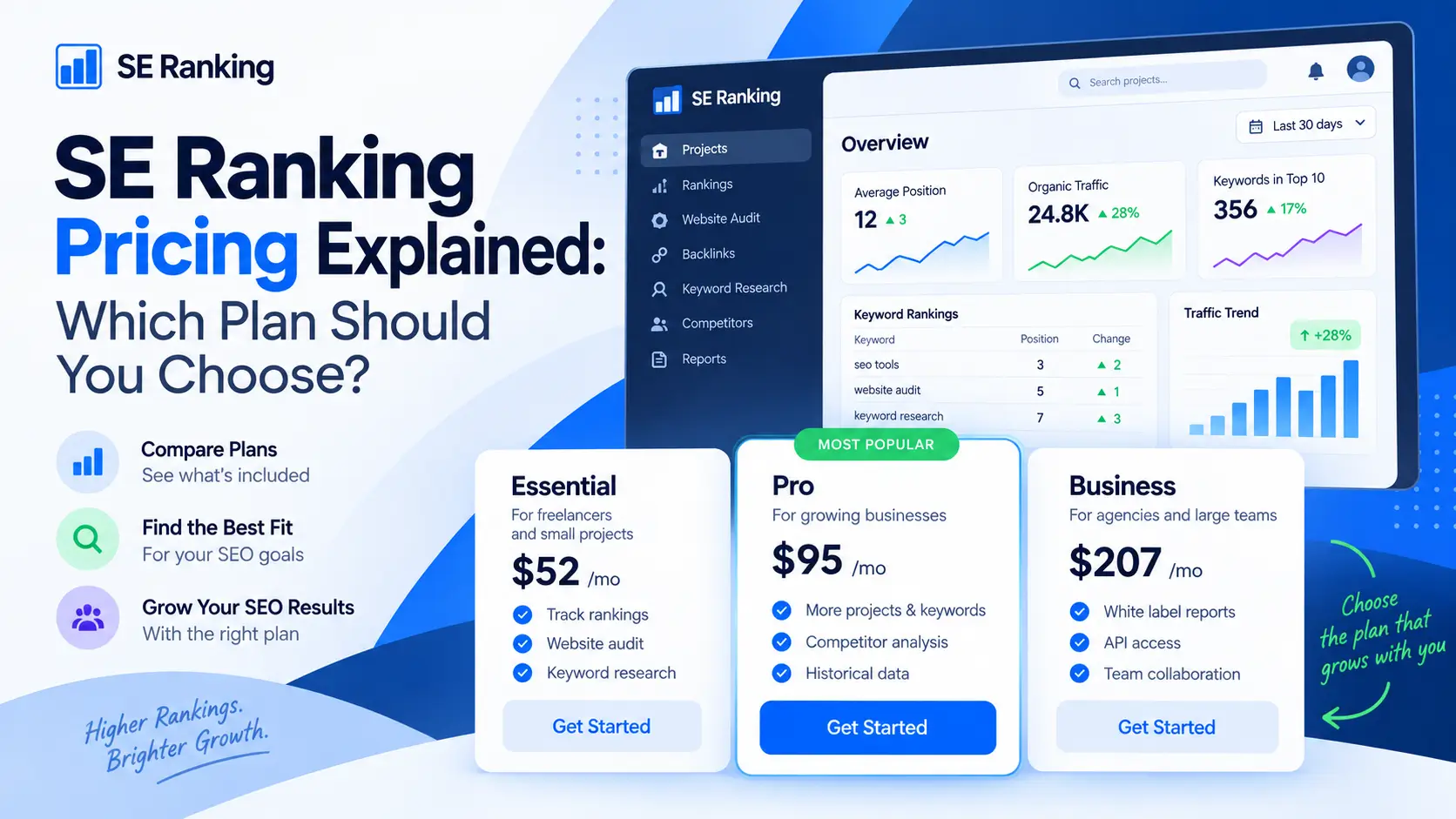
SE Ranking is the best Search Atlas alternative for agencies that want rank tracking, website audits, backlink monitoring, competitor research, client reporting, local SEO, and controlled workflows without relying heavily on autonomous technical deployment.
SE Ranking is a more traditional all-in-one SEO platform.
It focuses on:
- Rankings.
- Audits.
- Competitors.
- Backlinks.
- Keywords.
- Reports.
- Local SEO.
- Agency tools.
What It Can Replace
SE Ranking can replace Search Atlas features related to:
- Rank tracking.
- Site audits.
- Competitor research.
- Keyword research.
- Backlink monitoring.
- Agency reporting.
- Local SEO.
- Client dashboards.
Where It Beats Search Atlas
SE Ranking may be better when:
- You prefer manual approval.
- Rank tracking is the core service.
- Clients need clean reports.
- Budget matters.
- Your agency does not need aggressive automation.
- You want fewer technical deployment risks.
Integration
SE Ranking is generally CMS-independent because it audits and tracks websites rather than deeply injecting changes into the CMS.
That reduces automation risk but increases manual implementation work.
Technical Weakness
SE Ranking’s main weakness is that it does not replace OTTO’s autonomous deployment model. It identifies many issues but usually requires human or developer implementation.
Best For
- Agencies.
- Consultants.
- Rank-tracking teams.
- Local SEO providers.
- Client-reporting workflows.
Verdict
Choose SE Ranking when you want a dependable agency SEO platform with strong reports and controlled implementation. Choose Search Atlas when automation is the main reason to buy.
🔌 Integration and Deployment Comparison
Integration matters because some tools only report issues, while others can publish or deploy changes directly.
| Tool | WordPress | Shopify | Deployment Style | Best Integration Use |
|---|---|---|---|---|
| ClickRank | Yes | Website integration options | Cloud-managed SEO optimization | OTTO-style fixes |
| Scalenut | Yes | Yes | Content publishing and workflows | Content and GEO production |
| Frase | Content workflows | Export-based workflows | Briefs, audits, optimization | GEO and content teams |
| Writesonic | Publishing workflows | Integrations vary by workflow | SEO and GEO workflows | AI visibility and content |
| RankinAI | Not CMS-focused | Not CMS-focused | Tracking and recommendations | GEO monitoring |
| Surfer | Yes | Content workflow integrations | Editor, topical maps, audits | Semantic optimization |
| NeuronWriter | WordPress and integrations | Limited by setup | Content optimization | Budget NLP |
| SE Ranking | CMS-independent | CMS-independent | Audits and reports | Agency reporting |
What to Check Before Connecting Any Tool
- Does it overwrite existing metadata?
- Does it inject code or store changes in the CMS?
- Does it conflict with Rank Math or AIOSEO?
- Can you exclude high-value pages?
- Can you reverse changes?
- Are schema changes visible in rendered HTML?
- Does it work with page builders?
- Are internal links stored or injected?
- What happens after cancellation?
- Is there a change log?
⚠️ Technical Weakness Matrix
Every Search Atlas alternative has a trade-off. The safest choice is not the tool with the most automation, but the tool with the best fit, clearest review process, and lowest risk for your website.
| Tool | Main Technical or Financial Weakness |
|---|---|
| ClickRank | Narrower than Search Atlas; automation must be checked against existing SEO plugins |
| Scalenut | Strong for content but weaker for deep technical deployment |
| Frase | GEO and content focused; not a complete technical SEO suite |
| Writesonic | Advanced GEO plans can become expensive as prompts and engines scale |
| RankinAI | Focused tracker; requires other tools for implementation |
| Surfer | Excellent for content but limited for technical automation |
| NeuronWriter | Budget-friendly but not built for enterprise automation |
| SE Ranking | Strong reporting but less autonomous implementation |
| Search Atlas | Powerful but complex, expensive for small sites, and risky when blindly automated |
💰 Pricing and Value Comparison
AI SEO platform pricing changes quickly. Search Atlas starts at $99 per month, but the real comparison depends on whether you need automation, GEO tracking, content optimization, or agency reporting.
| Tool | Pricing Position | Best Value For |
|---|---|---|
| Search Atlas | Starts at $99/month | Teams using OTTO, Content Genius, LLM Visibility, and reports together |
| ClickRank | Tiered by sites and pages | Teams replacing OTTO-style automation |
| Scalenut | Lower entry pricing than Search Atlas | Content teams and startups |
| Frase | Lower entry pricing than Search Atlas | GEO and content optimization teams |
| Writesonic | Lower entry plan, expensive at advanced GEO levels | Enterprise AI visibility programs |
| RankinAI | Free entry available | Small teams testing AI visibility |
| Surfer | Similar entry price to Search Atlas | Premium semantic content optimization |
| NeuronWriter | Budget-friendly positioning | Bloggers and affiliate content teams |
| SE Ranking | Plan-based SEO platform pricing | Agencies needing SEO reports and tracking |
Best Value by Budget
| Budget Level | Best Direction |
|---|---|
| Low budget | NeuronWriter or RankinAI |
| Content-focused budget | Scalenut |
| GEO-focused budget | Frase or RankinAI |
| Premium content workflow | Surfer |
| Agency SEO workflow | SE Ranking |
| Technical automation workflow | ClickRank |
| Full AI SEO operating system | Search Atlas |
Pricing Verdict
Search Atlas can be good value when one team uses several modules every week. It becomes expensive when the user pays for automation, GEO tracking, content, local SEO, and reporting but only uses one feature.
🛡️ How to Avoid AI Automation Mistakes
AI SEO tools should recommend and prepare changes, but humans should approve anything that affects indexing, metadata, schema, internal links, redirects, or high-value pages.
Never Blindly Automate
Do not auto-approve:
- Robots.txt changes.
- Noindex directives.
- Canonical tags.
- Redirects.
- Sitewide schema.
- Product metadata.
- Legal content.
- Medical or financial pages.
- High-converting landing pages.
- Broad internal link rules.
Safe Workflow
Use this process:
- Connect the tool.
- Run a limited audit.
- Review recommendations.
- Exclude sensitive pages.
- Approve a small batch.
- Validate rendered HTML.
- Check Search Console.
- Monitor rankings and conversions.
- Expand gradually.
- Keep rollback options ready.
Why Error Rates Are Hard to Compare
A tool may be accurate on a clean WordPress blog and risky on a custom ecommerce site.
Error risk depends on:
- CMS.
- theme.
- page builder.
- existing SEO plugin.
- custom schema.
- indexation rules.
- language.
- template logic.
- site size.
- reviewer skill.
So instead of asking, “Which tool is 92% accurate?” ask:
Can I preview, limit, approve, validate, and reverse the change?
❓ FAQ
1. What is the best Search Atlas alternative?
ClickRank is the best alternative for OTTO-style automation, Frase for GEO tracking, Surfer for semantic optimization, NeuronWriter for budget NLP, and SE Ranking for agency SEO workflows.
2. What is the best OTTO SEO alternative?
ClickRank is the closest focused alternative because it emphasizes AI-powered on-page optimization, metadata, schema, image SEO, and internal link automation.
3. What is the best Search Atlas alternative for GEO?
Frase is a strong, balanced option for AI visibility and content workflows. Writesonic is better for advanced teams tracking many AI platforms, prompts, citations, and competitors.
4. What is the best affordable Search Atlas alternative?
NeuronWriter is the best affordable option for semantic content optimization. RankinAI is a lighter choice for AI visibility tracking, while Scalenut is strong for content workflows.
5. Is Surfer better than Search Atlas?
Surfer is better for focused content optimization, SERP analysis, topical maps, and semantic SEO. Search Atlas is stronger for broad automation, technical deployment, local SEO, and agency workflows.
6. Can Scalenut replace Search Atlas?
Scalenut can replace Search Atlas for content planning, optimization, GEO content, internal linking, and publishing workflows. It does not fully replace OTTO-style technical automation.
7. Can RankinAI replace LLM Visibility?
RankinAI can replace the focused AI visibility tracking part for smaller teams. It does not replace Search Atlas’s content, technical, ranking, local SEO, or automation features.
8. Is SE Ranking a Search Atlas competitor?
Yes, but it competes more as a traditional SEO platform. It is better for rank tracking, audits, reporting, and agency workflows than autonomous SEO deployment.
9. Should I replace Search Atlas with multiple tools?
Use multiple tools when specialist depth matters more than simplicity. Keep Search Atlas when a single integrated workflow saves more time and reduces tool switching.
10. Can AI SEO automation hurt rankings?
Yes. Poor automated changes to titles, canonicals, robots directives, schema, redirects, internal links, or high-value pages can damage search performance. Always review and validate.
🏁 Final Verdict
The best Search Atlas alternative depends on which competitive feature you want to replace.
Choose ClickRank if your main need is AI technical automation and OTTO-style on-page fixes.
Choose Scalenut if you want a more affordable AI content workflow with planning, optimization, internal links, and publishing.
Choose Frase if AI visibility, prompt tracking, and content improvement matter more than technical deployment.
Choose Writesonic if you need advanced GEO tracking across many AI engines and the budget supports higher plans.
Choose RankinAI if you only want focused AI visibility tracking without a full SEO platform.
Choose Surfer if Search Atlas Content Genius and topical maps are the main features you want to replace.
Choose NeuronWriter if you need affordable NLP optimization for blog posts, affiliate content, and small SEO teams.
Choose SE Ranking if you need a reliable agency SEO platform with rank tracking, audits, reports, local SEO, and controlled implementation.
Search Atlas remains a strong option when you actively use OTTO SEO, Content Genius, LLM Visibility, topical maps, local SEO, and reporting in one platform.
It becomes poor value when you pay for the entire ecosystem but only use one module.
The clearest takeaway is this: replace Search Atlas by workflow, not by feature count. The best alternative is the tool that solves your real bottleneck with less cost, less risk, and enough human control.
Comments 4