Best AI Tools Tested for SaaS SEO
📌 In This Guide
- What SaaS SEO tools need to do now
- Why SaaS SEO changed in the AI era
- How I evaluated these tools
- Best tools for SaaS entity building
- Best tools for AI share of voice and brand visibility
- Best tools for comparison pages and competitive capture
- Best tools for AEO, GEO, and intent modeling
- Best tools for docs-to-content workflows
- Best tools for E-E-A-T and technical content quality
- Best tools for forecasting, automation, and privacy
- Pros and cons of the leading tools
- The decision matrix
- Best AI tools for SaaS SEO FAQ
- Final thoughts
Introduction
If I were running SaaS SEO today, I would not judge success only by rankings. I would want to know whether AI systems understand my product as a real entity, whether they recommend it in comparison prompts, and whether my content can turn technical documentation into discoverable search assets.
That is the real shift.
SaaS SEO used to be mostly about:
- feature pages
- blog content
- alternative pages
- backlinks
- free-trial keywords
That still matters.
But now I also care about:
- AI share of voice
- answer-engine citations
- entity clarity
- machine-readable product understanding
- docs-to-content pipelines
- sentiment in AI responses
- scalable comparison-page systems
That is why the best AI tools for SaaS SEO are not just keyword tools. They are visibility, structure, authority, and execution tools.
🔍 What SaaS SEO Tools Need to Do Now
A SaaS SEO tool is useful when it helps answer practical questions like:
- Does AI understand what this product does?
- Does the brand appear in answer engines?
- Are comparison pages strong enough to convert?
- Are docs and help-center assets being turned into search traffic?
- Can the team scale improvements without editing every page manually?
Direct Answer
The best AI tools for SaaS SEO are the ones that help software brands become easier for search engines and AI systems to understand, easier for buyers to compare, and easier for internal teams to scale.
For me, the strongest tools in this category usually do at least one of these especially well:
- build entity clarity
- measure AI visibility
- improve comparison and alternative pages
- convert product knowledge into searchable content
- model intent around trials and demos
- automate large on-page changes
- protect brand and content quality
That is what makes them useful for SaaS teams.
🚀 Why SaaS SEO Changed in the AI Era
SaaS buyers now discover tools through:
- AI Overviews
- ChatGPT
- Perplexity
- Gemini
- community summaries
- comparison prompts
That means it is no longer enough to rank for:
- best CRM for startups
- best project management software
- best AI note-taking app
- HubSpot alternatives
You also need to know:
- whether AI systems mention your product
- whether they describe it correctly
- whether they cite your content
- whether competitors dominate the answer layer
The clearest SaaS SEO rule
A SaaS brand can lose pipeline even with decent rankings if answer engines repeatedly recommend competitors instead.
That is why entity building, AI visibility, and comparison-page coverage matter so much now.
🧪 How I Evaluated These Tools
Because this article is for SaaS SEO, I did not judge tools only by raw SEO power.
I judged them by how useful they are when:
- The product is technical
- The sales cycle is longer
- Content has to educate and convert
- AI visibility matters
- Internal teams need scalable workflows
What I looked for
I evaluated these tools based on:
- entity and schema support
- AI share-of-voice visibility
- comparison-page usefulness
- intent modeling
- docs-to-content capability
- content-quality controls
- forecasting and prioritization
- sentiment tracking
- privacy readiness
- large-scale implementation
What mattered most
The strongest tools did at least one of these especially well:
- made the product easier for machines to understand
- tracked how often the brand appeared in AI answers
- helped build “vs” and “alternatives” pages faster
- turned support or documentation knowledge into SEO assets
- Reduced the manual effort of scaling SaaS SEO
That is the standard I used here.
🧠 Best Tools for SaaS Entity Building
SaaS SEO works better when search systems understand the product as a clear, trustworthy entity.
That means:
- What the tool is
- who it is for
- which problem it solves
- which concepts it connects to
- How it differs from adjacent software categories
1. WordLift
WordLift is one of the clearest tools in this category because it helps turn product and content relationships into a machine-readable structure.
What I like most is that it helps SaaS teams strengthen:
- entity clarity
- structured data
- semantic relationships
- knowledge-graph style understanding
- search-system comprehension
For SaaS companies, this matters because vague positioning often leads to vague visibility.
My take
If the product is hard to classify or sits inside a crowded category, WordLift is one of the smartest tools to look at first.
🤖 Best Tools for AI Share of Voice and Brand Visibility
This is the category that many SaaS marketing leaders care about most now.
They want to know:
- How often does AI recommend the product
- Which competitors appear more often
- whether the product is cited or just ignored
- whether brand visibility is improving over time
1. Peec AI
Peec AI is one of the most interesting tools here because it is built around AI search analytics and visibility tracking across major answer engines.
It is especially useful for:
- brand visibility tracking
- share of voice
- citation monitoring
- competitor benchmarking
- identifying what is actually being cited
2. Profound
Profound is one of the strongest platforms in this category when the goal is broader AI visibility intelligence.
It is useful for:
- AI share of voice
- sentiment
- citation analysis
- competitor tracking
- answer-engine benchmarking
My take
If I wanted clearer operational AI visibility data for a SaaS team, I would start with Peec AI. If I wanted a more strategic visibility and brand-intelligence layer, Profound would be one of the strongest options.
⚔️ Best Tools for Comparison Pages and Competitive Capture
Some of the highest-converting SaaS keywords still look like this:
- product vs competitor
- best alternative to X
- X vs Y
- best CRM for agencies
- best email platform for B2B SaaS
These pages convert because the buyer is already comparing.
1. Jasper
Jasper is especially useful here when the team wants to scale comparison content without losing brand voice.
That matters because comparison pages often need:
- clear positioning
- persuasive but controlled language
- clean structure
- reusable content systems
- different brand voices for different markets or product families
2. Search Atlas
Search Atlas deserves attention here because it helps with:
- semantic relevance
- intent filtering
- content planning
- AI visibility-aware SEO workflows
- topic and authority mapping
That makes it useful when the goal is not only writing “vs” pages, but making them more relevant to buyer intent and search context.
My take
If I wanted stronger brand-controlled writing for comparison pages, I would look at Jasper. If I wanted a deeper search intent and semantic layer behind those pages, Search Atlas becomes very compelling.
🧭 Best Tools for AEO, GEO, and Intent Modeling
SaaS SEO is now partly about being the result and partly about being the answer.
That means I want tools that help with:
- answer-engine optimization
- semantic relevance
- buyer intent
- free-trial intent
- comparison intent
- citation readiness
1. Search Atlas
Search Atlas is one of the stronger tools here because it connects:
- intent modeling
- semantic relevance
- high-intent keyword discovery
- AEO and GEO workflows
- AI visibility positioning
For SaaS, that matters because not every high-volume keyword has the same buying value. Some queries signal curiosity. Others signal real product consideration.
2. Peec AI
Peec AI also matters here because it helps teams see whether the brand is actually getting surfaced in AI search, not just whether a keyword looks promising in theory.
My take
If I wanted to improve intent targeting and AI relevance at the same time, Search Atlas is one of the better fits. If I wanted to measure whether that work is translating into AI visibility, I would pair it with Peec AI.
🧱 Best Tools for Docs-to-Content Pipelines
This is one of the most underrated SaaS SEO opportunities.
Help docs, setup guides, API explanations, onboarding flows, and product FAQs often contain some of the best long-tail SEO opportunities on the whole site.
1. HubSpot Breeze
HubSpot Breeze is worth attention here because it can generate or refine:
- blog posts
- knowledge base content
- website pages
- content based on existing text
- AI-assisted drafts built from existing internal materials
That makes it useful if the SaaS company already has:
- a help center
- a support team
- a knowledge base
- a large body of product education
and wants to turn those materials into SEO-friendly assets more efficiently.
My take
If I already had a strong product knowledge base and wanted to turn that into more searchable content, HubSpot Breeze would be one of the most practical tools to test.
✅ Best Tools for E-E-A-T and Technical Content Quality
This matters a lot in SaaS because shallow AI-written content tends to fail fast.
Technical buyers notice weak content quickly.
Google does too.
1. Originality.ai
Originality.ai is useful because it adds a quality-control layer across:
- plagiarism checking
- AI checking
- fact checking
- readability
- grammar support
For SaaS teams publishing technical content at scale, that matters.
2. Jasper
Jasper belongs here again because quality is not only about accuracy. It is also about consistency and brand precision, especially when multiple people or teams are publishing.
My take
If I wanted a stronger publish-control layer for SaaS content, Originality.ai is a smart safeguard. If I wanted more control over how the content sounds and aligns with brand standards, Jasper would become more useful.
📈 Best Tools for Forecasting and Prioritization
SaaS teams do not just want rankings.
They want to know:
- What is worth targeting
- What is likely to generate ROI
- where traffic could grow fastest
- Which opportunities deserve resources now
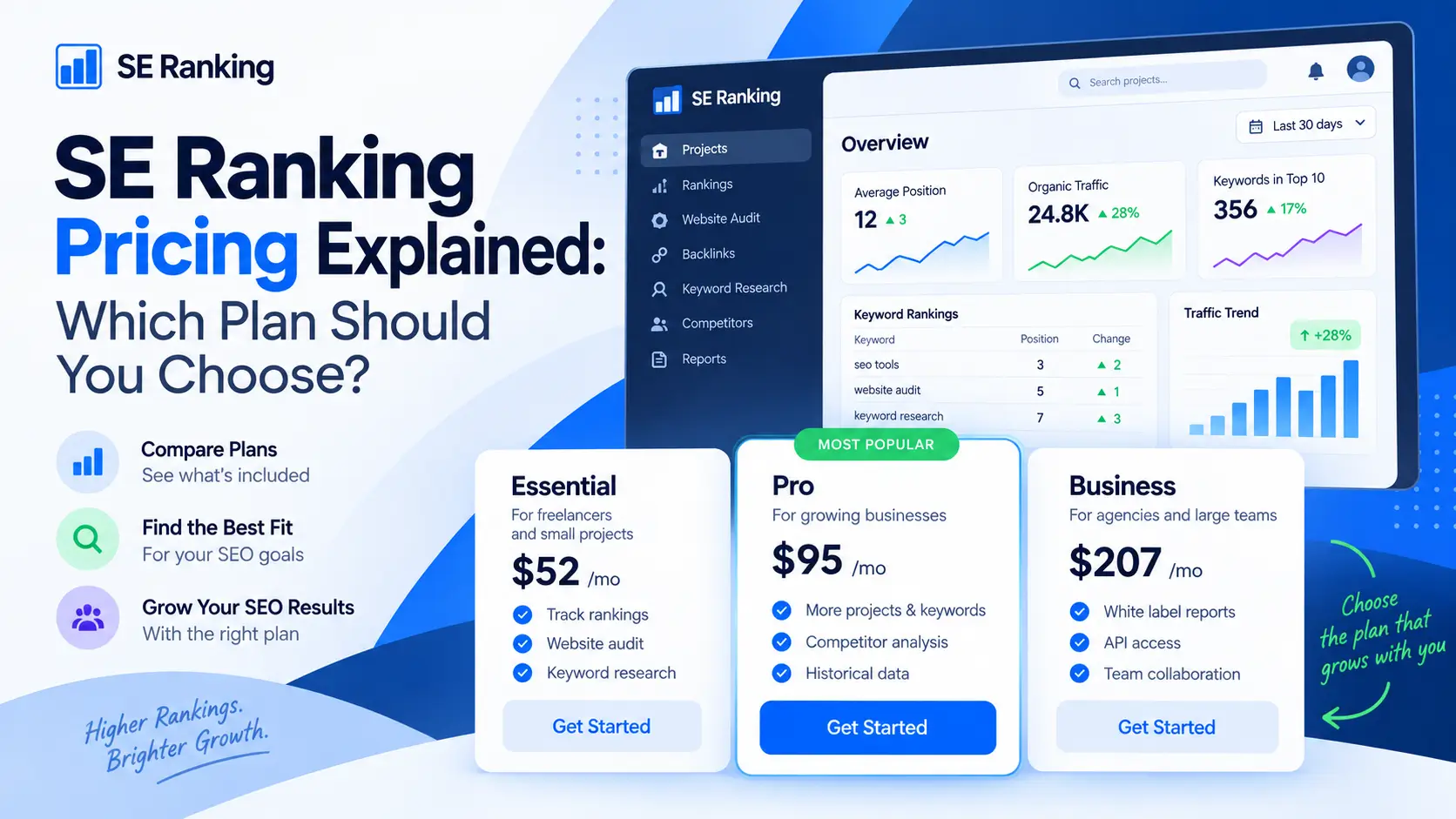
1. SE Ranking
SE Ranking is one of the better tools in this category because it supports traffic forecasting and practical keyword workflows in a way that is easier to operationalize than many heavier platforms.
It is useful for:
- forecasting potential traffic
- evaluating keywords
- prioritizing opportunities
- combining classic SEO with newer AI visibility workflows
My take
If I wanted forecasting in a way that felt useful to a SaaS growth team rather than just interesting to an SEO analyst, SE Ranking would be one of the first tools I would test.
⚙️ Best Tools for Automation, Privacy, and One-Click Execution
SaaS sites often have:
- many landing pages
- pricing pages
- integrations pages
- feature pages
- comparison pages
- help docs
That means scale matters.
1. Alli AI
Alli AI is one of the clearest tools in this article for large-scale implementation.
It helps with:
- bulk on-page changes
- title and meta updates
- schema-related adjustments
- deployment without waiting on developers
- broad execution across many pages
That is incredibly useful for larger SaaS websites.
2. Jasper
Jasper also matters here for a different reason: privacy.
If a SaaS company is handling sensitive positioning, product messaging, or internal brand systems, privacy and model-training policies matter.
My take
If the biggest problem is implementation speed, I would look at Alli AI first. If the biggest concern is privacy and enterprise-safe AI workflows, Jasper matters more.
✅ Pros and Cons of the Leading Tools
1. WordLift
Pros
- Strong entity and schema support
- Useful for product classification and semantic clarity
- Helps machines understand complex software categories better
Cons
- More specialized than an all-in-one SEO suite
- Best as part of a wider SaaS SEO strategy
2. Peec AI
Pros
- Strong AI search visibility tracking
- Useful share-of-voice reporting
- Good fit for modern SaaS AI-discovery workflows
Cons
- More specialized than classic SEO platforms
- Best when AI visibility is already a strategic KPI
3. Profound
Pros
- Strong brand intelligence for AI search
- Good sentiment and citation analysis
- Useful for strategic benchmarking against competitors
Cons
- More advanced and specialized
- Better fit for serious AI-visibility programs than lightweight teams
4. Jasper
Pros
- Strong brand voice control
- Useful for comparison-page writing and content consistency
- Strong privacy and enterprise-ready positioning
Cons
- Not a complete SEO platform on its own
- Needs keyword, visibility, and optimization support around it
5. Search Atlas
Pros
- Strong intent modeling
- Useful semantic relevance and GEO/AEO framing
- Good for buyer intent and comparison page strategy
Cons
- Broader platform than some teams need at the start
- Best when the SaaS team wants a deeper integrated workflow
6. HubSpot Breeze
Pros
- Useful for docs, knowledge base, and blog workflows
- Practical for turning support knowledge into content
- Good fit for SaaS teams already inside HubSpot
Cons
- Strongest inside the HubSpot ecosystem
- Less useful if the company’s content stack is elsewhere
7. Originality.ai
Pros
- Strong content quality controls
- Good for AI checking, plagiarism, readability, and fact checking
- Useful for technical content publishing at scale
Cons
- Not a growth platform by itself
- Best as a final review layer, not the main SEO engine
8. SE Ranking
Pros
- Strong value
- Forecasting and practical SEO workflows
- Easier to operationalize for learner teams
Cons
- Not as deep as the biggest enterprise suites
- Better on balance than on category-leading depth
9. Alli AI
Pros
- Excellent bulk on-page execution
- Strong no-code or low-code implementation layer
- Saves a large team in real time
Cons
- More operational than strategic
- Best when the team already knows what it wants to deploy
🧭 The Decision Matrix
| Tool | Price position | Strongest advantage | Best for |
|---|---|---|---|
| WordLift | Mid to premium | Entity building and semantic clarity | SaaS brands with complex positioning |
| Peec AI | Mid to premium | AI share of voice and citation visibility | SaaS teams focused on AI search discovery |
| Profound | Premium | Strategic AI visibility and brand sentiment | More advanced SaaS marketing teams |
| Jasper | Mid to premium | Brand voice and comparison-page writing | Teams producing high volumes of branded content |
| Search Atlas | Premium | Intent modeling and AEO/GEO support | Teams focused on semantic relevance and conversion intent |
| HubSpot Breeze | Ecosystem-dependent | Docs-to-content workflow potential | SaaS brands with strong knowledge-base content |
| Originality.ai | Affordable to mid | Content quality control | Teams publishing technical content at scale |
| SE Ranking | Affordable to mid | Forecasting and practical SEO execution | Lean SaaS teams that want balance |
| Alli AI | Mid to premium | One-click large-scale on-page fixes | SaaS sites with many pages and limited dev bandwidth |
My simpler buying advice
- Choose WordLift if your product needs stronger entity clarity
- Choose Peec AI if you care most about the AI share of voice
- Choose Profound if brand sentiment and competitive AI reporting matter most
- Choose Jasper if you need scalable comparison pages with a strong brand voice
- Choose Search Atlas if your team wants stronger intent modeling and AEO/GEO alignment
- Choose HubSpot Breeze if your help center is a hidden content asset
- Choose Originality.ai if quality control is becoming a risk
- Choose SE Ranking if you want practical prioritization and forecasting
- Choose Alli AI if implementation speed is your biggest bottleneck
❓ Best AI Tools for SaaS SEO FAQ
1. What is the best AI visibility tool for SaaS SEO?
For operational AI visibility tracking, Peec AI is one of the strongest options. For more strategic AI visibility and brand intelligence, Profound is a very strong choice.
2. What is the best tool for SaaS entity SEO?
WordLift is one of the strongest options because it helps build structured, machine-readable entity relationships around the product and its content.
3. What is the best tool for SaaS comparison pages?
Jasper is especially useful when the team needs scalable comparison-page writing with better brand control and consistency.
4. What is the best docs-to-content tool for SaaS SEO?
HubSpot Breeze is one of the more practical options if the company already has a knowledge base and wants to turn existing support content into blog or SEO assets more efficiently.
5. Do SaaS companies need GEO and AEO tools already?
Yes, especially in crowded categories where answer engines influence buying decisions before the click.
6. What is the best forecasting tool for SaaS SEO?
SE Ranking is one of the stronger practical options when the team wants traffic forecasting and easier keyword prioritization.
7. What is the best quality-control tool for AI-assisted SaaS content?
Originality.ai is one of the best options for AI checking, plagiarism checks, fact checking, and readability control.
8. What is the best no-code SEO execution tool for SaaS sites?
Alli AI is one of the strongest tools for deploying changes across many pages without heavy developer involvement.
🏁 Final Thoughts
When I think about the best AI tools for SaaS SEO, I do not think first about who has the biggest dashboard.
I think about who helps a SaaS brand become:
- easier to understand
- easier to recommend
- easier to compare
- easier to cite
- easier to scale
If I had to reduce the whole article to one idea, it would be this:
The future of SaaS SEO is not just ranking for software keywords. It is becoming the software entity that search engines and AI systems trust enough to recommend.
Recommended Next Reads
- Best AI SEO Platforms for Client Reporting
- Best AI SEO Tools Tested for Agencies
- Best GEO Tools Tested
- Best AEO Tools Tested
- Ahrefs vs Semrush for AI Visibility
Comments 4