Ahrefs Review: Is This SEO and AI Marketing Platform Worth It?
🚀 Introduction
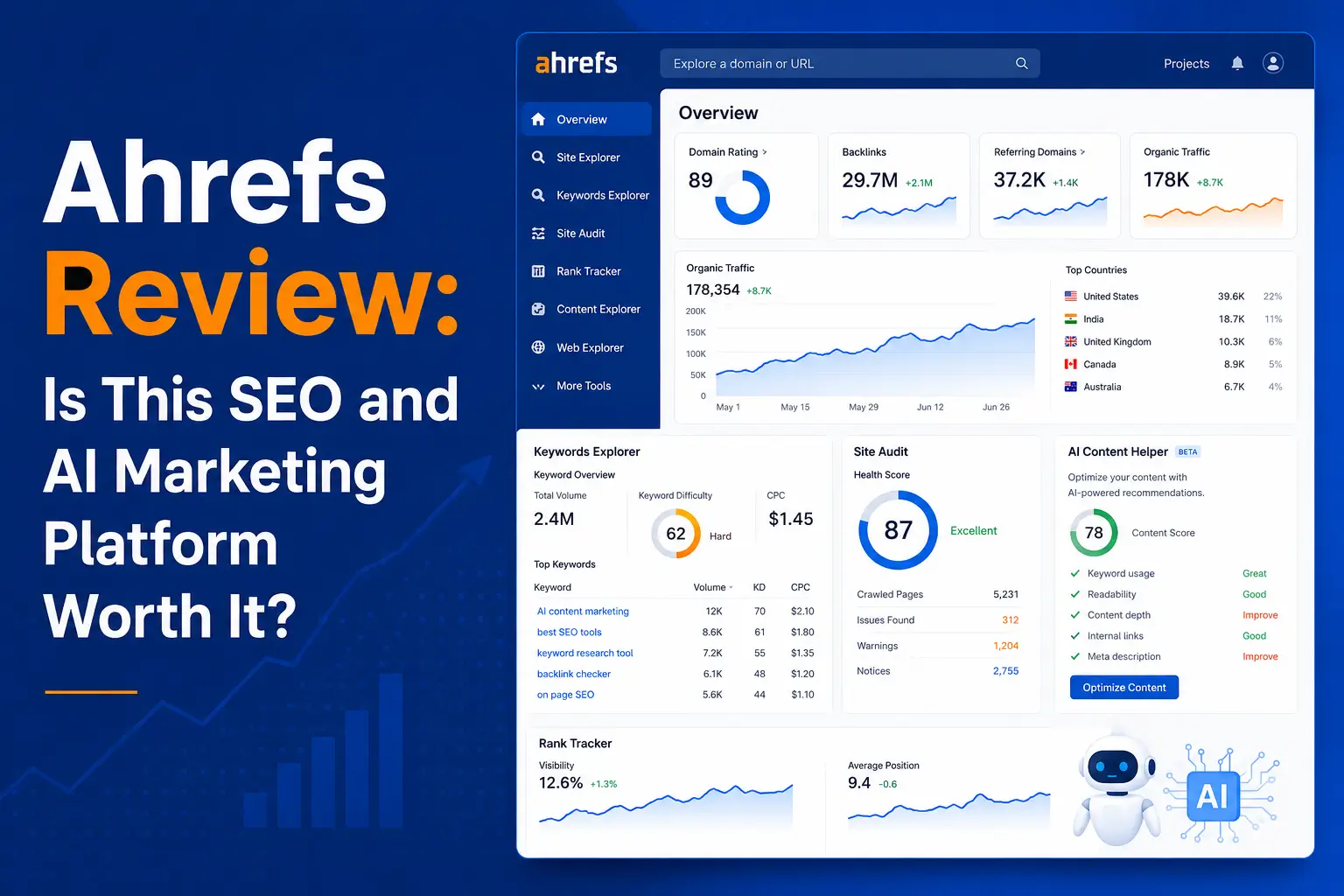
Ahrefs is one of the strongest SEO platforms for backlink analysis, competitor research, keyword research, rank tracking, technical audits, and AI search visibility. It is best for SEO professionals, agencies, SaaS teams, publishers, and serious marketers, but it may be too expensive for beginners.
Ahrefs started with a reputation for backlink data, but it has grown into a broader SEO and AI marketing platform. Today, it supports classic SEO workflows such as Site Explorer, Keywords Explorer, Site Audit, Rank Tracker, and Content Explorer, while also moving into AI visibility, brand monitoring, and AI-assisted content workflows.
That shift matters.
Modern SEO is no longer only about ranking in Google. Brands also need to understand how they appear across AI answers, search results, competitor landscapes, and content discovery systems.
In this Ahrefs review, I will explain what Ahrefs does, who it is best for, where it performs well, where it falls short, and whether it is worth paying for.
⚡ Quick Verdict
Ahrefs is worth it if you need serious SEO data for backlinks, competitors, keywords, content gaps, technical audits, rank tracking, and AI visibility.
It is not the cheapest SEO tool, and it may be too much for small websites that only need basic keyword research. But for teams that use SEO as a real growth channel, Ahrefs remains one of the most valuable platforms on the market.
| Question | Quick Answer |
|---|---|
| Best for | SEO professionals, agencies, SaaS teams, affiliate marketers, publishers, and serious content teams. |
| Strongest feature | Site Explorer for backlink analysis, competitor research, and organic search intelligence. |
| Biggest advantage | Ahrefs gives deep competitive SEO data across backlinks, keywords, top pages, content gaps, and AI visibility. |
| Biggest drawback | Pricing and usage limits can feel high for beginners, freelancers, and small sites. |
| Best alternatives | Semrush for broader marketing workflows, SE Ranking for agencies, Mangools for beginners, and Screaming Frog for technical audits. |
| My verdict | Ahrefs is one of the best SEO research platforms if you can justify the cost and actively use the data. |
| I would use Ahrefs if you need | I would not use Ahrefs if you need |
|---|---|
| Deep backlink analysis | The cheapest SEO tool possible |
| Competitor SEO research | A beginner-only keyword tool |
| Keyword research at scale | One-click AI article writing |
| Content gap analysis | Premium content optimization like Clearscope |
| Rank tracking and site audits | Full SEO automation like Search Atlas OTTO SEO |
| AI visibility and brand monitoring | A simple WordPress SEO plugin |
| Large-scale SEO strategy | A tool only for internal linking |
| Strong data before content planning | A lightweight tool for occasional blogging |
The clearest takeaway is this: Ahrefs is not the cheapest SEO tool, but it is one of the strongest platforms for understanding why competitors rank and what your site needs to improve.
📚 Recommended Reads
- Ahrefs vs Semrush for AI Visibility: Which One Is Better?
- Semrush Review: Is It Worth It for SEO and AI Visibility?
- Best AI SEO Tools Tested for This Year
- Best AI Keyword Research Tools Tested This Year
- Best AI Visibility Tools Tested
📌 In This Guide
- What Is Ahrefs?
- How Ahrefs Works
- Ahrefs Key Features
- Ahrefs for SEO, Content, and AI Visibility
- Ahrefs Pricing and Value
- Real-World Evidence: What Independent Reviews and User Feedback Show
- Ahrefs Pros and Cons
- Ahrefs for Agencies and SEO Professionals
- Ahrefs for Bloggers and Affiliate Site Owners
- Ahrefs for SaaS and Content Teams
- Ahrefs Alternatives
- My Practical Ahrefs Workflow
- Common Mistakes When Using Ahrefs
- FAQ
- Final Verdict: Is Ahrefs Worth It?
- Recommended Next Reads
🧠 What Is Ahrefs?
Ahrefs is an SEO and AI marketing platform used for keyword research, backlink analysis, competitor research, technical SEO audits, rank tracking, content research, and brand visibility monitoring.
It is one of the most recognized tools in the SEO industry because of its large backlink index and strong competitor research features.
Ahrefs can help with:
- Backlink analysis.
- Competitor research.
- Keyword research.
- Content gap analysis.
- Rank tracking.
- Site audits.
- Organic traffic estimates.
- Paid search research.
- Top pages analysis.
- Broken backlink research.
- Content Explorer.
- Brand Radar.
- AI visibility monitoring.
- AI Content Helper.
- Webmaster Tools.
- SEO browser extension.
- Reporting and dashboards.
- Technical SEO issue detection.
The most effective way to understand Ahrefs is to see it as a research-first SEO platform.
It helps answer questions like:
- Which keywords do competitors rank for?
- Which pages drive the most organic traffic for competitors?
- Who links to my competitors?
- What content gaps does my site have?
- Which pages are losing visibility?
- Which keywords are worth targeting?
- Which backlinks are helping a competitor?
- How visible is my brand across search and AI systems?
That makes Ahrefs especially useful before you create content, update content, build links, or plan an SEO campaign.
It gives you the data to make better decisions.
⚙️ How Ahrefs Works
Ahrefs works by crawling the web, collecting backlinks and search data, and turning that data into tools for SEO research and monitoring.
A typical Ahrefs workflow may look like this:
- Add your website as a project.
- Use Site Audit to find technical and on-page SEO issues.
- Use Site Explorer to analyze your own site and competitors.
- Use Keywords Explorer to find keyword opportunities.
- Use Content Gap to find keywords competitors rank for, but you do not.
- Use Top Pages to see what content drives traffic.
- Use Backlinks and Referring Domains reports to study link profiles.
- Use Rank Tracker to monitor important keywords.
- Use Brand Radar or AI visibility tools to understand AI search presence.
- Turn the findings into content, link-building, and optimization actions.
This workflow is useful because SEO is not only about finding keywords.
Strong SEO needs a complete view of:
- search demand
- competition
- backlinks
- content quality
- technical health
- internal links
- topical authority
- brand visibility
- search intent
- AI visibility
Ahrefs helps connect many of those signals.
One of the strongest patterns is that Ahrefs becomes more valuable when you use it to make decisions, not just for reports.
The tool can show you data, but the real value comes from choosing better keywords, creating better content, improving technical issues, and finding stronger link opportunities.
🛠️ Ahrefs Key Features
🔎 Site Explorer
Site Explorer is one of Ahrefs’ strongest features.
It lets you analyze any domain, subdomain, URL, or path to understand organic traffic estimates, backlinks, referring domains, top pages, organic keywords, paid keywords, content gaps, and competitor performance.
This is useful because competitor research is one of the fastest ways to understand a market.
With Site Explorer, you can review:
- Which pages drive the most traffic to a competitor?
- Which keywords do they rank for?
- Which pages attract backlinks?
- Which domains link to them?
- Which content topics are working?
- Which pages have lost or gained traffic?
- Which pages could inspire your own content plan?
- Which competitors are growing?
The biggest mistake is using Site Explorer only to check traffic estimates.
The better use is to reverse-engineer the strategy.
For example, if a competitor has several high-traffic comparison pages, that may reveal a content opportunity. If a competitor has many backlinks to research reports, that may reveal a digital PR angle. If a competitor has weak content ranking for valuable keywords, that may reveal an opportunity to create something better.
Site Explorer is where Ahrefs feels strongest.
🔗 Backlink Analysis
Ahrefs is famous for backlink analysis.
The platform helps users inspect backlinks, referring domains, anchor text, lost links, new links, broken backlinks, link growth, and competitor link profiles.
This is useful because backlinks still influence SEO, especially in competitive markets.
A backlink workflow in Ahrefs may include:
- Analyze competitor referring domains.
- Find links pointing to competing pages.
- Review anchor text.
- Identify broken backlink opportunities.
- Find resource pages.
- Study linkable assets.
- Track lost backlinks.
- Compare link profiles across competitors.
- Build outreach targets.
- Monitor link growth over time.
Ahrefs is especially useful for understanding why a page may be difficult to outrank.
If a competing page has hundreds of strong referring domains, you may need more authority, better links, or a different keyword strategy. If a page ranks with few backlinks, content quality and intent may matter more.
The clearest signal is this: Ahrefs helps you understand link-based competition better than most SEO tools.
🧠 Keywords Explorer
Keywords Explorer is Ahrefs’ keyword research tool.
It helps users find keyword ideas, search volume, keyword difficulty, clicks, parent topics, SERP overview, ranking pages, related terms, questions, and traffic potential.
This is useful because keyword research should not stop at search volume.
A keyword with 10,000 searches may be less valuable than a keyword with 500 searches if the smaller keyword has stronger intent and easier competition.
Ahrefs helps users evaluate keywords through multiple angles:
- Search volume.
- Keyword difficulty.
- Traffic potential.
- Parent topic.
- Clicks.
- Search intent.
- SERP features.
- Ranking pages.
- Related keywords.
- Competitor pages.
The most effective way to use Keywords Explorer is to move from keyword to topic.
For example, instead of targeting one exact phrase, you can identify a parent topic and build a page that covers the broader intent.
This is especially useful for content hubs, affiliate sites, SaaS blogs, and SEO content teams.
🧩 Content Gap
Content Gap is one of Ahrefs’ most practical strategy features.
It shows keywords that your competitors rank for, but your site does not.
This can help you find missing content opportunities.
A content gap workflow may look like this:
- Enter your domain.
- Add competing domains.
- Run Content Gap.
- Review keywords competitors rank for.
- Filter by intent, difficulty, and relevance.
- Group opportunities into clusters.
- Decide what to create, update, or ignore.
- Build a content roadmap.
This is useful because competitor content gaps often reveal market expectations.
If three competitors rank for a topic and your site has no page on it, that may be a content gap. But not every gap is worth filling. You still need to check business value, difficulty, search intent, and whether your site can create something better.
The biggest mistake is turning every gap into an article.
Content Gap should inspire strategy, not create a random content calendar.
🧪 Site Audit
Ahrefs includes Site Audit for technical and on-page SEO checks.
It can crawl your website and report issues related to:
- Indexability.
- Crawlability.
- Internal links.
- Redirects.
- Broken pages.
- Title tags.
- Meta descriptions.
- Canonicals.
- Hreflang.
- Structured data.
- Performance.
- Content quality.
- Duplicate pages.
- Images.
This is useful because technical SEO problems can weaken otherwise strong content.
A practical audit workflow could include:
- Run a crawl.
- Review the Health Score.
- Prioritize errors over warnings.
- Focus on indexability problems first.
- Fix broken internal links.
- Review redirected internal links.
- Check duplicate metadata.
- Review important pages with issues.
- Re-crawl after fixes.
- Monitor changes over time.
Ahrefs Site Audit is useful, but Screaming Frog or Sitebulb may still be better for deep technical SEO specialists who need more crawl control.
Ahrefs is better when you want audits inside a broader SEO research platform.
📈 Rank Tracker
Ahrefs Rank Tracker helps users monitor keyword positions over time.
It can track rankings across countries, devices, and search locations depending on setup and plan limits.
Rank tracking is useful because SEO results take time.
After publishing or updating content, you need to know whether pages are moving up, stuck, or declining.
A rank tracking workflow may include:
- Add priority keywords.
- Group keywords by page or topic.
- Track desktop and mobile rankings.
- Monitor competitors.
- Review ranking movement after updates.
- Identify pages stuck on page two.
- Improve internal links and content depth.
- Track results over time.
Rank Tracker is especially useful for agencies and SEO teams that need to monitor performance across important keyword groups.
📝 Content Explorer
Content Explorer helps users research content across the web.
You can search topics and discover pages by organic traffic, backlinks, referring domains, publish date, language, author, and other filters.
This is useful for:
- Content research.
- Linkable asset ideas.
- Digital PR research.
- Guest post prospecting.
- Trend analysis.
- Content gap discovery.
- Finding outdated content.
- Finding pages that attract links.
Content Explorer is especially useful when planning content that needs to earn backlinks.
For example, if you search a topic and find that statistics pages attract many referring domains, that may suggest a data-led content opportunity. If how-to guides get traffic but few links, that may suggest an organic traffic opportunity but not a link-building one.
This helps teams decide what type of content to create.
🤖 Brand Radar and AI Visibility
Ahrefs has expanded into AI visibility and brand monitoring through features such as Brand Radar and AI visibility tools.
This matters because search is changing.
Brands now need to know not only where they rank in Google, but also how they appear across AI-generated answers and large language model responses.
AI visibility workflows can help users understand:
- Whether AI systems mention their brand.
- Which competitors appear in AI answers?
- Which prompts trigger brand mentions?
- How brand share of voice changes.
- How AI search visibility compares with traditional SEO visibility.
- Which topics need stronger authority signals?
This is especially useful for SaaS companies, agencies, enterprise brands, and AI SEO teams.
Ahrefs is not only a backlink tool anymore. Its move into AI visibility makes it more relevant for Searchmora’s audience.
🧰 Ahrefs Webmaster Tools
Ahrefs Webmaster Tools gives website owners free, limited access to some Ahrefs data for verified websites.
It includes access to tools such as Site Audit and Site Explorer for your own site, with limits.
This is useful for small site owners who cannot justify a paid Ahrefs plan yet.
A practical use of Ahrefs Webmaster Tools could include:
- Verify your website.
- Run a site audit.
- Review technical SEO issues.
- Check which pages get traffic.
- Review backlinks to your own site.
- Monitor basic SEO health.
- Upgrade later if deeper competitor data is needed.
This is a smart way to test Ahrefs before paying.
🔎 Ahrefs for SEO, Content, and AI Visibility
Ahrefs is useful across several SEO workflows.
It can help with:
- backlink analysis
- keyword research
- competitor research
- content gap analysis
- rank tracking
- technical SEO audits
- content research
- broken link building
- digital PR research
- AI visibility monitoring
- brand tracking
- strategic SEO planning
However, Ahrefs does not replace:
- hands-on technical SEO crawling in every case
- premium content optimization
- AI article writing workflows
- internal linking plugins
- SEO automation tools
- conversion analytics
- editorial judgment
- human strategy
The most effective way to use Ahrefs is as the research layer of your SEO stack.
A practical workflow could look like this:
- Use Site Explorer to analyze competitors.
- Use Content Gap to find missing topics.
- Use Keywords Explorer to validate search demand.
- Use Site Audit to clean technical issues.
- Use Content Explorer to find linkable content angles.
- Create or update content based on the findings.
- Build internal links to important pages.
- Use backlink reports to plan outreach.
- Track rankings in Rank Tracker.
- Monitor brand and AI visibility over time.
Ahrefs tells you where opportunities are.
Your team still needs to turn those opportunities into content, links, fixes, and growth.
💰 Ahrefs Pricing and Value
Ahrefs is a premium SEO platform, and pricing is one of the biggest factors in deciding whether it is right for you.
At the time of writing, Ahrefs’ current paid plans include:
| Plan | Monthly Price | Best For |
|---|---|---|
| Starter | $29/month | Users who want limited access to Ahrefs core tools. |
| Lite | $129/month | Small businesses, freelancers, and solo marketers. |
| Standard | $249/month | SEO professionals and growing teams. |
| Advanced | $449/month | Agencies and larger marketing teams. |
| Enterprise | $1,499/month | Large organizations with advanced needs. |
Annual billing may provide savings, and plan limits can vary by projects, users, historical data, credits, tracked keywords, crawl credits, exports, and advanced features.
Ahrefs also offers free, limited access through Ahrefs Webmaster Tools for verified sites.
Prices may change over time, so always check Ahrefs’ official pricing page before subscribing.
Here is how I would think about value:
| User Type | Is Ahrefs Worth It? | Why |
|---|---|---|
| New blogger | Usually no | Start with free tools like Mangools, LowFruits, or Ubersuggest. |
| Affiliate site owner | Yes, if revenue supports it | Strong for competitor research, backlinks, and keyword gaps. |
| SEO freelancer | Maybe | Worth it if client work needs deep research. |
| SEO agency | Yes | Strong fit for competitive analysis, backlinks, rank tracking, and audits. |
| SaaS content team | Yes | Useful for product-led SEO, content gaps, and competitor research. |
| Publisher | Yes | Strong for content research and link analysis. |
| Enterprise SEO team | Yes | Best value when SEO is a serious acquisition channel. |
Ahrefs becomes easier to justify when the data directly supports revenue.
If you use Ahrefs to find content opportunities, build links, improve technical SEO, and win more organic traffic, the cost can be reasonable.
If you only open it once a month to check search volume, it is probably too expensive.
📊 Real-World Evidence: What Independent Reviews and User Feedback Show
Ahrefs has a strong industry reputation, but external reviews help show both its strengths and weaknesses more clearly.
External sources: EXPERTE.com independent Ahrefs review, TechRadar Ahrefs review, and G2 verified Ahrefs reviews.
EXPERTE.com reviewed Ahrefs as an SEO platform and highlighted its strong competitor analysis, backlink profile insights, content gap analysis, and top pages reports. Their review also gives a useful warning: traffic estimates can be inaccurate, so Ahrefs data should be used for directional decisions rather than treated as perfect analytics data.
TechRadar’s Ahrefs review describes it as a premium SEO platform with core tools such as Site Explorer, Keywords Explorer, Site Audit, Rank Tracker, and Content Explorer. The review also notes newer AI-focused features such as Brand Radar and AI Content Helper, which show how Ahrefs is expanding beyond classic SEO.
G2 user feedback is also useful because it reflects real customer experience. G2’s review summary says users consistently praise Ahrefs for backlink data, keyword research, competitor analysis, and ease of setup, while many users also mention pricing as a concern for freelancers and small teams.
Here is the practical evidence summary:
| Evidence Point | What It Means for Ahrefs Users |
|---|---|
| Independent expert reviews | Ahrefs is consistently positioned as a top-tier SEO platform. |
| Strong backlink and competitor research feedback | Supports Ahrefs’ reputation as a research-first SEO tool. |
| Content gap and top pages reports praised | Confirms its value for content strategy and competitor analysis. |
| AI visibility features noted externally | Shows Ahrefs is expanding into AI search and brand visibility workflows. |
| Pricing criticism from users | Confirms that Ahrefs may be difficult to justify for beginners and small teams. |
| Traffic estimates are directional | Ahrefs should guide decisions, not replace first-party analytics. |
For Searchmora readers, the fair conclusion is this:
Ahrefs is best supported as a premium SEO intelligence platform. It is excellent for discovering opportunities, understanding competitors, studying backlinks, and planning content. But it does not guarantee rankings, and its estimates should be validated with Google Search Console, analytics data, and manual SERP review.
A smart 30-day Ahrefs test would look like this:
- Add your website as a project.
- Run Site Audit and fix the highest-priority technical issues.
- Use Site Explorer to analyze 3–5 competitors.
- Run Content Gap to find missing keyword opportunities.
- Choose 10 realistic keywords from Keywords Explorer.
- Identify 5 competitor pages worth improving on.
- Publish or refresh 3–5 pieces of content.
- Build internal links to the updated pages.
- Review backlink opportunities from competitor reports.
- Track rankings and Search Console performance for 60–90 days.
The strongest way to use Ahrefs is to turn data into decisions. Reports alone do not grow traffic. Better keywords, better content, better links, and better technical execution do.
✅ Ahrefs Pros and Cons
✅ Pros
| Pro | Why It Matters |
|---|---|
| Excellent backlink analysis | Helps users understand link profiles, referring domains, anchors, and competitor authority. |
| Strong competitor research | Site Explorer makes it easy to study competing domains, pages, and keywords. |
| Powerful keyword research | Keywords Explorer supports topic discovery, difficulty checks, and traffic potential analysis. |
| Content Gap is very practical | Helps find missing topics competitors rank for. |
| Site Audit included | Useful for identifying technical and on-page SEO issues. |
| Rank tracking included | Helps monitor keyword performance over time. |
| Content Explorer is useful for linkable assets | Helps find content ideas that attract traffic or backlinks. |
| AI visibility direction | Brand Radar and AI-focused tools make Ahrefs more relevant for modern search. |
| Ahrefs Webmaster Tools | Free limited access helps site owners monitor their own websites. |
❌ Cons
| Con | Why It Matters |
|---|---|
| Expensive for beginners | Small sites may not use enough features to justify the cost. |
| Usage limits can be confusing | Plans, credits, exports, and historical data limits need review. |
| Not a premium content optimizer | Tools like Clearscope, Surfer, and NeuronWriter are better for article scoring. |
| Not a full technical crawler replacement | Screaming Frog and Sitebulb offer more technical crawl control. |
| Traffic estimates are not analytics data | Use Ahrefs estimates directionally, not as exact traffic numbers. |
| No automatic SEO implementation | Search Atlas OTTO SEO and Alli AI are better for deployment automation. |
| AI tools may require add-ons or higher plans | Users should check feature access before subscribing. |
The biggest mistake is buying Ahrefs without a clear workflow.
Ahrefs is powerful, but it only pays off if you use the data regularly to make better content, link-building, and SEO strategy decisions.
🧑💼 Ahrefs for Agencies and SEO Professionals
Ahrefs is one of the strongest tools for agencies and SEO professionals.
Agencies can use Ahrefs for:
- Competitor analysis.
- Keyword research.
- Content gap reports.
- Backlink audits.
- Link-building research.
- Technical site audits.
- Rank tracking.
- Content research.
- Client strategy.
- SEO reporting support.
I would use it if you need:
| Use Ahrefs If | Why |
|---|---|
| You analyze competitors often | Site Explorer is excellent for competitor intelligence. |
| You build links | Backlink data and broken link reports are very useful. |
| You plan content strategies | Content Gap and Top Pages help identify opportunities. |
| You need keyword research at scale | Keywords Explorer is strong for serious SEO planning. |
| You manage SEO clients | Ahrefs supports audits, tracking, and research in one platform. |
I would not use it if you need:
| Avoid Ahrefs If | Better Fit |
|---|---|
| White-label reporting as the main need | SE Ranking or AgencyAnalytics |
| Deep technical crawling | Screaming Frog or Sitebulb |
| Content optimization scoring | Clearscope, Surfer, NeuronWriter |
| Automated SEO deployment | Search Atlas OTTO SEO or Alli AI |
| Budget beginner SEO | Mangools, Ubersuggest, LowFruits |
For agencies, Ahrefs is strongest as a strategy and research tool.
It helps you understand competitors, content gaps, and backlinks before deciding what to do.
🧲 Ahrefs for Bloggers and Affiliate Site Owners
Ahrefs can be very useful for bloggers and affiliate site owners, but only when the site is mature enough to justify the price.
A blogger can use Ahrefs to:
- Find keyword opportunities.
- Study competitor blogs.
- Identify content gaps.
- Track rankings.
- Find backlink opportunities.
- Audit technical issues.
- Research content ideas.
An affiliate site owner can use Ahrefs to:
- Analyze competitor money pages.
- Find “best” and “review” keywords.
- Identify backlink gaps.
- Study top affiliate content.
- Find broken link opportunities.
- Track commercial rankings.
- Build content clusters.
I would use it if you need:
| Use Ahrefs If | Why |
|---|---|
| Your site already earns revenue | The cost is easier to justify. |
| You compete in difficult niches | Backlink and competitor data become more important. |
| You publish commercial content | Content Gap can reveal review and comparison opportunities. |
| You build links | Ahrefs is one of the strongest link research tools. |
| You want to study successful competitors | Top Pages and Organic Keywords are very useful. |
I would not use it if you need:
| Avoid Ahrefs If | Better Fit |
|---|---|
| Cheap keyword research | Mangools or Ubersuggest |
| Low-competition keyword discovery | LowFruits |
| Keyword clustering | WriterZen or Keyword Insights |
| Article optimization | NeuronWriter or Surfer |
| Internal linking | Link Whisper |
For affiliate SEO, Ahrefs is powerful because it shows why competitors win.
But it should not replace real product experience, screenshots, honest recommendations, and conversion-focused content.
🏢 Ahrefs for SaaS and Content Teams
Ahrefs is a strong fit for SaaS and content teams that use SEO as a major acquisition channel.
A SaaS team can use Ahrefs for:
- Product-led SEO research.
- Competitor comparison pages.
- Alternative content.
- Use-case content.
- Integration keyword research.
- Glossary pages.
- Content gap analysis.
- Linkable asset planning.
- Rank tracking.
- Brand visibility monitoring.
Ahrefs is especially useful for understanding competitors.
For example, a SaaS company can analyze:
- Which competitor pages bring the most traffic
- Which comparison pages rank
- Which alternative keywords matter
- Which content earns backlinks
- Which topics are missing from their own site?
- Which AI visibility areas competitors appear in
I would use it if you need:
- Competitive SEO research.
- Product-led content planning.
- Content gap analysis.
- Backlink and authority insights.
- AI visibility direction.
- Rank tracking for important keywords.
I would not use it if you need:
- Product analytics.
- Conversion testing.
- Technical documentation automation.
- AI article writing only.
- Enterprise content governance.
- Automated SEO deployment.
For SaaS teams, Ahrefs works best when paired with product marketers, content strategists, and subject matter experts.
The tool finds the opportunities. The team still needs to create content that reflects the product, customer pain points, and competitive positioning.
🔁 Ahrefs Alternatives
Ahrefs is powerful, but it is not the only SEO platform worth considering.
Here are the best alternatives depending on your main need:
| Alternative | Best For | Why Choose It Instead of Ahrefs |
|---|---|---|
| Semrush | All-in-one SEO and marketing | Better for PPC research, broader marketing workflows, local SEO, and agency reporting. |
| SE Ranking | Agency-friendly SEO platform | Better for affordable rank tracking, audits, reporting, and client workflows. |
| Mangools | Beginner-friendly SEO | Better if you want simple keyword research and rank tracking at a lower price. |
| Ubersuggest | Budget SEO basics | Better if you need a low-cost starter SEO tool. |
| Screaming Frog | Technical SEO crawling | Better for deep technical audits, crawl control, and migration checks. |
| Majestic | Link intelligence | Better if your main focus is link graph analysis. |
| Moz Pro | Beginner-to-mid SEO workflows | Better if you prefer Moz metrics and a simpler SEO suite. |
| Search Atlas OTTO SEO | AI SEO automation | Better if your main need is implementing SEO fixes at scale. |
Ahrefs’ advantage is SEO intelligence, especially backlinks and competitor research.
Its weakness is cost and the fact that it does not replace every specialist tool.
For many teams, Ahrefs works best as the research engine inside a broader SEO stack.
🧪 My Practical Ahrefs Workflow
If I were using Ahrefs for a Searchmora-style SEO project, I would use it as the research and strategy layer.
Start With Competitor Research
First, I would identify 5–10 direct competitors.
Then I would use Site Explorer to review:
- Top pages.
- Organic keywords.
- Backlinks.
- Referring domains.
- Content gaps.
- Traffic growth.
- Pages gaining or losing visibility.
Find Content Gaps
Next, I would use Content Gap.
I would look for keywords that several competitors rank for, but my site does not.
Then I would filter by:
- Relevance.
- Search intent.
- Difficulty.
- Business value.
- Traffic potential.
- Ranking realism.
Validate Keywords
After that, I would use Keywords Explorer.
I would check:
- Parent topic.
- Keyword difficulty.
- Traffic potential.
- SERP overview.
- Ranking pages.
- Clicks.
- Related questions.
- Search intent.
Plan Content
Then I would turn opportunities into content types.
For example:
- Review articles.
- Comparison pages.
- Alternative pages.
- Best tools lists.
- How-to guides.
- Glossary pages.
- Product-led pages.
- Linkable assets.
Check Backlink Requirements
Before publishing, I would check how many referring domains competing pages have.
If competitors have strong links, I would plan internal links and outreach.
Audit the Site
Next, I would run a Site Audit.
I would fix issues on important pages first.
Track Rankings
Finally, I would add important keywords to Rank Tracker and monitor results.
This workflow turns Ahrefs into a decision-making system instead of just a data dashboard.
⚠️ Common Mistakes When Using Ahrefs
Treating Traffic Estimates as Exact Numbers
Ahrefs traffic estimates are useful, but they are not analytics data.
Use them directionally.
Chasing High-Volume Keywords Too Early
High search volume does not mean a keyword is realistic.
Check difficulty, SERP strength, backlinks, and authority.
Ignoring Search Intent
A keyword may look valuable, but require a different page type.
Always review the SERP before creating content.
Only Looking at Backlinks
Ahrefs is excellent for backlinks, but SEO also needs content quality, internal links, technical health, and intent match.
Exporting Data Without Action
Reports do not grow traffic.
Use Ahrefs to create decisions, tasks, and content plans.
Buying Ahrefs Too Early
If your site is new and has no budget, Ahrefs may be too expensive.
Start with free tools, then upgrade when the data can support real revenue decisions.
Not Pairing Ahrefs With Content Optimization
Ahrefs helps you choose topics and study competitors.
A content optimizer like NeuronWriter, Surfer, or Clearscope may still help improve drafts before publishing.
❓ FAQ
1. Is Ahrefs good for SEO?
Yes, Ahrefs is one of the strongest SEO platforms for backlink analysis, keyword research, competitor research, content gap analysis, rank tracking, and technical site audits.
2. What is Ahrefs best for?
Ahrefs is best for backlink analysis, competitor research, keyword research, content gap analysis, top pages analysis, and SEO strategy planning.
3. Is Ahrefs worth it?
Ahrefs is worth it if SEO is a serious growth channel and you actively use the data. It may not be worth it for beginners or small sites that only need occasional keyword research.
4. How much does Ahrefs cost?
At the time of writing, Ahrefs paid plans include Starter at $29/month, Lite at $129/month, Standard at $249/month, Advanced at $449/month, and Enterprise at $1,499/month.
5. Is Ahrefs better than Semrush?
Ahrefs is often stronger for backlink analysis and competitor SEO research. Semrush may be better for broader digital marketing workflows, PPC research, local SEO, reporting, and content marketing tools.
6. Is Ahrefs better than Ubersuggest?
Ahrefs is much stronger for serious SEO research, backlinks, competitor analysis, and keyword data. Ubersuggest is cheaper and easier for beginners.
7. Does Ahrefs have a free plan?
Ahrefs offers Ahrefs Webmaster Tools, which gives free,e limited access to Site Audit and Site Explorer for verified websites.
8. Does Ahrefs track AI visibility?
Yes, Ahrefs has expanded into AI visibility and brand monitoring through tools such as Brand Radar and AI search-related features.
9. Does Ahrefs guarantee rankings?
No. Ahrefs provides SEO data and analysis, but rankings depend on search intent, content quality, backlinks, internal links, technical SEO, authority, competition, and execution.
🏁 Final Verdict: Is Ahrefs Worth It?
Ahrefs is worth it for SEO professionals, agencies, SaaS teams, affiliate marketers, publishers, and serious content teams that need deep SEO research and competitive intelligence.
It is not the cheapest tool, and it is not the best fit for every beginner. But if your SEO workflow depends on understanding competitors, backlinks, keyword gaps, rankings, and content opportunities, Ahrefs is one of the strongest platforms available.
My final recommendation is simple:
Use Ahrefs if SEO is a serious business challenge; you need reliable research data before making content, backlink, and strategy decisions.
Skip Ahrefs if you only need a cheap beginner tool, one-click AI writing, simple WordPress SEO settings, or automated SEO implementation.
For Searchmora readers, I would position Ahrefs as a premium SEO intelligence platform. Its strongest value is helping you understand the competitive landscape before you invest time and money into content, links, and SEO campaigns.
The clearest takeaway is this: Ahrefs is not just a keyword tool or backlink checker. It is a research engine for serious SEO decisions.
📚 Recommended Next Reads
To continue learning about SEO tools, AI visibility, and competitive research, these Searchmora guides are useful next reads:
- Ahrefs vs Semrush for AI Visibility: Which One Is Better?
- Semrush Review: Is It Worth It for SEO and AI Visibility?
- Best AI SEO Tools Tested for This Year
- Best AI Keyword Research Tools Tested This Year
- Best AI Visibility Tools Tested
Comments 4