🚀 Introduction
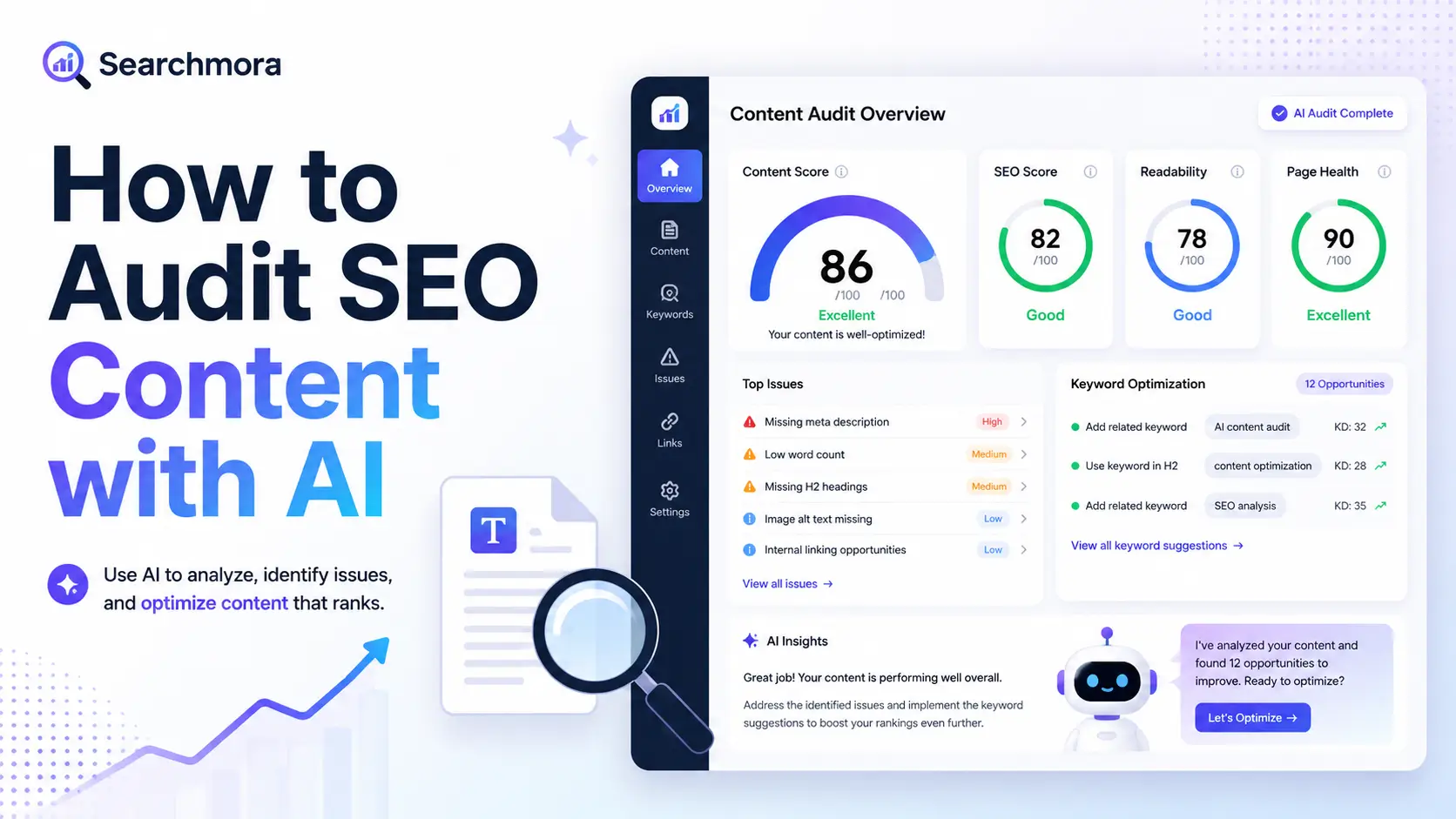
To audit SEO content with AI, combine crawl data with Google Search Console and GA4 performance, classify every page as Keep, Update, Merge, or Delete, compare priority pages with current competitors, inspect entity and topic gaps, evaluate citation readiness, and require human approval before making destructive changes.
AI can process hundreds or thousands of pages faster than a manual audit.
However, AI cannot make reliable content decisions when it receives only:
- A list of URLs.
- Page titles.
- Word counts.
- Publication dates.
- Generic SEO scores.
A useful content audit must combine technical, search, engagement, conversion, topical, and business data.
For example, a page with little organic traffic may still:
- Generate qualified leads.
- Support existing customers.
- Earn valuable backlinks.
- Rank during a specific season.
- Explain an essential product feature.
- Protect the company legally.
- Strengthen an important topic cluster.
- Assist conversions from other channels.
Deleting that page because an AI model labels it “low performing” could damage the business.
The safest role for AI is therefore:
Collect → classify → compare → prioritize → recommend
The final role of the SEO auditor is:
Verify → approve → implement → monitor
This guide explains how to create that workflow step by step.
⚡ Quick Verdict
The best AI content audit starts with real performance data, not an AI prompt. Export technical crawl data, Google Search Console metrics, GA4 engagement and conversion data, backlinks, internal links, and content details. Then use AI to identify patterns and recommend actions while keeping humans responsible for merges, redirects, noindex decisions, and deletions.
| Audit Stage | Best Use of AI | Human Responsibility |
|---|---|---|
| Data collection | Combine and clean large datasets | Confirm tracking accuracy |
| Page classification | Suggest Keep, Update, Merge, or Delete | Approve the final decision |
| Semantic audit | Find missing topics and entities | Decide what improves the article |
| Cannibalization | Detect pages with overlapping intent | Choose the primary page |
| GEO audit | Check answer structure and citations | Verify factual authority |
| Information gain | Flag generic or repeated content | Add real evidence and experience |
| Implementation | Prepare briefs and updates | Review and publish changes |
| Pruning | Identify weak candidates | Approve redirects or removals |
| Measurement | Summarize performance changes | Interpret business impact |
Content Audit Decision Matrix
| Page Condition | Recommended Action |
|---|---|
| High impressions, strong clicks, and conversions | Keep and protect |
| High impressions but low CTR | Update title, description, and intent alignment |
| Declining traffic with valuable backlinks | Update rather than delete |
| Two pages serving the same search intent | Merge and redirect carefully |
| Low traffic but strong conversions | Keep |
| No traffic, links, conversions, or strategic role | Consider pruning |
| Old facts but valuable topic | Update |
| Thin page supporting no cluster | Improve, merge, or remove |
| Strong ranking page | Avoid unnecessary rewriting |
| Weak page in an important cluster | Rewrite or consolidate |
The clearest takeaway is this: AI should narrow your content library into a manageable review queue, not make irreversible decisions without context.
📚 Recommended Reads
- Best AI SEO Tools Tested This Year: Practical Tools for Better Rankings, Content Quality, and AI Visibility
- NeuronWriter Review: Is This Budget-Friendly SEO Content Optimizer Worth It?
- Frase Review: Is It the Best AI SEO Tool for Content Optimization and AI Visibility?
- MarketMuse Review: Is This AI Content Strategy Platform Worth It?
- Search Atlas OTTO SEO Review: Is This AI SEO Automation Platform Worth It?
📌 In This Guide
1. 🧠 What Is an AI SEO Content Audit?
2. 📊 What Data Should You Collect?
3. 🔗 How to Combine Crawl, GSC, and GA4 Data
4. 🧭 Build the Keep, Update, Merge, or Delete Matrix
5. ✅ How to Identify Pages to Keep
6. 🔄 How to Identify Pages to Update
7. 🧩 How to Find Pages to Merge
8. 🗑️ How to Identify Pruning Candidates
9. 🧬 Run a Topical and Entity Audit
10. 🔎 Compare Old Content with Current SERPs
11. 🌐 Run a Citatability and AEO Audit
12. 💡 Audit Information Gain
13. 🛡️ Audit E-E-A-T and Trust Signals
14. 🏗️ Audit Content Structure
15. ⚙️ Audit Technical SEO and Schema
16. 🤖 Use AI Prompts for Content Auditing
17. 📋 Build an AI Content Audit Spreadsheet
18. 🚦 Prioritize the Audit Actions
19. 📈 Measure the Results
20. ⚠️ Avoid Human-in-the-Loop Failures
21. ❓ FAQ
22. 🏁 Final Content Audit Workflow
23. 📚 Recommended Next Reads
🧠 What Is an AI SEO Content Audit?
An AI SEO content audit is a structured review of published pages using technical crawl data, search performance, engagement, conversions, topical coverage, content quality, and AI-search readiness. AI helps organize the evidence and suggest actions, while an experienced human approves the final decisions.
A traditional content audit often depends on one large spreadsheet.
An auditor may manually review:
- URLs.
- Page titles.
- Organic traffic.
- Word counts.
- Publication dates.
- Rankings.
- Backlinks.
- Internal links.
- conversions.
- Content quality.
AI accelerates the process by:
- Summarizing pages.
- Classifying search intent.
- Finding related content.
- Detecting duplicate topics.
- Grouping pages into clusters.
- Identifying outdated information.
- Comparing pages with current competitors.
- Flagging weak answer structures.
- Suggesting update priorities.
- Creating detailed content briefs.
What AI Can Do Well
AI is useful for identifying patterns across large datasets.
For example, it can find:
- Pages with deep impressions but weak CTR.
- Articles are losing clicks year over year.
- Pages with similar titles and overlapping intent.
- Content that lacks clear answers.
- Pages missing important entities.
- Articles with no supporting evidence.
- Old pages that have not been updated.
- Content with weak internal linking.
- Pages that do not belong to a clear topic cluster.
What AI Cannot Know Automatically??
AI usually does not understand:
- Why does a low-traffic page exist
- Which pages support sales teams?
- Which pages are legally required?
- Which article protects a brand reputation?
- Which page converts through phone calls?
- Which content serves existing customers?
- Whether a case study is genuine.
- Whether an author has real expertise.
- Which technical configuration is intentional?
- Whether removing a page creates business risk.
That is why AI should act as an audit assistant, not an unsupervised decision maker.
📊 What Data Should You Collect?
A useful AI audit requires technical, search, engagement, conversion, authority, and editorial data. The richer and cleaner the dataset, the more useful the AI recommendations become.
Technical Crawl Data
Collect technical data using Screaming Frog, Sitebulb, Ahrefs, Semrush, or another crawler.
Important fields include:
| Technical Field | Why It Matters |
|---|---|
| URL | Identifies the page |
| Status code | Finds errors and redirects |
| Indexability | Shows whether the page can be indexed |
| Canonical URL | Detects duplicate or conflicting signals |
| Robots directive | Identifies noindex or blocked pages |
| Title | Helps classify topic and intent |
| Meta description | Supports CTR analysis |
| H1 | Confirms the page’s main subject |
| Word count | Provides context, not a quality decision |
| Internal inbound links | Shows how strongly the site supports the page |
| Internal outbound links | Shows how the page connects to the site |
| Crawl depth | Shows how difficult the page is to discover |
| Structured data | Identifies schema coverage |
| Last modified date | Helps detect possible staleness |
| Response time | Reveals technical performance issues |
Google Search Console Data
Collect:
- Clicks.
- Impressions.
- Average CTR.
- Average position.
- Queries.
- Countries.
- Devices.
- Search appearance.
- Indexed status where available.
- Comparison with previous periods.
Search Console reveals whether Google is showing the page and whether users choose it.
GA4 Data
Collect:
- Landing-page sessions.
- Engaged sessions.
- Engagement rate.
- Average engagement time.
- Key events.
- Leads.
- Purchases.
- Revenue.
- Returning users.
- Assisted with journey data where available.
GA4 helps prevent a common mistake:
Deleting a page because it has low search traffic, even though it produces conversions.
Backlink and Authority Data
Collect:
- Referring domains.
- Backlinks.
- Link quality.
- Anchor text.
- Lost links.
- External mentions.
- Pages receiving direct referral traffic.
A weak page with strong backlinks may be better updated or redirected than deleted.
Editorial and Business Data
Add:
- Page type.
- Target audience.
- Funnel stage.
- Topic cluster.
- Primary keyword.
- Author.
- Publication date.
- Last reviewed date.
- Business importance.
- Product or service relevance.
- Legal importance.
- Conversion purpose.
AI cannot infer all of this reliably from the page alone.
🔗 How to Combine Crawl, GSC, and GA4 Data
Combine technical crawl data with Search Console and GA4 using the final canonical URL as the shared identifier. This creates one row per page containing technical health, Google visibility, engagement, conversions, internal links, and editorial context.
Recommended Data Workflow
- Crawl the website.
- Export all indexable canonical URLs.
- Connect Google Search Console.
- Connect GA4.
- Import backlink data.
- Normalize URL formats.
- Remove tracking parameters.
- Match HTTP and HTTPS versions correctly.
- Match trailing-slash formats.
- Create one master content inventory.
Example Master Inventory
| URL | Status | Clicks | Impressions | CTR | Position | Sessions | Conversions | Inlinks | Backlinks |
|---|---|---|---|---|---|---|---|---|---|
| /ai-seo-guide/ | 200 | 1,200 | 30,000 | 4% | 6.2 | 1,500 | 18 | 24 | 12 |
| /old-ai-seo-tips/ | 200 | 20 | 4,000 | 0.5% | 22 | 35 | 0 | 2 | 0 |
| /seo-software/ | 200 | 300 | 12,000 | 2.5% | 11 | 500 | 25 | 15 | 8 |
The third page may deserve higher priority than the second because it produces conversions.
Why Data Integration Matters
Each source answers a different question.
| Data Source | Main Question |
|---|---|
| Crawler | Can search engines access and understand the page? |
| Search Console | Does Google show the page, and do users click? |
| GA4 | What happens after users arrive? |
| Backlink tool | Does the page have external authority? |
| CMS data | Is the page current and strategically important? |
| AI semantic tool | Does the page cover the topic completely? |
| Human review | Does the page deserve to exist? |
No single tool can answer every question.
🧭 Build the Keep, Update, Merge, or Delete Matrix
The four-way content matrix turns a large inventory into clear actions. Every recommendation should use multiple signals rather than one metric.
Keep
Keep pages that perform well, convert, earn links, support important topics, or serve a valuable business purpose.
A page does not need rewriting simply because an AI tool suggests more terms.
Keep Signals
- Strong clicks.
- High-quality traffic.
- Meaningful conversions.
- Stable or improving rankings.
- Valuable backlinks.
- Strong engagement.
- Unique search intent.
- Strategic topic importance.
- Current and accurate information.
- Positive assisted-conversion value.
Protect Strong Pages
For strong pages, consider only low-risk improvements:
- Update outdated dates.
- Repair broken links.
- Add a new source.
- Improve one unclear explanation.
- Add relevant internal links.
- Preserve the URL and core intent.
Do not rewrite a successful page only to increase an optimization score.
Update
Update pages with visibility or authority that no longer perform as well as they should. Common candidates have high impressions but weak CTR, declining clicks, outdated information, weak structure, or missing topical coverage.
Update Signals
- Deep impressions but low CTR.
- Rankings between positions 5 and 20.
- Declining year-over-year clicks.
- Old prices, statistics, or screenshots.
- Changed search intent.
- Missing entities.
- New competitors with better coverage.
- Weak direct answers.
- Poor internal linking.
- Strong backlinks but outdated content.
What to Update
An update may include:
- A clearer title.
- A better meta description.
- A direct opening answer.
- Current examples.
- New statistics.
- Stronger sources.
- Missing sections.
- Better tables.
- Improved internal links.
- More specific conclusions.
- New screenshots.
- Author review.
High Impressions and Low CTR
This pattern may indicate:
- A weak title.
- A vague meta description.
- Search-intent mismatch.
- An outdated date.
- A stronger competing result.
- Visibility for loosely related queries.
- AI answers reduce clicks.
Do not rewrite the full article before checking which queries generate the impressions.
Merge
Merge pages when they compete for the same search intent, repeat the same information, split authority, or provide weaker versions of one stronger topic.
Merge Signals
- Similar target keywords.
- Similar ranking queries.
- Nearly identical SERPs.
- Repeated headings.
- Overlapping audience.
- Both pages perform weakly.
- Internal links point inconsistently.
- Google alternates between the URLs.
- Neither page covers the topic fully.
- One stronger combined page would serve users better.
Keyword Cannibalization Audit
Keyword overlap does not always mean cannibalization.
Two pages may rank for similar keywords while serving different purposes.
For example:
- “Best AI SEO tools”
- “AI SEO tools for agencies”
These pages may deserve separate URLs if the audience, tools, and recommendations differ substantially.
Merge Workflow
- Choose the strongest destination URL.
- Compare both pages.
- Preserve unique information.
- Retain useful examples and sources.
- Create one comprehensive version.
- Update internal links.
- Redirect the weaker URL.
- Update the sitemap.
- Check canonicals.
- Monitor rankings and traffic.
Never merge two pages only because an AI model says their titles are similar.
Delete or Prune
Delete or prune content only when it has no meaningful search, business, authority, legal, user, or strategic value and no useful consolidation opportunity exists.
Possible Pruning Signals
- No clicks over a meaningful period.
- No impressions.
- No conversions.
- No backlinks.
- No internal strategic role.
- Obsolete subject.
- Duplicate information.
- Thin content.
- No relevant replacement needed.
- No customer-support value.
Before Deleting, Check
- GA4 conversions.
- Referral traffic.
- Backlinks.
- Assisted conversions.
- Seasonal history.
- Brand importance.
- Legal or compliance requirements.
- Internal links.
- Customer support use.
- A relevant redirect destination.
Delete vs Redirect vs Noindex
| Situation | Better Action |
|---|---|
| Relevant replacement exists | Redirect |
| Page must remain accessible but not indexed | Noindex |
| Content can strengthen another page | Merge and redirect |
| No value and no replacement | Remove with appropriate status |
| Temporary campaign may return | Keep or noindex |
| Legal page with low traffic | Keep |
| Brand page with low organic traffic | Keep |
Low traffic is not enough evidence for deletion.
🧬 Run a Topical and Entity Audit
A topical and entity audit compares an older page with current search results to identify missing concepts, entities, relationships, questions, and supporting evidence. The objective is to improve completeness and clarity—not to force every competitor term into the article.
What Is a Topical Gap?
A topical gap is an important part of the subject that the page does not explain sufficiently.
For example, an internal linking article may discuss anchor text but omit:
- Orphan pages.
- Crawl depth.
- Topic clusters.
- Internal PageRank.
- Cannibalization.
- Automated linking risks.
- Link auditing.
- User journeys.
What Is an Entity Gap?
An entity gap occurs when important recognized concepts are missing or unclear.
For an AI SEO article, relevant entities might include:
- Google Search Console
- Google AI Overviews
- ChatGPT
- Perplexity
- structured data
- search intent
- content optimization
- topical authority
Tools for Semantic Auditing
Tools such as Surfer and NeuronWriter can compare a page with current competitors and suggest:
- Important topics.
- Entities.
- Questions.
- headings.
- Related phrases.
- Content length context.
- Search-intent signals.
- Weak topic coverage.
Semantic Audit Prompt
Compare this article with the supplied ranking competitors. Identify important topics, entities, questions, definitions, and relationships that competitors cover but this article does not.
Separate the findings into:
- Essential gaps
- Useful supporting gaps
- Optional details
- Irrelevant competitor patterns
Do not recommend adding a term solely because competitors repeat it.
Avoid Semantic Over-Optimization
Do not:
- Add every recommended phrase.
- Repeat entities unnaturally.
- Copy competitor headings.
- Increase length without adding value.
- Remove original insights.
- Change to a clear structure to chase a score.
A semantic tool provides clues.
The editor decides what the page needs.
🔎 Compare Old Content with Current SERPs
A current SERP audit reveals whether the expected page type, search intent, content depth, and information format have changed since the article was published.
Review Current Results for
- Page type.
- Search intent.
- Featured snippets.
- AI Overviews.
- Videos.
- Forums.
- Product pages.
- Comparison articles.
- Recent dates.
- Common questions.
- Named entities.
- Evidence quality.
Search Intent Change Example
An old page may have ranked when Google preferred informational guides.
The current results may now favor:
- Product comparisons.
- Free tools.
- Templates.
- Videos.
- Community discussions.
- Direct product pages.
Adding more words to the old page may not solve the problem.
The page type itself may need to change.
SERP Audit Questions
- Does the page still match the dominant intent?
- Are the ranking pages newer?
- Do competitors provide tools or templates?
- Are first-hand examples now common?
- Does Google show an AI Overview?
- Are forums occupying more results?
- Do ranking pages use clearer, direct answers?
- Has the topic become more commercial?
🌐 Run a Citatability and AEO Audit
A citability audit evaluates whether AI systems can easily identify, extract, verify, and reuse the page’s main claims. It checks direct answers, structure, evidence, entities, data, tables, author information, and source quality.
Citatability Checklist
| Element | Audit Question |
|---|---|
| Direct answer | Is the main question answered in the first 40–50 words? |
| Section openings | Does each major section begin with a concise answer? |
| Definitions | Are technical concepts defined clearly? |
| Tables | Do tables contain useful facts rather than decoration? |
| Lists | Are processes presented as clear steps? |
| Evidence | Are factual claims supported by reliable sources? |
| Dates | Are time-sensitive claims dated? |
| Entities | Are brand and product names consistent? |
| Structure | Can each section stand alone when quoted? |
| Author | Is the writer clearly identified? |
| Organization | Is the publisher transparent? |
| Freshness | Is the page reviewed regularly? |
Direct-Answer Audit
Ask AI to find:
- The main question.
- The current answer.
- How many words appear before the answer?
- Whether the answer is self-contained.
- Whether it contains vague language.
- Whether it can be shortened to 40–50 words.
Table Audit
Tables should help answer decisions such as:
- Which option is best?
- What changed?
- What should the reader do?
- Which page should be updated?
- What does each metric mean?
Avoid tables that repeat paragraphs without adding comparison value.
Schema Audit
Check appropriate structured data such as:
- Article.
- BlogPosting.
- Organization.
- Person or author information.
- BreadcrumbList.
- Product when appropriate.
- Review when eligible and compliant.
- FAQ only when the visible content and current requirements support it.
- HowTo when the content genuinely follows a process.
Schema helps machines understand page elements.
It does not guarantee rankings or AI citations.
AI Citation Audit Prompt
Audit this article for AI citation readiness.
Check:
- Direct answer in the first 40–50 words
- Clear definitions
- Fact density
- Reliable sources
- Numeric tables
- Extractable lists
- Entity consistency
- Author and organization transparency
- Outdated claims
- Unsupported conclusions
Recommend specific edits without inventing statistics or sources.
💡 Audit Information Gain
An information-gain audit determines whether the page adds meaningful knowledge beyond what already exists in competing content. AI can identify generic sections, but humans must supply the original experience, data, examples, and conclusions.
Weak Information Gain
A page has weak information gain when it:
- Restates competitors.
- Uses generic AI language.
- Provides no evidence.
- Uses no original examples.
- Offers no clear opinion.
- Avoids difficult trade-offs.
- Repeats definitions.
- Adds length without insight.
- Makes unsupported claims.
- Provides no reason to trust the author.
Strong Information Gain
A stronger page may include:
- Real case studies.
- Original tests.
- First-party data.
- Screenshots.
- Custom charts.
- Original photographs.
- Expert interviews.
- Practical failures.
- Transparent methodology.
- Clear editorial judgment.
- Unique comparison criteria.
- Real implementation details.
Information Gain Matrix
| Content Element | Generic Version | Higher-Value Version |
|---|---|---|
| Tool review | Lists product features | Explains who should and should not buy |
| Tutorial | Repeats standard steps | Shows real obstacles and solutions |
| Comparison | Uses vendor claims | Applies consistent decision criteria |
| Case study | Claims improvement | Documents baseline, changes, and limitations |
| Statistics | Repeats uncited numbers | Uses current primary-source data |
| Screenshots | Uses stock images | Shows the actual workflow |
| Opinion | Says every tool is good | Makes a clear recommendation |
Information Gain Prompt
Evaluate this article for information gain compared with the supplied competitors.
Identify:
- Sections that merely repeat common information
- Unsupported claims
- Generic examples
- Missing first-hand evidence
- Opportunities for original data, screenshots, case studies, interviews, or expert conclusions
Do not invent the missing evidence. Label where human input is required.
Never Ask AI to Invent Experience
Do not instruct AI to create:
- Fake tests.
- Fake screenshots.
- Fake customer experiences.
- Fake statistics.
- Fake case studies.
- Fake expert quotations.
- Fake ranking gains.
AI can create a placeholder such as:
Add a real screenshot showing the audit workflow here.
A human must provide the evidence.
🛡️ Audit E-E-A-T and Trust Signals
An E-E-A-T audit checks whether the page demonstrates real experience, appropriate expertise, external authority, and trust. AI can identify missing signals, but it cannot verify whether claimed experience or credentials are genuine.
Experience Audit
Ask:
- Does the author show how the process was performed?
- Are real screenshots included?
- Are limitations discussed?
- Are mistakes or failed approaches mentioned?
- Is there evidence of actual use?
- Are conclusions connected to observations?
Expertise Audit
Check:
- Author qualifications.
- Relevant professional experience.
- Technical accuracy.
- Correct terminology.
- Appropriate depth.
- Primary sources.
- Expert review for sensitive topics.
Authority Audit
Review:
- Backlinks.
- Brand mentions.
- Expert citations.
- Author profiles.
- Industry references.
- Third-party reputation.
- Consistent topic coverage.
Trust Audit
Check:
- Author name.
- Detailed author biography.
- Publication date.
- Last updated date.
- Editorial policy.
- Contact information.
- Affiliate disclosure.
- Correction policy.
- Source citations.
- Clear company identity.
- Secure website.
- Transparent claims.
Author and Organization Data
A credible article should clearly connect:
- The article.
- The author.
- The publisher.
- Relevant professional profiles.
- Editorial responsibility.
Do not create false biographies to improve E-E-A-T.
🏗️ Audit Content Structure
A structure audit checks whether users and machines can understand the page quickly. Strong pages use a clear hierarchy, direct section openings, short paragraphs, useful tables, numbered processes, and descriptive headings.
Structure Audit Questions
- Does the page answer the query early?
- Is there one clear H1?
- Do H2 headings represent major questions?
- Do H3 headings organize supporting details?
- Are headings descriptive?
- Are paragraphs easy to scan?
- Are the steps numbered?
- Are comparisons presented in tables?
- Are long sections divided logically?
- Does the conclusion make a decision?
Weak Structure
A weak article may contain:
- A long introduction.
- Repeated ideas.
- Vague headings.
- Large blocks of text.
- No clear recommendation.
- Decorative lists.
- Tables without purpose.
- FAQs repeating the article.
Strong Structure
A strong article may include:
- Direct answer.
- Quick Verdict.
- Decision table.
- Clear guide navigation.
- Logical H2 sections.
- Practical examples.
- Numbered workflow.
- Risk warnings.
- Concise FAQs.
- Decisive conclusion.
Section-Level Direct Answers
For important H2 or H3 sections, begin with a concise paragraph that answers the section question.
This helps readers understand the conclusion before reviewing supporting details.
⚙️ Audit Technical SEO and Schema
Content quality cannot compensate for pages that are blocked, incorrectly canonicalized, difficult to crawl, slow, or connected to the wrong structured data.
Technical Audit Checklist
- Status code is correct.
- Pageee is indexable.
- Canonical points to the intended UR
- Robots’ directives are correct.
- URL is in the sitemap.
- Internal links point to the final URL.
- The page is not orphaned.
- No redirect chains exist.
- Structured data is valid.
- Mobile rendering works.
- Images are optimized.
- Main content loads correctly.
- Core Web Vitals are reviewed.
- JavaScript does not hide essential content.
- Language and hreflang settings are correct where applicable.
Content and Technical Data Must Agree
A page may appear weak because:
- Google cannot crawl it.
- The canonical points elsewhere.
- The page is accidentally noindexed.
- Internal links are missing.
- JavaScript prevents rendering.
- The URL redirects.
- The page loads too slowly.
Do not rewrite content before checking these issues.
🤖 Use AI Prompts for Content Auditing
AI prompts work best when they include structured data, clear decision rules, and explicit safety restrictions. Do not send only a URL and ask whether the page should be deleted.
Prompt 1: Classify the Page
Act as a senior SEO content auditor.
Review the page data and recommend one action:
- Keep
- Protect
- Update
- Rewrite
- Merge Review
- Redirect Review
- Delete Review
- Manual Expert Review
Use technical status, GSC clicks, impressions, CTR, average position, GA4 conversions, engagement, backlinks, internal links, content freshness, search intent, and business value.
Never recommend deletion based only on low traffic, word count, or publication age.
Explain the decision and list the evidence that a human must verify.
Prompt 2: Find Cannibalization
Compare these pages using titles, headings, target keywords, ranking queries, SERP overlap, audience, and search intent.
Classify the relationship as:
- Separate valid pages
- Partial overlap
- Strong cannibalization risk
- Merge candidate
Explain whether the pages answer the same user need. Do not classify them as duplicates only because they share keywords.
Prompt 3: Run a Semantic Audit
Compare the article with current ranking competitors.
Identify:
- Missing essential topics
- Missing entities
- Search-intent changes
- Weak explanations
- New questions
- Outdated information
- Irrelevant competitor patterns
Separate essential updates from optional additions. Do not recommend keyword stuffing.
Prompt 4: Run a GEO Audit
Audit this page for GEO, AEO, and AI citation readiness.
Check:
- Direct answer in first 40–50 words
- Clear section-level answers
- Extractable definitions
- Useful tables
- Numbered steps
- Current statistics
- Primary sources
- Entity consistency
- Author transparency
- Organization transparency
- Information gain
Do not claim that any recommendation guarantees an AI citation.
Prompt 5: Audit Information Gain
Identify sections that repeat information commonly found on competing pages.
Recommend opportunities to add:
- Real experience
- Original screenshots
- First-party data
- Custom examples
- Expert interviews
- Case studies
- Clear editorial opinions
Do not generate fake evidence. Mark every item that requires human input.
Prompt 6: Review a Pruning Candidate
Evaluate whether this page is a safe content-pruning candidate.
Review:
- Organic performance
- GA4 conversions
- Backlinks
- Referral traffic
- Seasonality
- Brand value
- Legal value
- Customer-support use
- Internal links
- Search intent
- Possible replacement page
Recommend Keep, Update, Merge Review, Redirect Review, Noindex Review, or Delete Review.
Destructive actions must require human approval.
📋 Build an AI Content Audit Spreadsheet
A structured spreadsheet makes AI decisions easier to review and prevents important business signals from being lost.
Recommended Columns
| Group | Columns |
|---|---|
| URL data | URL, status, canonical, indexability |
| Content | Title, H1, word count, author, publish date |
| Search | Clicks, impressions, CTR, position, queries |
| Engagement | Sessions, engagement rate, engagement time |
| Business | Conversions, revenue, funnel stage, business value |
| Authority | Backlinks, referring domains, internal inbound links |
| Quality | Freshness, sources, experience, readability |
| Topical | Cluster, intent, primary entity, overlap |
| GEO | Direct answer, tables, citations, author schema |
| Decision | AI recommendation, confidence, human decision |
| Implementation | Owner, deadline, status, redirect URL |
| Measurement | Before metrics, after metrics, review date |
Decision Labels
Use controlled labels rather than free text:
- Keep.
- Protect.
- Update.
- Rewrite.
- Merge Review.
- Redirect Review.
- Delete Review.
- Noindex Review.
- Technical Fix.
- Manual Expert Review.
This makes filtering and prioritization easier.
🚦 Prioritize the Audit Actions
Do not begin with the weakest pages. Start with pages where an improvement is likely to create meaningful search, conversion, authority, or customer value.
High-Priority Candidates
- Deep impressions with low CTR.
- Pages ranking between positions 5 and 20.
- Declining pages with backlinks.
- High-converting pages are losing traffic.
- Important pillar pages with content gaps.
- Pages cited by external websites.
- Content with outdated critical information.
- Strong topics affected by cannibalization.
- Pages close to earning AI citations.
- Important orphan pages.
Lower-Priority Candidates
- Low-demand pages with no business role.
- Old campaigns.
- Pages scheduled for migration.
- Low-value tags.
- Content outside the website’s focus.
- Pages requiring legal review before changes.
Impact and Effort Matrix
| Impact | Effort | Priority |
|---|---|---|
| High | Low | Do first |
| High | High | Plan carefully |
| Low | Low | Batch later |
| Low | High | Avoid or reconsider |
AI Prioritization Prompt
Rank these pages by expected audit impact.
Consider:
- Impressions
- CTR
- Ranking position
- Conversions
- Backlinks
- Topic importance
- Content decay
- Update effort
- Business risk
Return High, Medium, or Low priority and explain the reason. Do not prioritize traffic alone.
📈 Measure the Results
Measure an AI content audit through search visibility, clicks, conversions, content health, crawl efficiency, and AI citations. Record changes and review them over a meaningful period rather than assuming immediate results.
Search Metrics
Track:
- Clicks.
- impressions.
- CTR.
- Average position.
- Ranking queries.
- indexed pages.
- Organic landing-page sessions.
- Non-branded visibility.
Business Metrics
Track:
- Leads.
- purchases.
- revenue.
- Affiliate clicks.
- Newsletter subscriptions.
- trial signups.
- assisted conversions.
- customer-support outcomes.
Content Health Metrics
Track:
- Pages updated.
- Pages merged.
- Orphan pages reduced.
- Duplicates removed.
- Outdated statistics replaced.
- Missing sources added.
- Author profiles improved.
- Topic clusters strengthened.
- Broken links fixed.
- Pages protected from unnecessary rewrites.
GEO Metrics
Where measurable, monitor:
- Brand mentions.
- AI citations.
- Cited URLs.
- Prompt visibility.
- competitor mentions.
- Citation share.
- sentiment.
- AI platforms using the page.
Maintain an Audit Log
Record:
| Field | Example |
|---|---|
| Date | August 15 |
| URL | /ai-content-audit/ |
| Decision | Update |
| Changes | New answer, sources, table, entities |
| Technical changes | Internal links and schema |
| Reviewer | SEO editor |
| Baseline clicks | 200 |
| Baseline conversions | 4 |
| Follow-up date | October 15 |
Annotations make later analysis more reliable.
⚠️ Avoid Human-in-the-Loop Failures
AI is a diagnostic assistant, not an autonomous content owner. Every merge, redirect, noindex instruction, deletion, major rewrite, and high-value page change should be reviewed by someone who understands SEO, the business, and the page’s purpose.
The Most Dangerous AI Error
The most dangerous error is not recommending a weak heading.
It is recommending the removal of a page that appears unimportant in organic search but has another essential role.
Examples include:
- Brand pages.
- Legal pages.
- Investor information.
- Support documentation.
- Sales enablement pages.
- Conversion landing pages.
- Partner pages.
- Seasonal pages.
- Media resources.
- Customer onboarding content.
Required Approval Levels
| AI Recommendation | Required Approval |
|---|---|
| Improve title | SEO editor |
| Add missing section | Content editor |
| Replace statistics | Source verification |
| Rewrite full page | Senior editor |
| Merge pages | SEO and editorial review |
| Redirect URL | Technical SEO review |
| Add noindex | Technical SEO approval |
| Delete page | SEO, business, and content approval |
| Change legal page | Legal approval |
| Change high-converting page | SEO and conversion approval |
Safe Audit Principle
Use this process:
AI recommends → human investigates → stakeholders approve → team implements → performance is monitored
Never use:
AI recommends → script deletes
❓ FAQ
1. How do you audit SEO content with AI?
Combine crawl data, Search Console metrics, GA4 conversions, backlinks, and editorial information. Ask AI to classify pages as Keep, Update, Merge, or Delete Review, then manually approve the final actions.
2. What data should an AI content audit include?
Include technical status, indexability, titles, internal links, clicks, impressions, CTR, rankings, engagement, conversions, backlinks, content freshness, search intent, and business importance.
3. Can ChatGPT perform a content audit?
ChatGPT can classify pages, identify overlap, find semantic gaps, evaluate structure, and create updated briefs. It needs structured data and cannot safely approve deletions alone.
4. How do you combine Screaming Frog with Search Console?
Connect Search Console through the crawler’s API settings or merge exports by canonical URL. This combines technical crawl information with clicks, impressions, CTR, and ranking data.
5. How does GA4 improve a content audit?
GA4 reveals engagement, key events, leads, purchases, and revenue. It helps protect pages that have low search traffic but create business value.
6. What is the Keep, Update, Merge, or Delete framework?
It is a decision system that preserves successful pages, improves pages with potential, consolidates overlapping content, and removes only pages with no meaningful value.
7. How can AI find keyword cannibalization?
AI can compare ranking queries, search intent, headings, content, and SERP overlap. Similar keywords alone do not prove cannibalization.
8. What is a semantic content audit?
A semantic audit identifies missing entities, concepts, questions, and relationships by comparing a page with the current topic and competing content.
9. What is an accessibility audit?
A citability audit checks whether a page has clear answers, extractable facts, useful tables, reliable sources, consistent entities, transparent authorship, and an easy-to-understand structure.
10. Can AI decide which pages to delete?
AI can identify candidates, but humans must check conversions, backlinks, legal value, brand importance, seasonality, and possible replacement pages before deletion.
11. What is information gain in SEO content?
Information gain is the unique value a page adds beyond existing content, such as original data, real tests, case studies, screenshots, expert insight, or a clearer decision framework.
12. How often should SEO content be audited?
Review performance monthly and run deeper audits quarterly or twice yearly. Audit sooner after major traffic losses, migrations, algorithm changes, or significant business updates.
🏁 Final Content Audit Workflow
The best way to audit SEO content with AI is to combine real website data with structured AI analysis and strict human approval.
Follow this process:
- Define the audit objective.
- Crawl the website.
- Export indexability and technical data.
- Connect Google Search Console.
- Add GA4 engagement and conversion metrics.
- Add backlink and internal-link data.
- Add editorial and business information.
- Clean and normalize the URLs.
- Segment pages by type and topic cluster.
- Ask AI to classify each page.
- Protect strong and high-converting pages.
- Identify high-impression, low-CTR update candidates.
- Find overlapping pages for merge review.
- Review pruning candidates manually.
- Compare priority pages with current SERPs.
- Identify missing topics and entities.
- Run a citatability and AEO audit.
- Audit information gain.
- Review E-E-A-T and author signals.
- Check technical SEO and schema.
- Create update briefs.
- Implement changes in controlled batches.
- Redirect or delete only after approval.
- Monitor search, conversion, and AI visibility.
- Record results in an audit log.
For small websites, a spreadsheet, Search Console, GA4, and ChatGPT may be enough.
For larger sites, combine:
- Screaming Frog or another crawler.
- Search Console.
- GA4.
- Backlink data.
- Surfer or NeuronWriter.
- An AI model.
- A human SEO auditor.
The clearest takeaway is this: AI can make content audits faster and more consistent, but it cannot understand every page’s business value. Use it to diagnose and prioritize; keep humans responsible for irreversible decisions.
📚 Recommended Next Reads
- Best AI SEO Tools Tested This Year: Practical Tools for Better Rankings, Content Quality, and AI Visibility
- NeuronWriter Review: Is This Budget-Friendly SEO Content Optimizer Worth It?
- Frase Review: Is It the Best AI SEO Tool for Content Optimization and AI Visibility?
- MarketMuse Review: Is This AI Content Strategy Platform Worth It?
- Search Atlas OTTO SEO Review: Is This AI SEO Automation Platform Worth It?
Comments 4