Introduction
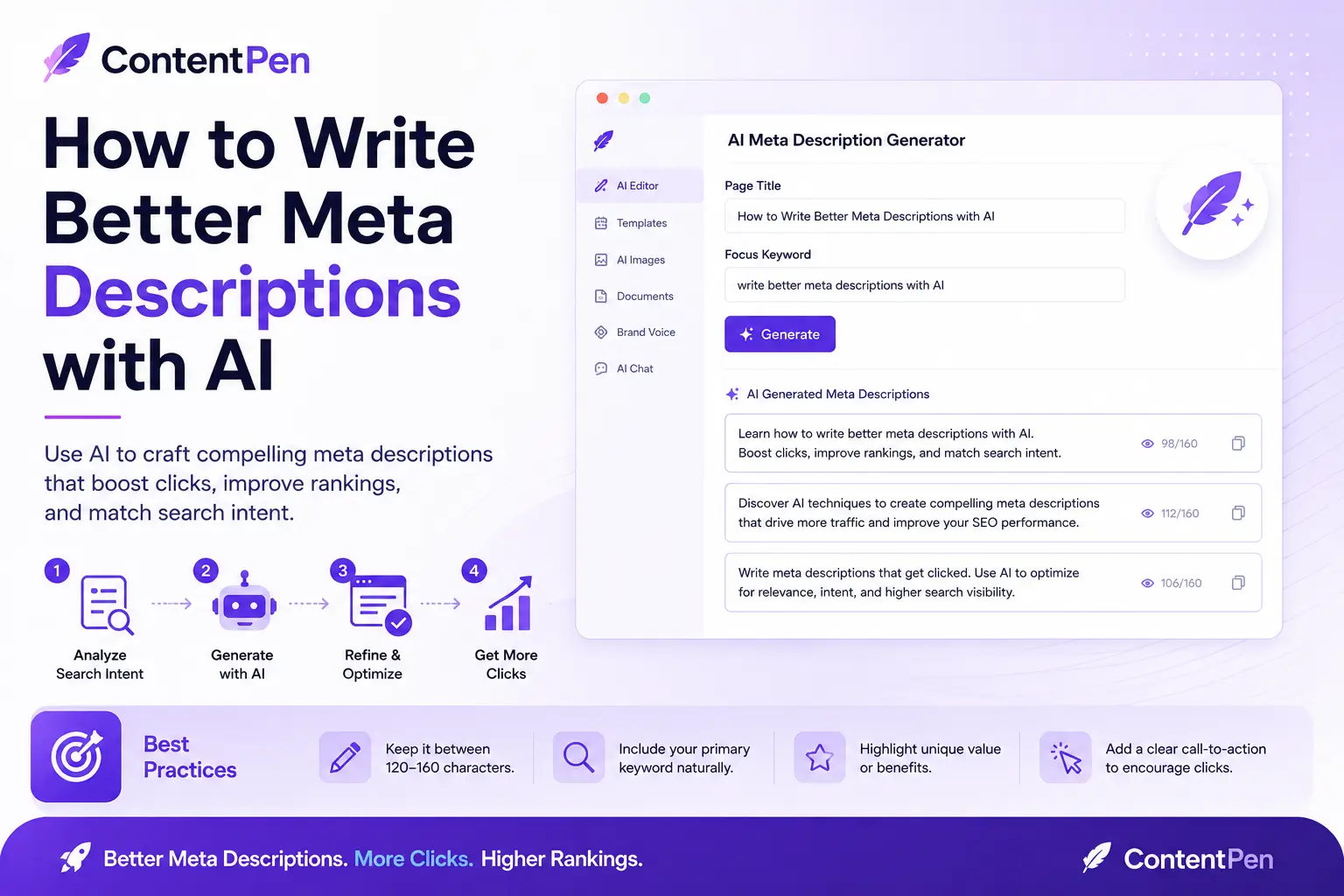
To write better meta descriptions with AI, give the model the page type, search intent, primary keyword, key entities, and strict length rules. Ask for a direct answer followed by a short call to action, then review every output for accuracy, uniqueness, CTR value, and hallucinated claims.
Meta descriptions are not only short promotional summaries anymore.
They help search users decide whether your result answers their question. They also help search engines understand whether your page summary matches the query and the page content.
Google may use the meta description as the search snippet when it believes the tag gives users a more accurate description than on-page text. But Google can also generate a different snippet from visible page content depending on the query.
That means your goal is not to “force” Google to use your description.
Your goal is to write a description that is:
- Accurate.
- specific.
- concise.
- page-matched.
- useful for users.
- attractive enough to earn clicks.
- Safe from hallucinated claims.
- Clear for search and AI systems.
AI can help you write better descriptions faster.
But it must be given strict rules.
⚡ Quick Verdict
The best AI meta description follows a simple formula: answer the page’s main search intent first, add one clear reason to click, keep the description around 140–155 characters, include the primary keyword naturally once, add one relevant entity, and never invent claims that are not on the page.
| Meta Description Element | Best Practice |
|---|---|
| Opening | Start with the main answer or benefit |
| Length | Aim for 140–155 characters |
| Keyword | Use the primary keyword once, naturally |
| Entity | Add one related entity or page-specific detail |
| CTA | Use a clear action verb |
| Accuracy | Use only facts from the page |
| Tone | Clear, direct, non-clickbait |
| Page type | Match blog, product, category, or service intent |
| QA | Check duplication, length, and hallucination |
| Measurement | Track CTR in Google Search Console |
Better Meta Description Formula
| Part | Purpose | Example |
|---|---|---|
| Answer | Gives immediate value | Learn how AI helps write meta descriptions |
| Entity | Clarifies topic | using keywords, entities, and search intent |
| CTA | Encourages click | See prompts and examples |
| Limit | Prevents cut-off | Keep near 140–155 characters |
The clearest takeaway is this: AI should not write vague summaries. It should write accurate, snippet-friendly descriptions that answer the query and give users a reason to click.
Recommended Tools To Explore
📚 Recommended Reads
- Best AI Tools Tested for Meta Titles and Descriptions
- Best AI Tools Tested for Heading Optimization
- How to Audit SEO Content with AI
- Best AI Tools Tested for Content Audits
- ContentPen Review: Is This AI Blog Writer Worth It?
📌 In This Guide
1. 🧠 What Is an AI Meta Description?
2. 🔎 Why Meta Descriptions Still Matter
3. 🧪 How to Give AI the Right Inputs
4. 🧩 Use the Answer + CTA Framework
5. 📏 Control Character and Pixel Length
6. 🧬 Add NLP Entities Without Keyword Stuffing
7. 🧱 Match the Meta Description to Page Type
8. 🛒 Ecommerce Meta Descriptions
9. 📘 Informational Article Meta Descriptions
10. 🏢 Service Page Meta Descriptions
11. 🚀 Bulk Meta Description Generation
12. ⚠️ Avoid AI Hallucination
13. 🌐 GEO and AEO Meta Description Rules
14. 🧰 AI Prompts You Can Copy
15. 📊 Examples: Weak vs Better Meta Descriptions
16. 📈 How to Measure Results
17. ❓ FAQ
18. 🏁 Final Verdict
19. 📚 Recommended Next Reads
🧠 What Is an AI Meta Description?
An AI meta description is a search snippet draft generated by an AI tool using page content, search intent, keywords, entities, audience, and length rules. The best version summarizes the page accurately and encourages the right user to click.
A weak AI meta description sounds like this:
Learn more about this topic and discover helpful tips in our complete guide.
That could describe almost any article.
A better AI meta description says:
Learn how to write AI meta descriptions with direct answers, keywords, entities, CTAs, and QA rules. See prompts and examples.
The better version is specific.
It tells the reader what the page actually contains.
What AI Can Improve
AI can help you:
- shorten long descriptions.
- generate several variations.
- include the keyword naturally.
- add a CTA.
- match the description to intent.
- avoid duplicate wording.
- create templates for page types.
- rewrite low-CTR snippets.
- summarize page content.
- check hallucination risk.
What AI Cannot Do Alone?
AI cannot safely know:
- current pricing unless you provide it.
- product availability unless you provide it.
- real shipping policies unless you provide them.
- private conversion data.
- current stock status.
- legal disclaimers.
- brand rules.
- affiliate disclosure requirements.
- whether Google will use the description.
- whether the description improved CTR.
You must provide the facts and review the result.
🔎 Why Meta Descriptions Still Matter
Meta descriptions still matter because they can influence how your page appears in search snippets, how users understand your result, and whether your listing earns clicks. They are not a direct ranking guarantee, but they support search-result clarity.
Google’s documentation explains that snippets are summaries shown in search results and that Google may use the meta description tag if it provides the best description for the page.
However, Google may also use visible page text instead.
That means you should write descriptions that accurately summarize the page rather than rely on manipulative wording.
Meta Descriptions Help With
- Search-result clarity.
- CTR improvement.
- intent alignment.
- page differentiation.
- brand positioning.
- ecommerce product context.
- service-page qualification.
- AI-readable page summaries.
- duplicate-snippet reduction.
- user trust.
Meta Descriptions Do Not Guarantee
They do not guarantee:
- higher rankings.
- exact snippet display.
- AI Overview inclusion.
- featured snippets.
- conversions.
- protection from Google rewriting the snippet.
A good description increases the chance that your search result makes sense.
It does not control the entire SERP.
🧪 How to Give AI the Right Inputs
AI writes better meta descriptions when you provide the page content, search intent, page type, primary keyword, entities, audience, and strict rules. Without these inputs, the output becomes generic or risky.
Required Inputs
Give AI:
| Input | Example |
|---|---|
| Page type | Blog article, product page, category page, service page |
| Primary keyword | AI meta description generator |
| Search intent | Learn how to write better descriptions |
| Audience | Bloggers, SEO editors, ecommerce managers |
| Page summary | A guide with prompts, examples, and QA rules |
| Key entities | Google snippets, CTR, NLP entities, AI Overviews |
| CTA style | Learn, compare, discover, see, choose |
| Length limit | 140–155 characters |
| No-invention rule | Use only facts provided |
| Tone | Simple, direct, non-clickbait |
Bad Prompt
Write a meta description for this page.
Better Prompt
Write 3 meta descriptions for this article. Each must be 140–155 characters, include the keyword “AI meta descriptions” in the first 60 characters, summarize the page accurately, add one CTA, and avoid invented claims.
The second prompt gives the AI clear boundaries.
🧩 Use the Answer + CTA Framework
The Answer + CTA framework writes the meta description in two parts: first, a direct answer or benefit that matches search intent; second, a short call to action that encourages the user to read the full page.
The Formula
Use:
Direct Answer + Specific Value + CTA
Example:
Write AI meta descriptions that answer intent, include entities, avoid stuffing, and stay under 155 characters. See prompts and examples.
This description works because it:
- answers the topic.
- names the process.
- includes entities.
- shows a benefit.
- includes a CTA.
- stays concise.
Part 1: Direct Answer
The first part should explain what the page helps the reader do.
Examples:
- Learn how to write AI meta descriptions.
- Compare the best AI tools for meta titles.
- Discover how to audit SEO content with AI.
- Find the right ContentPen plan for your site.
Part 2: CTA
The second part should invite the click naturally.
Good CTA phrases:
- See examples.
- Compare options.
- Learn the steps.
- Get prompts.
- Review the checklist.
- Choose the right plan.
- Improve your workflow.
Avoid weak CTAs:
- Click here.
- Read more now.
- Don’t miss out.
- Unlock secrets.
- Guaranteed results.
Answer + CTA Examples
| Page Type | Example Meta Description |
|---|---|
| How-to guide | Learn how to write AI meta descriptions with direct answers, entities, CTAs, and QA rules. See prompts and examples. |
| Comparison | Compare the best AI metadata tools for WordPress, ecommerce, CTR, and bulk SEO workflows. Choose the right option. |
| Review | See if ContentPen is worth it for SEO content, affiliate sites, pricing, bulk generation, and content quality. Read the verdict. |
📏 Control Character and Pixel Length
AI-generated meta descriptions should usually target 140–155 characters. This is not a guaranteed display rule, but it helps reduce the risk of truncation while leaving enough space for a useful answer and CTA.
Practical Length Targets
| Element | Practical Target |
|---|---|
| SEO title | About 50–60 characters |
| Meta description | About 140–155 characters |
| Short mobile description | About 120–145 characters |
| Longer desktop-safe draft | Up to about 155–160 characters |
Pixel width matters because some characters are wider than others.
For example:
- “W” uses more space than “i”.
- Uppercase text can use more width.
- Numbers and symbols vary.
- Mobile SERPs may show less space.
That is why character count is only a practical proxy.
Why 140–155 Characters Work
This range usually gives enough room for:
- the main answer.
- one keyword.
- one entity.
- one benefit.
- one CTA.
Going too short can make the snippet vague.
Going too long increases the risk of cut-off.
Prompt for Length Control
Write 3 meta description options for this article.
Rules:
- Each option must be 140–155 characters including spaces
- Include the primary keyword in the first 60 characters
- Use one related entity naturally
- End with a clear CTA
- Do not invent facts
Always Count Characters
After generation, count the characters.
Do not trust the AI to count perfectly.
AI models often miscount characters, especially when punctuation, emojis, or special characters are included.
🧬 Add NLP Entities Without Keyword Stuffing
A better AI meta description uses the primary keyword once and adds one or two related entities naturally. This helps clarify the page topic without repeating the same keyword mechanically.
What Is an Entity?
An entity is a specific concept, brand, product, process, or topic that helps define the page.
For this article, related entities include:
- Google snippets.
- CTR.
- Search intent.
- NLP.
- AI Overviews.
- Perplexity.
- Meta tags.
- Title tags.
- ecommerce pages.
- Search Console.
Weak Keyword-Stuffed Description
AI meta descriptions help write AI meta descriptions for better AI meta descriptions and SEO meta descriptions.
This sounds unnatural.
Better Entity-Rich Description
Write AI meta descriptions that match search intent, include entities, avoid stuffing, and improve snippet clarity. Get prompts.
This version uses:
- the main keyword
- search intent
- entities
- snippet clarity
- CTA
Entity Rule
Use:
Primary keyword once + one related entity + one benefit
Do not force every related term into the description.
The meta description should read like a useful sentence, not a keyword list.
🧱 Match the Meta Description to Page Type
The best AI prompt changes by page type. A product page needs facts such as price, availability, and main feature. An informational article needs the answer or result. A service page needs the offer, audience, and trust signal.
Page-Type Matrix
| Page Type | What the Description Should Include |
|---|---|
| Blog article | Main answer, benefit, CTA |
| Product page | Product type, main feature, price or availability if accurate |
| Category page | Product range, audience, key benefit |
| Service page | Service, audience, location or outcome |
| Review page | Product, use case, verdict angle |
| Comparison page | Compared options and decision help |
| Affiliate page | Product category, selection criteria, disclosure-safe language |
| Tool page | What the tool does and who it is for |
Why Page Type Matters
A generic prompt may produce the same style for every URL.
That creates weak metadata.
For example, an ecommerce product description should not sound like a blog intro.
A service page should not sound like a product listing.
A review page should not make claims that are not supported by the article.
🛒 Ecommerce Meta Descriptions
Ecommerce meta descriptions should use only verified product data such as product name, category, key feature, price, availability, shipping policy, or use case. AI should never invent discounts, stock status, ratings, or delivery promises.
Ecommerce Prompt
Write a meta description for this product page.
Rules:
- 140–155 characters
- Use only the product data provided
- Include product type and main feature
- Include price, availability, or shipping only if provided
- Do not invent discounts, reviews, ratings, compatibility, or delivery promises
Product data: [paste product fields]
Ecommerce Example
Product data:
- Product: Smart Pet Feeder Pro
- Feature: app-controlled feeding schedule
- Audience: busy cat owners
- Shipping: Kuwait delivery available
Meta description:
Smart Pet Feeder Pro helps busy cat owners schedule meals by app, with Kuwait delivery available. Check features and availability.
Ecommerce QA Checklist
Check:
- Is the product name correct?
- Is the price current?
- Is availability accurate?
- Is the shipping policy real?
- Is the feature on the page?
- Is the description unique?
- Does it avoid fake discounts?
- Does it match the category?
- Does it use the right brand name?
- Does it avoid keyword stuffing?
📘 Informational Article Meta Descriptions
Informational meta descriptions should answer what the reader will learn or solve. The best version states the outcome, includes the main topic, and invites the reader to see the process, examples, checklist, or guide.
Informational Prompt
Write 3 meta descriptions for this informational article.
Rules:
- 140–155 characters
- Start with the reader outcome
- Include the primary keyword naturally
- Add one related entity
- End with a useful CTA
- Avoid vague phrases like “learn more”
Informational Examples
| Article Topic | Better Meta Description |
|---|---|
| SEO content audits | Audit SEO content with AI using crawl data, GSC, GA4, content decay, and pruning rules. See the workflow. |
| Internal linking | Build internal links with AI using topic clusters, anchor text, orphan page checks, and human review. See the steps. |
| Heading optimization | Optimize headings with AI for AEO, entities, H2 structure, and CTR without keyword stuffing. See tools and prompts. |
Informational Rule
Focus on the result.
Do not write:
This article discusses many things about SEO and AI.
Write:
Audit SEO content with AI using crawl data, GSC, GA4, content decay, and pruning rules. See the workflow.
🏢 Service Page Meta Descriptions
Service page meta descriptions should state the service, target audience, location or niche, main outcome, and one trust signal if it is true. Avoid vague promises or guaranteed results.
Service Page Prompt
Write 3 meta descriptions for this service page.
Rules:
- 140–155 characters
- Mention the service
- Mention the target audience or location
- Include one real trust signal if provided
- Add a natural CTA
- Do not promise guaranteed results
Service Page Example
Service data:
- Service: SEO content audit
- Audience: SaaS companies
- Trust signal: includes GSC and GA4 review
Meta description:
SEO content audits for SaaS teams using GSC, GA4, content decay checks, and update priorities. Request a review.
Service Page Warning
Do not use:
- guaranteed rankings
- instant results
- fake client numbers
- unverifiable claims
- unrealistic timelines
Trust matters more than hype.
🚀 Bulk Meta Description Generation
Bulk meta description generation works best when AI receives structured page data, not only URLs. Use page titles, H1s, product fields, category names, body extracts, prices, and canonical URLs to prevent generic or hallucinated descriptions.
Good Bulk Inputs
For each URL, include:
- URL.
- page type.
- title.
- H1.
- primary keyword.
- body excerpt.
- product name.
- category.
- price if available.
- availability if available.
- brand.
- existing meta description.
- target audience.
- no-invention rule.
Bulk Generation Rules
Use strict instructions:
- Create one unique description per URL.
- Keep each description 140–155 characters.
- Use only supplied data.
- Include the page’s main entity.
- Avoid duplicate openings.
- Do not invent facts.
- Avoid clickbait.
- Flag pages with insufficient data.
- Use different templates by page type.
- Return a QA column.
Bulk Output Table
| URL | Page Type | Meta Description | Character Count | QA Status |
|---|---|---|---|---|
| /product/x | Product | Product-specific description | 148 | Needs price check |
| /blog/y | Article | Article-specific description | 152 | Approved |
| /category/z | Category | Category-specific description | 144 | Approved |
Bulk Warning
Never bulk-publish generated descriptions without sampling.
Review:
- high-traffic pages.
- product pages.
- pages with prices.
- pages with medical or financial claims.
- important category pages.
- pages with affiliate links.
- pages with brand-sensitive messaging.
- pages flagged by QA.
⚠️ Avoid AI Hallucination
AI hallucination happens when the model invents facts, features, prices, discounts, statistics, guarantees, or product details not found on the page. The safest prompt forces AI to use only supplied data and flag missing information.
Common Hallucinations
| Hallucination Type | Example |
|---|---|
| Fake price | “Starts at $9/month” when no price is provided |
| Fake discount | “Save 50% today” without a real offer |
| Fake feature | “Includes API access” when the page does not say that |
| Fake guarantee | “Guaranteed to rank higher” |
| Fake stock | “In stock now” without availability data |
| Fake shipping | “Free shipping” when not provided |
| Fake review | “Rated 4.9 stars” without source |
| Fake result | “Increase CTR by 30%” without data |
Anti-Hallucination Prompt Rule
Add this to every prompt:
Use only facts provided in the page content or structured data. If a detail is missing, do not invent it. If the page lacks enough information for a useful description, flag it instead of guessing.
Human QA Questions
Ask:
- Is every claim on the page?
- Is the price current?
- Is the product available?
- Is the CTA honest?
- Is the benefit realistic?
- Is the description too generic?
- Is the same phrase repeated across pages?
- Is there any unsupported statistic?
- Is the page type correct?
- Would a user feel misled?
🌐 GEO and AEO Meta Description Rules
For GEO and AEO, the meta description should function as a concise semantic summary of the page. It should state the core answer, name the main entity, include context, and use a helpful CTA without relying on hype.
Rule 1: Start With the Answer
Write:
Write better meta descriptions with AI using direct answers, entities, CTAs, and strict QA rules.
Not:
In this article, we will explore many useful tips for meta descriptions.
Rule 2: Use Entities Naturally
Include page-specific entities when helpful:
- Google snippets
- Search Console
- AI Overviews
- CTR
- ecommerce pages
- title tags
- NLP entities
- meta tags
Rule 3: Make It Extractable
Avoid clever or vague wording.
A machine-readable description should be specific enough to stand alone.
Rule 4: Add One CTA
Use simple action verbs:
- Learn.
- See.
- Compare.
- Choose.
- Review.
- Improve.
- Audit.
- Build.
- Discover.
- Check.
Rule 5: Do Not Treat GEO as a Trick
A better meta description supports clarity.
It does not guarantee inclusion in Google AI Overviews, Perplexity, or any answer engine.
🧰 AI Prompts You Can Copy
Prompt 1: Standard AI Meta Description
Write 3 meta descriptions for this page.
Rules:
- 140–155 characters including spaces
- Include the primary keyword in the first 60 characters
- Use the Answer + CTA framework
- Include one related entity naturally
- Do not invent facts, prices, guarantees, or statistics
- Avoid clickbait
- Use simple English
Page type: [page type]
Primary keyword: [keyword]
Search intent: [intent]
Page summary: [summary]
Entities: [entities]
Prompt 2: GEO-Friendly Meta Description
Write 5 GEO-friendly meta descriptions for this article.
Each option must:
- Start with the main answer
- Include the primary keyword once
- Include one related entity
- Stay under 155 characters
- End with a useful CTA
- Avoid vague phrases like “learn more”
Prompt 3: Ecommerce Meta Description
Write a product-page meta description using only the product data below.
Rules:
- 140–155 characters
- Mention product type and main feature
- Include price, shipping, or availability only if provided
- Do not invent discounts, stock status, reviews, ratings, or guarantees
Product data: [paste data]
Prompt 4: Bulk Meta Description Generation
Generate one unique meta description for each URL in this table.
Rules:
- Use only the supplied row data
- 140–155 characters
- Include the main entity
- Avoid duplicate openings
- Match the page type
- Add a QA status
- Flag insufficient data instead of guessing
Prompt 5: Low-CTR Rewrite
Rewrite this meta description for a page with high impressions and low CTR.
Improve clarity and click appeal without exaggeration. Keep the meaning accurate. Use one action verb. Stay under 155 characters.
Current description: [description]
Target query: [query]
Page summary: [summary]
Prompt 6: Hallucination Check
Audit this meta description for hallucination risk.
Check whether it invents:
- prices
- features
- discounts
- availability
- guarantees
- statistics
- product claims
- results
Return Approved, Needs Edit, or Unsafe.
📊 Examples: Weak vs Better Meta Descriptions
Example 1: SEO Guide
| Version | Meta Description |
|---|---|
| Weak | Learn everything you need to know about SEO content audits in this complete and helpful guide. |
| Better | Audit SEO content with AI using crawl data, GSC, GA4, pruning rules, and content decay checks. See the workflow. |
Example 2: Product Page
| Version | Meta Description |
|---|---|
| Weak | Buy this amazing smart feeder today and enjoy the best pet feeding experience with great features. |
| Better | Smart pet feeder with app-based meal scheduling for busy cat owners. Check features, availability, and delivery options. |
Example 3: Affiliate Review
| Version | Meta Description |
|---|---|
| Weak | Read our review of this tool and find out if it is the best choice for your business. |
| Better | See if ContentPen fits affiliate sites needing bulk SEO articles, internal links, and refresh tools. Read the verdict. |
Example 4: Comparison Page
| Version | Meta Description |
|---|---|
| Weak | Compare these two tools and find out which one is better for you in this detailed comparison. |
| Better | Compare Frase vs Surfer for SEO content optimization, GEO readiness, outlines, audits, and pricing. Choose the right tool. |
Example 5: Service Page
| Version | Meta Description |
|---|---|
| Weak | We provide high-quality SEO services to help your website rank higher and grow your business fast. |
| Better | SEO content audits for SaaS teams using GSC, GA4, content decay, and update priorities. Request a review. |
📈 How to Measure Results
Measure AI-written meta descriptions by tracking organic CTR, clicks, impressions, query-level performance, snippet rewrites, and conversions in Google Search Console and analytics tools.
Metrics to Watch
| Metric | Why It Matters |
|---|---|
| CTR | Shows whether users click more often |
| Clicks | Shows traffic impact |
| Impressions | Shows visibility changes |
| Average position | Separates CTR from ranking movement |
| Query-level CTR | Shows which searches improved |
| Snippet rewrite rate | Shows whether Google ignores the description |
| Conversions | Shows business impact |
| Bounce or engagement | Shows whether the snippet matched the page |
Best Test Pages
Start with pages that have:
- high impressions.
- low CTR.
- stable rankings.
- vague descriptions.
- duplicate descriptions.
- missing descriptions.
- important commercial intent.
- clear page content.
Testing Rule
Do not rewrite every description at once.
Start with a controlled group.
Then compare:
- 28 days before.
- 28 days after.
- Same query set.
- Similar ranking position.
- Same country and device where possible.
CTR can change for reasons unrelated to descriptions, so avoid over-crediting one edit.
❓ FAQ
1. How do you write better meta descriptions with AI?
Give AI the page type, search intent, keyword, entities, summary, and length rules. Ask for a direct answer plus CTA, then review for accuracy, uniqueness, and hallucinations.
2. What is the best AI prompt for meta descriptions?
Ask for 3–5 options, 140–155 characters each, with the primary keyword in the first 60 characters, one related entity, one CTA, and a strict no-invention rule.
3. How long should a meta description be?
A practical target is 140–155 characters. This helps avoid unnecessary truncation while leaving enough room for a clear summary and CTA.
4. Should AI meta descriptions include keywords?
Yes, but naturally. Use the primary keyword once and add one related entity or concept if it improves clarity.
5. Can AI meta descriptions improve CTR?
They can help when old descriptions are missing, vague, duplicated, or poorly matched to intent. CTR results depend on rankings, query, SERP layout, and whether Google uses the description.
6. Does Google always use my meta description?
No. Google may use the meta description tag when it is useful, but it may also generate snippets from visible page content depending on the query.
7. What is an AEO-friendly meta description?
It is a concise description that answers the page’s main question, names the main entity, includes context, and gives users a clear reason to click.
8. Can AI hallucinate meta descriptions?
Yes. AI may invent prices, features, discounts, availability, statistics, or guarantees. Use structured data and a no-invention prompt.
9. How do I write ecommerce meta descriptions with AI?
Provide product name, category, features, price, availability, shipping, and audience. Tell AI to use only those facts and avoid invented claims.
10. Can I generate meta descriptions in bulk with AI?
Yes, but provide structured page data and QA rules. Review samples before publishing, especially for product, service, legal, medical, or financial pages.
11. Should every page have a unique meta description?
Yes. Unique descriptions help users understand each page and reduce duplicate snippets across large websites.
12. What should I avoid in AI meta descriptions?
Avoid fake claims, keyword stuffing, duplicate text, vague summaries, clickbait, unsupported statistics, and descriptions that do not match the page.
🏁 Final Verdict
AI can help you write better meta descriptions, but only when you control the input and review the output.
The best workflow is:
- Identify the page type.
- define the search intent.
- provide the page summary.
- give the primary keyword.
- add related entities.
- require 140–155 characters.
- use the Answer + CTA framework.
- forbid invented claims.
- generate 3–5 options.
- count characters.
- review accuracy.
- publish carefully.
- measure CTR.
For informational articles, focus on the answer and the result the reader will get.
For ecommerce pages, focus on verified product data.
For service pages, focus on the offer, audience, and honest trust signal.
For bulk generation, use structured data and strict QA before publishing.
The clearest takeaway is this: a good AI meta description is not just a short sales pitch. It is a precise, factual, snippet-friendly summary that helps both users and search systems understand why the page deserves the click.
Comments 4