Introduction
The best AI tools for heading optimization are Frase for question-based AEO headings, Surfer for SERP and NLP-driven outlines, Clearscope for entity-rich content structure, InLinks for semantic entity headings, Jasper for brand-safe headline variations, and CoSchedule Headline Studio for CTR-focused title testing.
Headings are no longer just formatting elements.
They help readers understand the page quickly. They also help search engines, AI crawlers, and answer engines understand what each section is about.
A weak heading says:
More Details
A strong heading says:
How AI Tools Find Missing H2 and H3 Topics
The second version gives both the reader and the machine a clearer signal.
This guide compares the best AI tools for improving:
- H1 titles.
- SEO title tags.
- H2 structure.
- H3 subheadings.
- Question-based headings.
- Entity-based headings.
- CTR hooks.
- SERP-based outlines.
- GEO-ready answer blocks.
- Logical heading hierarchy.
The goal is not to stuff keywords into every heading.
The goal is to build a clear page structure where each heading introduces a useful answer.
⚡ Quick Verdict
Frase is the best tool for AEO and question-based headings. Surfer is strongest for SERP-based outline building and NLP headings. Clearscope is best for editorial teams that need term coverage and structure guidance. Jasper and CoSchedule are better for H1, title tag, and CTR-focused headline improvement.
| Tool | Best For | Heading Optimization Type | Main Limitation |
|---|---|---|---|
| Frase | AEO and search intent | Question-based H2s and answer-focused outlines | Not a deep technical SEO platform |
| Surfer | SERP and NLP structure | SERP-based outlines, competitor headings, NLP terms | Can lead to over-optimized outlines if followed blindly |
| Clearscope | Editorial content teams | Topic coverage, readability, questions, and outline review | Expensive for small sites |
| InLinks | Entity SEO | Entity-based headings and semantic relationships | More complex than a simple heading tool |
| Jasper | Brand and marketing teams | H1, meta title, and campaign headline variations | Requires SEO judgment for structure |
| CoSchedule Headline Studio | CTR and hook testing | SEO titles, emotional hooks, headline scoring | Mainly headline-focused, not full content structure |
| NeuronWriter | Budget SEO teams | NLP headings and SERP questions | Less polished than premium platforms |
| ChatGPT / Gemini | Manual workflow | Custom heading audits and rewrites | Output quality depends heavily on prompts |
Best Tool by Heading Goal
| Heading Goal | Best Tool |
|---|---|
| Build question-based H2s | Frase |
| Build SERP-backed outlines | Surfer |
| Add NLP terms naturally | Surfer or Clearscope |
| Build entity-rich headings | InLinks |
| Improve H1 and meta title hooks | CoSchedule or Jasper |
| Maintain brand voice | Jasper |
| Optimize headings on a budget | NeuronWriter |
| Audit existing heading hierarchy | ChatGPT or Gemini with a crawl export |
The clearest takeaway is this: use AI to improve heading clarity and structure, not to force more keywords into H2s and H3s.
Recommended Tools To Explore
📚 Recommended Reads
- Best AI Tools Tested for Content Audits
- How to Audit SEO Content with AI
- Best AI Internal Linking Tools
- How to Build Internal Links with AI
- Surfer Alternatives: Best AI SEO Tools Tested
📌 In This Guide
1. 🧠 What Is AI Heading Optimization?
2. 🧪 How These Tools Were Evaluated
3. 🧭 The Main Types of AI Heading Tools
4. 📊 Best AI Heading Optimization Tools Compared
5. 🏆 Best AI Tools Tested for Heading Optimization
6. ❓ Best Tools for AEO and Question-Based Headings
7. 🧬 Best Tools for NLP and Entity Headings
8. 🧲 Best Tools for CTR and Hook Optimization
9. 🧱 Technical Rules for GEO-Ready Headings
10. 🛡️ How to Avoid AI Heading Over-Optimization
11. 🧰 Heading Optimization Prompts You Can Copy
12. 📈 How to Measure Heading Optimization Results
13. ❓ FAQ
14. 🏁 Final Verdict
15. 📚 Recommended Next Reads
🧠 What Is AI Heading Optimization?
AI heading optimization is the process of improving H1, H2, and H3 headings using search intent, SERP patterns, NLP terms, entities, user questions, readability, and CTR signals. The goal is to make every section easier for people and search systems to understand.
A strong heading should answer three questions:
- What is this section about?
- Why should the reader continue?
- How does this section support the page’s main search intent?
AI tools can help by:
- Analyzing competitor outlines.
- Finding People Also Ask questions.
- Suggesting missing H2 sections.
- Adding important entities.
- Improving title hooks.
- Creating clearer H3 subtopics.
- Detecting duplicate headings.
- Checking topic gaps.
- Matching headings with search intent.
- Making sections easier to extract for AI answers.
H1 vs H2 vs H3
| Heading Type | Purpose |
|---|---|
| H1 | Defines the main page topic |
| SEO title tag | Influences the search result title link |
| H2 | Introduces a major section or question |
| H3 | Breaks an H2 section into specific details |
| FAQ H3 | Answers exact user questions |
| Meta title | Helps improve SERP click appeal |
The H1 and title tag may be similar, but they do not have to be identical.
The H1 is for the page.
The title tag is for search results.
🧪 How These Tools Were Evaluated
These tools were evaluated based on how well they improve heading structure, search intent alignment, semantic coverage, readability, CTR potential, and AEO/GEO readiness.
Evaluation Criteria
| Test Area | What Was Reviewed |
|---|---|
| H1 clarity | Does the tool create a clear main title? |
| H2 logic | Does it build major sections in a natural order? |
| H3 support | Do subheadings support the H2 instead of jumping randomly? |
| Intent match | Do headings reflect the real search intent? |
| Question coverage | Does the tool use actual user questions? |
| Entity coverage | Are important entities included naturally? |
| NLP balance | Does it avoid keyword stuffing? |
| SERP awareness | Does it compare current ranking pages? |
| CTR support | Does it improve title hooks and click appeal? |
| GEO readiness | Can each section support a direct answer? |
| Human control | Can the editor review and reject suggestions? |
What “Tested” Does Not Mean
This article does not claim that every tool was tested on the same production website with identical traffic, rankings, and Search Console data.
It also does not invent:
- Featured Snippet gains.
- AI Overview wins.
- Exact CTR increases.
- Ranking improvements.
- Accuracy percentages.
- Conversion lifts.
The evaluation is based on current tool workflows, official capabilities, accessible feature behavior, and a consistent editorial scoring framework.
🧭 The Main Types of AI Heading Tools
AI heading tools should be grouped by what they optimize. Some tools improve search intent and questions, others improve semantic coverage, and others improve the H1 or SEO title for clicks.
1. Question-Based and Intent Heading Tools
These tools help you build H2s and H3s around real user questions.
Examples:
- Frase.
- InLinks.
- AlsoAsked.
- ChatGPT with People Also Ask data.
They are useful for:
- AEO.
- voice search.
- AI Overviews.
- FAQ sections.
- direct-answer blocks.
- informational guides.
2. NLP and Entity Heading Tools
These tools analyze current SERPs and recommend important entities, concepts, and topic coverage.
Examples:
- Surfer.
- Clearscope.
- NeuronWriter.
- InLinks.
They are useful for:
- topical authority.
- semantic SEO.
- content refreshes.
- H2 and H3 gap analysis.
- entity-rich outlines.
3. CTR and Hook Optimization Tools
These tools improve the visible page title, title tag, and sometimes the H1.
Examples:
- Jasper.
- CoSchedule Headline Studio.
- ChatGPT.
- Copy.ai.
They are useful for:
- improving organic CTR.
- testing headline angles.
- matching brand voice.
- writing clearer page titles.
- creating stronger meta title variations.
4. Manual AI Audit Tools
ChatGPT and Gemini can audit a heading structure when you provide:
- The current article.
- The target keyword.
- Competing headings.
- Search Console queries.
- Audience.
- Page goal.
They are flexible, but they require better prompts and stronger human review.
📊 Best AI Heading Optimization Tools Compared
| Tool | Best Category | H1 / Title | H2 / H3 Structure | Entity Support | AEO Support | CTR Support |
|---|---|---|---|---|---|---|
| Frase | AEO and intent headings | Good | Strong | Good | Strong | Moderate |
| Surfer | SERP and NLP headings | Good | Strong | Strong | Good | Moderate |
| Clearscope | Editorial semantic headings | Moderate | Strong | Strong | Good | Moderate |
| InLinks | Entity-based headings | Moderate | Good | Strong | Good | Limited |
| Jasper | Brand headline generation | Strong | Moderate | Moderate | Moderate | Strong |
| CoSchedule Headline Studio | CTR and hook testing | Strong | Limited | Limited | Limited | Strong |
| NeuronWriter | Budget NLP headings | Good | Good | Strong | Good | Moderate |
| ChatGPT / Gemini | Custom heading audit | Good | Good | Depends on data | Good | Good |
🏆 Best AI Tools Tested for Heading Optimization
1. Frase: Best for AEO and Question-Based Headings
Frase is the best tool for turning user questions into clear H2 and H3 headings. It pulls questions from search results, People Also Ask, forums, and answer engines, making it especially useful for AEO, FAQ sections, and AI-extractable content structures.
Frase is strongest when the page needs to answer real user questions.
It can help you build headings such as:
- What Is AI Heading Optimization?
- How Do AI Tools Improve H2 Structure?
- Which Heading Format Works Best for AI Overviews?
- How Many H2s Should an SEO Article Have?
These headings are clearer than vague alternatives such as:
- Overview
- Benefits
- More Information
- Extra Tips
What Frase Does Well
Frase helps with:
- SERP research.
- People Also Ask questions.
- forum questions.
- answer-engine questions.
- structured outlines.
- content briefs.
- search-intent alignment.
- content gaps.
- brand voice drafting.
- content optimization.
Heading Quality
Frase is useful because it encourages headings that directly match the questions users ask.
This helps content teams build sections that can begin with a direct answer.
That structure is valuable for:
- Featured snippets.
- Voice search.
- AI Overviews.
- Perplexity-style summaries.
- ChatGPT-style source extraction.
- Human readers who skim.
Main Weakness
Frase can generate too many question-based headings if you follow every suggestion.
Not every section needs to be phrased as a question.
Use question headings when they match real search behavior and improve readability.
Best Use Case
Use Frase when you are writing:
- tutorials
- definitions
- comparison articles
- FAQs
- how-to guides
- AEO-focused content
Verdict
Choose Frase when your main goal is to make the article easier for answer engines and users to understand quickly.
2. Surfer: Best for SERP-Based Outline and NLP Headings
Surfer is the strongest tool for building headings from live SERP patterns, competitor outlines, NLP terms, and topical gaps. It is best for pages that need a search-focused H2 and H3 structure based on what already ranks.
Surfer’s Content Editor can generate AI-powered outlines based on top-ranking pages.
It also shows competitor heading structures, which helps editors understand:
- Which sections are common.
- Which topics competitors prioritize.
- Which headings are missing.
- Where search intent has changed.
- Which H2s may be unnecessary.
What Surfer Does Well
Surfer helps with:
- SERP-based outlines.
- NLP term recommendations.
- content score.
- competitor heading analysis.
- topic gaps.
- content briefs.
- Auto-Optimize.
- topical maps.
- AI search readiness.
- internal link guidance.
Heading Quality
Surfer is useful when a page needs to match current search expectations.
For example, if ranking pages all include sections about:
- pricing
- alternatives
- pros and cons
- use cases
- setup process
Surfer can reveal those structural patterns.
Main Weakness
Surfer can tempt writers to copy the average SERP too closely.
A good outline should include:
- Required sections.
- original insight.
- first-hand experience.
- stronger examples.
- a clearer decision framework.
Do not use Surfer to create a generic clone of competing pages.
Best Use Case
Use Surfer when optimizing:
- review articles
- comparison pages
- buying guides
- content refreshes
- long-form SEO posts
- topical authority pages
Verdict
Choose Surfer when you want data-backed headings based on the current SERP, but keep editorial control over what makes the article unique.
3. Clearscope: Best for Editorial Teams and Semantic Coverage
Clearscope is best for editorial teams that need clear content briefs, outline review, common questions, readability guidance, and term coverage. It helps writers improve headings without turning every H2 into a keyword-stuffed SEO line.
Clearscope’s strength is editorial usability.
It shows how top-ranking content is organized and helps teams understand:
- Which terms matter.
- Which questions users ask.
- Which sources are commonly cited.
- How readable the page is.
- Which headings competitors use.
- Whether topic coverage is complete.
What Clearscope Does Well
Clearscope supports:
- Content grading.
- term recommendations.
- question discovery.
- readability checks.
- competitor outline review.
- content inventory.
- internal linking.
- AI term presence.
- Google Docs integration.
- WordPress integration.
Heading Quality
Clearscope is useful when a team wants polished, readable content.
It can help improve headings by making them:
- More specific.
- Better aligned with user questions.
- Semantically complete.
- Easier to scan.
- Less repetitive.
Main Weakness
Clearscope is expensive for small publishers.
It is also not a dedicated headline-testing tool. Its strongest role is improving content structure and semantic coverage, not writing emotional hooks.
Best Use Case
Use Clearscope when you have:
- a professional editorial workflow
- multiple writers
- recurring content updates
- high-value pages
- a need for consistent content quality
Verdict
Choose Clearscope when heading quality must balance SEO coverage with readability and editorial consistency.
4. InLinks: Best for Entity-Based Heading Optimization
InLinks is best for entity-based heading optimization because it analyzes content through a semantic knowledge graph. It helps identify important entities and topic relationships that can be reflected naturally in H2 and H3 headings.
InLinks is different from basic keyword tools.
It focuses on entities and relationships.
For example, instead of only seeing keyword heading optimization, it may help connect the topic with:
- Search intent.
- structured data.
- entity SEO.
- internal links.
- knowledge graphs.
- answer engines.
- topical authority.
What InLinks Does Well
InLinks helps with:
- Entity extraction.
- knowledge graph creation.
- content optimization.
- internal linking.
- schema automation.
- topic targeting.
- semantic relevance.
- cornerstone page relationships.
- topical coverage.
- search engine understanding.
Heading Quality
InLinks is useful when headings need to describe precise entities and concepts.
A weak heading says:
Important Things
A better entity-focused heading says:
How Entity-Based Headings Improve Topical Authority
This makes the section easier to interpret.
Main Weakness
InLinks has a higher learning curve than simple content optimizers.
It is not the best option if you only want a fast H1 rewrite or a title tag hook.
Best Use Case
Use InLinks when your site needs:
- semantic SEO
- knowledge graph support
- entity-rich architecture
- internal link context
- topical authority
Verdict
Choose InLinks when heading optimization is part of a wider entity SEO strategy.
5. Jasper: Best for Brand-Safe H1 and Meta Title Variations
Jasper is best for marketing teams that need headline, H1, and meta title variations that match brand voice. It is stronger for messaging and hook development than for deep SERP-based H2 and H3 structure.
Jasper’s headline and meta title agents are useful when a page needs several title options.
For example:
- A direct SEO title.
- A more emotional title.
- A brand-safe title.
- A social-friendly version.
- A clearer H1.
- A shorter SERP title.
What Jasper Does Well
Jasper helps with:
- headline generation.
- meta title generation.
- meta descriptions.
- brand voice.
- style guide alignment.
- campaign consistency.
- audience-specific copy.
- title variations.
- marketing hooks.
- content rewriting.
Heading Quality
Jasper is useful when the current headline is technically correct but weak.
Example:
Weak:
AI Heading Tools
Better:
Best AI Heading Tools for SEO, AEO, and Higher Organic CTR
The second version is clearer and more compelling.
Main Weakness
Jasper is not a specialist SEO heading auditor.
It can generate strong titles, but you still need SEO judgment to decide whether the heading structure matches the SERP and search intent.
Best Use Case
Use Jasper when optimizing:
- H1 titles
- meta titles
- landing-page headlines
- campaign headlines
- email subject-style hooks
- brand-safe title variations
Verdict
Choose Jasper when brand voice and click appeal matter as much as SEO clarity.
6. CoSchedule Headline Studio: Best for CTR and Hook Optimization
CoSchedule Headline Studio is best for improving H1s, title tags, and marketing headlines using headline scoring, SEO analysis, sentiment, word balance, and AI-powered headline suggestions. It is not a full H2/H3 structure optimizer.
CoSchedule is a headline tool first.
It helps improve:
- Blog titles.
- SEO titles.
- YouTube titles.
- Social captions.
- Email subject lines.
- Ad-style hooks.
What CoSchedule Does Well
CoSchedule Headline Studio supports:
- headline scoring.
- SEO analysis.
- sentiment analysis.
- Headline AI.
- word banks.
- power words.
- emotional words.
- SERP preview.
- browser extension.
- WordPress plugin.
Heading Quality
CoSchedule is useful when you need a title that earns attention without becoming clickbait.
It can help test whether a headline is:
- Clear.
- emotional.
- specific.
- concise.
- SEO-friendly.
- stronger than a plain keyword title.
Main Weakness
It does not build full article architecture.
Use it for the H1 and title tag, then use Frase, Surfer, Clearscope, or InLinks for H2 and H3 structure.
Best Use Case
Use CoSchedule when optimizing:
- blog post titles
- meta titles
- social headlines
- email subject lines
- ad headlines
- YouTube titles
Verdict
Choose CoSchedule when your title gets impressions but not enough clicks.
7. NeuronWriter: Best Budget Tool for NLP Heading Optimization
NeuronWriter is the best budget option for writers who want SERP comparison, NLP terms, competitor heading ideas, content scoring, and AI-assisted structure without paying for premium tools like Surfer or Clearscope.
NeuronWriter is useful when you need to improve an existing article’s structure.
It can help identify:
- Missing questions.
- Missing entities.
- Important terms.
- Competitor headings.
- Weak topic coverage.
- Content-score gaps.
What NeuronWriter Does Well
NeuronWriter supports:
- SERP analysis.
- NLP recommendations.
- competitor comparison.
- content scoring.
- AI writing.
- outline support.
- query and question ideas.
- content planning.
- semantic optimization.
- budget-friendly workflows.
Heading Quality
NeuronWriter can help turn broad headings into clearer semantic sections.
Example:
Weak:
Features
Better:
Which NLP Features Help Improve H2 and H3 Headings?
Main Weakness
The interface and workflow can feel less polished than Surfer or Clearscope.
It is also not the strongest tool for CTR-focused headline testing.
Best Use Case
Use NeuronWriter when you want strong semantic heading guidance at a lower price.
Verdict
Choose NeuronWriter if your main goal is affordable NLP-based heading improvement.
8. ChatGPT or Gemini: Best Flexible Manual Heading Auditor
ChatGPT or Gemini can audit headings effectively when you provide the article, target keyword, search intent, SERP notes, Search Console queries, and clear rules. They are flexible but depend heavily on the quality of your prompt.
Generic AI prompts produce generic headings.
A weak prompt says:
Improve these headings for SEO.
A stronger prompt says:
Audit this H1, H2, and H3 hierarchy for search intent, entity coverage, AEO structure, and readability.
What ChatGPT or Gemini Can Do Well
They can help:
- Rewrite weak headings.
- Remove duplicate sections.
- Fix hierarchy.
- Create question headings.
- Add direct-answer sections.
- Improve H1 clarity.
- Generate title variations.
- Identify missing entities.
- Create FAQ headings.
- Simplify technical titles.
Main Weakness
They do not automatically know current SERPs or Search Console data unless you provide it.
They may also invent entities or over-optimize headings if the prompt is weak.
Best Use Case
Use ChatGPT or Gemini when you already have:
- Current article draft.
- Target keyword.
- Search intent.
- Competitor headings.
- List of missing entities.
- Brand voice rules.
- Content goal.
Verdict
Choose ChatGPT or Gemini as a flexible heading editor, not as a standalone SEO data source.
❓ Best Tools for AEO and Question-Based Headings
Frase is the strongest tool for AEO headings because it collects user questions and turns them into structured outlines. InLinks is better when question headings must also reflect entities and semantic relationships.
Good AEO Heading Examples
| Weak Heading | Better AEO Heading |
|---|---|
| Overview | What Is Heading Optimization? |
| Benefits | Why Do H2 Headings Matter for SEO? |
| Process | How Do AI Tools Improve Heading Structure? |
| Tools | Which AI Tool Is Best for H2 Optimization? |
| Tips | How Should You Write GEO-Ready Headings? |
AEO Heading Rules
- Use real questions when the section answers a question.
- Start the section with a direct answer.
- Keep the answer concise.
- Add examples after the answer.
- Use lists and tables where helpful.
- Avoid clever headings that hide the meaning.
🧬 Best Tools for NLP and Entity Headings
Surfer, Clearscope, InLinks, and NeuronWriter are the strongest tools for NLP and entity heading optimization. They help identify missing terms, concepts, entities, and SERP patterns that can improve topic clarity.
Entity Heading Examples
| Generic Heading | Entity-Rich Heading |
|---|---|
| Technical Details | How H2 and H3 Tags Help Search Engines Understand Page Structure |
| AI Features | How NLP Tools Detect Missing Entities in Headings |
| Optimization | How Semantic Headings Support Topical Authority |
| SEO Tips | How Question-Based H2s Improve AEO and GEO Readiness |
Entity Heading Rules
- Name the specific concept.
- Avoid vague headings.
- Use natural language.
- Do not repeat the same keyword in every H2.
- Match the section content exactly.
- Add entities only when they improve clarity.
🧲 Best Tools for CTR and Hook Optimization
Jasper and CoSchedule Headline Studio are the strongest tools for improving H1s, title tags, and marketing headlines. They help generate clearer, more compelling title options without changing the full article structure.
CTR Heading Examples
| Plain Title | Stronger Title |
|---|---|
| AI Heading Tools | Best AI Heading Tools for SEO, AEO, and Organic CTR |
| Heading Optimization Guide | How to Optimize Headings for Google AI Overviews |
| SEO Titles | How to Write SEO Titles That People Actually Click |
| Content Structure | How to Structure Content for Readers and AI Crawlers |
CTR Rules
- Put the main topic early.
- Match search intent.
- Avoid vague promises.
- Keep the title concise.
- Do not use fake urgency.
- Avoid clickbait.
- Make the benefit clear.
- Keep the title aligned with the page.
Google may rewrite title links when the title element does not clearly represent the page or when other prominent text better fits the query.
🧱 Technical Rules for GEO-Ready Headings
GEO-ready headings should be descriptive, entity-rich, logically ordered, and followed by direct answer blocks. Each major section should be easy for readers, search engines, and AI systems to understand without reading the entire article.
1. Use One Clear H1
The H1 should describe the main page topic.
Do not use multiple competing H1s.
2. Keep the Heading Hierarchy Logical
Use:
- H1 for the article title.
- H2 for major sections.
- H3 for supporting details.
- H4 only when necessary.
Avoid jumping from H2 to H4 without a clear reason.
3. Add a Direct Answer Under Important Headings
For important sections, add a direct answer in the first 40–50 words.
This makes the section easier to extract and summarize.
4. Use Entity-Based Headings
Avoid:
- More Details
- Important Notes
- Extra Information
- Overview
- Final Thoughts
Use:
- How Entity-Based Headings Improve Topical Authority
- Why Question-Based H2s Help AEO
- How AI Tools Detect Missing SERP Topics
- How to Avoid Keyword Stuffing in H2 Tags
5. Match the Heading to the Section
Do not write a heading that promises one answer and then delivers another.
6. Do Not Stuff Keywords
A bad H2:
Best AI Heading Optimization Tools for AI Heading Optimization and SEO Heading Optimization
A better H2:
Best AI Tools for NLP Heading Optimization
7. Use Tables After Decision Headings
If a heading asks readers to choose, include a comparison table.
8. Use FAQ Headings for Exact Questions
FAQ headings should match real user questions.
9. Keep Title Tags Concise
Google recommends descriptive and concise title text.
The title should clearly represent the page and use the same language as the main content.
10. Review Headings After Drafting
The first outline is rarely the best.
After writing, check whether each heading still matches the section.
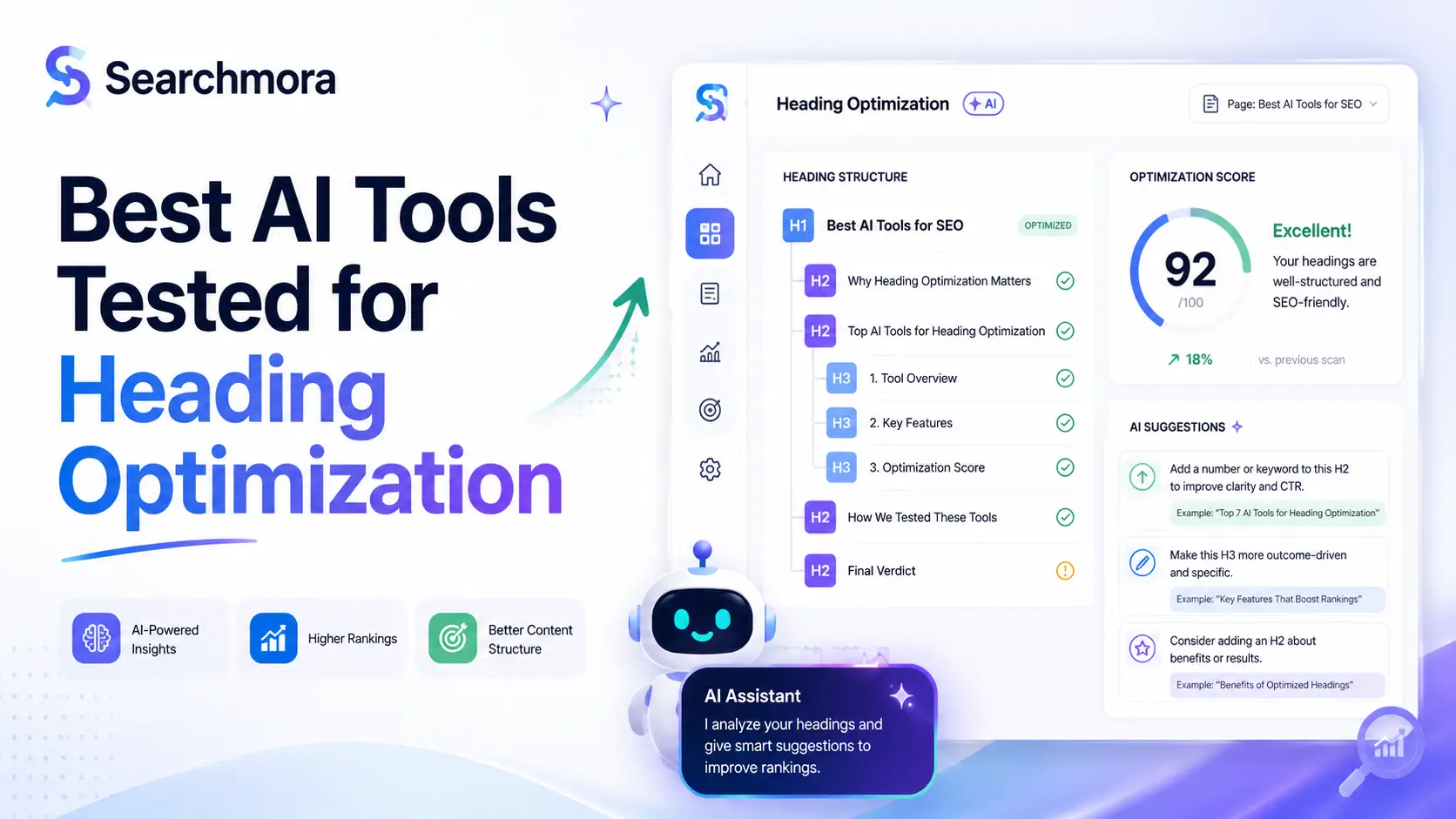
🛡️ How to Avoid AI Heading Over-Optimization
AI heading tools can damage readability when they add too many keywords, repeat the same phrase, copy competitor structures, or create sections that do not serve the reader.
Warning Signs
- Every H2 repeats the primary keyword.
- H3s do not support the H2.
- Question headings feel forced.
- Competitor headings are copied too closely.
- The article becomes longer but not clearer.
- Entities are added without explanation.
- Headings promise answers the section does not provide.
- The H1 and title tag become clickbait.
- The structure jumps between levels.
- The outline has too many similar sections.
Human Review Checklist
Before publishing, ask:
- Does the H1 clearly describe the article?
- Does the title tag encourage the right click?
- Does each H2 answer a major reader need?
- Does each H3 support its parent H2?
- Are headings easy to understand without context?
- Are important entities included naturally?
- Are headings not stuffed with repeated keywords?
- Does each major section begin with a useful answer?
- Are FAQ headings real questions?
- Would a human reader feel guided, not manipulated?
🧰 Heading Optimization Prompts You Can Copy
Prompt 1: Full Heading Audit
Act as a senior SEO editor. Audit this H1, H2, and H3 structure for search intent, AEO readiness, semantic coverage, entity clarity, and readability.
Identify:
- Weak headings
- Duplicate headings
- Missing questions
- Missing entities
- Hierarchy problems
- Keyword stuffing
- Sections that need a direct 40–50 word answer
Return a revised heading structure without inventing unsupported claims.
Prompt 2: AEO Heading Rewrite
Rewrite these headings for AEO and AI Overviews. Use question-based headings only where the section directly answers a real user question. Keep headings clear, specific, and natural. Avoid vague headings such as “Overview” or “More Details.”
Prompt 3: Entity Heading Audit
Review this article outline and identify where important entities should appear in H2 or H3 headings. Add entities only when they improve clarity. Do not repeat the primary keyword unnecessarily.
Prompt 4: CTR Title Variations
Generate 10 SEO title and H1 variations for this article. Each title should be clear, concise, aligned with search intent, and not clickbait. Include one direct version, one benefit-focused version, one comparison version, and one question version.
Prompt 5: Hierarchy Fix
Fix this heading hierarchy. Ensure the structure follows H1 → H2 → H3 logically. Do not jump levels. Merge duplicate sections. Rename vague headings. Preserve the article’s original intent.
📈 How to Measure Heading Optimization Results
Measure heading optimization by checking CTR, rankings, featured snippet presence, AI visibility, engagement, scroll behavior, and whether users move through the article more easily.
Metrics to Track
| Metric | What It Shows |
|---|---|
| Organic CTR | Whether the title tag attracts clicks |
| Impressions | Whether the page still matches queries |
| Average position | Whether visibility changes |
| Featured snippets | Whether direct-answer sections are extracted |
| AI citations | Whether AI systems reference the page |
| Engagement time | Whether readers stay longer |
| Scroll depth | Whether structure helps reading |
| Internal link clicks | Whether section flow improves navigation |
| Conversions | Whether clearer structure improves action |
Measurement Warning
Do not attribute every change to headings alone.
Results can also be affected by:
- Algorithm updates.
- content changes.
- backlinks.
- internal links.
- page speed.
- competitors.
- seasonality.
- SERP layout changes.
- brand demand.
- AI Overview changes.
Use annotations in Search Console, GA4, or your SEO tracker.
❓ FAQ
1. What is the best AI tool for heading optimization?
Frase is best for AEO and question-based headings, Surfer is best for SERP and NLP outlines, Clearscope is best for editorial semantic coverage, and CoSchedule is best for CTR-focused title testing.
2. Can AI improve H2 and H3 headings?
Yes. AI can identify weak headings, missing questions, semantic gaps, duplicate sections, and hierarchy problems. Human review is still needed to avoid keyword stuffing and generic structures.
3. What is an AEO heading?
An AEO heading is a clear question or answer-focused section title designed to help users and answer engines quickly understand the section’s purpose.
4. Should every H2 be a question?
No. Use question-based H2s when the section answers a real question. Some sections work better as direct descriptive headings.
5. What is an entity-based heading?
An entity-based heading names a specific concept, product, process, or topic clearly, such as “How NLP Tools Detect Missing Entities in Headings.”
6. Does heading optimization help GEO?
Yes, strong headings can make content easier for AI systems to parse and summarize. However, headings alone do not guarantee AI citations.
7. Can AI tools over-optimize headings?
Yes. They may repeat keywords, copy competitor headings, add unnecessary sections, or create unnatural question headings.
8. What is the best tool for SEO title optimization?
CoSchedule Headline Studio is strong for headline scoring and CTR improvement. Jasper is better when brand voice and campaign consistency matter.
9. What is the best tool for topical headings?
Surfer is strong for topical maps and SERP-based outlines. InLinks is better when entity relationships and knowledge graphs matter.
10. How should I structure headings for SEO?
Use one clear H1, descriptive H2s for major sections, H3s for supporting points, and concise direct answers under important headings.
11. Should headings include keywords?
Yes, but naturally. Headings should describe the section first and include keywords only when they fit the meaning.
12. Can ChatGPT audit headings?
Yes. ChatGPT can audit headings when you provide the article, target keyword, search intent, competitor outlines, and clear rules.
🏁 Final Verdict
The best AI heading optimization tool depends on the heading problem you need to solve.
Choose Frase if your article needs question-based H2s, People Also Ask coverage, answer-engine structure, and AEO-friendly briefs.
Choose Surfer if you want SERP-based outlines, NLP terms, competitor heading analysis, topical maps, and content optimization.
Choose Clearscope if your editorial team needs semantic coverage, readability guidance, common questions, and professional content briefs.
Choose InLinks if entity SEO and knowledge-graph structure matter more than simple keyword heading suggestions.
Choose Jasper if you need brand-safe variations for H1, meta title, and campaign headline.
Choose CoSchedule Headline Studio if your biggest problem is CTR and headline appeal.
Choose NeuronWriter if you need affordable SERP and NLP heading optimization.
Choose ChatGPT or Gemini if you already have data and need a flexible heading editor.
My recommendation is simple:
- Use Frase for AEO structure.
- Use Surfer for SERP and NLP outlines.
- Use Clearscope for editorial quality.
- Use InLinks for entity headings.
- Use Jasper or CoSchedule for H1 and title tag hooks.
- Use ChatGPT to audit the final hierarchy before publishing.
The clearest takeaway is this: headings should guide people first and machines second. The best AI tools make headings clearer, more specific, and easier to extract—not louder, longer, or more repetitive.
Comments 4