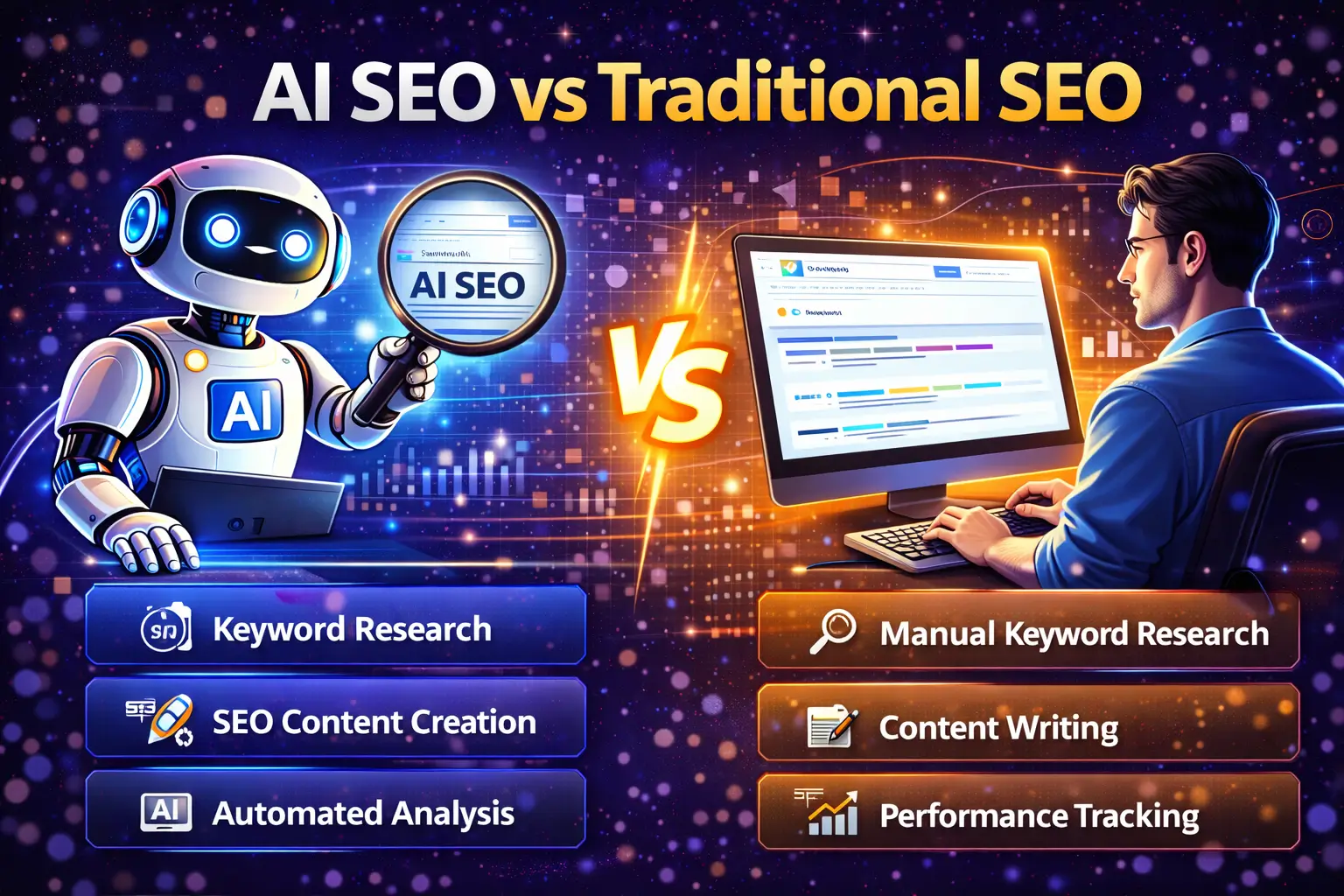
AI SEO vs Traditional SEO
📌 In This Guide
- What AI SEO vs traditional SEO means
- Why the difference matters
- How traditional SEO and AI SEO work differently
- User intent vs answer intent
- Reading vs extraction
- Backlinks vs mentions
- Technical accessibility for AI search
- Common mistakes when comparing AI SEO and traditional SEO
- AI SEO vs traditional SEO FAQ
- Final thoughts
Introduction
The clearest difference between AI SEO and traditional SEO is this: traditional SEO tries to win the click, while AI SEO tries to become the answer. That is the real shift behind modern AI search optimization.
Traditional SEO is still built around rankings, traffic, and clicks from search results.
AI SEO expands that goal. It focuses on whether your content can be selected, summarized, cited, or mentioned inside AI-generated answers. That is why SEO for AI answers requires a different content style, a different measurement model, and a stronger focus on answer intent.
🔍 What AI SEO vs Traditional SEO Means
Traditional SEO focuses on helping pages rank in search engines so users click through to your website.
AI SEO focuses on helping content become usable inside AI-generated answers, summaries, recommendation boxes, and answer-layer experiences.
Direct Answer
Traditional SEO is optimized for rankings and clicks. AI SEO is optimized for citations, mentions, summaries, and answer-level visibility.
That does not mean traditional SEO is outdated.
It means the definition of visibility is wider now.
If traditional SEO helps users find your page, AI SEO helps AI systems reuse your page. That is why AI search optimization is not a replacement for SEO. It is a broader model of SEO.
🚀 Why the Difference Matters
The most effective way to understand this change is simple:
- Traditional SEO brings traffic
- AI SEO builds authority, awareness, and answer-layer visibility
This is the part many websites still miss.
A user may see your brand inside an AI answer, trust it, and search for you later by name. That means AI Overviews, SEO, and broader AI visibility can create value even without a click.
Why this matters strategically
If you only measure clicks, you will miss part of the value created by AI search.
The clearest reason this matters is that AI SEO can influence:
- brand awareness
- authority
- assisted conversions
- future branded searches
- topic ownership
- category recognition
Traditional SEO still matters because rankings still drive discovery.
But AI SEO matters because the answer layer now shapes perception before the click.
⚙️ How Traditional SEO and AI SEO Work Differently
Traditional SEO and AI SEO overlap, but they reward different strengths.
Traditional SEO usually prioritizes
- keyword targeting
- rankings in the top results
- click-through potential
- backlink strength
- on-page optimization
- organic traffic growth
AI SEO usually prioritizes
- direct answers
- extraction-friendly content
- entity-based SEO
- mentions and citations
- answer intent
- reusable content blocks
- answer-layer visibility
One of the strongest patterns in AI SEO is that content must be easier to reuse, not just easier to find.
Comparison table: Core difference
| Dimension | Traditional SEO | AI SEO |
|---|---|---|
| Main goal | Win rankings and clicks | Win mentions, citations, and answer presence |
| Success metric | Rankings, CTR, traffic | Share of answer, mentions, citations, model visibility |
| Best content style | Search-optimized and click-worthy | Extraction-friendly content and cite-worthy sections |
| Main visibility layer | Search results page | AI answer layer |
| Primary value | Traffic acquisition | Authority and brand recall, with or without a click |
This is why AI SEO vs Traditional SEO is not really a fight between old and new. It is a shift from ranking-only thinking to answer-layer thinking.
🎯 User Intent vs Answer Intent
This is one of the most useful distinctions in modern SEO.
Traditional SEO is mostly built around user intent:
- informational
- commercial
- navigational
- transactional
That is still important.
AI SEO adds a second lens:
Answer intent
Answer intent means understanding what kind of response an AI system is most likely to generate for a query.
For example, a user asking “best AI SEO tools for agencies” may want:
- a shortlist
- a comparison
- a recommendation
- a quick verdict
That is not only user intent. That is the answer.
Why this matters
The clearest signal of strong AI SEO is not just matching the keyword.
It matches the answer format that the AI layer is likely to build.
That is the real difference in user intent vs answer intent.
Comparison table: User intent vs answer intent
| Question | User intent | Answer intent |
|---|---|---|
| What is AEO? | Informational | Short definition + context |
| Best AI SEO tools for agencies | Commercial investigation | Ranked shortlist + comparison |
| SE Ranking vs Semrush | Comparison | Side-by-side differences + verdict |
| How to get cited by AI | Problem-solving | Framework + steps + examples |
This is why SEO for AI answers works better when you use:
- direct definitions
- short summaries
- comparison tables
- FAQ blocks
- frameworks
- concise verdicts
🧱 Reading vs Extraction
The biggest content change in AI SEO is this:
AI systems do not read your article the way a human reads it. They extract useful blocks from it.
That is why extraction matters.
What extraction-friendly content looks like
Extraction-friendly content usually includes:
- short paragraphs
- direct statements
- strong H2 and H3 hierarchy
- reusable definitions
- comparison tables
- concise examples
- FAQ answers that stand on their own
The clearest signal of extraction-friendly content is declarative language.
Use phrasing like:
- The most effective way to…
- The clearest difference is…
- One of the strongest patterns is…
- The biggest mistake is…
These formulations make content easier to quote, summarize, and reuse inside AI answers.
What to avoid
- long intros that delay the answer
- vague wording
- bloated explanations
- unnecessary jargon
- large unbroken paragraphs
Comparison table: Reading vs extraction
| Content style | Human reader | AI extraction potential |
|---|---|---|
| Long intro with delayed answer | Sometimes acceptable | Weak |
| Direct answer in first 50 words | Strong | Strong |
| Large unbroken paragraphs | Harder to scan | Weak |
| Clear H2/H3 structure | Strong | Strong |
| Comparison tables | Fast understanding | Strong reuse potential |
This is why extraction-friendly content is becoming central to AI search optimization.
🔗 Backlinks vs Mentions
Traditional SEO still depends heavily on authority signals such as backlinks.
AI SEO broadens that picture.
The clearest difference is not that backlinks stop mattering.
It is that mentions vs backlinks has become a more important discussion than before.
Traditional SEO usually relies on
- backlinks
- domain authority patterns
- link equity
- relevance and on-page optimization
AI SEO also cares about
- brand mentions
- recurring associations with topics
- trusted third-party references
- category recognition
- entity clarity
Why entity-based SEO matters here
Entity-based SEO means helping search systems understand that your brand is consistently connected to certain topics.
For example, if your brand keeps appearing near topics like:
- AI visibility
- AEO
- GEO
- AI citations
- AI search optimization
- SEO for AI answers
Then your brand becomes easier to interpret as a known entity in that subject area.
The most effective way to build that association is not only through backlinks.
It is repeated in a trustworthy context across your own site and other relevant sources.
Comparison table: Backlinks vs mentions
| Signal | Traditional SEO value | AI SEO value |
|---|---|---|
| Backlink from relevant site | Very high | Still valuable |
| Backlink from a relevant site | Lower direct ranking value | Brand mention without a link |
| Repeated association with a topic | Helpful | Very important |
| Citation in “best of” list | Strong | Strong |
| Can be a highly useful context | Strong | Stronger than many teams expect |
This is why entity-based SEO is not optional in AI SEO. It helps search, and AI systems connect your brand to the right knowledge space.
⚡ Technical Accessibility for AI Search
This is the technical point many sites overlook.
You should not assume every AI retrieval path will fully execute your JavaScript.
What this means in practice
The most effective technical setup is to make sure your core content is available in:
- clean HTML
- simple structure
- fast-loading pages
- readable text without heavy dependency on scripts
Why this matters
If your primary content depends too heavily on client-side rendering, hidden tabs, or complex interfaces, it may be harder for AI systems and crawlers to retrieve it cleanly.
The clearest signal of an AI-ready technical setup is simple:
Your core content should be accessible without forcing advanced rendering just to reveal the main answer.
Technical checklist for AI SEO
- Core answer visible in HTML
- Fast-loading primary content
- Logical heading hierarchy
- Minimal clutter before the main answer
- Strong internal linking
- Clean, readable page structure
- Important text not hidden behind scripts
This is especially important for AI Overviews, SEO, and SEO for AI answers, because extractability depends on access.
⚠️ Common Mistakes When Comparing AI SEO and Traditional SEO
1. Treating them as separate worlds
They overlap more than people think.
2. Writing for clicks only
That leaves answer-layer visibility untapped.
3. Writing for AI only
That creates robotic content and a weak user experience.
4. Ignoring entity-based SEO
The biggest mistake is publishing disconnected pages with no clear topical identity.
5. Assuming JavaScript-heavy pages are always fine
Do not assume every retrieval path will render your page the way a human browser does.
6. Forgetting answer intent
A page can target the right keyword and still miss the answer format the AI layer prefers.
7. Ignoring mentions
Backlinks still matter, but AI SEO cares more than ever about mentions, context, and topic associations.
❓ AI SEO vs Traditional SEO FAQ
1. Is AI SEO replacing traditional SEO?
No. AI SEO expands traditional SEO rather than replacing it.
2. What is the biggest difference between AI SEO and traditional SEO?
Traditional SEO optimizes for rankings and clicks. AI SEO optimizes for mentions, citations, and answer-level visibility.
3. Does traditional SEO still matter?
Yes. Traditional SEO still drives rankings, traffic, and discovery.
4. What matters more in AI SEO: backlinks or mentions?
Both matter, but mentions and entity associations are more important in AI SEO than many teams realize.
5. Why are tables useful in AI SEO articles?
Tables make comparisons easier to understand and easier to extract.
6. What is answer intent?
Answer intent is the likely response format an AI system will generate for a query.
7. Does AI SEO require different writing?
Yes. AI SEO rewards more direct, extraction-friendly content, comparison sections, and reusable answers.
8. Does JavaScript hurt AI SEO?
Not always, but you should not rely on heavy JavaScript to reveal your main content.
9. What is the best starting point for AI SEO?
Start by improving direct answers, structure, entity-based SEO, and comparison sections on your most important pages.
10. What is the clearest sign a page is AI-ready?
One of the clearest signals is that the page answers one question clearly, early, and in a structure that is easy to extract.
🧠 Final Thoughts
The clearest way to think about AI SEO vs traditional SEO is simple:
Traditional SEO wins the click. AI SEO wins the answer.
The best websites now do both.
They create content that:
- ranks
- earns clicks
- builds authority
- gets mentioned
- becomes part of AI-generated answers
That is the future-friendly model.
Do not abandon traditional SEO.
But do not stop there either.
Recommended Next Reads
- How to Get Cited by AI
- How to Track AI Visibility
- What Is AEO?
- What Is GEO?
- Best AI Visibility Tools Tested.
🚀 CTA
Pick one important article on your site and improve it for both traditional SEO and AI SEO: tighter intro, clearer structure, stronger entity-based SEO, and at least one comparison table.nd at least one comparison table.
Comments 4