Best AI SEO Tools Tested for Small Business
📌 In This Guide
- What small businesses actually need from an AI SEO tool
- Why automation matters more than feature count
- How I evaluated these tools
- Best tools for automation and time savings
- Best tools for AI visibility and answer-engine tracking
- Best all-in-one SEO platforms for small businesses
- Best tools for local SEO and no-code implementation
- Best tools for content, brand voice, and niche opportunities
- Best tools for entity-based SEO and GEO workflows
- Budget-friendly winners
- Pros and cons of the leading tools
- The executive decision matrix
- Best AI SEO tools for small businesses FAQ
- Final thoughts
Introduction
If I were running a small business, I would not buy an SEO tool just because it has the biggest dashboard. I would buy the one that saves me time, automates repetitive work, and shows a clear path from effort to revenue.
That is what matters most.
Most small businesses do not have:
- a full SEO team
- a developer on standby
- hours every week to interpret complex reports
- room in the budget for five overlapping subscriptions
So the best AI SEO tools for small businesses are not always the most powerful on paper.
They are the ones that:
- save time
- reduce busywork
- surface quick wins
- help with AI visibility
- fit a real budget
- feel manageable for a lean team
🔍 What Small Businesses Actually Need from an AI SEO Tool
A small business usually needs an SEO tool to answer three practical questions:
- What should I do next?
- What can I fix fast without a developer?
- Which SEO work is most likely to turn into leads, calls, or sales?
Direct Answer
The best AI SEO tools for small businesses are the ones that combine automation, clear guidance, realistic keyword targeting, and affordable workflows without forcing the owner into enterprise-level complexity.
For me, the best tools in this category usually do at least one of these especially well:
- automate repetitive SEO tasks
- simplify technical fixes
- help create or improve content
- Monitor AI visibility,
- support local SEO
- surface realistic opportunities for smaller sites
That is what makes a tool useful, not just impressive.
🚀 Why Automation Matters More Than Feature Count
Small business owners do not need more dashboards.
They need more time.
That is why I care so much about automation in this category.
The right tool can save a small team from:
- manually editing dozens of titles
- checking rankings every day
- guessing which keyword to target next
- rewriting weak pages blindly
- digging through giant technical reports
The clearest small-business rule
If a tool saves ten hours a week, it is usually more valuable to a small business than a tool with fifty advanced features nobody has time to use.
That is the lens I used throughout this article.
🧪 How I Evaluated These Tools
Because this article is for small businesses, I did not judge tools only by raw SEO power.
I judged them by how well they work when:
- The team is small
- The budget matters
- Implementation speed matters
- Technical support is limited
- ROI needs to show up quickly
What I looked for
I evaluated these tools based on:
- automation
- ease of use
- AI visibility tracking
- no-code implementation
- local SEO usefulness
- content support
- Internal linking helps
- entity-based SEO support
- Search Console usefulness
- pricing and long-term value
What mattered most
The strongest tools did at least one of these especially well:
- automate tasks that normally waste time
- simplify SEO for non-technical teams
- improve visibility without a huge learning curve
- help small businesses publish better content faster
- Provide a realistic all-in-one path instead of tool sprawl
That is what I optimized for here.
⚙️ Best Tools for Automation and Time Savings
1. diib
Diib is one of the easiest SEO tools to recommend to a small business owner who wants simple direction instead of technical overload.
What I like most is that it turns SEO into:
- a health score
- a task list
- clear alerts
- practical improvement ideas
That is useful because most small business owners do not want to interpret complex SEO reports. They want the tool to tell them what matters today.
2. Hike SEO
Hike SEO is another strong option for small businesses because it feels like a guided SEO roadmap instead of a giant analytics platform.
It is especially useful for:
- local businesses
- service businesses
- smaller teams that want checklists
- users who prefer step-by-step directions
My take
If I wanted the simplest daily workflow, I would lean toward Diib. If I wanted a more guided, checklist-heavy setup for a smaller business site, I would seriously consider Hike SEO.
🤖 Best Tools for AI Visibility and Answer-Engine Tracking
This matters more than ever because small businesses can lose visibility even when they rank well if AI answer boxes absorb the click.
1. OtterlyAI
OtterlyAI is one of the strongest small-business AI visibility tools because it makes AI monitoring feel understandable.
It helps answer practical questions like:
- Is my brand being mentioned in AI search?
- Which prompts matter most?
- Which AI engines mention competitors more than me?
- Am I being cited, or just ignored?
I like it because it feels focused and useful without requiring an enterprise setup.
2. AIClicks
AIClicks is also worth watching if your main goal is understanding whether your business is appearing in AI-generated answers in a simpler, more visual way.
For beginners and smaller teams, that kind of visibility tracking can be easier to grasp than a bigger SEO suite.
My take
OtterlyAI feels stronger if AI search visibility becomes a real growth channel for the business. AIClicks makes more sense when simplicity and visual tracking matter most.
🧩 Best All-in-One SEO Platforms for Small Businesses
Not every small business wants to manage multiple tools.
Some just want one platform that does enough of everything.
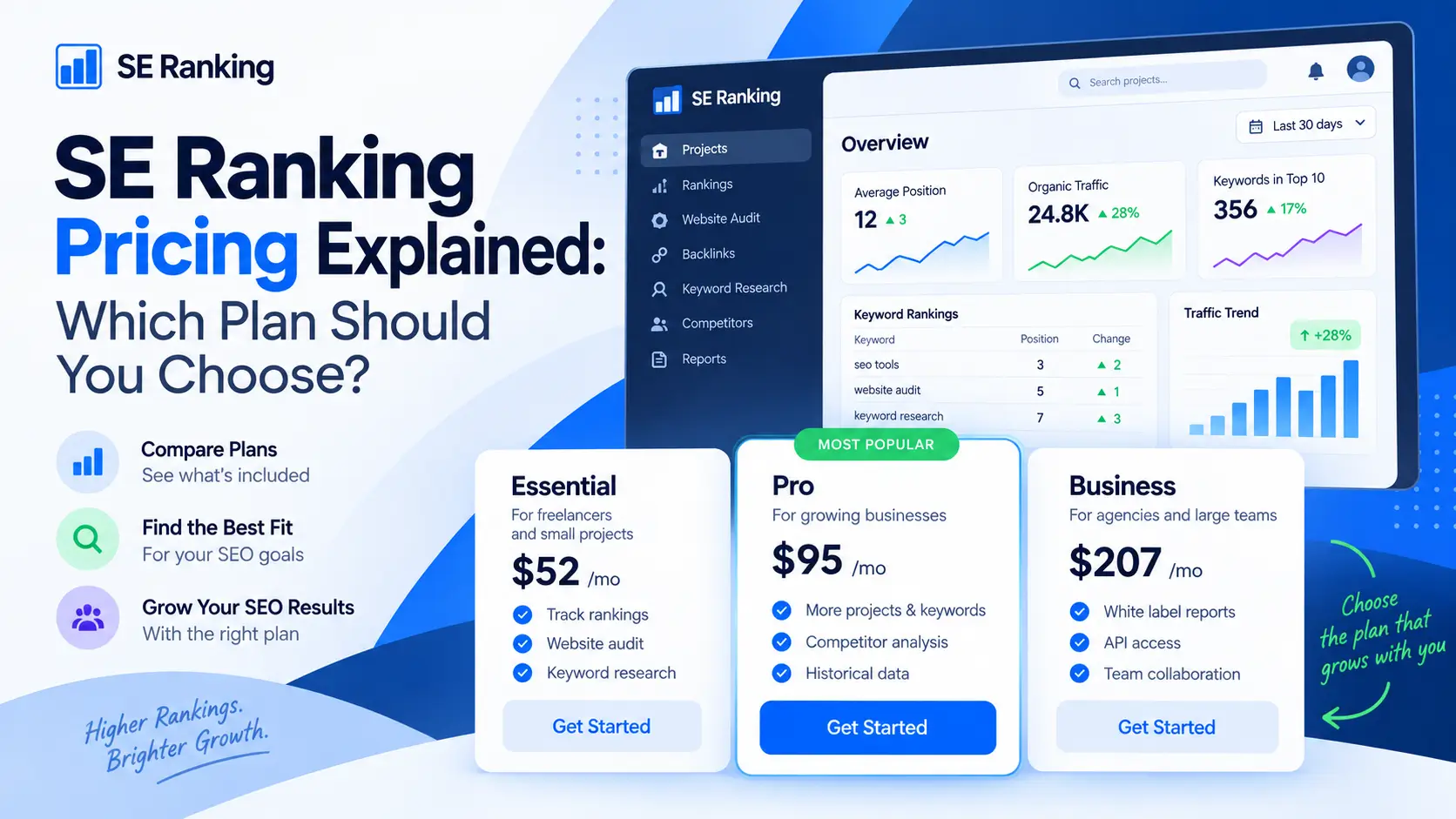
1. SE Ranking
SE Ranking is one of the easiest all-in-one platforms I would recommend to a small business.
It combines:
- rank tracking
- site audits
- backlink monitoring
- reporting
- keyword research
- AI-related visibility workflows
What I like most is the balance. It does not feel as overwhelming as bigger platforms, but it still gives a growing business room to scale.
2. ConvertMate
ConvertMate is especially interesting for e-commerce and Shopify-style businesses because it focuses on growth across:
- search
- AI visibility
- content
- paid channels
- automation
It is not the tool I would recommend to every small business, but for product-led brands, it can be a very strong fit.
My take
If I wanted the strongest all-around value, I would lean toward SE Ranking. If I ran a product-heavy ecommerce business, I would pay closer attention to ConvertMate.
📍 Best Tools for Local SEO and No-Code Implementation
Most small businesses care deeply about local discovery.
That makes local SEO and no-code fixes especially important.
1. Alli AI
Alli AI is one of the clearest no-code SEO tools in this category.
It helps with:
- title changes
- meta updates
- schema improvements
- internal linking updates
- sitewide on-page changes
without needing a developer for every task.
That is a very big advantage for smaller teams.
Why this matters
A lot of small businesses know what they need to fix,x but do not act because implementation feels risky or technical.
Alli AI shortens that gap.
My take
If the business does not have a developer and still needs sitewide SEO changes, Alli AI is one of the most practical tools in this category.
✍️ Best Tools for Content, Brand Voice, and Niche Opportunities
This category matters because content is still how many small businesses grow organic visibility.
1. Jasper
Jasper is especially useful if brand voice matters a lot.
That is important for:
- premium businesses
- service businesses
- Companies with strong positioning
- Teams that want AI help without sounding generic
Its strength is not just writing faster. It is helping the writing stay closer to the brand.
2. Writesonic
Writesonic is useful for small businesses that care about:
- content speed
- workflow automation
- article generation
- AI visibility-aware content production
- image, and content support in one broader workflow
3. MarketMuse
MarketMuse is valuable for a different reason.
It helps small businesses find niche content gaps that bigger competitors may ignore.
That is powerful because the smartest path for a smaller business is often:
- avoid giant broad topics
- found a narrower niche
- own it deeply
- become the most useful source in that space
My take
If brand voice is the priority, I would lean toward Jasper. If speed is the priority, Writesonic becomes very attractive. If strategic niche positioning is the goal, MarketMuse deserves serious attention.
🧠 Best Tools for Entity-Based SEO and GEO Workflows
This matters because answer engines and search systems prefer brands they can understand clearly.
1. WordLift
WordLift is one of the clearest tools here.
It helps with:
- structured data
- semantic relationships
- entity linking
- machine-readable content layers
- knowledge-graph style understanding
For a small business, this matters because it can help search systems understand:
- What the business actually is
- what services or products it offers
- how it relates to a broader topic space
2. AthenaHQ
AthenaHQ is one of the more serious GEO workflow tools in this category.
It is useful for:
- AI answer visibility
- share of the answer
- authority gaps
- competitive GEO workflows
- self-guided answer-engine optimization
I would not call it the first tool every small business should buy, but I would absolutely call it one of the more interesting options for companies that want to own AI search visibility more proactively.
My take
If the problem is entity clarity and machine understanding, I would look at WordLift first. If the problem is broader, answer-engine visibility and GEO workflow, AthenaHQ is the stronger choice.
💰 Budget-Friendly Winners
Not every small business can justify a premium SEO stack immediately.
That is why this section matters.
1. diib
Best if you want the easiest entry point and a simple daily pulse.
2. SE Ranking
Best if you want the strongest balance of features, usability, and value.
3. NeuronWriter
Best if content and on-page optimization are your biggest bottlenecks.
4. Mangools
Best if you mainly need easier keyword research without dashboard overload.
The clearest budget rule
A small business should buy the tool that solves the current bottleneck, not the tool that promises to solve every future problem.
That keeps ROI healthier and tool sprawl lower.
✅ Pros and Cons of the Leading Tools
1- diib
Pros
- Easy daily guidance
- Very simple health score workflow
- Good for busy owners
Cons
- Less depth than broader SEO suites
- Better for guidance than advanced analysis
2- Hike SEO
Pros
- Strong step-by-step workflow
- Great for local and smaller businesses
- Easier to follow than larger platforms
Cons
- Narrower than bigger all-in-one tools
- Less powerful for advanced SEO teams
3- OtterlyAI
Pros
- Clear AI visibility monitoring
- Useful for ChatGPT and AI search tracking
- Focused and practical
Cons
- More specialized than all-in-one SEO suites
- Usually best alongside another SEO tool
4- SE Ranking
Pros
- Strong all-in-one value
- Easier to use than heavier suites
- Good fit for growing businesses
Cons
- Not as deep as the biggest enterprise platforms
- Better on balance than category-leading depth
5- Alli AI
Pros
- Strong no-code implementation
- Great for non-technical teams
- Saves real time on repetitive fixes
Cons
- More operational than educational
- Best when the business already knows what it wants to automate
6- WordLift
Pros
- Strong semantic and entity support
- Useful for business understanding in search
- Helps machine readability
Cons
- More specialized than broad SEO suites
- Best as part of a wider SEO strategy
6- Jasper
Pros
- Strong brand voice workflows
- Good for consistent business messaging
- Useful for content teams
Cons
- Better for content than for full SEO operations
- Needs a stronger SEO workflow around it
7- Writesonic
Pros
- Fast content production
- Good workflow automation
- Useful for small teams publishing at scale
Cons
- More editing is still needed
- Better for output than a deep strategy
8- MarketMuse
Pros
- Strong niche gap analysis
- Useful for topic authority
- Good for strategic content planning
Cons
- More strategic than operational
- Not the simplest first tool for every small business
9- AthenaHQ
Pros
- Strong GEO workflow
- Useful for answer engine visibility strategy
- Good for teams thinking ahead
Cons
- More serious than many small businesses need at first
- Better once AI visibility becomes a strategic priority
🧭 The Executive Decision Matrix
| Best fit | Recommended tool | Why |
|---|---|---|
| Best for automation | Alli AI | Strong no-code implementation and sitewide SEO fixes |
| Best for competitor intel | Semrush | Strong broader research, gaps, and competitive visibility workflows |
| Best for content ROI | Surfer AI | Strong optimization and ranking-focused content workflows |
My simpler buying advice
- Choose 1. diib if you want the easiest daily SEO direction
- Choose 2. SE Ranking, if you want the strongest all-in-one value
- Choose 3. Alli A,I if implementation is your biggest bottleneck
- Choose 4. Otterly,AI if AI visibility matters most right now
- Choose 5. WordL,ift if entity understanding is your missing layer
- Choose 6. Ja,sper if brand voice matters heavily
- Choose 7. Write,sonic if you need more content output with less time
- Choose 8. Mark,etMuse if you want niche content opport,unities the bigger competitors ignore
❓ Best AI SEO Tools for Small Business FAQ
1. What is the best AI SEO tool for a small business?
It depends on the main bottleneck. SE Ranking is one of the strongest all-around options, diib is one of the easiest, and Alli AI is one of the most useful for no-code implementation.
2. What is the best affordable SEO tool for a small business?
SE Ranking, diib, and NeuronWriter are all strong value options depending on whether the business needs monitoring, all-in-one SEO, or content support.
3. Do small businesses need AI visibility tools already?
Yes, especially if answer engines affect discovery in your niche. Even simple monitoring can help a small brand understand whether it is showing up in AI answers at all.
4. What is the best no-code SEO tool for a small business?
Alli AI is one of the strongest no-code options because it helps automate many sitewide SEO changes.
5. What is the best AI writing tool for a small business?
That depends on the goal. Jasper is stronger for brand voice, Writesonic is stronger for speed, and Surfer AI is stronger for ranking-focused content workflows.
6. What is the best local SEO tool for a small business?
Hike SEO and SE Ranking are both very practical for small businesses that care about local visibility and simpler SEO workflows.
7. Should a small business buy one all-in-one tool or several smaller tools,
Usually one or two focused tools are enough in the beginning. The best choice is the one that solves the biggest bottleneck first.
8. What matters more for a small business: automation or advanced features?
Automation usually matters more because time is often the scarcest resource.
🏁 Final Thoughts
When I think about the best AI SEO tools for businesses, I do not think about who has the biggest platform.
I think about who helps a smaller team move faster.
The best tools in this category help a business:
- save time
- publish better content
- fix issues without a developer
- understand AI visibility
- Find realistic growth opportunities
- Turn SEO into a repeatable business process
If I had to simplify the whole article into one idea, it would be this:
Small businesses do not need more SEO complexity. They need more SEO leverage.
That is what the right AI SEO tool should give them.
Comments 4