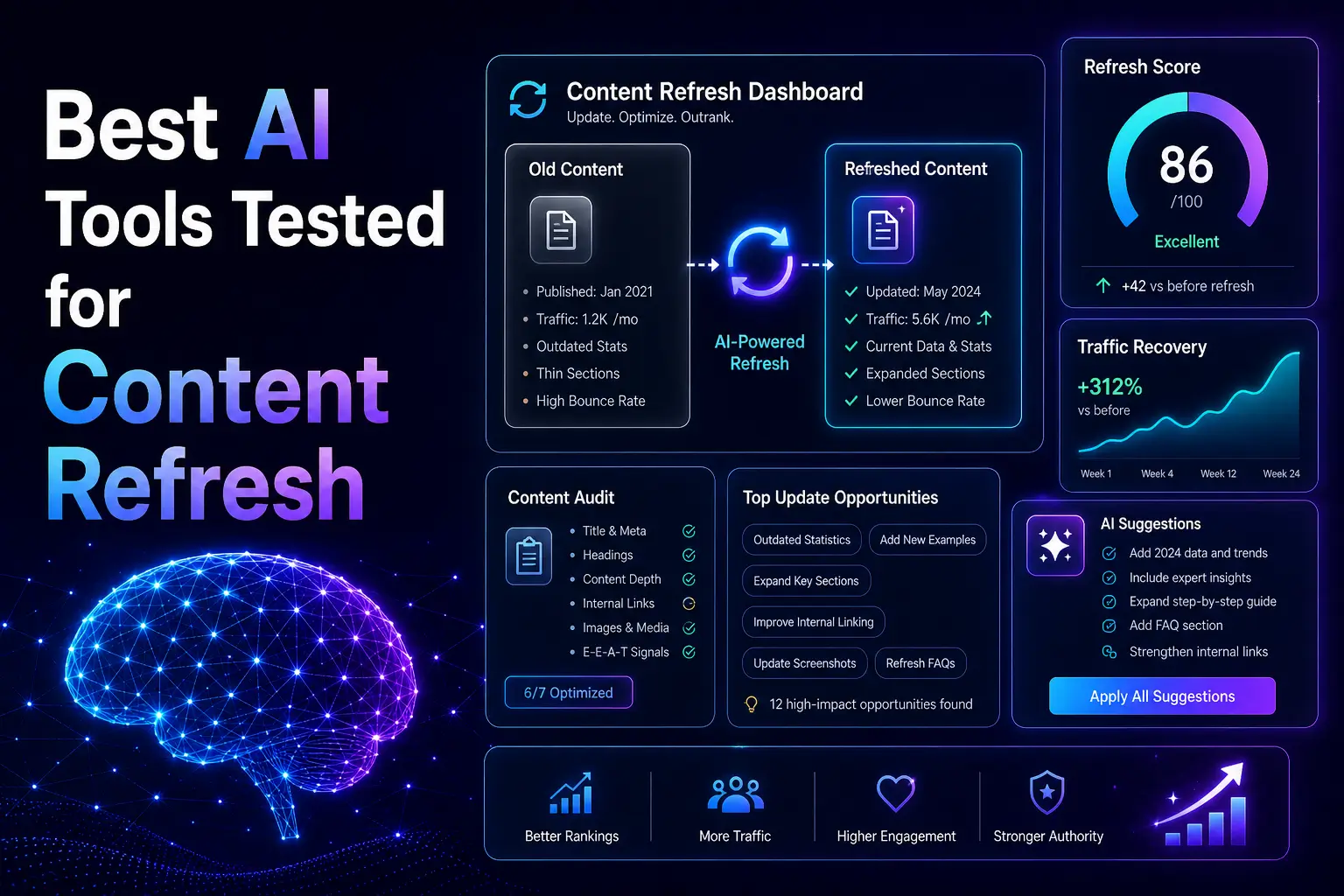
Best AI Tools Tested for Content Refresh
📌 In This Guide
- What content refresh tools do we need to use now
- Why content refresh changed in the AI era
- Quick Verdict
- How I evaluated these tools
- Best tools for content decay analysis
- Best tools for AEO and citation optimization
- Best tools for topical gap analysis
- Best tools for fact-checking and live updates
- Best tools for content scores and smart restructuring
- Best tools for internal link refresh
- Best tools for technical updates and schema
- The Content Refresh Tech Stack
- Pros and cons of the leading tools
- The Refresh Matrix
- FAQ
- Final thoughts
Introduction
The best AI tools for content refresh help you find pages that are losing traffic, understand why they are declining, and update them for today’s search intent, AI citations, internal links, and content quality standards.
If I were refreshing old content today, I would not update everything blindly.
That is one of the biggest mistakes site owners make.
A smart content refresh starts by asking:
- Which pages are actually decaying?
- Which keywords lost impressions or clicks?
- Which competitors now cover the topic better?
- Which article needs a definition, table, FAQ, or stronger expert insight?
- Which page is worth updating, and which one should be merged or retired?
That is why the best AI tools for content refresh are not just rewriting tools.
They are audit, prioritization, optimization, and quality-control tools.
⚡ Quick Verdict
- Best for full content refresh workflow: Surfer SEO
- Best for affordable semantic optimization: NeuronWriter
- Best for authority gap analysis: MarketMuse
- Best for large-scale technical updates: Alli AI
- Best for internal link refresh: Link Whisper
- Best for quality control and fact checks: Originality.ai
- Best for repurposing refreshed content: Castmagic
🔍 What Content Refresh Tools Need to Do Now
A content refresh tool should not only say, “Add more keywords.”
That is too shallow.
A good tool should help you decide:
- What to update
- What to remove
- What to expand
- What to restructure
- What to link internally
- What to make more citable for AI systems
Direct Answer
The best AI content refresh tools combine content decay analysis, SERP comparison, topical gap detection, content scoring, internal linking, and AEO-focused improvements so old content can compete again.
For me, the strongest tools do at least one of these jobs well:
- Detect declining pages
- Compare your article against current competitors
- Identify missing subtopics
- improve content structure
- update metadata at scale
- Add internal links
- improve citation readiness
- support factual review
🚀 Why Content Refresh Changed in the AI Era
Content refresh used to mean updating dates, adding a few paragraphs, and improving the title.
That is no longer enough.
Now, a refreshed article should also be easier for answer engines to extract and cite.
That means the update should improve:
- direct answers
- definitions
- comparison tables
- concise summaries
- FAQ sections
- entity coverage
- internal links
- source accuracy
- schema and metadata
The clearest content refresh rule
The goal is not to make an old article longer. The goal is to make it more useful, more current, and easier to quote.
That is where AI tools can help, but only when they are used strategically.
💡 Pro-Tip: Don’t refresh content just because it is old. Refresh it because it lost rankings, lost clicks, lost relevance, or now fails to match current search intent.
🧪 How I Evaluated These Tools
I evaluated these tools based on how useful they are for real content refresh work.
I looked for tools that help with:
- content decay detection
- Google Search Console data
- SERP comparison
- missing-topic analysis
- content score benchmarking
- AEO and citation readiness
- internal link refresh
- metadata and schema updates
- fact-checking and quality control
- repurposing updated content
I gave more weight to tools that help prioritize work.
That matters because most sites do not have a content quality problem alone. They have a prioritization problem.
They update the wrong pages first.
📉 Best Tools for Content Decay Analysis
Content decay is when a page slowly loses traffic, impressions, rankings, or relevance over time.
The smartest refresh strategy starts here.
1. MarketMuse
MarketMuse is one of the strongest tools for content decay and content inventory work because it looks at the site as a content system, not just as a list of URLs.
What I like most is that it helps you think in terms of authority, topic clusters, and update priorities.
That matters because an old article may not only need a rewrite. It may need supporting content, better topical depth, or a stronger connection to related pages.
2. Surfer SEO
Surfer SEO is also strong here because its Content Audit workflow helps identify pages that need re-optimization based on performance and content score signals.
It is especially useful when you want a more practical page-by-page refresh workflow.
3. NeuronWriter
NeuronWriter is useful for site owners who want a more affordable content monitoring and optimization workflow.
Its Google Search Console integration makes it especially relevant for identifying pages that need attention based on real performance signals.
My Take
If I wanted strategic content inventory and authority-based prioritization, I would choose MarketMuse.
If I wanted faster page-level refresh actions, I would choose Surfer SEO.
If I wanted a budget-friendly refresh workflow, I would choose NeuronWriter.
🤖 Best Tools for AEO and Citation Optimization
Refreshing content now means making it easier for AI systems to extract useful answers.
That means your article should include:
- clear definitions
- direct answers
- short explanatory blocks
- comparison tables
- structured FAQ sections
- quotable statements
1. Surfer SEO
Surfer SEO is useful here because it helps you compare your content against what is currently ranking and then improve structure, terms, and optimization depth.
For AEO, I would use it to identify what the article is missing, then rewrite key sections into clearer, more direct answer blocks.
2. NeuronWriter
NeuronWriter is strong for semantic optimization. It helps identify terms, topics, and NLP-style recommendations that make the article more complete.
For AI citations, that matters because thin topical coverage reduces trust.
3. MarketMuse
MarketMuse is especially useful when the issue is deeper authority.
If your article is too shallow compared with the topic, MarketMuse is better at showing where the content needs more depth.
My Take
If I wanted a practical citation-ready refresh, I would combine Surfer SEO for structure, NeuronWriter for semantic completeness, and MarketMuse for authority gaps.
💡 Pro-Tip: Add a direct definition within the first 40–50 words of the section you want cited. AI systems prefer clean, extractable answers over long introductions.
🧩 Best Tools for Topical Gap Analysis
Refreshing an article is not only about improving what is already there.
It is also about finding what is missing.
Competitors may now cover:
- newer tools
- updated pricing models
- fresh use cases
- new FAQs
- new product features
- better examples
- stronger comparison tables
1. MarketMuse
MarketMuse is one of the strongest tools for finding deeper topical gaps.
It is especially useful when you need to know whether a page lacks authority, not just whether it lacks a few keywords.
2. Surfer SEO
Surfer SEO is strong when you want a fast comparison against current competitors.
It helps show which terms, structure patterns, and content elements are common among top-ranking pages.
3. NeuronWriter
NeuronWriter is useful for affordable SERP-based and NLP-driven content improvement.
It is a strong fit for bloggers, niche site owners, and small teams that want to close topical gaps without paying for a larger enterprise platform.
My Take
If the article is important and competitive, I would use MarketMuse for strategic gap analysis.
If I need speed, I would use Surfer SEO.
If I need value for money, I would use NeuronWriter.
🔄 Best Tools for Fact-Checking and Live Updates
Old facts can damage trust.
That includes:
- outdated prices
- old statistics
- expired features
- changed product names
- old screenshots
- outdated laws or platform rules
- broken examples
1. Perplexity
Perplexity is not a classic content refresh platform, but it is very useful as a research assistant for checking whether older claims still hold up.
I would use it to validate facts, find current context, and identify areas where the article needs updated examples or newer information.
2. Originality.ai
Originality.ai is useful as a quality-control layer.
For refresh work, I would use it to check for originality, readability, factual risk, and AI-heavy patterns before republishing.
3. ChatGPT with live research workflow
When connected to current sources, ChatGPT can be useful for comparing old article claims against new information.
But I would still treat it as an assistant, not the final authority.
My Take
If I were refreshing a review, pricing guide, or tool comparison, I would never rely only on the old article.
I would verify important claims first, then rewrite.
🧱 Best Tools for Content Scores and Smart Restructuring
Content scores are not perfect.
But they are useful when you treat them as a benchmark, not as a religion.
1. Surfer SEO
Surfer SEO is one of the best-known tools for content score benchmarking.
I like it for refreshing work because it gives a clear before-and-after view. You can see whether the article is structurally closer to what search results currently reward.
2. NeuronWriter
NeuronWriter also provides practical content optimization scoring, but often at a more accessible price point.
It is especially useful when you want to refresh many articles without using a more expensive content platform.
3. MarketMuse
MarketMuse is less about chasing a simple score and more about improving the authority and completeness of the page.
That is useful when the article needs deeper rebuilding rather than surface-level optimization.
My Take
If the article is close to ranking, Surfer SEO or NeuronWriter may be enough.
If the article is strategically important but shallow, MarketMuse is more useful.
🔗 Best Tools for Internal Link Refresh
Old articles often miss links to newer content.
That is a major problem.
A refreshed article should not only update its own content. It should also reconnect with the rest of the site.
1. Link Whisper
Link Whisper is one of the best tools for internal link refresh because it helps identify link opportunities across old and new content.
This is especially useful if your site has published many articles since the original page went live.
2. NeuronWriter
NeuronWriter can also support internal linking workflows, especially when connected with performance data and content optimization planning.
My Take
If internal linking is weak, Link Whisper is one of the fastest wins in a content refresh project.
💡 Pro-Tip: Every content refresh should include two link checks: links from the old article to newer pages, and links from newer pages back to the refreshed article.
⚙️ Best Tools for Technical Updates and Schema
Sometimes, a content refresh is not only editorial.
It can also include:
- metadata updates
- schema updates
- FAQ schema review
- product schema fixes
- title and description improvements
- large-scale page-level changes
1. Alli AI
Alli AI is one of the strongest tools for technical and on-page updates at scale.
It is useful when you need to update meta titles, meta descriptions, schema markup, headings, or other page-level SEO elements across many URLs.
That makes it especially valuable for large sites, agencies, and e-commerce stores.
2. WordLift
WordLift is useful when the refresh requires a stronger entity structure, schema, and semantic clarity.
If the article now needs to connect more clearly to a knowledge graph or topic entity, WordLift is the better fit.
My Take
Use Alli AI when execution at scale is the bottleneck.
Use WordLift when machine understanding and entity clarity are the bottlenecks.
🎬 Best Tools for Repurposing Refreshed Content
A refreshed article should not stay trapped as one blog post.
A good update can become:
- a LinkedIn post
- a short video script
- an email newsletter
- a carousel outline
- a YouTube script
- a social media thread
1. Castmagic
Castmagic is useful for turning media and long-form content into multiple content formats.
For refresh workflows, I would use it when I want to turn the updated article into supporting content for social or video.
2. Jasper
Jasper is useful when the repurposed content needs to stay close to the brand voice.
That matters for companies that do not want every LinkedIn post or video script to sound generic.
My Take
If repurposing is part of the refresh strategy, Castmagic is a practical tool for content extraction and transformation. If brand voice matters more, Jasper is a stronger fit.
🧰 The Content Refresh Tech Stack
If I were building a practical refresh stack, I would not overcomplicate it.
For a small content site
- NeuronWriter for affordable optimization
- Link Whisper for internal links
- Originality.ai for quality checks
For a serious content brand
- Surfer SEO for content audit and re-optimization
- MarketMuse for topic authority gaps
- Originality.ai for quality control
For a large website or agency
- MarketMuse for inventory and prioritization
- Alli AI for large-scale technical updates
- Surfer SEO for page-level optimization
The right stack depends on whether the problem is traffic decay, topical weakness, technical scale, or content quality.
✅ Pros and Cons of the Leading Tools
1. Surfer SEO
Pros
- Strong for content audit and re-optimization
- Useful content score benchmarking
- Good for practical page-level refresh workflows
Cons
- Can become expensive for larger refresh projects
- A high score does not guarantee rankings by itself
2. NeuronWriter
Pros
- Strong value for semantic optimization
- Supports GSC-informed content monitoring
- Good for budget-friendly refresh workflows
Cons
- Less strategic than MarketMuse for authority planning
- Best when paired with clear refresh priorities
3. MarketMuse
Pros
- Excellent for content inventory and authority gaps
- Strong for strategic refresh prioritization
- Useful for deciding what to update, expand, or create
Cons
- More advanced than many small sites need
- Better for content strategy than quick edits
4. Alli AI
Pros
- Excellent for bulk metadata and schema updates
- Useful for large sites and agencies
- Reduces technical implementation delays
Cons
- More operational than editorial
- Best when the team already knows what to deploy
5. Link Whisper
Pros
- Strong internal link refresh workflows
- Helpful for connecting old and new content
- Useful for topical authority
Cons
- Mostly focused on linking
- Best as part of a wider refresh stack
6. Originality.ai
Pros
- Good quality-control layer
- Useful for fact-checking, readability, and originality checks
- Helpful when updating AI-assisted content
Cons
- Not a content optimizer
- Best used before republishing, not as the main refresh tool
7. Perplexity
Pros
- Useful for live research and current context
- Good for checking outdated claims
- Helpful for finding fresh examples
Cons
- Not a full SEO refresh platform
- Still requires editorial judgment
8. Castmagic
Pros
- Useful for content repurposing
- Helps turn refreshed content into social and video assets
- Good for multimedia workflows
Cons
- Not an SEO optimizer by itself
- Best after the main article refresh is complete
🧭 The Refresh Matrix
| Situation | Best Tool | Why |
|---|---|---|
| Article is slipping from page one | Surfer SEO | Strong page-level audit and content score benchmarking |
| The article lacks authority and depth | NeuronWriter | Affordable NLP and topic coverage optimization |
| The article is semantically thin | MarketMuse | Strong content inventory and authority gap analysis |
| The article is slipping from page one | Alli AI | Bulk metadata and schema updates at scale |
| Old posts do not link to newer content | Link Whisper | Strong internal link refresh workflow |
| Facts, pricing, or claims may be outdated | Originality.ai | Research plus quality-control workflow |
| Refreshed article should become social/video content | Castmagic | Repurposes long-form content into new formats |
My simpler buying advice
- Choose Surfer SEO if your article needs stronger on-page re-optimization
- Choose NeuronWriter if you want affordable semantic refresh support
- Choose MarketMuse if your biggest issue is topical authority
- Choose Alli AI if you need large-scale technical refreshes
- Choose Link Whisper if internal links are outdated
- Choose Originality.ai if quality control is becoming a risk
- Choose Castmagic if content repurposing is part of your refresh strategy
❓ Best AI Tools for Content Refresh FAQ
1. What is the best AI tool for content refresh?
It depends on the bottleneck. Surfer SEO is strong for re-optimization, MarketMuse is strong for authority gaps, and NeuronWriter is strong for affordable semantic updates.
2. What is content decay?
Content decay happens when a page loses traffic, impressions, rankings, or relevance over time because search intent, competitors, or information freshness have changed.
3. Should I refresh every old article?
No. Refresh pages that have lost performance, still target valuable keywords, and have a realistic chance of recovering traffic or visibility.
4. What is the best tool for finding topical gaps?
MarketMuse is one of the strongest options for strategic gap analysis, while Surfer SEO and NeuronWriter are useful for page-level topic coverage.
5. What is the best tool for updating internal links?
Link Whisper is one of the strongest options because it helps connect old articles with newer content opportunities.
6. How does content refresh help AEO?
A refresh can make the article easier for answer engines to extract by adding direct definitions, cleaner headings, FAQ blocks, tables, and more concise explanations.
7. What is the best tool for bulk metadata updates?
Alli AI is one of the strongest options for updating titles, meta descriptions, schema, and other on-page elements at scale.
8. How often should I refresh content?
For important pages, review performance every quarter. Refresh only when the data shows decay, intent change, competitor improvement, or outdated information.
🏁 Final Thoughts
When I think about the best AI tools for content refresh, I do not think first about rewriting.
I think about recovery.
The right tool should help you understand:
- What is decaying
- Why is it declining
- What competitors now do better
- What needs to be updated
- What should be linked
- What should become more citable
If I had to reduce the whole article to one idea, it would be this:
Content refresh is not about making old articles look new. It is about making valuable pages useful, current, and competitive again.
Recommended Next Reads
- Best AI Content Optimization Tools
- Best AI SEO Tools Tested for Beginners
- How to Track AI Visibility
- Best AEO Tools Tested
- Best GEO Tools Tested


Comments 4