🚀 Introduction
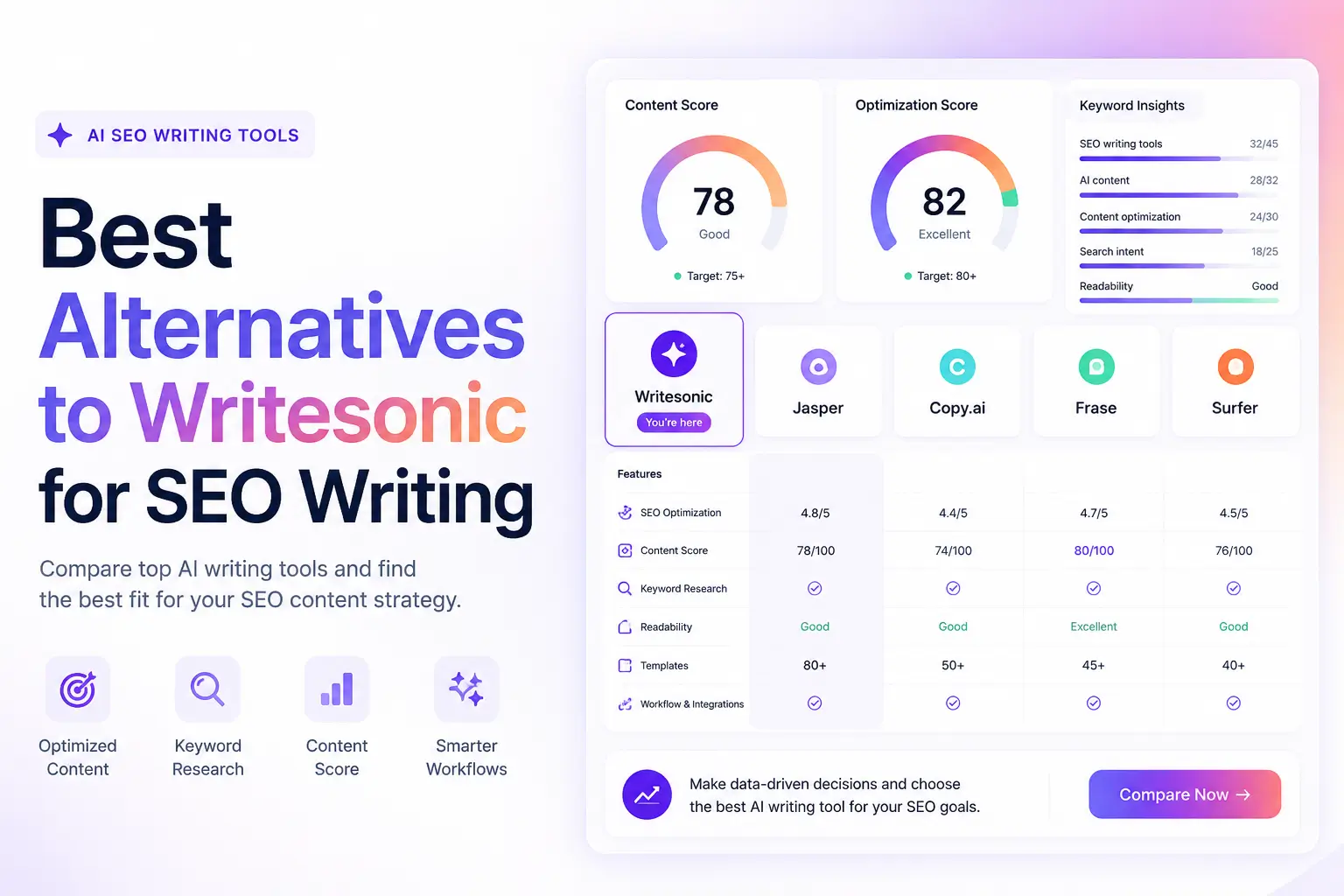
The best alternatives to Writesonic for SEO writing are NeuronWriter, Surfer SEO, Jasper, Scalenut, Frase, Clearscope, MarketMuse, and ContentPen. Choose NeuronWriter for affordable semantic optimization, Surfer for real-time content scoring, Jasper for brand voice, Scalenut for guided production, and Frase for research-driven briefs.
Writesonic is no longer a basic AI article generator.
It now combines content generation, SEO optimization, AI visibility, GEO workflows, competitor research, and content improvement features.
That breadth is useful, but it does not mean Writesonic is the best SEO writing platform for every team.
Some users need deeper semantic guidance. Others need stronger brand control. Some need detailed content briefs for human writers, while publishers may care more about WordPress publishing, internal linking, and automated refreshes.
This guide focuses on one narrow question:
Which Writesonic alternatives are better for producing useful, search-optimized content?
The tools are compared based on:
- SERP research.
- Search intent analysis.
- Semantic topic coverage.
- Entity and NLP recommendations.
- Content scoring.
- Content briefs.
- Brand voice.
- AI draft quality.
- Human editing requirements.
- Topical authority planning.
- Content refresh workflows.
- WordPress and Google Docs integrations.
- AI-search readiness.
- Value for bloggers and agencies.
- Long-term editorial quality.
The goal is not to find the tool that generates the most words.
The goal is to find the tool that helps produce the most useful publishable content with the least waste.
⚡ Quick Verdict
NeuronWriter is the best value alternative to Writesonic for affordable SEO optimization. Surfer SEO is the strongest premium option for live content scoring. Jasper is better for brand-controlled marketing content, while Scalenut is stronger for fast, guided SEO article production.
| Tool | Best For | Main Advantage Over Writesonic | Main Limitation |
|---|---|---|---|
| NeuronWriter | Affordable semantic optimization | Strong NLP and SERP guidance at a lower price | The interface may feel less polished |
| Surfer SEO | Premium content optimization | Strong real-time scoring and editorial workflow | Expensive for smaller publishers |
| Jasper | Brand voice and marketing teams | Better brand consistency and governance | Less specialized in technical SEO optimization |
| Scalenut | Fast SEO article production | Guided keyword-to-draft Cruise Mode | Drafts still need careful editing |
| Frase | Research and content briefs | Strong SERP research and writer briefs | Less focused on strict brand governance |
| Clearscope | Editorial quality control | Clean grading system and semantic guidance | High starting price |
| MarketMuse | Topical authority planning | Strong site-level content strategy and gap analysis | Learning curve and higher cost |
| ContentPen | Automated blogging | Research, writing, linking, publishing, and refreshing | Less suitable for broad marketing campaigns |
| Your Main Need | Best Alternative |
|---|---|
| Affordable SEO optimization | NeuronWriter |
| Premium real-time content scoring | Surfer SEO |
| Brand voice | Jasper |
| Guided long-form production | Scalenut |
| Content briefs | Frase |
| Editorial quality control | Clearscope |
| Topical authority | MarketMuse |
| Automated WordPress publishing | ContentPen |
The clearest takeaway is this: choose Writesonic for breadth, but choose a specialist alternative when semantic depth, brand control, editorial consistency, or publishing automation matters more.
📚 Recommended Reads
- Writesonic Alternatives: Best AI Writing and GEO Tools
- NeuronWriter Review: Is This Budget-Friendly SEO Content Optimizer Worth It?
- Frase Review: Is It the Best AI SEO Tool for Content Optimization and AI Visibility?
- Jasper Review: Is This AI Marketing Platform Worth It?
- ContentPen Review: Is This AI Blog Writer Worth It?
📌 In This Guide
1. 🧠 What Makes an SEO Writing Tool Better Than a Basic AI Writer?
2. 🔎 Why Look for Writesonic Alternatives for SEO Writing?
3. 🧭 How to Choose the Right Writesonic Alternative
4. 📊 Writesonic vs the Best SEO Writing Alternatives
5. 🏆 Best Alternatives to Writesonic for SEO Writing
6. 🧱 Which Tools Are Best for Topical Authority?
7. 🤖 Which Tools Are Best for AI Overviews and AEO?
8. ✍️ How Much Human Editing Does Each Tool Require?
9. 💰 Pricing and Cost per Publishable Article
10. 🧪 A Practical SEO Writing Workflow
11. 📊 Real-World Evidence: What External Sources Show
12. ⚠️ Common Mistakes When Choosing an SEO Writing Tool
13. ❓ FAQ
14. 🏁 Final Verdict
15. 📚 Recommended Next Reads
🧠 What Makes an SEO Writing Tool Better Than a Basic AI Writer?
A strong SEO writing tool does more than generate paragraphs. It helps writers understand search intent, analyze competing pages, cover important entities, structure answers clearly, and improve content after publication.
A basic AI writer may produce fluent text.
That is not enough.
Useful SEO content should:
- Answer the searcher’s real question.
- Cover the topic comprehensively.
- Avoid repetitive filler.
- Use accurate terminology.
- Include clear definitions.
- Support claims with reliable evidence.
- Organize information logically.
- Distinguish primary topics from secondary details.
- Include original insight.
- Remain easy for humans to read.
- Be easy for search and AI systems to interpret.
- Receive updates when information changes.
AI Writing vs SEO Writing
| Basic AI Writing | SEO Writing |
|---|---|
| Generates fluent text | Targets a specific search intent |
| Focuses on speed | Balances quality, depth, and efficiency |
| May repeat generic ideas | Identifies missing topic coverage |
| Does not verify facts automatically | Requires evidence and editorial review |
| Can copy the shape of common content | Should add unique value |
| Produces a draft | Produces a draft plus an optimization plan |
| Often works from prompts alone | Uses SERP and competitor data |
| May ignore post-publish performance | Includes monitoring and refreshes |
The best Writesonic alternative is not necessarily the best AI writer.
It is the tool that fits the content team’s full workflow.
🔎 Why Look for Writesonic Alternatives for SEO Writing?
Writesonic is fast and broad, but users may prefer another tool when their main concern is editorial quality, semantic depth, brand consistency, content briefs, or long-term topical strategy.
1. You Need Deeper Semantic Optimization
Some teams want more control over:
- Relevant entities.
- Supporting concepts.
- Topic completeness.
- Search intent.
- Competitor coverage.
- Article structure.
- Content scoring.
NeuronWriter, Surfer SEO, and Clearscope focus more deeply on this layer.
2. You Need a Stronger Brand Voice
SEO content should not sound identical across every website.
Large brands may need:
- Approved terminology.
- Consistent tone.
- Audience-specific messaging.
- Product facts.
- Restricted claims.
- Formatting rules.
- Multiple brand voices.
Jasper is stronger when brand governance matters more than keyword automation.
3. You Use Human Writers
A team with experienced writers may not need an AI platform to generate the entire article.
It may need:
- Competitor research.
- Search intent analysis.
- Questions to answer.
- Recommended headings.
- Topic coverage.
- Internal instructions.
- Content length guidance.
- Reliable briefs.
Frase is often more suitable for this workflow.
4. You Want Topical Authority, Not Isolated Articles
Producing one optimized article is different from building authority across an entire subject.
MarketMuse is more useful when the team needs to understand:
- Which topic clusters are weak?.
- Which pages should be updated?
- Which supporting articles are missing?
- Where the site already has authority.
- Which topics are too competitive?
- How articles should link together.
5. You Need Publishing Automation
Some publishers care less about writing inside one editor and more about the entire production pipeline.
They want:
- Keyword selection.
- Article creation.
- Optimization.
- Images.
- Internal links.
- External sources.
- WordPress publishing.
- Scheduled updates.
- Content refreshes.
ContentPen provides a more publishing-focused workflow.
🧭 How to Choose the Right Writesonic Alternative
Choose the tool based on the most expensive weakness in your current content process.
Choose by Bottleneck
| Main Bottleneck | Best Direction |
|---|---|
| Articles lack semantic depth | NeuronWriter, Surfer, Clearscope |
| Writers lack clear briefs | Frase |
| Content sounds generic | Jasper |
| Production is too slow | Scalenut, ContentPen |
| Site lacks topical coverage | MarketMuse |
| Existing pages lose rankings | Clearscope, Surfer, ContentPen |
| The team needs WordPress automation | ContentPen |
| Budget is limited | NeuronWriter |
Choose by Team Type
| Team Type | Best Alternatives |
|---|---|
| Solo blogger | NeuronWriter, ContentPen |
| Affiliate publisher | NeuronWriter, ContentPen |
| Content agency | Surfer, Frase, Scalenut |
| Enterprise editorial team | Clearscope, Jasper, MarketMuse |
| In-house marketing team | Jasper, Surfer, Frase |
| SEO strategist | MarketMuse, Clearscope |
| High-volume publisher | ContentPen, Scalenut |
Choose by Editorial Philosophy
Some tools guide human writers.
Others generate drafts.
Others manage the whole content system.
| Philosophy | Best Tools |
|---|---|
| Human writer with AI guidance | Frase, Clearscope, Surfer |
| AI draft followed by human editing | Scalenut, ContentPen |
| Brand-controlled AI marketing | Jasper |
| Semantic optimization first | NeuronWriter |
| Site-level strategy first | MarketMuse |
📊 Writesonic vs the Best SEO Writing Alternatives
| Tool | SERP Research | Semantic Optimization | AI Drafting | Brand Voice | Topical Planning | Publishing |
|---|---|---|---|---|---|---|
| Writesonic | Strong | Strong | Strong | Good | Moderate | Strong |
| NeuronWriter | Strong | Strong | Moderate | Moderate | Moderate | WordPress and selected integrations |
| Surfer SEO | Strong | Excellent | Strong | Good | Strong | Google Docs and WordPress workflows |
| Jasper | Limited to moderate | Moderate | Excellent | Excellent | Limited | Marketing integrations |
| Scalenut | Strong | Strong | Strong | Moderate | Strong | Publishing workflows |
| Frase | Excellent | Strong | Strong | Moderate | Strong | Publishing and monitoring workflows |
| Clearscope | Strong | Excellent | Strong | Good | Strong | Google Docs and WordPress integrations |
| MarketMuse | Strong | Excellent | Moderate | Limited | Excellent | Editorial workflows |
| ContentPen | Strong | Strong | Strong | Good | Strong | Direct CMS publishing |
Which Tool Is Closest to Writesonic?
Scalenut is one of the closest alternatives for users who want keyword research, long-form generation, optimization, and topic planning in one workflow.
However:
- Jasper is better for brand voice.
- Surfer is better for premium optimization.
- Frase is better for content briefs.
- MarketMuse is better for topical authority.
- ContentPen is better for automated blogging.
- NeuronWriter is better for budget-focused optimization.
There is no universal winner.
🏆 Best Alternatives to Writesonic for SEO Writing
1. NeuronWriter: Best Affordable Alternative for Semantic SEO
NeuronWriter is the best affordable Writesonic alternative for bloggers and smaller teams that want SERP analysis, content scoring, competitor research, and NLP recommendations without paying for a broad enterprise content platform.
Why NeuronWriter Stands Out
NeuronWriter focuses on optimization.
It helps writers understand:
- Which concepts do competitors cover?
- Which terms appear across ranking pages?
- Which questions matter?
- How comprehensive is the draft?
- Where the article lacks context.
- How the content score changes during editing.
This is more useful than blindly inserting keywords.
The strongest use of NeuronWriter is not forcing every suggested term into the page.
It is using the recommendations to understand the subject more completely.
Topical Authority Value
NeuronWriter can support topical authority by helping users:
- Build content plans.
- Find related ideas.
- Compare topical coverage.
- Organize projects.
- Optimize multiple articles in one subject area.
However, it is not as strategy-focused as MarketMuse.
Main Advantages
- Affordable entry pricing.
- Strong NLP recommendations.
- SERP competitor analysis.
- Content scoring.
- AI drafting assistance.
- WordPress integration on supported plans.
- Suitable for bloggers and affiliate sites.
- Useful for updating existing pages.
Main Limitations
- The interface may feel less polished than Surfer or Clearscope.
- Beginners may over-focus on the score.
- AI drafting is not the strongest brand-writing experience.
- It does not replace full keyword research or backlink tools.
- Suggested terms still require editorial judgment.
Independent Editorial Verdict
Use NeuronWriter when budget matters and the writer already understands how to turn semantic recommendations into useful content.
Avoid treating the content score as a guarantee of rankings.
Best for: bloggers, affiliate marketers, freelancers, and smaller SEO teams.
2. Surfer SEO: Best Premium Alternative for Real-Time Optimization
Surfer SEO is the strongest premium Writesonic alternative for teams that want real-time content scoring, SERP-based recommendations, content audits, and a structured optimization environment for human or AI-assisted writers.
Why Surfer Stands Out
Surfer’s Content Editor gives writers immediate feedback about:
- Relevant terms.
- Article structure.
- Content length.
- headings.
- Topic coverage.
- Competing pages.
- Content score.
- Missing sections.
This helps standardize quality across multiple writers.
A content manager can provide a Surfer document and establish a consistent optimization process without manually explaining every target term.
AI Search and Citability
Surfer now positions its workflow around visibility in Google and AI search.
However, citability still depends on content quality.
A high content score does not automatically make an article cite-worthy.
Writers should still include:
- Clear, direct answers.
- Original examples.
- Verified statistics.
- Useful tables.
- Primary sources.
- Expert conclusions.
- Accurate definitions.
Main Advantages
- Strong real-time optimization.
- Writer-friendly Content Editor.
- SERP and NLP-based guidance.
- Content audits.
- AI-assisted article creation.
- Google Docs integration.
- WordPress workflows.
- Useful for agencies and editorial teams.
Main Limitations
- Pricing can be difficult for small publishers.
- Writers may chase the score instead of quality.
- Some recommendations may encourage unnecessary wording.
- It does not replace a deep content strategy.
- AI-generated drafts still require human editing.
Independent Editorial Verdict
Choose Surfer when your team already produces content and needs a consistent optimization gate.
NeuronWriter is more affordable. Clearscope may feel cleaner for enterprise writers. Surfer offers a stronger balance between depth and usability.
Best for: agencies, established publishers, and SEO content teams.
3. Jasper: Best Alternative for Brand Voice
Jasper is the best Writesonic alternative for marketing teams that need SEO content to remain consistent with approved brand voice, product language, audience positioning, and internal marketing standards.
Why Jasper Stands Out
Jasper’s strongest advantage is not keyword optimization.
It is brand control.
Teams can use brand materials to guide:
- Voice.
- Tone.
- Style.
- Terminology.
- Product facts.
- Audience language.
- Formatting preferences.
- Marketing standards.
This is useful for companies where generic AI content creates a reputation risk.
SEO Writing Value
Jasper can create:
- Blog drafts.
- Landing pages.
- Product content.
- Email campaigns.
- Social posts.
- Campaign variations.
But it is not as specialized in real-time SERP optimization as Surfer, NeuronWriter, or Clearscope.
A strong workflow may combine Jasper with a dedicated optimizer.
Main Advantages
- Strong Brand Voice controls.
- Consistency across channels.
- Multiple brand profiles.
- Audience controls.
- Marketing workflow automation.
- Team collaboration.
- Useful for repurposing content.
- Better fit for enterprise governance.
Main Limitations
- Less focused on deep SEO analysis.
- Higher cost than many simple writers.
- May require another content optimizer.
- Not ideal for small affiliate publishers.
- Brand consistency does not guarantee search performance.
Independent Editorial Verdict
Choose Jasper when the cost of generic or off-brand content is greater than the cost of the software.
Do not choose it solely because you need keyword recommendations.
Best for: in-house marketing teams, enterprises, agencies, and multi-brand businesses.
4. Scalenut: Best Alternative for Guided SEO Article Production
Scalenut is the best Writesonic alternative for teams that want a guided process from keyword and competitor research to outline creation, long-form drafting, optimization, and topic planning.
Why Scalenut Stands Out
Scalenut’s Cruise Mode is designed to reduce the steps between choosing a topic and creating a structured first draft.
The workflow can include:
- Keyword research.
- Competitor analysis.
- Article outline.
- Writing settings.
- NLP recommendations.
- Long-form generation.
- Content scoring.
- Optimization.
This is useful for teams that find Writesonic broad or fragmented.
Speed vs Quality
Scalenut can accelerate production.
That does not mean every draft is ready to publish.
Users should check:
- Repeated claims.
- Generic introductions.
- Unsupported statistics.
- Weak examples.
- Search intent alignment.
- Brand tone.
- Outdated information.
- Factual accuracy.
Main Advantages
- Guided Cruise Mode.
- Strong research-to-draft workflow.
- Topic clusters.
- SEO scoring.
- Long-form generation.
- Useful for repeatable production.
- Lower friction for beginners.
- Good for teams producing many articles.
Main Limitations
- Drafts still require editorial work.
- Brand voice controls are weaker than Jasper’s.
- Higher plans may become expensive.
- The workflow is not fully hands-free.
- Fast output may become generic without strong inputs.
Independent Editorial Verdict
Choose Scalenut when production speed and workflow simplicity matter most.
Choose Surfer or Clearscope when editorial optimization depth is more important than draft speed.
Best for: content agencies, growing blogs, SEO teams, and high-output publishers.
5. Frase: Best Alternative for Content Briefs and Research
Frase is the best Writesonic alternative for content teams that want fast SERP research, detailed content briefs, competitor headings, question discovery, optimization, and a clean handoff to human writers.
Why Frase Stands Out
Frase shortens the research process.
It can help identify:
- Common competitor topics.
- Relevant headings.
- Questions searchers ask.
- Content gaps.
- Supporting concepts.
- Search intent clues.
- Recommended structure.
- Sources for further research.
This makes it especially useful for agencies that work with freelance writers.
Content Brief Value
A good Frase brief should not be treated as a template that every writer copies.
It should explain:
- The target reader.
- The search intent.
- The direct answer.
- The primary sections.
- Important questions.
- Required evidence.
- Internal link opportunities.
- The original value that the article should add.
Frase can accelerate the research.
The editor must still define the angle.
Main Advantages
- Strong SERP research.
- Fast content briefs.
- Question discovery.
- Outline generation.
- Content optimization.
- Useful for human writers.
- SEO and GEO direction.
- Supports research-to-publishing workflows.
Main Limitations
- Generated briefs can resemble competitors too closely.
- Writers still need original research.
- Brand control is weaker than Jasper’s.
- It is not a full technical SEO platform.
- Pricing and document limits should be checked carefully.
Independent Editorial Verdict
Choose Frase when research and writer management create the biggest delay.
It is particularly valuable when the business already has writers but needs a faster, more consistent briefing system.
Best for: agencies, editors, content strategists, and teams using human writers.
6. Clearscope: Best for Editorial Quality Control
Clearscope is the best Writesonic alternative for established editorial teams that want clean semantic recommendations, easy-to-understand content grading, search intent guidance, and ongoing content monitoring.
Why Clearscope Stands Out
Clearscope is designed to be easy for writers to use.
It provides:
- Content grades.
- Relevant terms.
- Readability guidance.
- Competitor context.
- Topic exploration.
- Search intent signals.
- Content inventory.
- Post-publish monitoring.
The interface can be easier to introduce to professional writers than more technical SEO tools.
Content Monitoring Value
Clearscope is especially useful after publication.
Teams can monitor content and prioritize pages that need:
- New sections.
- Updated facts.
- Better topic coverage.
- Stronger internal links.
- Refreshed examples.
- Improved answers.
This can protect the value of an existing content library.
Main Advantages
- Clean editorial interface.
- Strong semantic recommendations.
- Clear grading system.
- Content monitoring.
- Topic exploration.
- Google Docs and WordPress integrations.
- Useful for multiple writers.
- Supports SEO and AI search visibility.
Main Limitations
- High starting price.
- Too expensive for many new blogs.
- Does not replace a complete SEO suite.
- Editors may still over-optimize for the grade.
- Smaller teams may not use enough reports to justify the cost.
Independent Editorial Verdict
Choose Clearscope when editorial consistency and ease of adoption matter more than low pricing.
For a solo blogger, NeuronWriter may provide more practical value.
Best for: enterprise editorial teams, agencies, and established publishers.
7. MarketMuse: Best for Topical Authority and Content Strategy
MarketMuse is the best Writesonic alternative for teams that want to plan site-wide topical authority, identify content gaps, prioritize updates, and understand where the domain has a realistic competitive advantage.
Why MarketMuse Stands Out
MarketMuse evaluates content at a broader level.
It helps teams think beyond one article.
Its workflow can support:
- Content inventory.
- Topic modeling.
- Cluster planning.
- Content gap analysis.
- Personalized difficulty.
- Authority assessment.
- Competing content analysis.
- Strategic briefs.
- Update prioritization.
- Internal content relationships.
This is useful for large sites with hundreds or thousands of pages.
Topical Authority Value
Topical authority does not come from publishing dozens of shallow articles.
It requires:
- Strong core pages.
- Supporting content.
- Complete topic coverage.
- Clear internal relationships.
- Credible expertise.
- Regular updates.
- Avoidance of cannibalization.
MarketMuse can help plan this system.
Main Advantages
- Site-level content strategy.
- Strong topic modeling.
- Personalized difficulty.
- Content gap analysis.
- Strategic content briefs.
- Inventory and update prioritization.
- Useful for large websites.
- Strong fit for long-term authority building.
Main Limitations
- Higher learning curve.
- Pricing can be difficult for small teams.
- Not the fastest option for generating articles.
- Data requires strategic interpretation.
- It may be excessive for a small new site.
Independent Editorial Verdict
Choose MarketMuse when the business has enough content to need prioritization and authority planning.
Do not buy it only to create one article per week.
Best for: publishers, SaaS companies, enterprise teams, and content strategists.
8. ContentPen: Best for Automated SEO Publishing
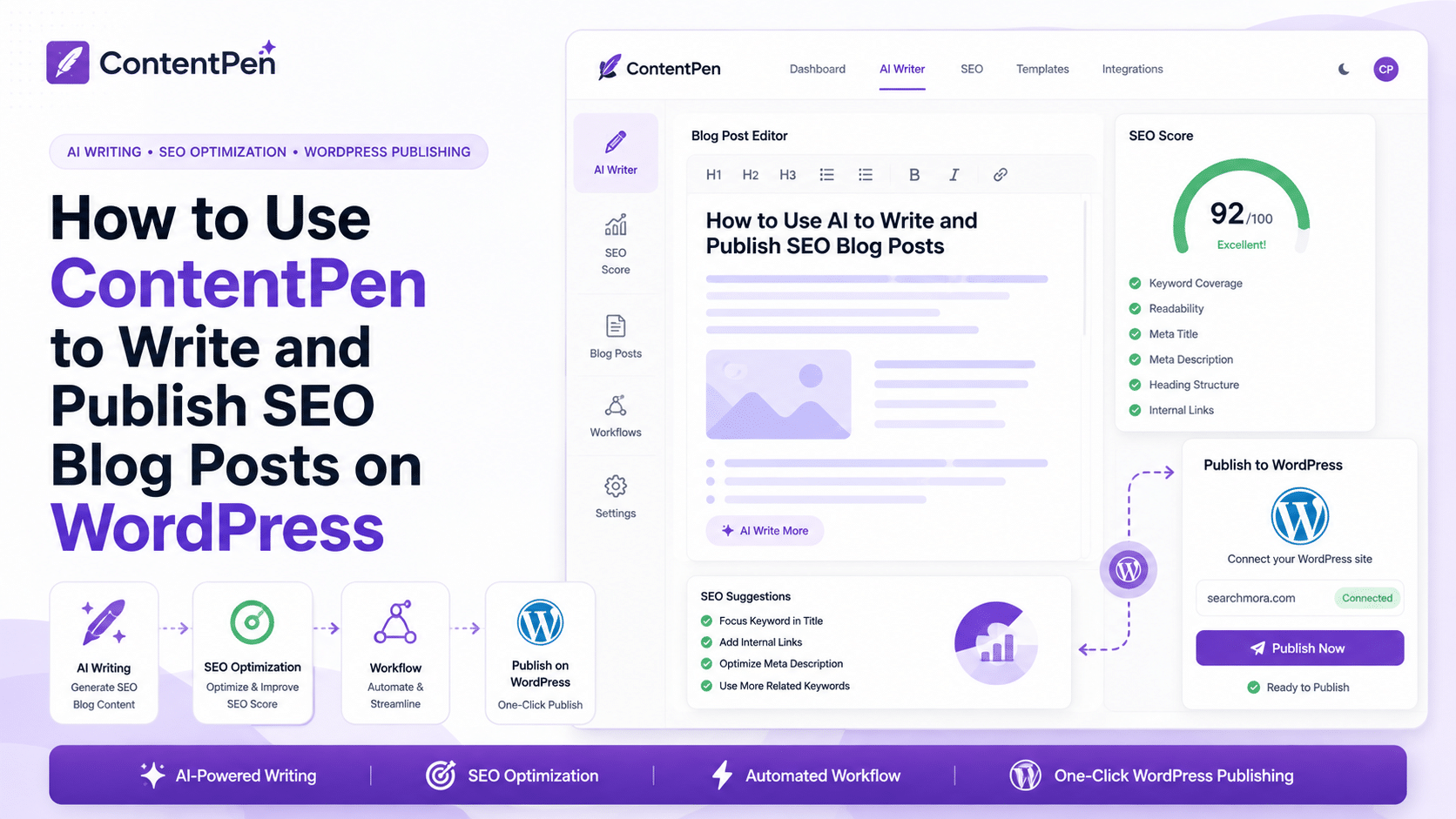
ContentPen is the best Writesonic alternative for bloggers and publishers who want keyword research, article generation, SEO, GEO scoring, internal links, images, WordPress publishing, and content refreshes in one workflow.
Why ContentPen Stands Out
ContentPen focuses on operational efficiency.
Its workflow may include:
- Keyword research.
- Topic clusters.
- Live SERP analysis.
- Long-form generation.
- SEO scoring.
- GEO scoring.
- Internal linking.
- External links.
- Images.
- WordPress publishing.
- Content decay alerts.
- Article refreshes.
This makes it useful for users who want to reduce copying and pasting between tools.
Automation vs Editorial Risk
Automation saves time.
It also increases the risk of publishing weak content quickly.
Every automated article should still receive fact-checking.
- Fact-checking.
- Search intent review.
- Original examples.
- Brand editing.
- Source verification.
- Internal linking review.
- Visual inspection.
- Final human approval.
Main Advantages
- End-to-end workflow.
- WordPress publishing.
- Topic planning.
- SEO and GEO scoring.
- Internal linking support.
- Images.
- Content refresh workflows.
- Useful for high-output blogs.
Main Limitations
- Automation still requires supervision.
- Less suitable for enterprise brand campaigns.
- Not as deep in editorial grading as Clearscope.
- Not as strong in brand voice as Jasper.
- High output can create quality problems without governance.
Independent Editorial Verdict
Choose ContentPen when operational friction is the main problem.
Choose Frase, Surfer, or Clearscope when human writers and editorial control are more important than automation.
Best for: bloggers, affiliate sites, publishers, and small content agencies.
🧱 Which Tools Are Best for Topical Authority?
MarketMuse is the strongest option for site-wide topical authority planning. NeuronWriter and Surfer are better for improving individual pages, while Scalenut and ContentPen are more useful for creating topic clusters and scaling supporting content.
| Tool | Topical Authority Strength | Best Use |
|---|---|---|
| MarketMuse | Excellent | Site-wide authority planning |
| Surfer SEO | Strong | Improving individual pages and clusters |
| NeuronWriter | Strong for the price | Optimizing related articles |
| Scalenut | Strong | Planning and creating clusters |
| ContentPen | Strong | Producing and publishing supporting content |
| Frase | Moderate to strong | Research and brief creation |
| Clearscope | Strong | Editorial optimization and monitoring |
| Jasper | Limited | Brand-consistent writing rather than strategy |
What Topical Authority Actually Requires
No tool creates authority automatically.
A site still needs:
- Accurate core pages.
- Useful supporting articles.
- Logical internal links.
- Clear entities.
- First-hand expertise.
- Trusted external references.
- Updated information.
- Consistent editorial standards.
Publishing more articles is not the same as building authority.
🤖 Which Tools Are Best for AI Overviews and AEO?
Frase, Surfer, Clearscope, and ContentPen increasingly connect SEO content workflows with AI-search visibility or GEO guidance. However, no writing tool can guarantee inclusion in Google AI Overviews, ChatGPT, Perplexity, or Gemini.
Content Characteristics That Support Citability
AI systems are more likely to extract content that is:
- Clearly structured.
- Direct.
- Specific.
- Supported by evidence.
- Easy to verify.
- Written with unambiguous language.
- Organized into useful tables and lists.
- Updated regularly.
- Connected to trusted entities.
- Free from promotional filler.
How the Tools Help
| Tool | Potential AEO Contribution |
|---|---|
| Frase | Questions, direct-answer structure, GEO workflows |
| Surfer | Topic coverage and AI-search-oriented optimization |
| Clearscope | Discoverability, prompt tracking, semantic optimization |
| ContentPen | GEO scoring and structured publishing |
| MarketMuse | Deep topic coverage and authority planning |
| NeuronWriter | Semantic entities and content completeness |
| Jasper | Consistent, clear brand explanations |
| Scalenut | Structured SERP-informed article production |
A high score does not make a page cite-worthy.
The article still needs evidence and original value.
✍️ How Much Human Editing Does Each Tool Require?
Every AI-generated SEO article requires human review. The amount of editing depends more on the prompt, topic, evidence, and editorial standards than on the brand name of the tool.
| Tool | Typical First-Draft Role | Human Editing Need |
|---|---|---|
| NeuronWriter | Optimization and assisted drafting | Moderate |
| Surfer SEO | AI draft plus optimization | Moderate |
| Jasper | Brand-controlled draft | Moderate |
| Scalenut | Guided full draft | Moderate to high |
| Frase | Research, outline, and draft | Moderate |
| Clearscope | Writer guidance and AI drafting | Moderate |
| MarketMuse | Strategy and briefs | Human writers usually remain central |
| ContentPen | Automated draft and publishing workflow | Moderate to high before publishing |
Editing Checklist
Before publishing, verify:
- Is every factual claim accurate?
- Does the introduction answer the query directly?
- Does the article add anything competitors do not?
- Are the examples specific?
- Are prices and features current?
- Are sources reliable?
- Does the text sound like the brand?
- Is keyword repetition natural?
- Are tables genuinely useful?
- Are limitations explained?
- Is the conclusion decisive?
- Is there a reason to trust the author?
💰 Pricing and Cost per Publishable Article
Do not compare SEO writing tools only by the monthly subscription price. The real cost includes research, editing, verification, formatting, publishing, and future content updates.
Starting Pricing Position
| Tool | Current Pricing Position | Best Value Scenario |
|---|---|---|
| NeuronWriter | Budget-friendly; annual entry around $19/month | Bloggers and smaller teams |
| Surfer SEO | Premium; current standard plan around $99/month annually | Agencies and established content teams |
| Jasper | Mid-to-premium marketing platform | Brands requiring strict voice control |
| Scalenut | Mid-range content platform | Teams producing regular long-form content |
| Frase | Mid-range SEO and GEO platform | Teams needing research and briefs |
| Clearscope | Premium; starts around $129/month | Established editorial teams |
| MarketMuse | Free entry with premium strategy plans | Larger sites planning topical authority |
| ContentPen | Lower-to-mid-range publishing workflow | Bloggers automating production |
Prices and limits change. Review the official pricing page before subscribing.
Calculate Cost per Publishable Article
Use this formula:
Total monthly content cost ÷ Number of publishable articles
Total cost includes:
- Software.
- Writer time.
- Editor time.
- FFact-checking
- Source research.
- Images.
- Formatting.
- Publishing.
- Updates.
A tool that generates 50 drafts but only produces 10 usable articles should be evaluated based on 10 articles.
Example
| Cost Element | Monthly Amount |
|---|---|
| SEO writing tool | $100 |
| Writer time | $1,000 |
| Editing | $500 |
| Images and formatting | $200 |
| Total | $1,800 |
| Publishable articles | 20 |
| Effective cost per article | $90 |
The software price is only one part of the real cost.
🧪 A Practical SEO Writing Workflow
A reliable workflow uses AI for speed while keeping research, expertise, and editorial judgment under human control.
Step 1: Confirm Search Intent
Determine whether the user wants:
- A definition.
- A tutorial.
- A comparison.
- A product review.
- A list of tools.
- Pricing information.
- A buying decision.
- Troubleshooting.
Do not begin writing before this is clear.
Step 2: Review the Search Results
Study:
- Ranking page types.
- Common questions.
- Competitor strengths.
- Missing information.
- Content freshness.
- Search intent differences.
- Featured snippets.
- AI Overview sources when visible.
Step 3: Create the Brief
The brief should include:
- Target reader.
- Direct answer.
- Primary keyword.
- Secondary topics.
- Required sections.
- Unique angle.
- Evidence requirements.
- Internal links.
- External primary sources.
- Calls to action.
Step 4: Produce the Draft
Use the selected tool for:
- Structure.
- Initial explanations.
- Table ideas.
- FAQ drafts.
- Transitions.
- Alternative phrasing.
Do not ask it to invent experience, tests, or statistics.
Step 5: Add Original Value
Add:
- First-party data.
- Real examples.
- Screenshots.
- Editorial opinion.
- Practical workflows.
- Clear limitations.
- Comparisons based on real criteria.
- Industry context.
Step 6: Optimize Semantically
Use NeuronWriter, Surfer, Clearscope, or another editor to check topic coverage.
Do not force every recommendation into the text.
Step 7: Make the Article Citable
Include:
- Direct definitions.
- Concise answers.
- Useful comparison tables.
- Accurate numbers.
- Reliable citations.
- Clear methodology.
- Unambiguous language.
Step 8: Publish and Monitor
After publication, review:
- Impressions.
- Clicks.
- Rankings.
- Engagement.
- AI citations were measurable.
- Content decay.
- Competitor updates.
- Search intent changes.
SEO writing does not end when the article is published.
📊 Real-World Evidence: What External Sources Show
External product documentation and current market reviews show that SEO writing tools are separating into distinct categories rather than competing as identical AI writers.
Surfer positions its platform around content optimization and AI visibility, with Content Editor, AI-assisted writing, SERP analysis, and post-publish monitoring. Its pricing places it in the premium category, making it more appropriate for teams that will use the optimization workflow consistently.
NeuronWriter remains positioned as a more affordable semantic optimization platform. Its official pricing currently begins at approximately $19 per month with annual billing, while higher plans expand projects, content analyses, AI credits, and integrations.
Jasper’s current product and pricing pages emphasize Brand Voice, audience controls, brand knowledge, and marketing workflows. This supports its position as a stronger brand-governance alternative rather than the deepest standalone SEO optimizer.
Frase now presents itself as a content operating system for both Google search and AI search, combining research, writing, optimization, publishing, and monitoring. This expands its role beyond its traditional reputation as a content brief generator.
Clearscope currently positions itself as a broader discoverability platform with optimization, content monitoring, internal linking, localization, topic exploration, and AI visibility. Its official pricing starts at $129 per month, reinforcing its focus on professional editorial teams rather than small entry-level publishers.
Independent reviews of MarketMuse continue to emphasize topic modeling, content inventory, cluster planning, personalized difficulty, and site-level content gaps. These capabilities make it more valuable for strategic planning than for rapid draft generation.
| Market Pattern | What It Means |
|---|---|
| Writesonic combines many content and AI-search features | It remains a strong, broad platform |
| NeuronWriter competes primarily on value | Better for budget-focused semantic optimization |
| Surfer emphasizes live optimization | Better for teams that need an editorial scoring process |
| Jasper emphasizes Brand Voice | Better for marketing governance |
| Frase connects research with AI-search workflows | Better for brief-driven content production |
| Clearscope targets editorial quality and monitoring | Better for established teams |
| MarketMuse focuses on site-level strategy | Better for topical authority planning |
| Automation tools reduce publishing friction | Human quality control becomes more important |
No external source proves that one tool will make every page rank.
Results still depend on:
- Website authority.
- Search intent.
- Competition.
- Content accuracy.
- Original experience.
- Internal links.
- Backlinks.
- Technical SEO.
- Freshness.
- User satisfaction.
⚠️ Common Mistakes When Choosing an SEO Writing Tool
1. Choosing Based on Word Volume
More generated words do not equal more useful content.
2. Treating Content Scores as Ranking Guarantees
A score is guidance, not an algorithmic promise.
3. Copying Competitor Structures Too Closely
SERP analysis should reveal expectations, not remove originality.
4. Ignoring Brand Voice
Generic content weakens recognition and trust.
5. Publishing AI Drafts Without Fact-Checking
AI can produce incorrect prices, dates, features, quotations, and statistics.
6. Confusing NLP Recommendations With Keyword Stuffing
Use terms naturally and only when they improve meaning.
7. Ignoring Topical Strategy
Optimizing one article does not build authority across a subject.
8. Failing to Update Published Content
Prices, software features, competitors, and search intent change.
9. Buying a Tool That Does Not Match the Team
A human writing team needs a different platform from a solo automated publisher.
10. Inventing First-Hand Experience
Never claim to have tested a tool or achieved a ranking result without real evidence.
❓ FAQ
1. What is the best Writesonic alternative for SEO writing?
NeuronWriter is the best-value option for semantic optimization, while Surfer SEO is the strongest premium choice. Scalenut is better for guided AI article production, and Frase is stronger for research and content briefs.
2. What is the cheapest Writesonic alternative for SEO writing?
NeuronWriter is one of the most affordable serious SEO content optimization platforms, with annual entry pricing around $19 per month at the time of writing.
3. Is Surfer SEO better than Writesonic?
Surfer SEO is better for focused content optimization, live scoring, and editorial guidance. Writesonic is broader and includes more generation, automation, and AI-visibility functionality.
4. Is Jasper better than Writesonic?
Jasper is better for brand voice, marketing consistency, and enterprise governance. Writesonic may be better for users who prioritize SEO content generation and broader AI-search workflows.
5. Is NeuronWriter better than Writesonic?
NeuronWriter may be better for users who mainly need affordable SERP and NLP optimization. Writesonic is more suitable for users who want a broader AI writing and AI visibility platform.
6. Is Scalenut a good Writesonic alternative?
Yes. Scalenut is a strong alternative for guided SEO article production, keyword planning, topic clusters, long-form drafts, and content scoring.
7. Is Frase better for content briefs?
Frase is one of the strongest options for SERP research, competitor analysis, question discovery, and creating structured briefs for human writers.
8. Is Clearscope worth the high price?
Clearscope can be worth it for established editorial teams that need a clean optimization workflow, consistent grading, content monitoring, and easy adoption across multiple writers.
9. Which Writesonic alternative is best for topical authority?
MarketMuse is the strongest strategic option for site-wide topical authority. Surfer, NeuronWriter, Scalenut, and ContentPen can help optimize or produce supporting articles.
10. Can SEO writing tools guarantee AI Overview citations?
No. These tools can improve structure, topic coverage, clarity, and discoverability, but they cannot guarantee citations in Google AI Overviews, ChatGPT, Perplexity, or Gemini.
🏁 Final Verdict
The best Writesonic alternative for SEO writing depends on how your content team works.
Choose NeuronWriter if you need affordable semantic optimization and SERP guidance.
Choose Surfer SEO if you want a premium real-time optimization workflow for writers and editors.
Choose Jasper if brand voice and marketing consistency matter more than deep SEO scoring.
Choose Scalenut if your priority is producing long-form SEO drafts through a guided workflow.
Choose Frase if research, outlines, and content briefs are the main bottlenecks.
Choose Clearscope if you manage an established editorial team and need simple, consistent quality control.
Choose MarketMuse if your goal is building site-wide topical authority rather than optimizing isolated articles.
Choose ContentPen if you want an automated workflow from research and generation to internal linking, publishing, and content refreshes.
My recommendation for most Searchmora readers is:
- Choose NeuronWriter for the best value.
- Choose Surfer SEO for premium optimization.
- Choose Frase for briefs and human-writer workflows.
- Choose ContentPen for automated publishing.
- Choose MarketMuse for long-term content strategy.
- Choose Jasper for brand-governed marketing teams.
The clearest takeaway is this: the best SEO writing tool is not the one that creates the longest draft. It is the one that helps your team produce accurate, useful, differentiated content with a repeatable editorial process.
📚 Recommended Next Reads
- Writesonic Alternatives: Best AI Writing and GEO Tools
- NeuronWriter Review: Is This Budget-Friendly SEO Content Optimizer Worth It?
- Frase Review: Is It the Best AI SEO Tool for Content Optimization and AI Visibility?
- Jasper Review: Is This AI Marketing Platform Worth It?
- ContentPen Review: Is This AI Blog Writer Worth It?


Comments 4