RankIQ Review: Is This AI SEO Tool for Bloggers Worth It?
🚀 Introduction
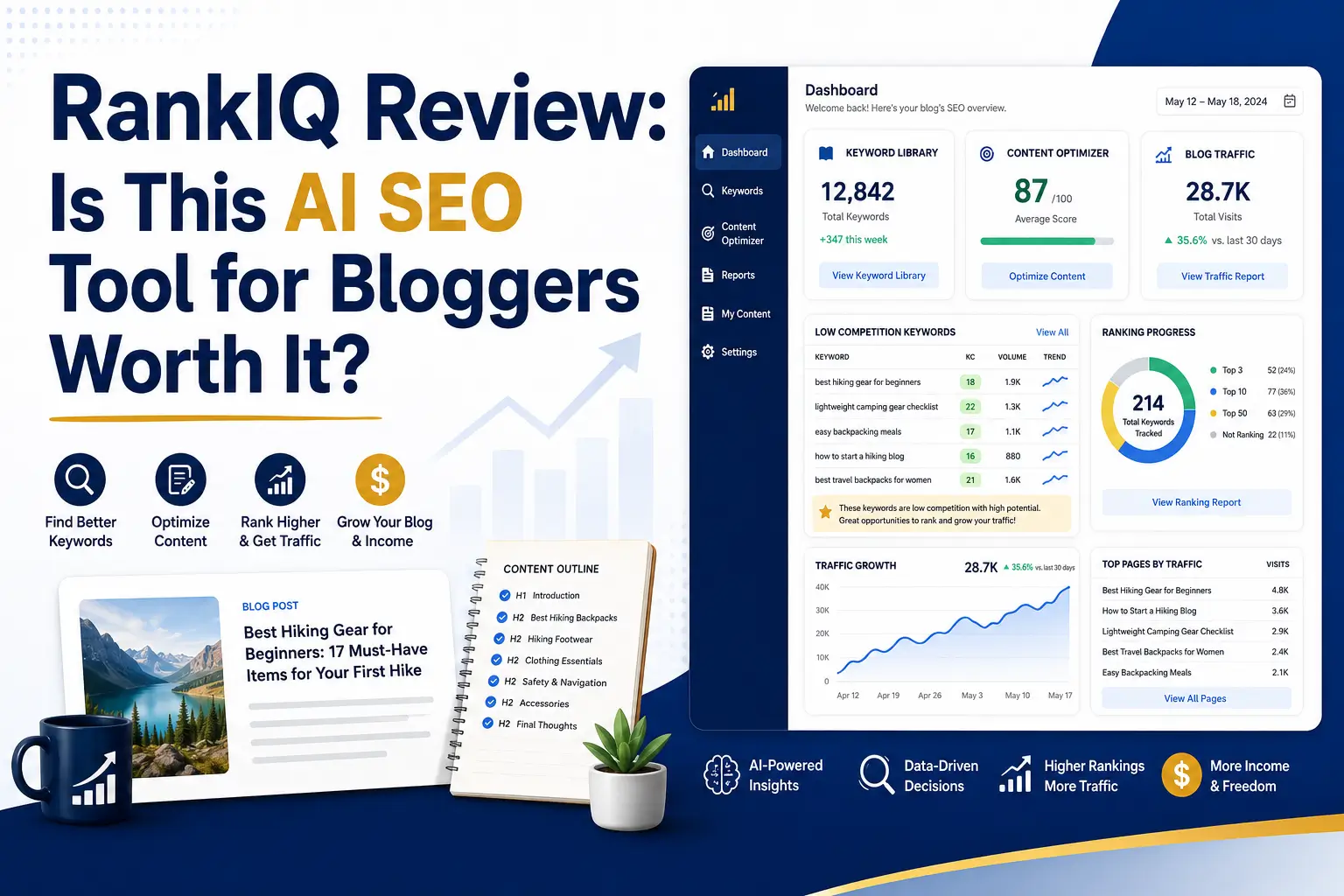
RankIQ is an AI SEO tool designed primarily for bloggers who want easier keyword research, faster content briefs, and simple optimization guidance without having to learn a complex SEO platform. It is best for bloggers, niche site owners, and small publishers, but it is not a full SEO suite like Semrush, Ahrefs, or SE Ranking.
The strongest thing about RankIQ is its focus.
Instead of trying to serve every SEO use case, RankIQ focuses on a few jobs bloggers care about most: finding easier keywords, creating SEO reports, improving blog posts, and writing better titles.
That makes it useful for non-technical bloggers who want a guided SEO workflow.
In this RankIQ review, I will explain what RankIQ does, who it is best for, where it performs well, where it falls short, and whether it is worth using for blogging and affiliate SEO.
⚡ Quick Verdict
RankIQ is worth considering if you are a blogger looking for a simple SEO tool to find low-competition topics, create blog post briefs, optimize content, and improve titles.
It is not the deepest SEO platform, and advanced users may outgrow it. But for bloggers who want practical guidance without technical complexity, RankIQ can be a useful tool.
| Question | Quick Answer |
|---|---|
| Best for | Bloggers, niche site owners, content creators, and small publishers. |
| Strongest feature | Curated keyword library and AI SEO reports for blog posts. |
| Biggest advantage | It simplifies SEO for bloggers who do not want a complex platform. |
| Biggest drawback | It lacks advanced backlink analysis, technical audits, and full SEO reporting. |
| Best alternatives | NeuronWriter, LowFruits, Mangools, WriterZen, Surfer SEO, and Ubersuggest. |
| My verdict | RankIQ is a strong blogger-focused SEO tool, but it works best for simple content workflows, not advanced SEO operations. |
| I would use RankIQ if you need | I would not use RankIQ if you need |
|---|---|
| Blog-focused keyword ideas | Deep backlink research |
| Simple SEO reports | Full technical SEO audits |
| Content optimization guidance | Advanced keyword clustering |
| Title analysis | Enterprise SEO reporting |
| A tool made for bloggers | SEO automation at scale |
| Help choosing easier blog topics | AI article generation as the main feature |
| A simpler alternative to large SEO platforms | Advanced competitor intelligence |
| A guided blog content workflow | A complete all-in-one SEO suite |
The clearest takeaway is this: RankIQ is not trying to be the most advanced SEO platform. It is trying to make SEO easier for bloggers who want clear keyword ideas, guided reports, and practical content optimization.
📌 In This Guide
- What Is RankIQ?
- How RankIQ Works
- RankIQ Key Features
- RankIQ for Bloggers and SEO Content
- RankIQ Pricing and Value
- Real-World Evidence: What Independent Reviews Show
- RankIQ Pros and Cons
- RankIQ for Bloggers and Niche Site Owners
- RankIQ for Affiliate Site Owners
- RankIQ for Agencies and Freelancers
- RankIQ Alternatives
- My Practical RankIQ Workflow
- Common Mistakes When Using RankIQ
- FAQ
- Final Verdict: Is RankIQ Worth It?
- Recommended Next Reads
🧠 What Is RankIQ?
RankIQ is an AI-powered SEO tool designed specifically for bloggers and content creators.
It helps users find blog topics, create AI SEO reports, optimize posts, improve titles, and write content with better chances of ranking in Google.
RankIQ can help with:
- Blog keyword research.
- Curated low-competition keyword ideas.
- AI SEO reports.
- Content briefs.
- Content optimization.
- Title analysis.
- Blog post updates.
- Topic discovery.
- Word count recommendations.
- Related terms and topics.
- Google Search Console workflows.
- Blogger-friendly SEO planning.
The most effective way to understand RankIQ is to see it as a blogger-focused SEO assistant.
It is not built for technical SEO audits, backlink analysis, enterprise reporting, or advanced competitor research. It is built for bloggers who want to know:
- What should I write about?
- Which keywords are easier to target?
- What should I include in my post?
- How long should the article be?
- Which terms should I cover?
- How can I improve my title?
- Which older posts should I update?
That makes RankIQ especially useful for bloggers who feel overwhelmed by larger SEO platforms.
⚙️ How RankIQ Works
RankIQ works by combining a curated keyword library with AI SEO reports and content optimization tools.
A typical RankIQ workflow may look like this:
- Choose a niche or topic from the keyword library.
- Pick a low-competition keyword.
- Create an AI SEO report for that keyword.
- Review the suggested topics, terms, and word count.
- Build or update your blog post.
- Use the content optimizer to improve your score.
- Use the title analysis feature to improve the headline.
- Publish or update the article.
- Track performance in Google Search Console.
- Refresh older posts based on data.
This workflow is useful because many bloggers struggle with the same issue: they write content without knowing whether the topic is realistic.
RankIQ tries to reduce that problem by giving bloggers keyword ideas that are easier to target.
One of the strongest patterns is that RankIQ works best for users who publish blog content consistently. If you only publish occasionally, the tool may feel less valuable. If you publish weekly, the workflow can help you plan and optimize faster.
🛠️ RankIQ Key Features
🔎 Curated Keyword Library
RankIQ’s curated keyword library is one of its most important features.
Instead of asking users to start with a blank keyword search, RankIQ provides a library of hand-picked keyword opportunities across many blog niches.
This is useful for bloggers because traditional keyword research can be confusing.
A blogger may not know how to judge keyword difficulty, search intent, SERP strength, or topical opportunity. RankIQ tries to simplify this by giving users keyword ideas that are already selected for blogging potential.
The keyword library can help with:
- Blog topic discovery.
- Low-competition keyword ideas.
- Niche content planning.
- Supporting article ideas.
- Content calendar creation.
- Updating old posts.
- Finding topics that match blogger-style content.
The biggest mistake is assuming every keyword in the library is automatically perfect for your site.
You should still check:
- Search intent.
- Relevance to your audience.
- Business value.
- Competition.
- Your site’s topical authority.
- Whether you can write a genuinely useful article.
RankIQ makes keyword research easier, but it does not remove judgment.
📄 AI SEO Reports
RankIQ’s AI SEO reports help users understand what to include in a blog post.
The report usually gives recommendations around topics, terms, headings, content length, and optimization targets.
This is useful because many bloggers know the topic but do not know how complete the article should be.
A good SEO report can help answer:
- What related terms should I include?
- What subtopics should I cover?
- How long should the article be?
- What are competing pages covering?
- How can I improve topical depth?
- What should I add to make the post more complete?
This helps bloggers move from “I have a keyword” to “I have a writing plan.”
The most effective way to use AI SEO reports is as a guide, not a script.
Do not force every suggested phrase into your article. Use the report to understand what the topic needs, then write naturally for readers.
✍️ Content Optimizer
RankIQ includes a content optimizer that helps you improve your draft.
This is useful for both new articles and older posts that need a refresh.
A content optimizer can help bloggers:
- Add missing related terms.
- Improve topic coverage.
- Check whether the article is too thin.
- Improve relevance.
- Update old posts.
- Make posts more competitive.
- Build a stronger article before publishing.
For bloggers, this is one of the most practical uses of RankIQ.
Many blog posts do not need to be completely rewritten. They need better coverage, clearer sections, stronger titles, and updated information.
RankIQ can help identify those gaps.
However, content scores should not become the only goal.
A high score does not automatically mean the article is helpful. The article still needs clear explanations, original insight, examples, internal links, and a good reader experience.
🧲 Title Analysis
RankIQ includes title analysis to help bloggers improve blog post headlines.
This matters because titles affect search clicks.
A page can rank but still underperform if the title is weak, unclear, too long, or not aligned with search intent.
A good title should be:
- Clear.
- Relevant.
- Search-intent aligned.
- Specific.
- Not misleading.
- Natural.
- Useful to the reader.
RankIQ’s title guidance can help bloggers create titles that are more likely to attract clicks.
This is especially useful for older posts with impressions but low click-through rates.
A practical workflow is:
- Find posts with impressions but low CTR in Google Search Console.
- Review the current title.
- Use RankIQ title analysis.
- Improve the title.
- Update the post.
- Monitor CTR over the next few weeks.
Title optimization is not a magic trick, but it can be a quick win when a page already has visibility.
🔁 Content Refresh Support
RankIQ can be useful for updating older blog posts.
This matters because many bloggers focus only on new content. But old content can often produce faster results when updated properly.
A content refresh may include:
- Updating outdated information.
- Adding missing subtopics.
- Improving the title.
- Adding FAQs.
- Improving readability.
- Adding internal links.
- Updating examples.
- Improving the introduction.
- Adding new sections.
- Re-optimizing the post.
RankIQ can help guide these updates through its SEO report and optimizer.
For bloggers with a large archive, this can be valuable.
Older posts may already have impressions and rankings. Improving them may be faster than starting from zero.
📊 Google Search Console Workflow
RankIQ works well when paired with Google Search Console.
Google Search Console shows which queries and pages already have impressions, clicks, and rankings. RankIQ can then help you improve the content around those opportunities.
A practical workflow could look like this:
- Open Google Search Console.
- Find pages with impressions but low clicks.
- Find pages ranking between positions 5 and 20.
- Choose a page to update.
- Run a RankIQ SEO report.
- Improve the article.
- Update the title.
- Add internal links.
- Republish or refresh the post.
- Track results over time.
This workflow is stronger than using RankIQ alone.
RankIQ gives optimization guidance. Google Search Console gives real performance data from your own site.
🧑🏫 Blogger-Friendly Interface
RankIQ is designed for bloggers, not technical SEO specialists.
That is one of its biggest advantages.
Many SEO tools are powerful but intimidating. They show too many reports, filters, metrics, dashboards, and advanced options.
RankIQ is simpler.
This makes it a good fit for bloggers who want SEO guidance without becoming full-time SEO analysts.
The interface is useful for:
- Food bloggers.
- Travel bloggers.
- Lifestyle bloggers.
- Parenting bloggers.
- DIY bloggers.
- Niche bloggers.
- Small publishers.
- New content creators.
That simplicity also creates limitations.
Advanced SEOs may want more data, more exports, more competitor analysis, more technical reporting, and stronger integrations.
RankIQ is best for bloggers who want to focus.
🔎 RankIQ for Bloggers and SEO Content
RankIQ is most useful for blog SEO.
It can help with:
- blog keyword research
- low-competition topic discovery
- SEO reports
- content briefs
- content optimization
- title improvement
- content refreshes
- blog post planning
- simple SEO workflows
- Google Search Console-based updates
However, RankIQ does not replace:
- technical SEO audits
- backlink research
- keyword clustering at scale
- AI article writing platforms
- internal linking tools
- full SEO reporting
- agency dashboards
- enterprise SEO workflows
The best way to use RankIQ is inside a simple blogging workflow.
A practical workflow could look like this:
- Find a low-competition topic in RankIQ.
- Create an AI SEO report.
- Build a clear article outline.
- Write the article manually or with AI assistance.
- Use RankIQ’s optimizer to improve coverage.
- Improve the title.
- Add internal links.
- Publish the post.
- Track results in Google Search Console.
- Refresh the article after it gains data.
RankIQ is strongest when it helps bloggers choose better topics and improve content before publishing.
It is weaker when users need advanced SEO research or technical work.
💰 RankIQ Pricing and Value
RankIQ pricing is built around monthly SEO report limits.
At the time of writing, public pricing sources show RankIQ plans starting at $49/month for the Blogger plan, with higher plans for users who need more monthly reports.
Current public pricing commonly appears as:
| Plan | Monthly Price | SEO Reports |
|---|---|---|
| Blogger | $49/month | 16 SEO reports per month |
| Pro | $99/month | 36 SEO reports per month |
| Agency | $199/month | 80 SEO reports per month |
| Enterprise | Custom | Custom report volume |
RankIQ sometimes runs special offers, so pricing may change. Always check the official pricing page before subscribing.
Here is how I would think about value:
| User Type | Is RankIQ Worth It? | Why |
|---|---|---|
| New blogger | Maybe | Useful if you publish consistently, but may be too early if you have no content rhythm. |
| Established blogger | Yes | Strong fit if you need keyword ideas, reports, and optimization guidance. |
| Affiliate site owner | Maybe | Useful for informational support content, but not enough for full affiliate SEO. |
| SEO freelancer | Maybe | Helpful for simple blog clients, but limited for advanced SEO work. |
| Agency | Usually not as main tool | Agencies may need broader reporting, audits, and competitor data. |
| Small publisher | Yes | Useful if the workflow is focused on blog content. |
| Enterprise SEO team | Usually no | Too limited for enterprise SEO operations. |
RankIQ becomes easier to justify if you publish regularly.
If you create 8–16 optimized posts or updates per month, the Blogger plan may make sense. If you publish rarely, the monthly cost may feel harder to justify.
The key pricing question is simple:
Will RankIQ help you publish or update enough articles every month to use the reports effectively?
If yes, it can be worth testing.
📊 Real-World Evidence: What Independent Reviews Show
RankIQ has strong marketing claims, but external reviews give a more balanced view of where it performs well and where it is limited.
External source: TechRadar’s RankIQ review and Capterra verified RankIQ listing.
TechRadar reviewed RankIQ as an AI-powered SEO tool built for bloggers and content creators. The review highlights the curated keyword library, AI-driven SEO reports, content optimizer, and title analysis as useful features for bloggers who want better organic traffic without deep SEO expertise. It also notes important limitations, including the lack of advanced backlink analysis, technical audits, and broader SEO integrations. (TechRadar)
Capterra’s RankIQ listing describes it as an AI-powered SEO toolset built for bloggers. It also emphasizes that RankIQ helps users understand what to include in blog posts and titles, and that it includes a hand-picked library of low-competition, high-traffic keywords across many niches. (Capterra)
Here is the practical evidence summary:
| Evidence Point | What It Means for RankIQ Users |
|---|---|
| Independent TechRadar review | Supports RankIQ’s positioning as a blogger-focused SEO tool. |
| Curated keyword library highlighted | Confirms RankIQ’s main strength for blog topic discovery. |
| Content optimizer and title analysis noted | Supports its value for improving blog posts before publishing. |
| Capterra listing supports blogger focus | Reinforces that RankIQ is designed mainly for bloggers, not enterprise SEO teams. |
| Limitations clearly noted | RankIQ is not a full SEO suite for backlinks, audits, or advanced reporting. |
For Searchmora readers, the fair conclusion is this:
RankIQ is best supported as a blogger-friendly SEO workflow tool. It can help with keyword ideas, SEO reports, post optimization, and title improvement. But it does not guarantee rankings and should not be treated as a complete SEO platform.
A smart 30-day RankIQ test would look like this:
- Choose one blog niche or category.
- Pick 4–8 keywords from RankIQ’s keyword library.
- Create AI SEO reports for those topics.
- Publish or update 4–8 blog posts.
- Improve each title using the title analysis tool.
- Add internal links from related posts.
- Track impressions and clicks in Google Search Console.
- Review results after 30 days.
- Continue monitoring for 60–90 days.
- Keep the workflow if it saves time and improves content quality.
The strongest way to use RankIQ is not to expect instant traffic. Use it to improve topic selection, content structure, and post optimization.
✅ RankIQ Pros and Cons
✅ Pros
| Pro | Why It Matters |
|---|---|
| Built specifically for bloggers | Easier to understand than broad SEO platforms. |
| Curated keyword library | Helps bloggers find lower-competition topics faster. |
| AI SEO reports | Gives users a guided plan for each article. |
| Content optimizer | Helps improve posts before publishing or after updating. |
| Title analysis | Useful for improving blog headlines and CTR potential. |
| Good for content refreshes | Helps update older posts with better coverage. |
| Beginner-friendly workflow | Useful for bloggers without deep SEO knowledge. |
| Works well with Google Search Console | Helpful for updating posts that already have impressions. |
❌ Cons
| Con | Why It Matters |
|---|---|
| Not a full SEO suite | It does not replace Ahrefs, Semrush, or SE Ranking. |
| No deep backlink research | Link analysis requires another tool. |
| No full technical SEO audit | Screaming Frog, Sitebulb, or SE Ranking are better for audits. |
| Limited advanced keyword research | Tools like Mangools, LowFruits, and Ahrefs may offer broader research workflows. |
| Not ideal for agencies | Reporting and client workflows are limited. |
| Report limits matter | Users need to manage monthly SEO reports carefully. |
| Less useful if you do not publish often | The tool is most valuable with consistent content production. |
The biggest mistake is expecting RankIQ to be a complete SEO platform.
It is better understood as a focused blogging SEO tool.
It helps bloggers choose and optimize posts, but it does not handle every SEO task.
📝 RankIQ for Bloggers and Niche Site Owners
RankIQ is best suited for bloggers and niche site owners.
A blogger can use RankIQ to:
- Find low-competition topics.
- Create SEO reports.
- Write better outlines.
- Optimize blog posts.
- Improve titles.
- Refresh old content.
- Build a consistent publishing workflow.
I would use it if you need:
| Use RankIQ If | Why |
|---|---|
| You are a blogger | The tool is built specifically for blog SEO. |
| You need easier keyword ideas | The curated library can reduce keyword research time. |
| You want simple SEO guidance | AI reports make the writing process clearer. |
| You update old posts | The optimizer can help improve existing articles. |
| You dislike complex SEO tools | RankIQ is easier than many advanced platforms. |
I would not use it if you need:
| Avoid RankIQ If | Better Fit |
|---|---|
| Deep keyword research | Mangools, Ahrefs, Semrush |
| Low-competition SERP discovery | LowFruits |
| Keyword clustering | WriterZen, Keyword Insights |
| Content scoring with deeper SERP analysis | NeuronWriter, Surfer, Clearscope |
| Technical SEO audits | Screaming Frog, Sitebulb, SE Ranking |
For bloggers, RankIQ is strongest when used consistently.
It works best when you use it to plan, write, optimize, and refresh content every month.
🧲 RankIQ for Affiliate Site Owners
RankIQ can help affiliate site owners, but it is not a complete affiliate SEO tool.
It is most useful for supporting informational content.
An affiliate site owner can use RankIQ to:
- Find informational blog topics.
- Create supporting articles.
- Optimize older posts.
- Improve titles.
- Build content around affiliate categories.
- Support review and comparison pages with internal links.
For example, an affiliate site reviewing smart pet products could use RankIQ to find informational articles around pet care, smart home pet routines, product questions, and buyer education.
Those posts could then internally link to product reviews and buying guides.
I would use it if you need:
| Use RankIQ If | Why |
|---|---|
| You need supporting blog content | RankIQ helps find blog-friendly keywords. |
| You want easier informational topics | Good for content that supports affiliate pages. |
| You update old posts | Useful for refreshing content with impressions. |
| You want title improvement | Helpful for CTR-focused updates. |
| You are not ready for expensive SEO tools | RankIQ is simpler than many broader tools. |
I would not use it if you need:
| Avoid RankIQ If | Better Fit |
|---|---|
| Product review generation | KoalaWriter, ContentPen, Jasper |
| Affiliate content optimization | NeuronWriter, Surfer |
| Internal linking | Link Whisper |
| Weak SERP research | LowFruits |
| Backlink research | Ahrefs, Semrush |
For affiliate SEO, RankIQ should support the content strategy. It should not replace product research, real testing, screenshots, pricing notes, or honest recommendations.
🧑💼 RankIQ for Agencies and Freelancers
RankIQ can be useful for freelancers who work with bloggers, but it is not usually the main tool for agencies.
A freelancer can use RankIQ to:
- Find blog topics for clients.
- Create SEO reports.
- Build article outlines.
- Optimize drafts.
- Refresh older posts.
- Improve titles.
A small agency may use RankIQ for blog-focused clients, but larger agencies will likely need broader tools.
I would use it if you need:
- Simple blog topic research.
- A guided content optimization workflow.
- Help writing briefs for blogger clients.
- A tool for refreshing existing posts.
- Easier SEO support for non-technical clients.
I would not use it if you need:
- White-label reporting.
- Technical SEO audits.
- Backlink analysis.
- Rank tracking dashboards.
- Large-scale keyword clustering.
- Enterprise SEO workflows.
For freelancers, RankIQ can be a helpful content tool.
For agencies, it is better as a niche blogging tool rather than a full SEO platform.
🔁 RankIQ Alternatives
RankIQ is useful for bloggers, but it is not the only tool worth considering.
Here are the best alternatives depending on your main need:
| Alternative | Best For | Why Choose It Instead of RankIQ |
|---|---|---|
| NeuronWriter | Budget content optimization | Better if you want semantic SEO scoring and competitor-based optimization. |
| LowFruits | Low-competition keyword discovery | Better if your main goal is finding weak SERPs and easier keywords. |
| Mangools | Beginner-friendly SEO toolkit | Better if you want keyword research, SERP analysis, rank tracking, and backlink checks. |
| WriterZen | Keyword clustering and planning | Better if you need topic discovery, clustering, and content briefs. |
| KoalaWriter | AI SEO article drafts | Better if you want fast first drafts for blog and affiliate content. |
| Surfer SEO | Premium content optimization | Better if you want stronger SERP-based content scoring and briefs. |
| Ubersuggest | Budget SEO basics | Better if you want a broader beginner SEO toolkit with audits and competitor research. |
| Rank Math | WordPress SEO plugin | Better if you need on-page SEO settings, schema, and WordPress SEO controls. |
RankIQ’s advantage is simplicity for bloggers.
Its weakness is limited depth.
If you want a focused blog SEO workflow, RankIQ is useful. If you need broader SEO data, a different tool may be better.
🧪 My Practical RankIQ Workflow
If I were using RankIQ for a blogging or affiliate site, I would use it for topic selection and content refreshes.
Start With the Keyword Library
First, I would search the RankIQ keyword library for my niche.
I would look for topics that match:
- My audience.
- My site category.
- Search intent.
- Content goals.
- Internal linking opportunities.
- Affiliate relevance when appropriate.
Create an AI SEO Report
Next, I would create a report for the chosen keyword.
I would review:
- Suggested terms.
- Word count guidance.
- Topic coverage.
- Content structure ideas.
- Optimization opportunities.
Build the Outline
Then I would create my own outline.
I would not copy the report mechanically.
I would add:
- A direct answer.
- Useful H2 sections.
- Practical examples.
- FAQ questions.
- Internal links.
- Human editorial judgment.
Write or Update the Post
After that, I would write the article or update an existing post.
If the article is an affiliate post, I would add:
- Real product insight.
- Screenshots when available.
- Honest pros and cons.
- Pricing notes.
- Buying guidance.
- Alternatives.
Optimize the Draft
Then I would use RankIQ’s content optimizer.
I would improve the missing coverage naturally.
I would avoid keyword stuffing.
Improve the Title
Next, I would use title analysis to create a clearer, stronger headline.
Publish and Track
Finally, I would publish or update the post and track it in Google Search Console.
I would review:
- Impressions.
- Clicks.
- CTR.
- Average position.
- Queries are gaining traction.
- Pages need another refresh.
This workflow keeps RankIQ practical and focused.
⚠️ Common Mistakes When Using RankIQ
Treating RankIQ as a Full SEO Suite
RankIQ is not a full SEO platform.
Use it for blog topics, reports, optimization, and titles.
Ignoring Search Intent
Even with a good keyword, the article must match what searchers want.
Check the SERP before writing.
Publishing Generic AI-Style Content
RankIQ can guide optimization, but the final article still needs human value.
Add examples, experience, and clarity.
Using Reports Without a Content Strategy
Do not create reports randomly.
Choose topics that support your site’s categories and goals.
Forgetting Internal Links
Optimized posts still need internal support.
Link from related posts to new or updated articles.
Not Updating Older Content
RankIQ can be very useful for refreshing old posts.
Do not use it only for new content.
Expecting Instant Rankings
SEO takes time.
Track results over 60–90 days, not just a few days.
❓ FAQ
1. What is RankIQ?
RankIQ is an AI SEO tool built for bloggers. It helps users find low-competition keywords, create SEO reports, optimize blog posts, and improve titles.
2. Is RankIQ good for SEO?
Yes, RankIQ is good for blog SEO, especially for topic discovery, content optimization, and title improvement. It is not a complete SEO suite for technical audits, backlinks, or advanced reporting.
3. Is RankIQ worth it?
RankIQ is worth it if you publish blog content consistently and want a simple SEO workflow. It may not be worth it if you rarely publish or need advanced SEO features.
4. How much does RankIQ cost?
Public pricing sources commonly show RankIQ plans starting at $49/month for the Blogger plan, with higher plans for more SEO reports. Pricing may change, so check the official site before subscribing.
5. Is RankIQ good for bloggers?
Yes, bloggers are RankIQ’s main audience. The tool is built to help bloggers find topics, create SEO reports, optimize articles, and improve post titles.
6. Is RankIQ good for affiliate sites?
RankIQ can help affiliate sites with supporting informational content, but it is not a complete affiliate SEO tool. Affiliate reviews still need product research, comparisons, internal links, and real buying guidance.
7. Is RankIQ better than NeuronWriter?
RankIQ is better for blogger-focused keyword ideas and simple blog workflows. NeuronWriter is better for semantic SEO optimization, competitor-based content scoring, and budget content optimization.
8. Is RankIQ better than LowFruits?
RankIQ is better for a guided blogging workflow. LowFruits is better if your main goal is finding weak SERPs and low-competition keyword opportunities.
9. Does RankIQ guarantee rankings?
No. RankIQ can help improve topic selection and content optimization, but rankings depend on search intent, content quality, backlinks, internal links, technical SEO, authority, and competition.
🏁 Final Verdict: Is RankIQ Worth It?
RankIQ is worth it for bloggers, niche site owners, and small publishers who want a simple SEO workflow focused on blog topics, content reports, optimization, and title improvement.
It is not the most advanced SEO tool, and it is not a full replacement for Ahrefs, Semrush, SE Ranking, Screaming Frog, or NeuronWriter.
But that is not its goal.
RankIQ is best for bloggers who want SEO to feel more manageable.
My final recommendation is simple:
Use RankIQ if you want a blogger-friendly SEO tool that helps you find topics, create reports, optimize posts, and improve titles.
Skip RankIQ if you need deep keyword research, backlink analysis, technical audits, large-scale keyword clustering, or enterprise SEO reporting.
For Searchmora readers, I would position RankIQ as a useful blog SEO tool for content creators who want guidance without complexity. It is especially attractive for bloggers who need a simpler way to choose topics and update posts.
The clearest takeaway is this: RankIQ is not the most powerful SEO platform, but it may be one of the easiest tools for bloggers who want clearer SEO direction without getting overwhelmed.
📚 Recommended Next Reads
- Best AI SEO Tools for Bloggers and Affiliate Sites
- NeuronWriter Review: Is This Budget-Friendly SEO Content Optimizer Worth It?
- LowFruits Review: Is This Low-Competition Keyword Tool Worth It?
- Mangools Review: (New Review)
- KoalaWriter Review: Is This AI SEO Writer Worth It?


Comments 4