🚀 Introduction
WriterZen is an SEO content workflow platform built for keyword research, topic discovery, keyword clustering, content briefs, AI-assisted writing, and plagiarism checking. It is best for bloggers, affiliate marketers, small SEO teams, and agencies that want a practical planning workflow without paying for a heavy enterprise SEO platform.
WriterZen is not just an AI writing tool. Its strongest value is helping users move from keyword discovery to content planning and then into a structured writing workflow.
That makes it useful for people who want to build topic clusters, organize keyword lists, create briefs, and publish more strategic content.
In this WriterZen review, I will explain what WriterZen does, who it is best for, where it performs well, where it falls short, and whether it is worth using for SEO content planning.
⚡ Quick Verdict
| Question | Quick Answer |
|---|---|
| Is WriterZen worth it? | Yes, if you need an affordable SEO content workflow tool for keyword research, clustering, and content planning. |
| Best for | Bloggers, affiliate marketers, niche site owners, SEO freelancers, and smaller content teams. |
| Not the best for | Teams that need full technical SEO audits, backlink analysis, advanced reporting, or enterprise content strategy. |
| Strongest feature | Keyword clustering and topic planning. |
| Biggest advantage | It helps turn messy keyword lists into organized content clusters. |
| Biggest drawback | It is not a full SEO suite like Semrush or Ahrefs. |
| Best alternative | Semrush for all-in-one SEO, Clearscope for premium content optimization, and MarketMuse for content strategy. |
| My verdict | WriterZen is strongest before and during content creation. It helps you research, cluster, plan, and brief content, but it is weaker for technical SEO, backlinks, and advanced reporting. |
I would use WriterZen if you need:
| Use It If You Need | Why It Helps |
|---|---|
| Keyword research for blog and SEO content | Helps you find content opportunities before writing. |
| Keyword clustering | Groups related keywords into better article ideas. |
| Topic discovery | Helps you find content angles and supporting topics. |
| A lighter SEO planning workflow | Easier to approach than enterprise SEO platforms. |
| Content briefs and AI-assisted drafts | Helps move from keyword research to content creation. |
| Plagiarism checking | Adds an originality check inside the workflow. |
| A tool for niche and affiliate sites | Useful for planning supporting articles, reviews, and buying guides. |
I would not use WriterZen if you need:
| Avoid It If You Need | Better Fit |
|---|---|
| Full technical SEO audits | Screaming Frog, Sitebulb, or Semrush |
| Advanced backlink analysis | Ahrefs or Semrush |
| Enterprise-level content strategy | MarketMuse |
| Premium content optimization | Clearscope or Surfer |
| Deep competitive SEO data | Ahrefs or Semrush |
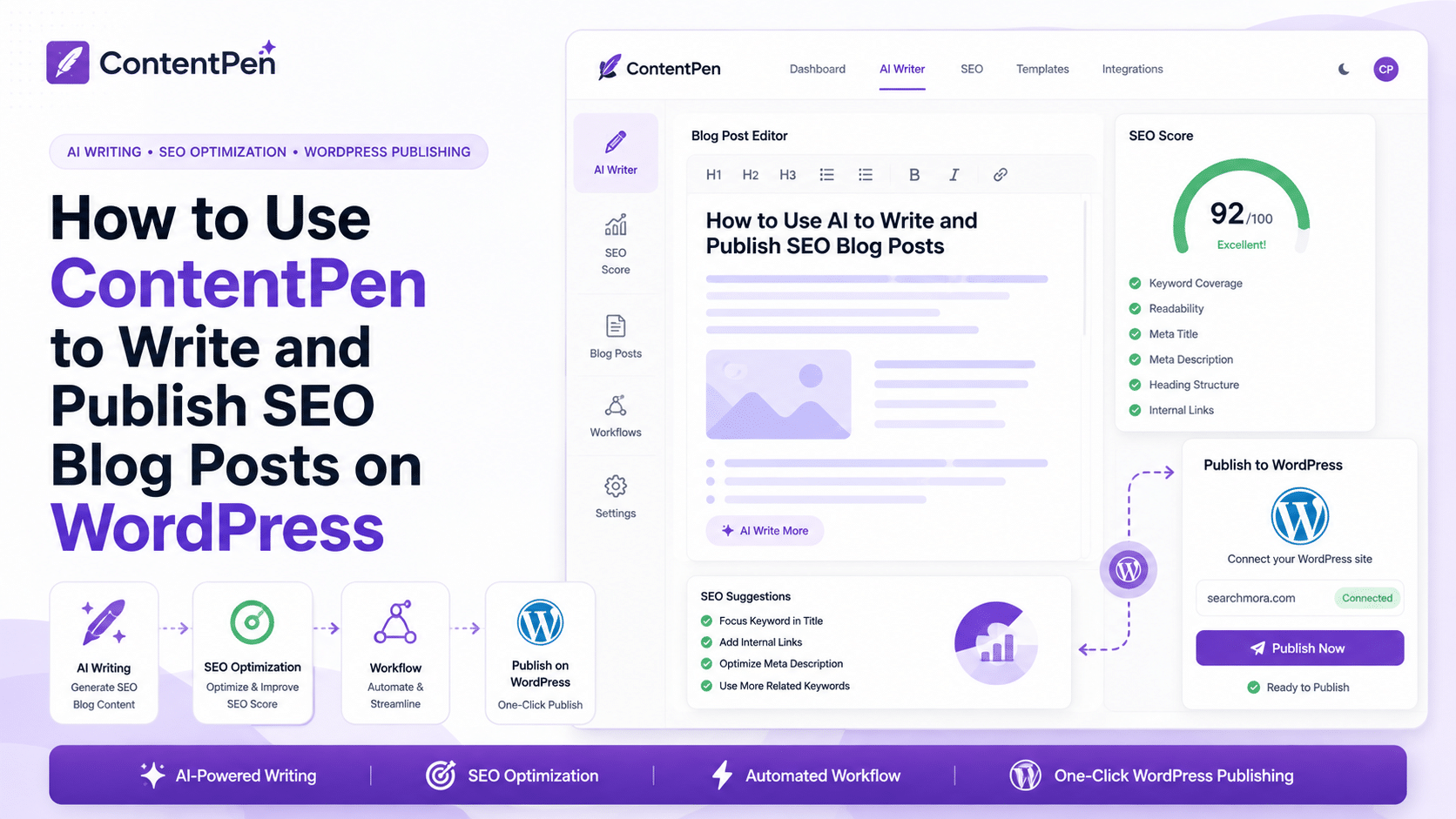
| One-click AI article writing | KoalaWriter or ContentPen |
| Advanced AI visibility or GEO tracking | Profound, Scrunch AI, or Peec AI |
The clearest takeaway is this: use the tool if it solves your main workflow problem, not just because it has AI features. The best SEO tools are the ones that help you save time, improve content quality, and make better decisions without removing human strategy, editing, or judgment.
📌 In This Guide
- What Is WriterZen?
- How WriterZen Works
- WriterZen Key Features
- WriterZen for SEO Content
- WriterZen Pricing and Value
- Real Case Study: How MediaCom Saved 100+ Hours per Month with WriterZen
- WriterZen Pros and Cons
- WriterZen for Agencies
- WriterZen for Bloggers and Affiliate Site Owners
- WriterZen for SaaS and Small Business Teams
- WriterZen Alternatives
- My Practical WriterZen Workflow
- Common Mistakes When Using WriterZen
- FAQ
- Final Verdict: Is WriterZen Worth It?
- Recommended Next Reads
🧠 What Is WriterZen?
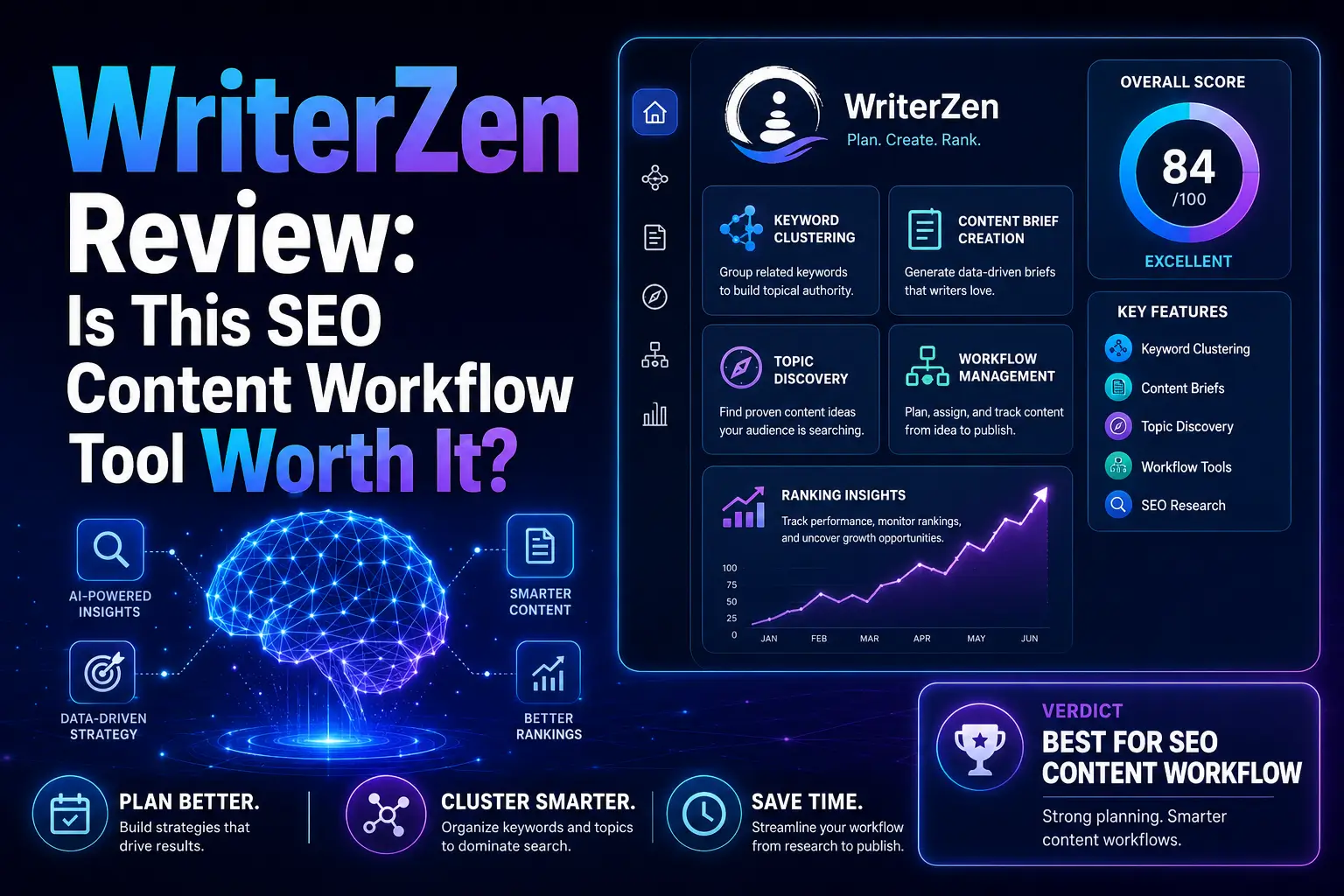
WriterZen is an SEO content workflow tool that helps users find keywords, organize them into clusters, discover topics, build content briefs, create drafts, and check content originality.
It is designed for people who need a more structured process than simply asking an AI tool to write an article.
WriterZen can help with:
- Topic discovery.
- Keyword research.
- Keyword clustering.
- Keyword Golden Ratio-style analysis.
- Content planning.
- Content brief creation.
- AI-assisted writing.
- SERP-based content research.
- Plagiarism checking.
- Team and freelancer workflows.
- Exporting and organizing keyword lists.
The most effective way to understand WriterZen is to see it as a planning-first SEO content tool.
It helps answer questions like:
- What topics should I write about?
- Which keywords belong together?
- Which keyword clusters can become articles?
- Which terms may be easier to rank for?
- What should the article’s brief include?
- How can I organize a content plan before writing?
This makes WriterZen especially useful for bloggers, affiliate marketers, niche site owners, and smaller SEO teams.
It is not the broadest SEO tool on the market, but it is practical for content planning.
⚙️ How WriterZen Works
WriterZen works by connecting keyword research, topic discovery, clustering, content briefs, writing, and originality checks into one workflow.
A typical WriterZen workflow may look like this:
- Start with a seed keyword or topic.
- Use Topic Discovery to explore related content ideas.
- Use Keyword Explorer to find keyword opportunities.
- Filter keywords by volume, competition, and ranking potential.
- Group keywords into clusters.
- Choose which cluster should become an article.
- Build a content brief.
- Draft the article with AI-assisted writing support.
- Check originality with the plagiarism checker.
- Export, publish, and track performance using other SEO tools.
This process is useful because many site owners do not struggle only with writing.
They struggle with choosing the right topics before writing.
That is where WriterZen can help. It gives you a more organized way to turn a messy keyword list into a content plan.
One of the strongest patterns is that WriterZen works best when you use it early in the SEO process. It is more useful for planning articles than for deeply optimizing a finished draft.
🛠️ WriterZen Key Features
🔎 Topic Discovery
Topic Discovery helps users explore content ideas around a seed keyword.
This is useful when you know the general niche but do not know which specific articles to create.
For example, if your niche is “AI SEO tools,” Topic Discovery can help you find related angles, subtopics, and content ideas that may become articles or clusters.
This is valuable because content planning should not start with random keywords only. It should start with topics, audience needs, and search intent.
Topic Discovery can help you:
- Find related content ideas.
- Understand topic branches.
- Build early-stage content plans.
- Discover supporting articles.
- Avoid publishing isolated posts with no cluster strategy.
The biggest mistake is using topic discovery only for inspiration. The better approach is to use it to build structured topic clusters.
🧩 Keyword Explorer
Keyword Explorer is one of WriterZen’s core features.
It helps users find keyword ideas, analyze search demand, and organize keyword lists. This can be useful for bloggers, affiliate marketers, SEO freelancers, and agencies that need a repeatable way to find content opportunities.
A strong keyword research workflow should answer:
- Is there search demand?
- Is the topic relevant to my site?
- Is the keyword realistic for my authority level?
- Does the keyword support a larger topic cluster?
- Can I create a useful article around it?
- Does the keyword match commercial, informational, or comparison intent?
WriterZen helps with the research and organization part of this process.
It is not a complete replacement for Ahrefs or Semrush, especially if you need advanced competitor data or backlink analysis. But it is useful for content-focused keyword planning.
🧠 Keyword Clustering
Keyword clustering is one of WriterZen’s strongest features.
Instead of treating every keyword as a separate article, clustering helps group related keywords together. This is important because many keywords share the same search intent and should be targeted with one strong page instead of several thin pages.
For example, these keywords may belong in one cluster:
- WriterZen review.
- WriterZen SEO tool.
- WriterZen pricing.
- WriterZen alternatives.
- WriterZen keyword clustering.
A weaker content process might create separate articles for each one. A stronger process might create one complete WriterZen review that covers all of them naturally.
Keyword clustering helps with:
- Reducing keyword cannibalization.
- Building stronger content briefs.
- Planning topic clusters.
- Choosing primary and secondary keywords.
- Organizing large keyword lists.
- Creating a more strategic content calendar.
The clearest signal is this: WriterZen is especially useful when your biggest problem is keyword organization.
🏆 Golden Filter and Ranking Potential
WriterZen includes ranking-potential style filtering, often connected to its Golden Filter and keyword competition workflow.
The idea is to help users find keywords that may offer a better balance between opportunity and difficulty.
This is especially useful for:
- New websites.
- Niche sites.
- Affiliate marketers.
- Smaller blogs.
- SEO freelancers working with lower-authority sites.
The most effective way to use this feature is not to chase only the easiest keywords. Instead, use it to build a realistic content plan.
A practical approach would be:
- Find low-competition opportunities.
- Group them into clusters.
- Publish supporting articles.
- Build internal links.
- Strengthen topical authority.
- Move gradually toward more competitive keywords.
This is a smarter approach than targeting only high-volume keywords from day one.
📄 Content Creator and Briefs
WriterZen includes content creation and briefing features that help users turn keyword research into article drafts.
This is useful because keyword research alone does not produce content. Writers need direction.
A good content brief should include:
- Primary keyword.
- Secondary keywords.
- Search intent.
- Suggested structure.
- Related questions.
- Competitor topics.
- Internal link targets.
- Audience notes.
- Content angle.
- Call-to-action guidance.
WriterZen can help make this process faster.
However, the brief still needs human judgment. The best content briefs include strategy, not only data.
For example, if you are writing a product review, the brief should include your editorial opinion, what you tested, what screenshots you have, and how the tool compares with alternatives.
✍️ AI Writing Support
WriterZen includes AI-assisted writing features, but I would not treat it as a replacement for human writing.
Its AI writing support is best used for:
- Drafting sections.
- Expanding outlines.
- Creating rough introductions.
- Generating content ideas.
- Rewriting weak sections.
- Creating FAQ drafts.
- Speeding up first drafts.
The biggest mistake is publishing AI-generated content without editing.
AI can help with speed, but the final article still needs:
- Accuracy.
- Experience.
- Examples.
- Human editing.
- Search intent alignment.
- Original insight.
- Internal links.
- Clear recommendations.
For SEO content, WriterZen’s AI support is most useful when paired with good keyword research and a strong human outline.
🛡️ Plagiarism Checker
WriterZen includes plagiarism checking, which can help users review originality before publishing.
This is useful for:
- Agencies working with freelancers.
- Publishers managing multiple writers.
- Affiliate sites producing content at scale.
- Teams are using AI-assisted drafts.
- Editors check content before publication.
A plagiarism checker is not a full quality control system, but it is a useful safety layer.
A clean plagiarism result does not automatically mean the content is useful. It only means the content is not obviously duplicated.
The final article still needs to be helpful, accurate, and better than competing pages.
🔎 WriterZen for SEO Content
WriterZen can be very useful for SEO content planning, but it is not a complete SEO platform.
It can help with:
- Keyword research.
- Topic discovery.
- Keyword clustering.
- Content planning.
- Content briefs.
- AI-assisted drafting.
- Plagiarism checks.
- Search-intent-based content organization.
However, WriterZen does not replace:
- Technical SEO audits.
- Backlink analysis.
- Rank tracking.
- Google Search Console analysis.
- Site speed optimization.
- Conversion optimization.
- Advanced competitor research.
- Enterprise content governance.
The most effective way to use WriterZen is inside a larger SEO workflow.
A practical SEO workflow could look like this:
- Use WriterZen to discover topics and keyword clusters.
- Choose realistic keyword opportunities.
- Build content briefs around clusters.
- Write or draft the article.
- Edit for quality, originality, and usefulness.
- Optimize with a content tool if needed.
- Add internal links from relevant pages.
- Publish the article.
- Track performance in Google Search Console.
- Refresh the content later based on real data.
WriterZen is strong at the planning stage. For full SEO execution, I would pair it with Google Search Console and, when budget allows, a broader SEO platform like Semrush or Ahrefs.
💰 WriterZen Pricing and Value
WriterZen pricing can vary depending on billing terms, promotions, and plan updates. Public software directories commonly list plans such as Basic, Standard, and Advanced, with monthly pricing often shown as around $39, $59, and $99 per month. Some listings also show lower annualized prices.
Prices and plan limits may change, so always verify WriterZen’s official pricing page before subscribing.
Here is a practical value breakdown:
| User Type | Is WriterZen Worth It? | Why |
|---|---|---|
| New blogger | Maybe | Useful for keyword planning, but only if you publish consistently |
| Affiliate site owner | Yes | Strong fit for keyword clustering and topic planning |
| SEO freelancer | Yes | Helpful for research, briefs, and client keyword organization |
| Small agency | Yes | Useful for planning clusters and briefing writers |
| SaaS content team | Maybe | Useful for planning, but may need deeper tools too |
| Enterprise SEO team | Maybe | Likely needs broader SEO and content strategy platforms |
WriterZen is easier to justify if keyword research and content planning are part of your weekly workflow.
If you only publish one article every few months, you may not need it. But if you are building a niche site, affiliate site, or content calendar, WriterZen can save time and help organize your strategy.
The biggest pricing question is simple:
Will WriterZen help you choose better keywords and build stronger content clusters?
If yes, it can be worth testing.
📊 Real Case Study: How MediaCom Saved 100+ Hours per Month with WriterZen
A strong real-world example comes from MediaCom, one of the world’s leading media communications companies.
MediaCom had a time-consuming keyword research and clustering process. The team had to work through large exports, scrape search results, run calculations, and manage keyword research across different tools and departments.
That type of workflow can create friction, especially in a large organization.
WriterZen helped MediaCom simplify keyword research and clustering in one platform. The key benefit was not just better keyword lists. It was reducing the manual work behind keyword strategy.
The reported result was significant:
| Result | What It Means |
|---|---|
| 100+ hours saved per month | WriterZen reduced heavy manual keyword and clustering work |
| Easier keyword list building | The team could organize keywords more efficiently |
| Better topic clustering workflow | MediaCom found the clustering model accurate and customizable |
| Improved collaboration | WriterZen helped reduce friction across workflow steps |
This case study matters because it shows WriterZen’s real strength.
The tool is not only about writing articles. Its biggest value is helping SEO teams organize keyword research, clustering, and planning faster.
For Searchmora readers, the lesson is clear:
WriterZen is most valuable when keyword organization is a bottleneck. If your content process is messy, your keyword lists are scattered, or your team spends too much time clustering topics manually, WriterZen can save time and make your workflow more consistent.
✅ WriterZen Pros and Cons
✅ Pros
| Pro | Why It Matters |
|---|---|
| Strong keyword clustering | Helps organize keywords into useful article groups |
| Good topic discovery | Useful for finding content ideas and building clusters |
| Practical keyword research workflow | Easier for bloggers and smaller teams than enterprise tools |
| Content briefs included | Helps move from research to writing |
| AI writing support | Speeds up first drafts and section expansion |
| Plagiarism checker | Useful for originality checks before publishing |
| Good fit for niche sites | Helps plan content around realistic keyword opportunities |
| More accessible than larger SEO suites | Useful for users who do not need a heavy platform |
❌ Cons
| Con | Why It Matters |
|---|---|
| Not a full SEO suite | You still need other tools for audits, backlinks, and rankings |
| Not as deep as Ahrefs or Semrush | Competitor and backlink data are more limited |
| Content optimization is not its strongest layer | You may still need tools like Surfer, Clearscope, or Frase |
| AI writing still needs editing | Drafts require human review and expertise |
| Pricing information can vary across listings | Always verify the current official pricing page |
| Not ideal for enterprise strategy alone | Larger teams may need deeper content inventory and reporting tools |
The biggest mistake is expecting WriterZen to replace every SEO tool.
It is better understood as a keyword research, clustering, and content workflow tool. Use it for planning. Pair it with other tools for technical SEO, backlinks, content optimization, and performance tracking.
🧑💼 WriterZen for Agencies
WriterZen can be useful for agencies that need to plan content for multiple clients.
An agency can use WriterZen to:
- Research keywords for client campaigns.
- Build keyword clusters.
- Create content calendars.
- Prepare content briefs.
- Assign keyword groups to writers.
- Check plagiarism before delivery.
- Organize content around topic clusters.
- Reduce manual keyword organization work.
I would use it if you need:
- Faster keyword clustering.
- Better content planning.
- A lighter tool for research and briefs.
- A practical workflow for smaller client campaigns.
- A way to reduce spreadsheet-heavy keyword work.
I would not use it if you need:
- Full client SEO reporting.
- Technical audit automation.
- Backlink outreach tools.
- Enterprise content inventory analysis.
- Advanced content optimization scoring.
For agencies, WriterZen is useful when the bottleneck is keyword organization and brief creation.
It is less useful as a standalone platform for complete SEO management.
📝 WriterZen for Bloggers and Affiliate Site Owners
WriterZen is a strong fit for bloggers and affiliate site owners because keyword planning matters a lot in these workflows.
A blogger or affiliate site owner can use WriterZen to:
- Find low-competition keywords.
- Group keywords into clusters.
- Build topic maps.
- Plan supporting articles.
- Create buying guide outlines.
- Draft informational content.
- Check originality.
- Avoid keyword cannibalization.
I would use it if you need:
- A better keyword planning workflow.
- Help build topic clusters.
- More organized content calendars.
- Keyword ideas for niche content.
- A tool that feels more accessible than enterprise SEO software.
I would not use it if you need:
- Automatic product reviews.
- Backlink analysis.
- Deep competitor research.
- A full SEO suite.
- A replacement for product testing and editorial opinion.
For affiliate SEO, WriterZen can help plan the content. But your reviews still need real product experience, pricing notes, screenshots, comparisons, and honest recommendations.
🏢 WriterZen for SaaS and Small Business Teams
WriterZen can also help SaaS and small business teams that need content planning without a large SEO department.
A SaaS or small business team can use WriterZen for:
- Blog topic planning.
- Educational content ideas.
- Keyword clusters.
- Glossary pages.
- Use-case article planning.
- Competitor topic research.
- Content briefs.
- Supporting content around product pages.
I would use it if you need:
- A practical content planning tool.
- Keyword clusters for blog strategy.
- Better article briefs.
- A simpler workflow than enterprise SEO platforms.
- A way to organize topics before hiring writers.
I would not use it if you need:
- Full product-led SEO strategy.
- Conversion optimization.
- Technical SEO auditing.
- Advanced customer research.
- Enterprise reporting dashboards.
For SaaS teams, WriterZen is best used as a planning support tool.
It can help organize content ideas, but the strongest SaaS content still needs product expertise, customer pain points, and strong positioning.
🔁 WriterZen Alternatives
WriterZen is useful for keyword clustering and content planning, but it is not the only option.
Here are some WriterZen alternatives worth considering:
| Alternative | Best For | Why Choose It Instead of WriterZen |
|---|---|---|
| Semrush | Full SEO operations | Better for keyword research, audits, reporting, and competitor analysis |
| Ahrefs | Keyword and backlink research | Stronger for backlinks and competitive SEO research |
| Surfer SEO | Content optimization | Better for on-page content scoring and optimization |
| Frase | SERP research and briefs | Better for research-to-brief workflows and question discovery |
| Clearscope | Premium content optimization | Better for editorial-quality content optimization |
| MarketMuse | Topic authority strategy | Better for large content inventories and authority planning |
| Content Harmony | Content briefs | Better for detailed search intent and brief workflows |
| NeuronWriter | Budget content optimization | Good lower-cost option for article-level optimization |
| Google Search Console | Real site performance data | Essential for tracking what already works on your site |
WriterZen’s advantage is practical keyword clustering and planning.
Its weakness is that it does not replace the deeper data and broader workflows of full SEO platforms.
🧪 My Practical WriterZen Workflow
If I were using WriterZen for a Searchmora-style SEO project, I would use it mainly in the planning stage.
Start with a Seed Topic
First, I would choose a broad topic that fits the site.
For example:
- AI SEO tools.
- Content optimization tools.
- AI visibility tracking.
- Keyword clustering tools.
- SEO content workflows.
Use Topic Discovery
Next, I would use Topic Discovery to find related ideas and subtopics.
The goal is not just to find one article. The goal is to find a cluster.
Run Keyword Research
Then I would use Keyword Explorer to collect relevant keywords.
I would filter by:
- Relevance.
- Search demand.
- Competition.
- Intent.
- Ranking potential.
- Fit with the site’s existing content.
Cluster the Keywords
After that, I would group keywords into clusters.
This helps decide which keywords belong in one article and which need separate pages.
Build the Content Brief
Next, I would create a brief around the cluster.
The brief should include:
- Primary keyword.
- Secondary keywords.
- Search intent.
- Suggested H2s.
- FAQ questions.
- Internal links.
- Reader pain points.
- Editorial angle.
Draft and Edit
Then I would draft the content with AI assistance if needed.
But I would edit heavily before publishing.
Add Human Editorial Value
Finally, I would add what the tool cannot provide by itself:
- Real examples.
- Practical comparisons.
- Honest recommendations.
- Tool screenshots when available.
- Pricing notes.
- Use-case judgment.
- Internal links.
- A strong conclusion.
This is what turns a keyword-driven article into a useful article.
⚠️ Common Mistakes When Using WriterZen
Treating Keyword Clusters as a Full Strategy
Keyword clusters are useful, but they are not the whole strategy.
You still need search intent, internal linking, content quality, and authority.
Publishing AI Drafts Without Editing
WriterZen can help with AI-assisted writing, but the output still needs review.
Always add examples, clarity, accuracy, and real editorial judgment.
Ignoring Search Intent
Two keywords can look similar but require different page types.
Always check what the searcher wants before writing.
Creating Too Many Similar Articles
Keyword clustering should reduce cannibalization, not create more of it.
If several keywords share the same intent, target them with one stronger page.
Skipping Performance Tracking
WriterZen helps with planning, but performance should be tracked in tools like Google Search Console.
Look at:
- Impressions.
- Clicks.
- CTR.
- Average position.
- Queries.
- Pages losing traffic.
- Pages with update opportunities.
Using WriterZen Alone
WriterZen is useful, but it works best with other tools.
A lean stack could include:
- WriterZen for keyword planning.
- Google Search Console for real performance data.
- A content optimizer for draft improvement.
- A crawler or audit tool for technical checks.
- Human editing for quality.
❓ FAQ
1. Is WriterZen good for SEO?
Yes, WriterZen is useful for SEO keyword research, topic discovery, keyword clustering, content briefs, AI-assisted writing, and plagiarism checking. It is especially helpful for content planning, but it does not replace technical SEO, backlink analysis, or rank tracking.
2. What is WriterZen best for?
WriterZen is best for keyword clustering, topic discovery, content planning, content briefs, and organizing SEO content ideas into a more structured workflow.
3. Is WriterZen worth it?
WriterZen is worth it if you publish content regularly and need a better way to research, cluster, and plan keywords. It may not be worth it if you only publish occasionally or need a full SEO suite.
4. Does WriterZen write articles for you?
WriterZen includes AI-assisted writing features, but it should not be treated as a full replacement for writers. The final article still needs editing, fact-checking, examples, and human judgment.
5. Is WriterZen good for affiliate sites?
Yes, WriterZen can be useful for affiliate sites because it helps find and cluster keywords, plan buying guides, and avoid keyword cannibalization. However, affiliate reviews still need real product testing and original editorial opinion.
6. Is WriterZen better than Semrush?
WriterZen is better for lightweight keyword clustering and content planning. Semrush is better for broader SEO workflows, including competitor research, technical audits, rank tracking, backlink analysis, and reporting.
7. Is WriterZen better than Surfer SEO?
WriterZen is stronger for keyword research and clustering. Surfer SEO is stronger for content optimization and on-page scoring. Many teams could use WriterZen before writing and Surfer after drafting.
8. Can agencies use WriterZen?
Yes, agencies can use WriterZen for keyword research, clustering, briefs, and content planning. However, agencies may still need separate tools for reporting, audits, backlinks, and rank tracking.
9. Does WriterZen guarantee rankings?
No. WriterZen can help improve keyword planning and content organization, but rankings depend on search intent, authority, backlinks, internal linking, technical SEO, competition, freshness, and content quality.
🏁 Final Verdict: Is WriterZen Worth It?
WriterZen is worth it for bloggers, affiliate marketers, freelancers, small agencies, and content teams that need a practical keyword research and clustering workflow.
It is not the deepest SEO platform, and it is not the strongest content optimizer. But it does a good job helping users move from keyword ideas to organized content plans.
My final recommendation is simple:
Use WriterZen if your main bottleneck is keyword research, topic discovery, and clustering.
Skip WriterZen if you need technical SEO audits, backlink analysis, advanced rank tracking, or enterprise-level content strategy.
For Searchmora readers, I would position WriterZen as a practical SEO content planning tool. Its strongest value is helping smaller teams organize content opportunities before writing. Its biggest limitation is that it still needs to be paired with human strategy, editing, performance tracking, and sometimes a separate content optimizer.
📚 Recommended Next Reads
To continue learning about SEO tools, AI content workflows, and content optimization, these published Searchmora guides are useful next reads:
- Best AI SEO Tools Tested This Year
A practical comparison of AI SEO tools for keyword research, content optimization, AI visibility, and content planning. - ContentPen Review: Is This AI Blog Writer Worth It?
A review of an AI blog writing tool focused on SEO articles, AEO structure, bulk generation, and publishing workflows. - Content Harmony Review: Is This Content Brief Platform Worth It?
A review of a content brief workflow tool for search intent analysis, competitor outlines, and writer-ready briefs. - MarketMuse Review: Is This AI Content Strategy Platform Worth It?
A review of a premium content strategy platform for topic authority, content planning, and content inventory workflows. - Clearscope Review: Is This Content Optimization Tool Worth It?
A review of a premium content optimization tool for editorial teams, agencies, and SEO content workflows. - Best Alternatives to Surfer for SEO Content
A practical guide to Surfer alternatives for content optimization, briefs, topical authority, and broader SEO workflows. - Best Alternatives to Frase for GEO and AEO
A guide to Frase alternatives for AI search visibility, answer engine optimization, GEO workflows, and structured content planning.


Comments 4