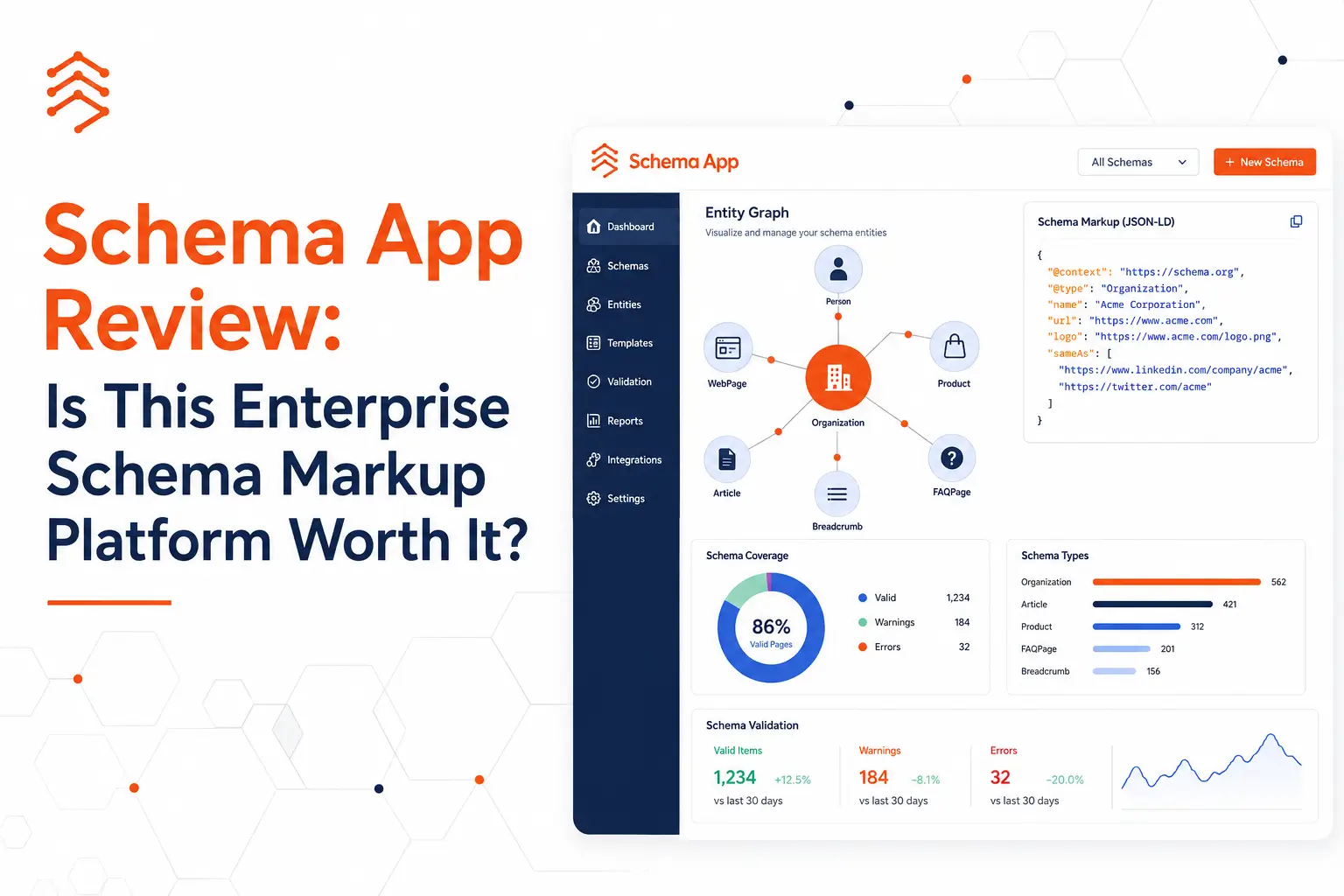
Schema App Review: Is This Enterprise Schema Markup Platform Worth It?
🚀 Introduction
Schema App is an enterprise schema markup platform built for SEO teams that need structured data at scale, entity linking, content knowledge graphs, and better control over how search engines and AI systems understand their brand. It is best for larger websites, not casual bloggers.
Schema markup has become more important as search moves beyond traditional blue links.
Google, AI Overviews, ChatGPT, Perplexity, Gemini, and other discovery systems need clear signals about your content, entities, products, authors, services, and organization. Schema App helps companies turn website content into structured, machine-readable data.
That makes it different from a simple schema plugin.
Schema App is not only about adding FAQ schema or Article schema to a few pages. Its stronger value is helping enterprise teams build, manage, and govern structured data across large websites.
In this Schema App review, I will explain what Schema App does, who should use it, where it performs well, where it falls short, and whether it is worth considering for SEO, AEO, and AI search readiness.
⚡ Quick Verdict
Schema App is worth considering if your business needs enterprise-level schema markup, entity linking, and a structured content knowledge graph for search and AI visibility.
It is not the cheapest schema tool, and it is probably too much for a small WordPress blog. But for enterprise SEO teams, healthcare brands, SaaS companies, ecommerce sites, financial brands, publishers, and multi-location businesses, Schema App solves a serious problem: structured data governance at scale.
| Question | Quick Answer |
|---|---|
| Best for | Enterprise SEO teams, large websites, ecommerce brands, healthcare, SaaS, finance, publishers, and agencies serving complex clients. |
| Strongest feature | Scalable schema markup and content knowledge graph development. |
| Biggest advantage | It helps brands control how search engines and AI systems understand their content and entities. |
| Biggest drawback | Pricing is custom, and the platform is likely overkill for small sites. |
| Best alternatives | WordLift for entity SEO, Rank Math for WordPress schema, Merkle tools for free testing, and Search Atlas for broader AI SEO automation. |
| My verdict | Schema App is one of the strongest options for enterprise schema markup and AI-ready structured data. |
| I would not use the Schema App if you need | I would not use Schema App if you need |
|---|---|
| Enterprise schema markup at scale | A cheap WordPress schema plugin |
| Content knowledge graph development | Basic FAQ or Article schema only |
| Entity linking and structured data governance | A free schema generator |
| Support for large or complex websites | Keyword research |
| Schema deployment without relying fully on developers | Backlink analysis |
| Better AI search and AEO readiness | AI article writing |
| Structured data quality control | A beginner SEO dashboard |
| High-touch enterprise support | A lightweight tool for one small blog |
The clearest takeaway is this: Schema App is not a basic schema generator. It is a structured data and knowledge graph platform for organizations that need search engines and AI systems to understand their brand accurately at scale.
📚 Recommended Reads
- Screaming Frog Review: Is This Technical SEO Crawler Worth It?
- Search Atlas OTTO SEO Review: Is This AI SEO Automation Platform Worth It?
- Alli AI Review: Is This SEO Automation Tool Worth It?
- Best Alternatives to Frase for GEO and AEO
- Best AI SEO Tools Tested This Year.
📌 In This Guide
- What Is Schema App?
- How Schema App Works
- Schema App Key Features
- Schema App for SEO, AEO, and AI Search
- Schema App Pricing and Value
- Real-World Evidence: What External Reviews and Schema Tests Show
- Schema App Pros and Cons
- Schema App for Enterprise SEO Teams
- Schema App for E-commerce and SaaS Websites
- Schema App for Agencies and Consultants
- Schema App Alternatives
- My Practical Schema App Workflow
- Common Mistakes When Using the Schema App
- FAQ
- Final Verdict: Is Schema App Worth It?
- Recommended Next Reads
🧠 What Is Schema App?
Schema App is an enterprise structured data platform that helps organizations create, deploy, manage, and govern schema markup across websites.
Its main goal is to help search engines and AI systems understand website content more accurately.
Schema App can help with:
- Schema markup deployment.
- Structured data management.
- Entity linking.
- Content knowledge graph development.
- JSON-LD markup.
- Rich result eligibility support.
- Structured data governance.
- Enterprise schema strategy.
- Schema markup monitoring.
- Large-site implementation.
- AI search readiness.
- AEO and GEO support.
- Technical SEO support.
- Cross-team schema workflows.
The most effective way to understand Schema App is to see it as a structured data layer for your website.
A small site may only need a plugin that adds Article, FAQ, Product, or LocalBusiness schema. A large enterprise needs something more reliable.
Large websites often have:
- Thousands of URLs.
- Many content templates.
- Multiple teams.
- Complex products or services.
- Authors, locations, reviews, and entities.
- Compliance concerns.
- Different CMS environments.
- Developer bottlenecks.
- AI search visibility concerns.
- A need for structured data governance.
Schema App is built for that more complex environment.
It helps companies move from manual schema markup to a more governed and scalable structured data system.
⚙️ How Schema App Works
Schema App works by helping teams identify, create, deploy, and maintain structured data across website content.
A typical Schema App workflow may look like this:
- Audit the website’s current structured data.
- Identify important content types and entities.
- Define the schema strategy.
- Map schema markup to page templates or content types.
- Add entity linking where useful.
- Deploy structured data through the Schema App’s platform.
- Validate markup and monitor errors.
- Improve rich result eligibility.
- Build toward a content knowledge graph.
- Maintain structured data as the website changes.
This is useful because schema markup can become difficult to manage manually.
For example, an e-commerce site may need a product schema across thousands of pages. A healthcare site may need Organization, MedicalOrganization, Physician, Service, Article, FAQ, and location-related structured data. A SaaS company may need Organization, SoftwareApplication, Product, FAQ, Article, HowTo, Review, and Breadcrumb markup.
Doing this manually can become messy.
Schema App helps make the process more systematic.
One of the strongest patterns is that the Schema App becomes more valuable as the website becomes more complex. If a site has only 20 pages, it may be too much. If a site has thousands of pages and many entities, a structured platform becomes much more useful.
🛠️ Schema App Key Features
🧩 Scalable Schema Markup Deployment
Schema App’s core feature is scalable schema markup deployment.
Instead of manually writing JSON-LD for every page, teams can use Schema App to create structured data across templates, content types, and large sections of a website.
This matters because schema markup needs consistency.
If one product page has a complete Product schema, another has incomplete markup, and another has outdated pricing or missing availability, structured data becomes unreliable.
Schema App helps teams manage structured data more consistently across large websites.
This is useful for:
- EE-commerce product pages.
- SaaS product pages.
- Healthcare provider pages.
- Location pages.
- Blog and article content.
- Author pages.
- FAQ content.
- Review content.
- Service pages.
- Organization-level markup.
The biggest mistake is treating schema markup as a one-time task.
Structured data needs maintenance as content, products, policies, reviews, and page templates change.
🧠 Content Knowledge Graph
One of Schema App’s strongest angles is its focus on building a content knowledge graph.
A content knowledge graph connects your website content, entities, products, people, services, locations, and topics in a structured way.
This is important because modern search and AI systems do not only read text. They try to understand relationships.
For example:
- Your brand is an organization.
- Your organization offers services.
- Your services are available in locations.
- Your authors have expertise.
- Your products have reviews, prices, and features.
- Your articles discuss specific topics.
- Your topics connect to related entities.
When those relationships are structured clearly, machines can understand your site with less ambiguity.
That is why Schema App’s knowledge graph positioning is important for AI search.
It helps move schema markup from “rich result markup” to “machine-readable brand understanding.”
🔗 Entity Linking
Entity linking helps connect the entities on your site to known, structured references.
This can improve clarity for search engines and AI systems.
For example, if a page mentions a company, person, medical condition, software category, product type, or location, entity linking can help clarify exactly what that entity means.
This is especially useful for:
- Healthcare websites.
- Financial institutions.
- SaaS companies
- E-commerce brands.
- Publishers.
- Education websites.
- Government or public-service websites.
- Large organizations with complex terminology.
Entity linking can support better semantic understanding.
It is also important for AI search because AI systems may summarize, recommend, or describe brands based on how clearly they understand entities and relationships.
The clearest signal is this: schema markup tells machines what something is. Entity linking helps clarify which exact thing it is.
✅ Structured Data Validation and Monitoring
Schema App helps teams validate and monitor structured data.
This matters because schema errors can prevent rich result eligibility and create inconsistent machine-readable signals.
Common schema issues include:
- Missing required fields.
- Invalid property values.
- Incorrect schema types.
- Duplicate markup.
- Outdated product information.
- Broken entity references.
- Template-level mistakes.
- Conflicting schema from plugins or themes.
- Missing review or author data.
- Markup that does not match visible content.
Large sites need monitoring because problems can appear after CMS changes, product updates, template edits, migrations, or plugin conflicts.
Schema App helps teams keep structured data cleaner over time.
🏢 Enterprise Governance
Schema App is especially useful for enterprise governance.
Large organizations often need structured data processes that involve:
- SEO teams
- developers
- legal teams
- content teams
- product teams
- ecommerce teams
- compliance teams
- analytics teams
- agencies
Without governance, structured data can become inconsistent.
For example, one team may add schema through a plugin, another team may hard-code markup, and another may update templates without reviewing schema output.
Schema App helps centralize schema strategy and management.
This is one of the main reasons it fits enterprise teams better than small blogs.
🛒 E-commerce Schema Support
E-commerce sites can benefit from the Schema App because product data is structured by nature.
A strong e-commerce schema sstrategyay include:
- Product schema.
- Offer schema.
- Review schema.
- AggregateRating schema.
- Breadcrumb schema.
- Organization schema
- Website schema.
- FAQ schema.
- CollectionPage schema.
- Merchant-related information.
For e-commerce, structured data can help search engines understand product names, prices, availability, ratings, categories, and relationships.
This does not guarantee rich results or rankings.
But without structured data, e-commerce pages may be harder for search engines and AI systems to interpret accurately. TheThe
Schema App is useful when e-commerce schema needs to be managed across many product pages and templates.
🏥 Industry-Specific Schema Strategy
Schema App is especially relevant for complex industries where accuracy matters.
These include:
- Healthcare.
- Finance.
- Insurance.
- Education.
- SaaS.
- E-commercecee.
- Multi-location businesses.
- Publishers.
- Government organizations.
- Enterprise service brands.
A healthcare site, for example, may need to structure providers, specialties, services, hospitals, locations, medical topics, and authors.
A financial brand may need to structure organization information, services, products, articles, authors, and compliance-sensitive content.
These industries need a careful schema strategy because incorrect representation can create trust problems.
Schema App is more suitable for these use cases than simple one-click schema plugins.
🤖 AI Search and AEO Readiness
Schema App’s positioning is increasingly tied to AI search, AEO, and entity understanding.
This matters because structured data can help AI systems interpret content more accurately.
AI search experiences may use many signals, but clear, structured data can support:
- Entity understanding.
- Brand accuracy.
- Content relationships.
- Product information.
- Author and organization clarity.
- Topic mapping.
- Reduced ambiguity.
- Machine-readable context.
- AI answer accuracy.
- Knowledge graph development.
This does not mean schema markup automatically gets your brand cited by AI tools.
But it can help create a cleaner semantic foundation.
For Searchmora readers, this is the strongest reason to care about Schema App today.
Structured data is no longer only about rich snippets. It is also about making your brand easier for machines to understand.
🔎 Schema App for SEO, AEO, and AI Search
Schema App can help with traditional SEO, search engine optimization, and AI search readiness.
It can support:
- rich result eligibility
- structured data consistency
- entity clarity
- knowledge graph development
- product understanding
- organization understanding
- author and content relationships
- AI search visibility foundations
- technical SEO governance
- scalable schema deployment
However, Schema App does not replace:
- keyword research
- content strategy
- technical SEO crawling
- backlink analysis
- rank tracking
- AI article writing
- conversion optimization
- human editorial review
The best way to use Schema App is inside a broader SEO and AI visibility workflow.
A practical workflow could look like this:
- Identify the most important page types.
- Audit existing structured data.
- Prioritize pages with business value.
- Define schema types and entity relationships.
- Deploy markup through the Schema App.
- Validate structured data.
- Monitor errors and warnings.
- Improve entity linking.
- Track rich result changes and search performance.
- Review AI search visibility over time.
Schema App is strongest when structured data is part of a serious SEO system.
It is weaker if you only need a basic schema for a small site.
💰 Schema App Pricing and Value
Schema App uses custom enterprise pricing.
Its official pricing page does not list fixed public monthly plans. Instead, the platform offers customized pricing based on the scale and complexity of enterprise needs.
That pricing model makes sense for large organizations, but it also means Schema App is not the best fit for users who want a cheap self-serve plugin.
Here is how I would think about value:
| User Type | Is Schema App Worth It? | Why |
|---|---|---|
| New blogger | Usually no | A free or low-cost WordPress schema plugin is enough. |
| Affiliate site owner | Usually no | Most affiliate sites can start with Rank Math, Yoast, or manual JSON-LD. |
| SEO freelancer | Maybe | Useful only if serving enterprise or complex clients. |
| Agency | Yes, for enterprise clients | Strong fit for structured data services at scale. |
| Ecommerce brand | Yes, if large | Useful for product schema, offers, reviews, and entity governance. |
| SaaS company | Yes, if SEO is mature | Helpful for SoftwareApplication, Organization, Product, FAQ, and article markup. |
| Healthcare or finance brand | Yes | Strong fit where accuracy, governance, and compliance matter. |
| Enterprise SEO team | Yes | Best fit for large-scale structured data and knowledge graph work. |
Schema App becomes easier to justify when structured data is difficult to manage manually.
If your site has a few dozen pages, it may be too much.
If your site has thousands of pages, multiple templates, complex entities, and AI search concerns, the value becomes clearer.
The biggest pricing question is simple:
Do you need structured data governance, or do you only need basic schema markup?
If you only need basic markup, use a cheaper tool.
If you need governance, scale, and knowledge graph development, Schema App becomes much more relevant.
📊 Real-World Evidence: What External Reviews and Schema Tests Show
Schema App has strong official customer stories, but for this review, the external evidence is more useful for keeping the analysis balanced.
External source: The Rank Masters structured data tools review, G2 verified Schema App reviews, and SearchPilot schema markup SEO testing.
The Rank Masters includes Schema App in its structured data tools review and positions it as an enterprise schema solution. The review notes that Schema App’s pricing is quote-based, that it is likely overkill for small sites, and that users need process maturity around taxonomy, templates, and governance to get full value.
G2 lists Schema App with a 4.75/5 rating from 18 reviews. This supports the idea that users who fit the platform’s target market generally view it positively.
SearchPilot’s schema markup testing is also important because it adds balance. Their schema SEO tests show that structured data changes can produce different outcomes depending on the site and implementation. In other words, schema markup should be tested and monitored rather than treated as a guaranteed traffic lever.
Here is the practical evidence summary:
| Evidence Point | What It Means for Schema App Users |
|---|---|
| External structured data tools review | Schema App is recognized as an enterprise-level schema solution. |
| Quote-based pricing noted externally | Supports the idea that Schema App is not a cheap beginner tool. |
| Overkill for small sites | Confirms that the platform is best for mature teams and complex websites. |
| G2 rating of 4.75/5 from 18 reviews | Suggests positive user satisfaction among its customer base. |
| SearchPilot schema testing | Shows that schema changes should be tested and monitored, not blindly assumed to improve traffic. |
For Searchmora readers, the fair conclusion is this:
Schema App is best supported as an enterprise structured data and knowledge graph platform. It can help large websites manage schema markup at scale, but schema markup itself is not a guaranteed ranking factor.
A smart 30-day Schema App evaluation would look like this:
- Audit your current structured data.
- Identify high-value templates and page types.
- Choose schema types that match visible content.
- Deploy markup on a controlled page group.
- Validate markup with testing tools.
- Monitor rich result eligibility.
- Track Search Console impressions and clicks.
- Review whether AI search systems describe your brand more accurately.
- Expand only after the first implementation is clean.
- Continue monitoring as content and templates change.
The strongest way to use Schema App is to treat structured data as an ongoing semantic layer, not a one-time SEO trick.
✅ Schema App Pros and Cons
✅ Pros
| Pro | Why It Matters |
|---|---|
| Strong enterprise schema platform | Built for large and complex websites. |
| Scalable schema deployment | Helps manage markup across templates and many pages. |
| Content knowledge graph focus | Supports better machine understanding of entities and relationships. |
| Entity linking support | Helps clarify meaning for search engines and AI systems. |
| Useful for AI search readiness | Aligns with AEO, GEO, and LLM-driven discovery trends. |
| Better governance than basic plugins | Useful for SEO teams managing structured data at scale. |
| Strong fit for complex industries | Healthcare, finance, e-commercee, SaaS, and publishers can benefit. |
| High-touch enterprise support | Useful when structured data needs strategy and implementation guidance. |
❌ Cons
| Con | Why It Matters |
|---|---|
| Custom pricing only | Not ideal for users who want transparency in now-cost plans. |
| Overkill for small sites | Bloggers may get enough schema from Rank Math or Yoast. |
| Requires strategy | Schema markup needs correct entity and content mapping. |
| Not a full SEO suite | It does not replace keyword research, audits, backlinks, or rank tracking. |
| Schema is not a ranking guarantee | Structured data supports understanding, but results vary. |
| Requires ongoing maintenance | Markup must stay accurate as content and templates change. |
| Best value needs mature processes | Large teams need governance, ownership, and QA. |
The biggest mistake is treating Schema App like a simple rich snippet tool.
Its real value is bigger than that.
Schema App is about structured data governance, entity understanding, and building a machine-readable foundation for search and AI.
🏢 Schema App for Enterprise SEO Teams
Schema App is one of the strongest fits for enterprise SEO teams.
Enterprise websites often have large-scale structured data problems:
- Many templates.
- Many page types.
- Multiple CMS systems.
- Large content libraries.
- Complex entities.
- Product or service data.
- Multiple stakeholders.
- Compliance requirements.
- AI search visibility concerns.
- Developer bottlenecks.
Schema App can help enterprise teams create a more consistent,, tent structured data system.
I would use it if you need the:
| Use Schema App If | Why |
|---|---|
| You manage a large website | Manual schema markup becomes hard to maintain. |
| You need governance | Schema App helps centralize structured data strategy. |
| Your content has many entities | Entity linking and knowledge graphs become more valuable. |
| You care about AI search accuracy | Structured data can help reduce ambiguity. |
| You need high-touch support | Enterprise schema strategy often needs expert help. |
I would not use it if you need:
| Avoid Schema App If | Better Fit |
|---|---|
| Basic WordPress schema | Rank Math, Yoast, AIOSEO |
| Free schema generation | Merkle tools, Schema.org validator, Google Rich Results Test |
| Keyword research | Semrush, Ahrefs, Mangools |
| Content optimization | NeuronWriter, Surfer, Clearscope |
| Technical crawling | Screaming Frog, Sitebulb |
For enterprise SEO, Schema App can be a strategic tool.
It helps teams move from scattered markup to a governed, structured data layer.
🛒 Schema App for Ecommerce and SaaS Websites
Schema App can be valuable for e-commerce and SaaS websites because both have structured information that search engines and AI systems need to understand clearly.
An e-commerce site can use the Schema App for:
- Product schema.
- Offer schema.
- Review schema.
- AggregateRating schema.
- Breadcrumb schema.
- Collection pages.
- Organization schema.
- FAQ schema.
- Merchant-related information.
- Entity relationships between products and categories.
A SaaS website can use Schema App for:
- SoftwareApplication schema.
- Organization schema.
- Product schema.
- FAQ schema.
- Review schema.
- Article schema.
- Author schema.
- Use-case pages.
- Feature pages.
- Integration pages.
I would use it if you need:
- Schema markup across many products or pages.
- Better structured product understanding.
- Knowledge graph support.
- Entity clarity for AI search.
- Enterprise-level schema management.
- A serious AI search foundation.
I would not use it if you need:
- A basic Product schema plugin.
- Product feed optimization
- E-commerce analytics.
- AI article generation.
- Conversion rate optimization.
- Simple SaaS landing page copy.
For e-commerce and SaaS, Schema App works best when schema is part of a larger SEO and content strategy.
Structured data can support clarity, but the pages still need useful content, accurate product information, and strong internal linking.
🧑💼 Schema App for Agencies and Consultants: The
Schema App can be useful for agencies and consultants serving enterprise clients.
It is less likely to be the right fit for agencies serving only small local businesses or beginner blogs.
An agency can use Schema App to support:
- Enterprise schema strategy.
- Structured data audits.
- Large-site schema deployment.
- Entity mapping.
- Knowledge graph development.
- Rich result optimization.
- AI search readiness.
- Technical SEO consulting.
- Structured data governance.
- Ongoing schema monitoring.
I would use it if you need:
- Enterprise schema services.
- A platform for complex client sites.
- Structured data governance.
- Entity linking workflows.
- Scalable schema deployment.
- High-touch schema support.
I would not use it if you need:
- A low-cost schema plugin for small clients.
- Simple schema generators.
- Client reporting dashboards only.
- Backlink outreach.
- AI writing.
- General SEO audits only.
For agencies, Schema App can help differentiate advanced technical SEO services.
Most agencies can add basic schema. Fewer can build a serious, structured data layer for enterprise search and AI visibility.
🔁 Schema App Alternatives
Schema App is strong for enterprise schema markup, but it is not the only option.
Here are the best alternatives depending on your main need:
| Alternative | Best For | Better if you want simple, built-in structured data as part of a WordPress SEO plugin. |
|---|---|---|
| WordLift | Entity SEO and knowledge graph workflows | Better if you want entity-based SEO and content knowledge graph features with a different platform approach. |
| Rank Math | WordPress schema basics | Better if you run a smaller WordPress site and need affordable schema markup. |
| Yoast SEO | WordPress SEO and basic schema | Better for crawling and auditing the schema across a site manually. |
| AIOSEO | WordPress SEO and schema | Better for small businesses wanting schema plus common WordPress SEO settings. |
| Merkle Schema Markup Generator | Free schema generation | Better if you need simple manual JSON-LD generation for individual pages. |
| Google Rich Results Test | Structured data validation | Better for checking rich result eligibility, not for managing schema at scale. |
| Search Atlas OTTO SEO | Broader AI SEO automation | Better if you want SEO automation beyond schema markup. |
| Screaming Frog | Structured data auditing | Better for crawling and auditing schema across a site manually. |
Schema App’s advantage is enterprise governance and scalable structured data.
Its weakness is that simpler sites may not need that level of platform.
If you need a basic schema, choose a plugin or free generator.
If you need structured data at scale, Schema App becomes much more relevant.
🧪 My Practical Schema App Workflow
If I were using Schema App for a serious enterprise SEO project, I would not start by adding random schema types.
I would start with a strategy.
Audit Existing Structured Data
First, I would review the existing schema.
I would check:
- Schema types.
- Required properties.
- Errors and warnings.
- Duplicate markup.
- Conflicting plugin output.
- Template-level issues.
- Rich result eligibility.
- Entity clarity.
Identify High-Value Page Types
Next, I would choose the most important page templates.
These may include:
- Product pages.
- Service pages.
- Location pages.
- Article pages.
- Author pages.
- FAQ pages.
- Review pages.
- Organization pages.
Define Entity Relationships
Then I would map important entities.
For example:
- Organization.
- Products.
- Services.
- Authors.
- Locations.
- Topics.
- Reviews.
- Offers.
Deploy Schema in Controlled Groups
I would avoid deploying everything at once.
A safer workflow is:
- Start with one template.
- Validate markup.
- Monitor results.
- Fix issues.
- Expand to more templates.
- Continue monitoring.
Monitor Search and AI Visibility
After implementation, I would track:
- Rich result eligibility.
- Search Console performance.
- Structured data errors.
- AI searches for brand accuracy.
- Entity visibility.
- Important page performance.
- Template changes that break markup.
Maintain the Knowledge Graph
Finally, I would treat structured data as a living system.
As the website changes, the schema strategy should evolve.
This is especially important for large brands.
⚠️ Common Mistakes When Using Schema App
Treating Schema as a Ranking Shortcut
Schema markup can help search engines understand content, but it does not guarantee rankings.
Content quality still matters.
Adding Schema That Does Not Match Visible Content
Structured data should describe what is actually visible on the page.
Misleading markup can create problems.
Ignoring Entity Relationships
Modern schema strategy is not only about page types.
Entity relationships matter.
Using Too Many Tools at Once
Multiple plugins, hard-coded schema, and platform-generated markup can conflict.
Use a governed approach.
Skipping Validation
Always validate structured data after deployment.
Errors can prevent rich result eligibility.
Forgetting Maintenance
Schema markup can break when templates or content change.
Monitor it regularly.
Using Enterprise Tools for Small Problems
Schema App is powerful, but not every site needs it.
Small blogs may be better served by Rank Math, Yoast, or manual JSON-LD.
❓ FAQ
1. What is Schema App?
Schema App is an enterprise schema markup and structured data platform that helps organizations create, deploy, manage, and govern schema markup across websites.
2. Is Schema App good for SEO?
Yes, Schema App is useful for SEO because it helps search engines better understand content, entities, products, services, authors, locations, and relationships through structured data.
3. What is Schema App best for?
Schema App is best for enterprise schema markup, structured data governance, entity linking, content knowledge graph development, and AI search readiness.
4. Is Schema App worth it?
Schema App is worth it for large websites and enterprise SEO teams that need schema markup at scale. It is usually not worth it for small blogs that only need a basic schema.
5. How much does Schema App cost?
Schema App uses custom pricing based on enterprise needs. The public pricing page does not show fixed monthly plans, so users need to request a quote or book a demo.
6. Is Schema App better than Rank Math?
Schema App is better for enterprise structured data and knowledge graph workflows. Rank Math is better for small WordPress sites that need basic SEO settings and simple schema markup.
7. Does Schema App help with AI search?
Schema App can support AI search readiness by creating structured data and entity relationships that help machines understand a brand and its content more accurately.
8. Does schema markup guarantee rich results?
No. Schema markup can make a page eligible for certain rich results, but Google decides whether to show them. Eligibility does not guarantee display.
9. Does Schema App replace technical SEO tools?
No. Schema App focuses on structured data and knowledge graph development. You may still need tools like Screaming Frog, Sitebulb, Semrush, Ahrefs, or Google Search Console for broader SEO work.
🏁 Final Verdict: Is Schema App Worth It?
Schema App is worth it for enterprise SEO teams, large ecommerce brands, SaaS companies, healthcare organizations, financial brands, publishers, and agencies that need structured data at scale.
It is not the right tool for everyone.
If you run a small WordPress blog, you probably do not need Schema App. A plugin like Rank Math, Yoast, or AIOSEO may be enough.
But if your organization needs structured data governance, entity linking, content knowledge graph development, and better control over how search engines and AI systems understand your brand, Schema App becomes much more valuable.
My final recommendation is simple:
Use Schema App if structured data is a serious business and an AI search priority.
Skip Schema App if you only need basic schema markup for a small site.
For Searchmora readers, I would position Schema App as a premium enterprise schema markup platform. Its strongest value is helping brands build a structured, machine-readable foundation for search, AI Overviews, answer engines, and future AI discovery systems.
The clearest takeaway is this: Schema App is not for adding quick schema to a few posts. It is for organizations that need structured data to become part of their long-term SEO and AI visibility infrastructure.
📚 Recommended Next Reads
- Screaming Frog Review: Is This Technical SEO Crawler Worth It?
- Search Atlas OTTO SEO Review: Is This AI SEO Automation Platform Worth It?
- Alli AI Review: Is This SEO Automation Tool Worth It?
- Best Alternatives to Frase for GEO and AEO
- Best AI SEO Tools Tested This Year.
Comments 4