
🚀 Introduction
Mangools is an affordable SEO toolkit best suited for bloggers, freelancers, small businesses, affiliate site owners, and marketers who need simple keyword research, rank tracking, SERP analysis, backlink checks, and site authority insights without the complexity or cost of Semrush or Ahrefs.
Its biggest strength is usability.
Mangools is not the deepest SEO platform on the market. It is not the best choice for enterprise SEO teams, advanced backlink analysis, or deep technical audits. But it gives smaller teams a clean and practical SEO workflow through tools like KWFinder, SERPChecker, SERPWatcher, LinkMiner, SiteProfiler, and AI Search Watcher.
In this Mangools review, I will cover every main Mangools tool, explain who it is best for, compare its value, discuss its limitations, and show real-world evidence from trusted independent reviews.
⚡ Quick Verdict
Mangools is worth considering if you want an easy-to-use SEO toolkit for keyword research, rank tracking, SERP analysis, backlinks, and competitor checks at a more affordable price than major all-in-one SEO platforms.
It is not as advanced as Ahrefs, Semrush, or SE Ranking for deep SEO operations. But for beginners, bloggers, affiliate marketers, and smaller teams, Mangools offers a very practical balance of simplicity, useful data, and lower pricing.
| Question | Quick Answer |
|---|---|
| Best for | Bloggers, affiliate marketers, freelancers, small businesses, and beginner-to-intermediate SEO users. |
| Strongest tool | KWFinder for keyword research. |
| Biggest advantage | Very easy to use compared with larger SEO platforms. |
| Biggest drawback | Not as deep for backlinks, audits, automation, or enterprise SEO workflows. |
| Best alternatives | SE Ranking for agencies, Ahrefs for backlinks, Semrush for all-in-one SEO, and WriterZen for keyword clustering. |
| My verdict | Mangools is one of the best SEO toolkits for users who want simple, affordable, and beginner-friendly SEO data. |
| I would use Mangools if you need | I would not use Mangools if you need |
|---|---|
| Easy keyword research with KWFinder | Deep backlink analysis like Ahrefs |
| Simple rank tracking with SERPWatcher | Full technical SEO audits |
| SERP analysis without a steep learning curve | Enterprise SEO reporting |
| Affordable SEO tools for a small site | Advanced content optimization like Clearscope |
| Competitor keyword and backlink checks | Deep backlink analysis, like Ahrefs |
| Local keyword research and city-level SERP checks | Large-scale keyword databases and automation |
| A cleaner alternative to complex SEO platforms | Advanced AI visibility or GEO monitoring |
The clearest takeaway is this: Mangools is not trying to be the most powerful SEO platform for enterprise teams. It is trying to be one of the easiest and most affordable SEO toolkits for people who want practical search data without feeling overwhelmed.
📌 In This Guide
- What Is Mangools?
- How Mangools Works
- Mangools Key Tools and Features
- Mangools for SEO Content and Keyword Research
- Mangools Pricing and Value
- Real-World Evidence: What Independent Reviews and Tests Show
- Mangools Pros and Cons
- Mangools for Bloggers and Affiliate Site Owners
- Mangools for Agencies and Freelancers
- Mangools for Small Businesses and SaaS Teams
- Mangools Alternatives
- My Practical Mangools Workflow
- Common Mistakes When Using Mangools
- FAQ
- Final Verdict: Is Mangools Worth It?
- Recommended Next Reads
🧠 What Is Mangools?
Mangools is a suite of SEO tools designed to make keyword research, SERP analysis, rank tracking, backlink research, and website authority analysis easier.
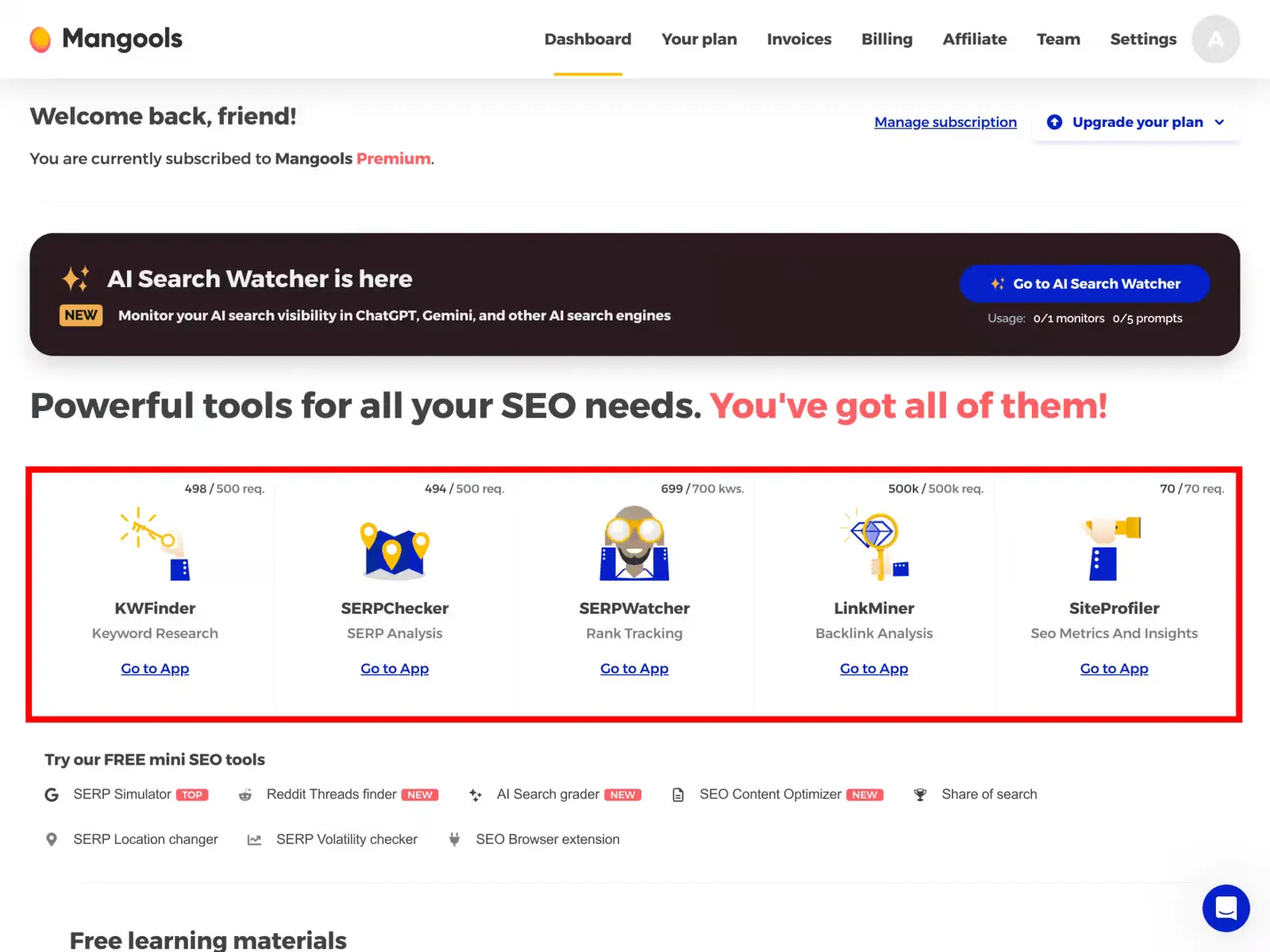
The main Mangools toolkit includes:
- KWFinder for keyword research.
- SERPChecker for SERP analysis.
- SERPWatcher for rank tracking.
- LinkMiner for backlink analysis.
- SiteProfiler for website metrics and competitor insights.
- AI Search Watcher for tracking AI search visibility.
- Free mini-tools such as SERP Simulator, AI Search Grader, SEO Content Optimizer, Share of Search, and Browser Extension.
The most effective way to understand Mangools is to see it as an accessible SEO toolkit.
It gives you the core tools many small website owners need:
- Find keywords.
- Check keyword difficulty.
- Analyze search results.
- Track ranking changes.
- Look at competitor backlinks.
- Review domain authority metrics.
- Monitor basic visibility.
- Explore free SEO utilities.
Mangools is not built for deep enterprise SEO operations. It is built for users who want enough data to make better SEO decisions without spending hours learning a complicated platform.
That is why KWFinder became one of the most recognized parts of Mangools. It is simple, clean, and useful for finding realistic keyword opportunities.
⚙️ How Mangools Works
Mangools works by separating SEO tasks into focused tools instead of placing everything inside one complex dashboard.
A typical Mangools workflow might look like this:
- Use KWFinder to discover keyword ideas.
- Check search volume, keyword difficulty, CPC, trends, and related keywords.
- Use SERPChecker to analyze the first page of Google for that keyword.
- Review competitors, SERP features, authority metrics, and ranking difficulty.
- Use SERPWatcher to track your keyword rankings after publishing.
- Use LinkMiner to inspect competitor backlinks and find link opportunities.
- Use SiteProfiler to evaluate competitor authority and top pages.
- Use AI Search Watcher or free AI tools to check early AI visibility signals.
- Use the browser extension for quick SEO checks while browsing.
- Repeat the process for new and existing content.
This workflow is useful because it keeps SEO simple.
Instead of trying to master a huge platform, you can open the tool that matches your task.
One of the strongest patterns is that Mangools works best when you are doing practical SEO research for a smaller site. It is especially useful when you need to choose keywords, understand competition, and monitor ranking movement without overcomplicating the process.
🛠️ Mangools Key Tools and Features
🔎 KWFinder: Keyword Research
KWFinder is the most important tool inside Mangools.
It helps you find keyword ideas, search volume, keyword difficulty, CPC, search trends, related keywords, autocomplete ideas, and competitor keywords.
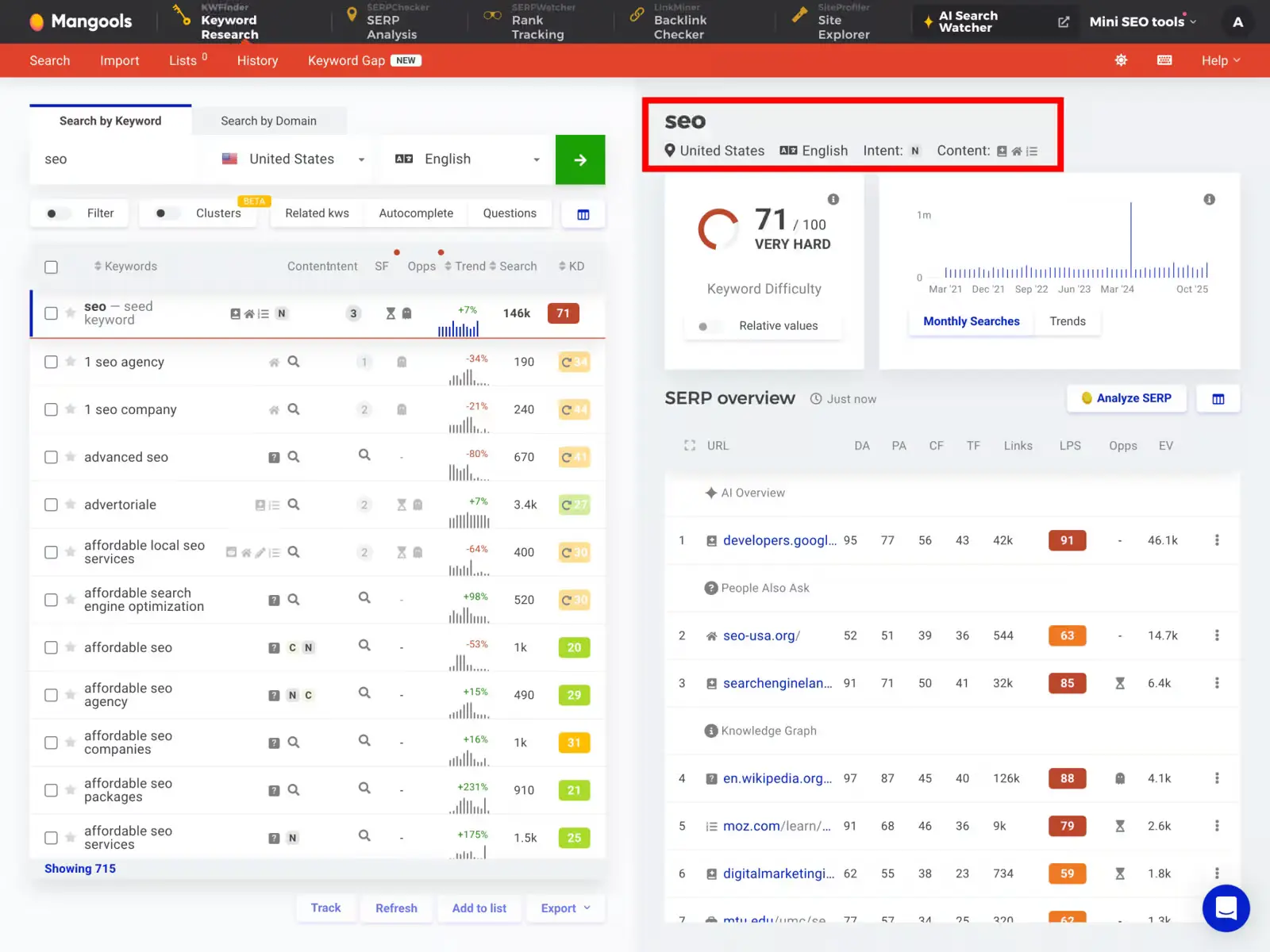
This is useful for:
- Blog keyword research.
- Affiliate content planning.
- Long-tail keyword discovery.
- Local SEO keyword research.
- Low-competition topic ideas.
- Competitor keyword checks.
- Content calendar planning.
- New website SEO research.
KWFinder’s main strength is simplicity.
Some keyword tools feel overwhelming because they show too much data at once. KWFinder presents the most important keyword metrics more cleanly.
For a blogger or affiliate site owner, this is useful because the goal is not to analyze every possible metric. The goal is to find keywords you can realistically rank for.
A practical KWFinder workflow could look like this:
- Enter a seed keyword.
- Filter by low SEO difficulty.
- Review search volume.
- Check keyword relevance.
- Open the SERP preview.
- Choose keywords with realistic competition.
- Group related keywords into one article.
- Save the best ideas for your content plan.
The biggest mistake is choosing keywords only because the difficulty score looks low.
You still need to check search intent, competitor quality, content format, and whether your site has enough authority to compete.
🧭 SERPChecker: SERP Analysis
SERPChecker helps you analyze Google’s first page for a target keyword.
This is important because keyword difficulty alone is never enough.
A keyword may look easy based on a score, but the SERP may still be difficult because it includes strong domains, ads, video results, featured snippets, shopping results, local packs, or other SERP features.
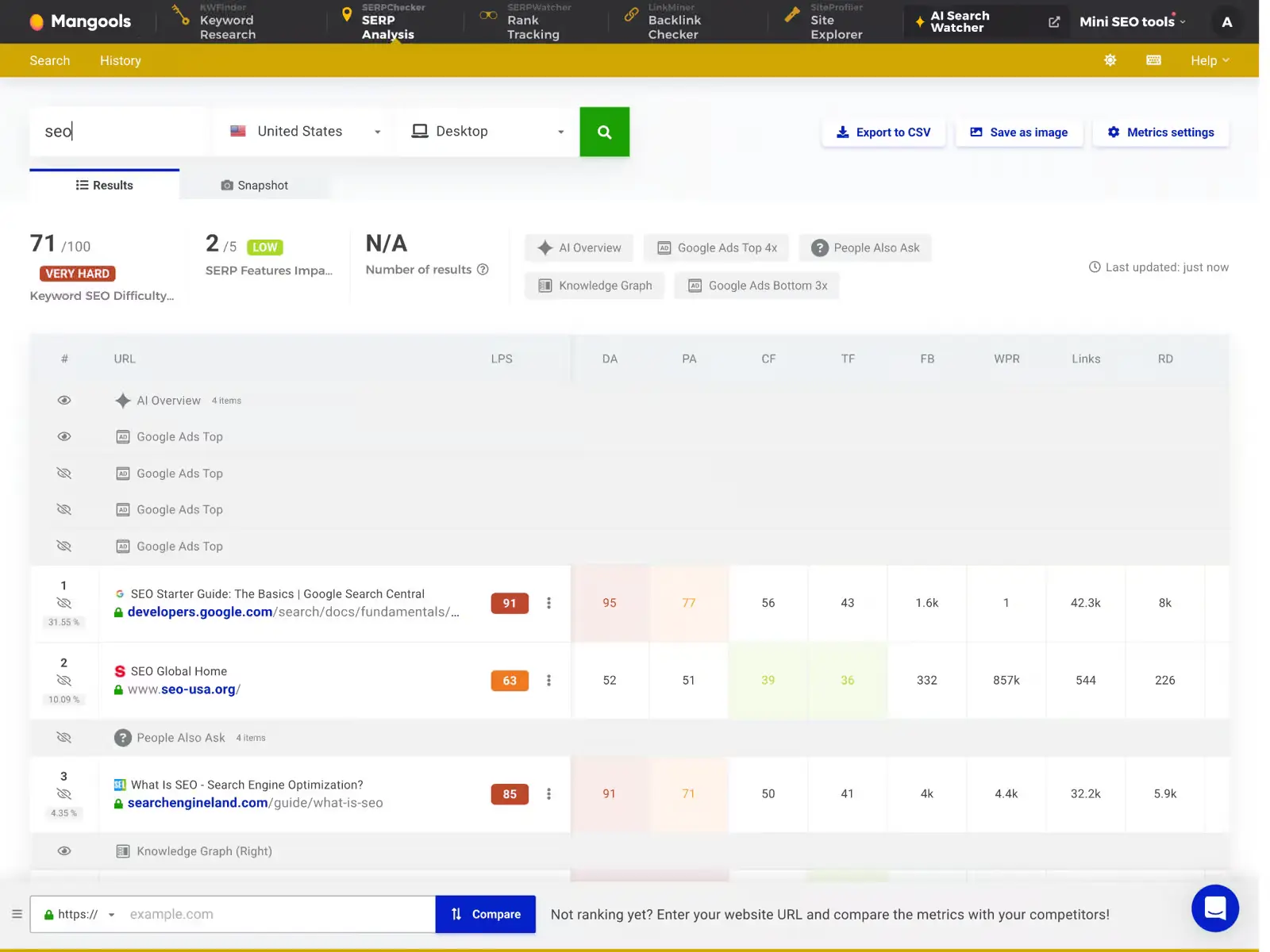
SERPChecker helps you review:
- Ranking pages.
- Domain strength.
- Page authority signals.
- Backlink metrics.
- SERP features.
- Estimated impact of SERP features.
- Localized search results.
- Ranking difficulty.
This is useful because SEO is not only about keywords. It is also about the page type Google prefers.
Before writing an article, I would use SERPChecker to answer:
- Are the top pages blog posts, product pages, reviews, or category pages?
- Are big authority sites dominating?
- Are there weak pages ranking?
- Are there many SERP features stealing clicks?
- Does the keyword deserve a long guide, short answer, comparison, or tool page?
- Can my site realistically compete?
The clearest signal is this: SERPChecker helps you avoid blindly trusting keyword scores.
📈 SERPWatcher: Rank Tracking
SERPWatcher is Mangools’ rank tracking tool.
It helps you monitor keyword ranking changes over time. This is useful after publishing content, refreshing articles, or updating important pages.
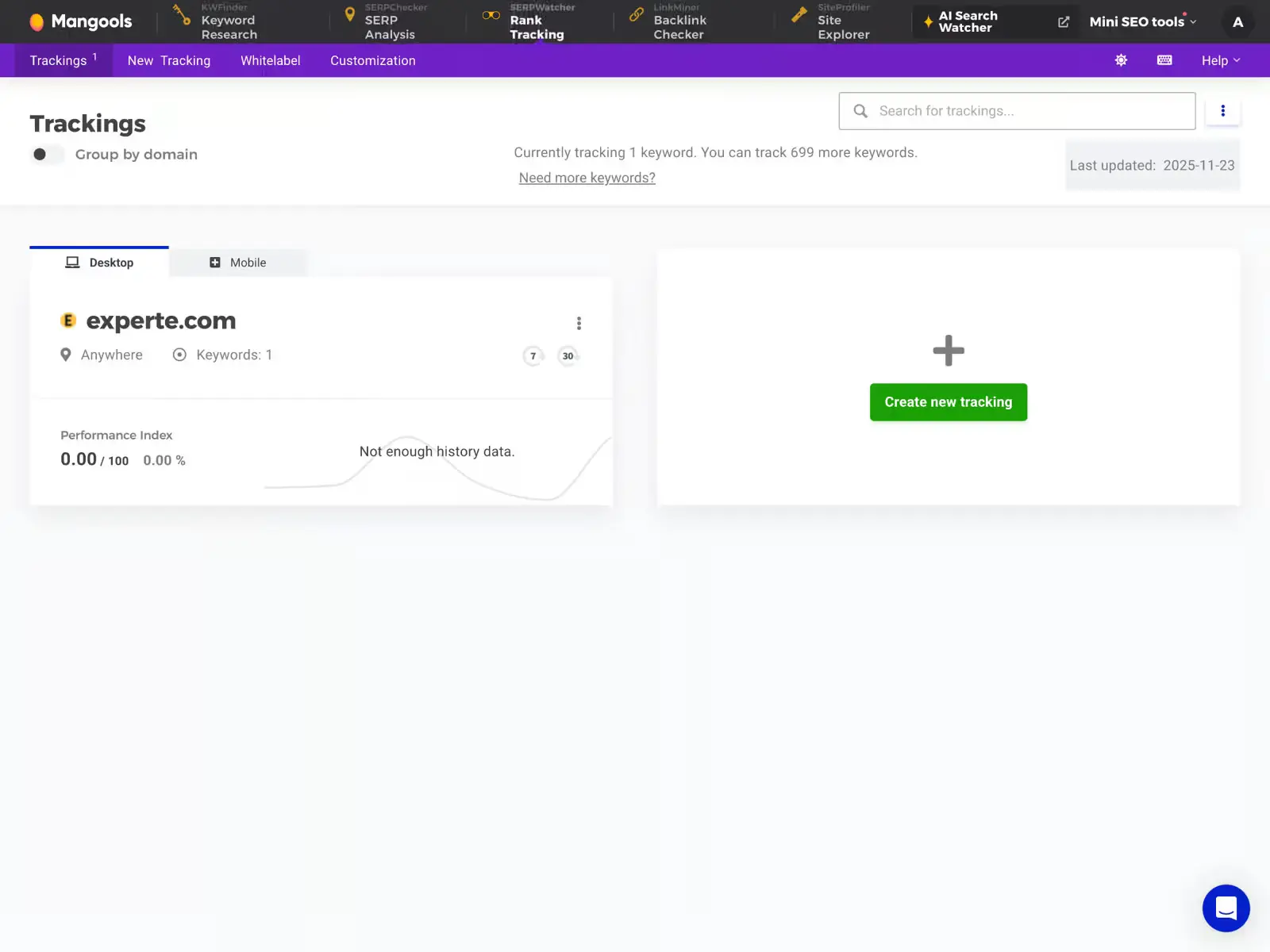
SERPWatcher can help you track:
- Keyword positions.
- Daily ranking changes.
- Desktop and mobile performance.
- Local ranking changes.
- Visibility trends.
- Keyword groups.
- Performance reports.
- Client or stakeholder updates.
Rank tracking matters because SEO takes time.
If you publish an article today, you may need weeks or months to understand how it performs. SERPWatcher gives you a clearer view of whether your pages are moving up, stuck, or declining.
A practical tracking workflow could look like this:
- Add target keywords after publishing.
- Group keywords by article or topic cluster.
- Monitor movement weekly.
- Identify pages stuck in positions 5–20.
- Refresh pages that stop improving.
- Improve internal links to important pages.
- Track rankings after updates.
- Repeat for future content.
SERPWatcher is not the most advanced rank tracker for large agencies, but it is clean and useful for small-to-mid-level SEO workflows.
🔗 LinkMiner: Backlink Analysis
LinkMiner is Mangools’ backlink analysis tool.
It helps you inspect backlinks for your site or competitors. You can use it to find backlink opportunities, check referring domains, review anchor text, and inspect link strength.
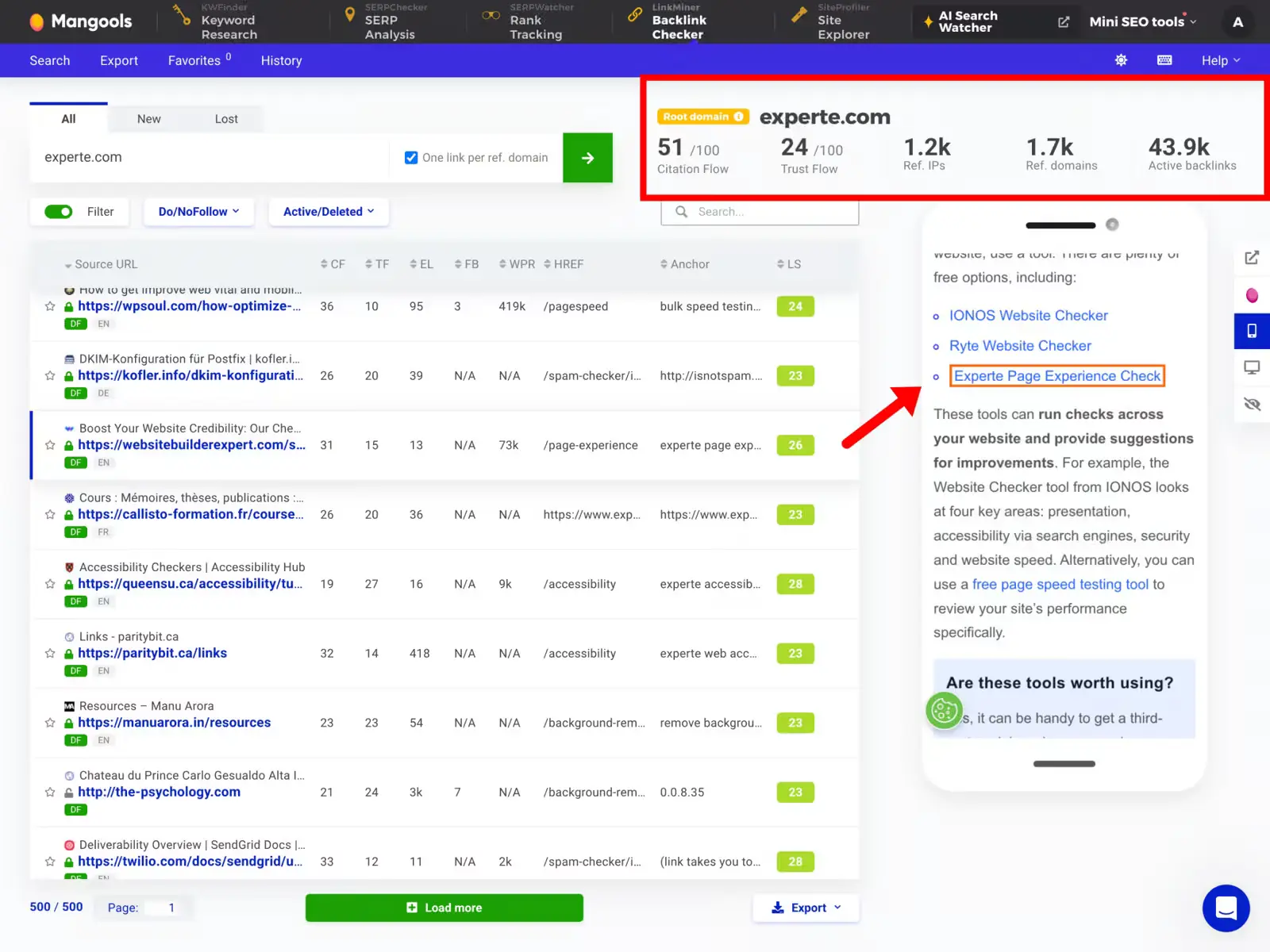
LinkMiner can help with:
- Competitor backlink research.
- Link opportunity discovery.
- Anchor text review.
- Referring to domain checks.
- Backlink quality evaluation.
- Outreach planning.
- Basic link profile analysis.
One practical feature is the ability to preview where a backlink appears on a page. This can make backlink analysis easier because you can quickly understand the context of a link.
However, LinkMiner is not as deep as Ahrefs for backlink research.
If backlinks are your main SEO strategy, Ahrefs is still stronger. But if you need basic backlink checks as part of an affordable SEO toolkit, LinkMiner is useful.
I would use LinkMiner to:
- Check where competitors are getting links.
- Save realistic link prospects.
- Find guest post or resource page opportunities.
- Review whether competitors have strong link advantages.
- Understand why some pages are harder to beat.
🏢 SiteProfiler: Website Metrics and Competitor Insights
SiteProfiler gives you a quick overview of a domain’s SEO strength.
It can help you review:
- Authority metrics.
- Backlink profile.
- Top content.
- Competitor websites.
- Popular pages.
- Link profile trends.
- Basic website-level SEO insights.
This is useful when you want a quick competitor snapshot.
For example, before targeting a keyword, you might check the top-ranking domains with SiteProfiler to understand whether they are small blogs, mid-sized brands, or large authority sites.
SiteProfiler is also useful for affiliate site owners and bloggers who want to analyze competing websites in their niche.
A practical SiteProfiler workflow could include:
- Enter a competitor domain.
- Review domain authority-style metrics.
- Check top-performing pages.
- Look at backlink growth.
- Identify content that attracts links.
- Find topic ideas from competitor strengths.
- Use KWFinder to research related keywords.
SiteProfiler is not a full competitive intelligence platform, but it is enough for quick SEO research.
🤖 AI Search Watcher
AI Search Watcher is a newer Mangools feature focused on AI search visibility.
This is important because SEO is no longer limited to traditional Google rankings. Brands now also care about whether they appear in AI-generated answers across systems like ChatGPT and other AI search experiences.
AI Search Watcher can help users think about:
- Brand visibility in AI search.
- AI answer monitoring.
- Search visibility beyond blue links.
- Early AI discovery signals.
- Whether a brand is being mentioned in AI-generated responses.
This is a useful direction for Mangools because many smaller businesses are starting to ask a new question:
“Do AI tools mention my brand when people ask about my category?”
AI visibility tracking is still a newer category, and I would not treat it as a replacement for traditional rank tracking. But it is a smart addition to the Mangools ecosystem.
🧰 Free Mini SEO Tools
Mangools also offers several free mini-tools that can be useful for quick SEO tasks.
These include tools like:
- SERP Simulator.
- SERP Location Changer.
- Reddit Threads Finder.
- AI Search Grader.
- SEO Content Optimizer.
- Share of Search.
- SERP Volatility Checker.
- Browser Extension.
These tools are useful because not every SEO task requires a full paid workflow.
For example:
- SERP Simulator helps preview the title and meta description appearance.
- SERP Location Changer helps check localized search results.
- Reddit Threads Finder can help discover community-driven search intent.
- AI Search Grader can provide quick AI visibility checks.
- A browser extension helps inspect metrics while browsing.
For beginners, these free tools are a good way to test Mangools before paying.
🔎 Mangools for SEO Content and Keyword Research
Mangools is especially strong for keyword research and SEO content planning.
It can help with:
- Finding low-competition keywords.
- Checking keyword difficulty.
- Discovering long-tail keywords.
- Reviewing SERP strength.
- Tracking rankings after publishing.
- Finding competitor keyword ideas.
- Checking backlink opportunities.
- Planning blog content.
- Supporting affiliate SEO.
- Supporting local keyword research.
However, Mangools does not replace:
- Advanced technical audits.
- Deep backlink research.
- Enterprise-level rank tracking.
- Content optimization scoring.
- AI writing tools.
- Topical authority planning.
- Advanced SEO automation.
- Conversion optimization.
The best way to use Mangools is inside a lean SEO workflow.
A practical workflow could look like this:
- Use KWFinder to find keyword ideas.
- Filter for relevance and realistic difficulty.
- Use SERPChecker to validate the SERP.
- Choose a keyword cluster for one article.
- Write or brief the content manually.
- Use an optimizer like NeuronWriter, Clearscope, or Surfer if needed.
- Publish the article.
- Track rankings in SERPWatcher.
- Use LinkMiner to find backlink opportunities.
- Refresh content based on ranking movement.
This is where Mangools becomes valuable.
It gives smaller teams the core data they need to make better SEO decisions without needing a very expensive tool stack.
💰 Mangools Pricing and Value
Mangools is priced as an affordable SEO toolkit compared with many major SEO platforms.
At the time of writing, Mangools’ official pricing page says plans start from $37.70 per month on annual billing, with plans for Basic, Premium, and Agency users.
Mangools’ plan positioning is generally:
| Plan | Best For | Practical Use |
|---|---|---|
| Basic | Solopreneurs, freelance SEOs, and marketers | Small sites, keyword research, basic tracking, and light backlink checks |
| Premium | Marketing teams and specialists | More usage capacity for active content and SEO workflows |
| Agency | Professional SEOs and agencies | Higher limits for client work, larger tracking needs, and broader research |
Prices may change over time, so always check the official Mangools pricing page before subscribing.
Here is how I would think about the value:
| User Type | Is Mangools Worth It? | Why |
|---|---|---|
| New blogger | Yes | Easy keyword research and simple SEO data |
| Affiliate site owner | Yes | Strong fit for long-tail keywords and niche research |
| SEO freelancer | Yes | Useful for affordable keyword and SERP analysis |
| Small agency | Maybe | Good for smaller clients, but may need deeper tools too |
| SaaS content team | Maybe | Useful for research, but may need content optimization and analytics tools |
| Enterprise SEO team | Usually no | Likely needs deeper data, automation, audits, and reporting |
Mangools becomes easier to justify if you need a simple and affordable SEO toolkit.
It is not trying to replace every advanced tool. It is trying to give practical SEO value at a more accessible price.
That makes it appealing for users who want to avoid paying hundreds of dollars per month for SEO software before their website is producing revenue.
📊 Real-World Evidence: Independent EXPERTE.com Benchmark
Mangools has many positive user reviews, but the most useful external evidence I found is not a “traffic growth case study.” It is an independent SEO tool benchmark from EXPERTE.com.
External source: EXPERTE.com independent Mangools review and SEO tool benchmark.
EXPERTE.com reviewed Mangools as a full SEO toolkit and tested part of its data quality by comparing SEO tool traffic estimates against real analytics data from Plausible.io. In that benchmark, Mangools achieved 51% traffic estimation accuracy across 30 test domains, placing it among the stronger tools in the comparison. (Expert)
That does not mean Mangools will automatically increase your traffic.
What it does suggest is that Mangools can provide useful competitive traffic estimates for SEO research, especially for bloggers, freelancers, affiliate marketers, and small businesses that need practical SEO data without paying for more advanced platforms.
The EXPERTE review also supports one of Mangools’ clearest strengths: ease of use. Mangools is not trying to be the deepest technical SEO platform. It is built to make keyword research, SERP analysis, rank tracking, backlink checks, and competitor research easier for users who do not want a complex enterprise SEO suite.
Here is the practical evidence summary:
| Evidence Point | What It Means for Mangools Users |
|---|---|
| Independent review source | The evidence does not come from Mangools’ own marketing page. |
| 30 test domains compared | The benchmark used multiple websites instead of one isolated example. |
| Real Plausible.io data used | The comparison was based on actual analytics data, not only SEO tool estimates. |
| 51% traffic estimation accuracy | Mangools’ traffic estimates appeared reasonably useful compared with other SEO tools. |
| Strong usability positioning | Mangools remains especially attractive for users who want simple SEO workflows. |
For Searchmora readers, the fair conclusion is this:
Mangools is not proven here as a tool that directly grows traffic by itself. But the independent benchmark supports the idea that Mangools can be a reliable research assistant for estimating competitor visibility, choosing keywords, validating SERPs, and making better SEO decisions.
A smart 30-day Mangools test would look like this:
- Use KWFinder to find 10 low-competition keywords.
- Validate each keyword manually with SERPChecker.
- Publish or update 5–10 articles.
- Add internal links to each article.
- Track target keywords in SERPWatcher.
- Review ranking movement after 30 days.
- Continue tracking for 60–90 days before making a final judgment.
The strongest way to use Mangools is not to expect instant rankings. Use it to make better keyword and SERP decisions, then let content quality, internal linking, and consistent updates do the real SEO work.
✅ Mangools Pros and Cons
✅ Pros
| Pro | Why It Matters |
|---|---|
| Very easy to use | Great for beginners, bloggers, freelancers, and small teams. |
| KWFinder is strong for keyword research | Useful for finding long-tail keywords and realistic content opportunities. |
| SERPChecker helps validate competition | Lets you check the actual Google results before trusting keyword difficulty. |
| SERPWatcher is simple for rank tracking | Helps monitor whether published content is moving up or losing visibility. |
| Let’s you check the actual Google results before trusting keyword difficulty. | Useful for checking competitor links without buying a premium backlink tool. |
| LinkMiner adds basic backlink research. | Helps users understand domain strength, top pages, and competitor authority. |
| More affordable than major SEO suites | A practical option before upgrading to Ahrefs, Semrush, or SE Ranking. |
| Good for local and long-tail SEO | Helpful for small businesses, niche sites, and affiliate blogs. |
| AI Search Watcher adds future-facing value | Useful as AI search visibility becomes more important. |
❌ Cons
| Con | Why It Matters |
|---|---|
| Not as deep as Ahrefs or Semrush | Advanced SEO teams may need larger databases and deeper competitive insights. |
| Tools like NeuronWriter, Surfer, or Clearscope are better suited for content scoring. | Backlink analysis is useful, but not deep enough for serious link-building teams. |
| No full technical SEO crawler | No premium content optimization and workflow |
| No premium content optimization and workflow | No premium content optimization andrkflow |
| Limited SEO automation | Search Atlas OTTO SEO and Alli AI are better for implementation at scale. |
| AI search tracking is still an emerging feature | Useful direction, but not yet a full GEO/AI visibility platform. |
| Not ideal for large agencies | Bigger teams may outgrow the reporting, limits, and workflow depth. |
The biggest mistake is comparing Mangools to Ahrefs or Semrush as if it were expected to match every advanced feature.
That is not the right frame.
Mangools is best understood as a clean, affordable SEO toolkit for people who need practical keyword research, SERP analysis, rank tracking, and basic competitor checks without enterprise-level complexity.
🧲 Mangools for Bloggers and Affiliate Site Owners
Mangools is a strong fit for bloggers and affiliate site owners.
Why?
Because these users often need to find realistic keywords before bigger competitors dominate them.
Mangools can help with:
- Long-tail keyword discovery.
- Affiliate review keyword research.
- Comparison keyword research.
- Buying guide planning.
- Informational support content.
- Local keyword ideas.
- SERP difficulty checks.
- Rank tracking after publishing.
I would use it if you need:
| Use Mangools If | Why |
|---|---|
| You are building a new niche site | KWFinder can help find easier long-tail keywords |
| You write affiliate reviews | SERPChecker helps validate competition |
| You publish supporting informational content | KWFinder helps find related ideas |
| You want to track ranking movement | SERPWatcher keeps monitoring simple |
| You need basic backlink insights | LinkMiner can show competitor link opportunities |
I would not use it if you need:
| Avoid Mangools If | Better Fit |
|---|---|
| Advanced affiliate SEO automation | Search Atlas OTTO SEO or Alli AI |
| Premium content optimization | NeuronWriter, Clearscope, or Surfer |
| Deep competitor backlink analysis | Ahrefs |
| Large-scale keyword clustering | WriterZen or Keyword Insights |
| Full SEO reporting for many clients | SE Ranking or Semrush |
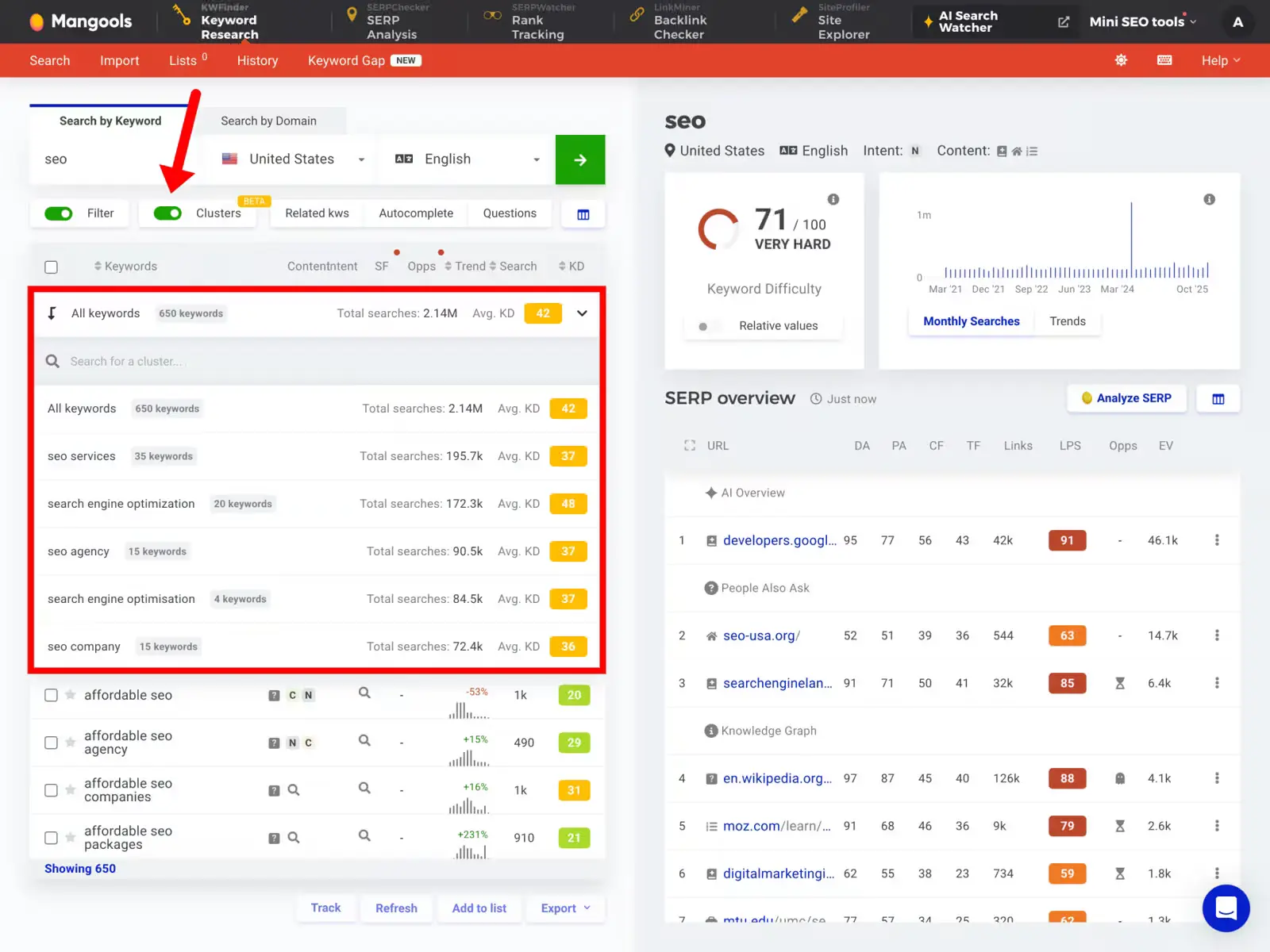
For affiliate SEO, Mangools is best at the planning stage.
It helps you find what to write about and how hard the SERP looks. But the final content still needs real product experience, screenshots, comparisons, and honest recommendations.
🧑💼 Mangools for Agencies and Freelancers
Mangools can be useful for freelancers and small agencies, especially if they serve smaller clients.
A freelancer can use Mangools to:
- Research keywords.
- Validate SERPs.
- Track rankings.
- Analyze competitor domains.
- Check basic backlinks.
- Build content plans.
- Prepare simple SEO reports.
A small agency can use it for:
- Client keyword research.
- Local SEO checks.
- Rank tracking.
- Competitor analysis.
- Light backlink research.
- Content planning.
I would use it if you need:
- Affordable SEO research for small clients.
- A simple tool that clients can understand.
- Keyword research without a steep learning curve.
- Rank tracking for important keywords.
- Local SERP checks.
I would not use it if you need:
- White-label agency reporting at scale.
- Advanced technical audits.
- Backlink outreach workflows.
- Large keyword databases.
- Enterprise SEO dashboards.
- SEO automation across client sites.
For agencies, Mangools is best for smaller workflows.
If you manage many clients, you may eventually need SE Ranking, Semrush, Ahrefs, or Search Atlas. But Mangools can still be a good lightweight tool for research and quick checks.
🏢 Mangools for Small Businesses and SaaS Teams
Mangools can help small businesses and SaaS teams that need simple SEO research without a large tool budget.
A small business can use Mangools to:
- Find service keywords.
- Check local keyword difficulty.
- Track important rankings.
- Analyze local competitors.
- Build blog content ideas.
- Review backlink opportunities.
- Improve title and meta descriptions using free tools.
A SaaS team can use Mangools for:
- Blog keyword research.
- Competitor keyword checks.
- Comparison page planning.
- Use-case content ideas.
- Rank tracking.
- SERP validation.
- Basic competitor authority checks.
I would use it if you need:
- A simple keyword research tool.
- Lower-cost SEO software.
- Local or long-tail keyword ideas.
- Easy rank tracking.
- Basic competitor analysis.
I would not use it if you need:
- Full product-led SEO strategy.
- Advanced content optimization.
- Technical SEO automation.
- Enterprise reporting.
- Deep backlink research.
- AI content creation.
For small businesses, Mangools is a sensible starting point.
It helps you make better SEO decisions without forcing you into a complicated and expensive platform too early.
🔁 Mangools Alternatives
Mangools is a strong, affordable SEO toolkit, but it is not the only option.
Here are the best alternatives depending on your main need:
| Alternative | Best For | Why Choose It Instead of Mangools |
|---|---|---|
| SE Ranking | Agency-friendly all-in-one SEO | Better for audits, reporting, client workflows, and broader SEO tracking |
| Semrush | Full SEO and marketing suite | Better for competitor research, PPC, content, audits, and reporting |
| Ahrefs | Backlink and competitor research | Better for link analysis, content gaps, and competitive SEO research |
| WriterZen | Keyword clustering and planning | Better if you need keyword grouping and content workflow planning |
| Keyword Insights | Keyword clustering at scale | Better for turning large keyword lists into content clusters |
| LowFruits | Low-competition keyword discovery | Better for finding weak SERPs and easy keyword opportunities |
| NeuronWriter | Budget content optimization | Better for improving and scoring article drafts |
| Ubersuggest | Beginner SEO and keyword ideas | Another accessible option for simple keyword research |
| Screaming Frog | Technical SEO crawling | Better for detailed site audits and technical diagnostics |
Mangools’ advantage is simplicity.
Its weakness is that specialist tools are stronger for advanced tasks. Choose Mangools if you want easy keyword research and practical SEO data. Choose a specialist tool if your main need is technical audits, content scoring, backlink research, automation, or keyword clustering at scale.
🧪 My Practical Mangools Workflow
If I were using Mangools for a Searchmora-style SEO project, I would use it mainly for keyword research, SERP validation, and ranking checks.
Start with KWFinder
First, I would enter a broad seed keyword.
For example:
- AI SEO tools.
- Keyword research tools.
- Content optimization tools.
- SEO tools for beginners.
- Affiliate SEO tools.
Then I would look for long-tail opportunities with realistic difficulty.
Validate the SERP with SERPChecker
Next, I would open SERPChecker and review the first page.
I would check:
- Are small sites ranking?
- Are results mostly blog posts?
- Are big brands dominating?
- Are there many SERP features?
- Is the content outdated?
- Can I create something better?
Build the Article Plan
After choosing the keyword, I would build an outline manually.
I would include:
- Search intent.
- Main angle.
- Required H2s.
- Related questions.
- Internal link targets.
- Suggested examples.
- Comparison tables.
- CTA direction.
Publish and Track with SERPWatcher
After publishing, I would add the target keyword to SERPWatcher.
Then I would monitor ranking movement weekly.
Use LinkMiner for Competitor Links
If the page is stuck, I would use LinkMiner to check whether competitors have stronger backlinks.
This can help decide whether the article needs:
- Better content.
- More internal links.
- External links.
- A stronger supporting cluster.
- A refresh.
- Better title and meta description.
Refresh Based on Results
After 60–90 days, I would review performance.
If rankings are weak, I would improve the page.
If rankings are close to page one, I would add internal links and improve content depth.
This workflow keeps Mangools practical.
It turns keyword data into action.
⚠️ Common Mistakes When Using Mangools
Trusting Keyword Difficulty Blindly
Keyword difficulty is useful, but it is not perfect.
Always check the SERP manually before choosing a keyword.
Choosing Keywords Only by Volume
High-volume keywords are not always better.
A low-volume keyword with strong buying intent may be more valuable.
Ignoring Search Intent
If the SERP wants a comparison page, do not publish a basic definition article.
Match the page format to the intent.
Using Mangools as a Full SEO Suite
Mangools is useful, but it does not replace every SEO tool.
You may still need content optimization, technical audits, backlink tools, and Google Search Console.
Not Tracking Rankings
Keyword research is only the beginning.
Use SERPWatcher to see whether your pages actually move.
Ignoring Internal Links
Mangools helps you choose keywords, but your site structure still matters.
Add internal links from relevant pages to support new content.
Expecting Instant Results
SEO takes time.
Use Mangools to improve decisions, then track performance over weeks and months.
❓ FAQ
1. Is Mangools good for SEO?
Yes, Mangools is good for keyword research, SERP analysis, rank tracking, basic backlink research, and competitor checks. It is especially useful for bloggers, freelancers, affiliate marketers, and small businesses that want a simple SEO toolkit.
2. What tools are included in Mangools?
Mangools includes KWFinder, SERPChecker, SERPWatcher, LinkMiner, SiteProfiler, AI Search Watcher, and several free mini-tools such as SERP Simulator, AI Search Grader, SEO Content Optimizer, Share of Search, SERP Location Changer, and the browser extension.
3. Is KWFinder good for keyword research?
Yes, KWFinder is one of Mangools’ strongest tools. It is useful for finding long-tail keywords, checking difficulty, reviewing search volume, and discovering related keyword ideas.
4. Is Mangools better than Ahrefs?
Mangools is easier to use and more affordable, but Ahrefs is stronger for backlink analysis, competitor research, keyword data, and advanced SEO workflows. Choose Mangools for simplicity and Ahrefs for depth.
5. Is Mangools better than Semrush?
Mangools is simpler and usually more affordable. Semrush is more powerful for all-in-one SEO, PPC research, audits, competitor analysis, reporting, and broader marketing workflows.
6. Is Mangools good for beginners?
Yes, Mangools is one of the more beginner-friendly SEO toolkits. Its interface is clean, and the tools are easier to understand than many enterprise-level platforms.
7. Is Mangools good for affiliate sites?
Yes, Mangools is useful for affiliate sites because KWFinder helps find long-tail keywords and SERPChecker helps validate competition before writing reviews, comparisons, and buying guides.
8. Does Mangools include rank tracking?
Yes, SERPWatcher is Mangools’ rank tracking tool. It helps users monitor keyword ranking changes over time.
9. Does Mangools guarantee rankings?
No. Mangools can help you make better SEO decisions, but rankings depend on content quality, search intent, authority, backlinks, technical SEO, internal links, competition, and freshness.
🏁 Final Verdict: Is Mangools Worth It?
Mangools is worth it for bloggers, affiliate marketers, freelancers, small businesses, and beginner-to-intermediate SEO users who want a simple and affordable SEO toolkit.
Its biggest strength is not that it has the most data.
Its biggest strength is that it makes useful SEO data easier to understand and act on.
KWFinder is the standout tool, SERPChecker helps validate competition, SERPWatcher gives simple rank tracking, LinkMiner supports basic backlink research, and SiteProfiler gives quick competitor insights. The addition of AI Search Watcher also makes Mangools more relevant as search expands beyond traditional Google rankings.
My final recommendation is simple:
Use Mangools if you want an affordable and easy SEO toolkit for keyword research, SERP analysis, and rank tracking.
Skip Mangools if you need enterprise SEO data, advanced backlink analysis, deep technical audits, large-scale automation, or premium content optimization.
For Searchmora readers, I would position Mangools as one of the best beginner-friendly SEO toolkits to recommend. It is especially attractive for bloggers, affiliate marketers, freelancers, and small businesses that want keyword research, SERP analysis, rank tracking, and basic backlink checks without paying for a heavy SEO platform too early.
The clearest takeaway is this: Mangools is not the deepest SEO tool, but it may be one of the easiest SEO toolkits to actually use consistently. For smaller websites, that simplicity can be more valuable than having advanced features they are not ready to use yet.
📚 Recommended Next Reads
To continue learning about SEO tools, keyword research, and content optimization, these published Searchmora guides are useful next reads:
- Best AI SEO Tools Tested This Year.
A broader guide to AI SEO tools for keyword research, content optimization, automation, and AI visibility. - WriterZen Review: Is This SEO Content Workflow Tool Worth It?
Useful if you want stronger keyword clustering and content planning before writing. - NeuronWriter Review: Is This Budget-Friendly SEO Content Optimizer Worth It?
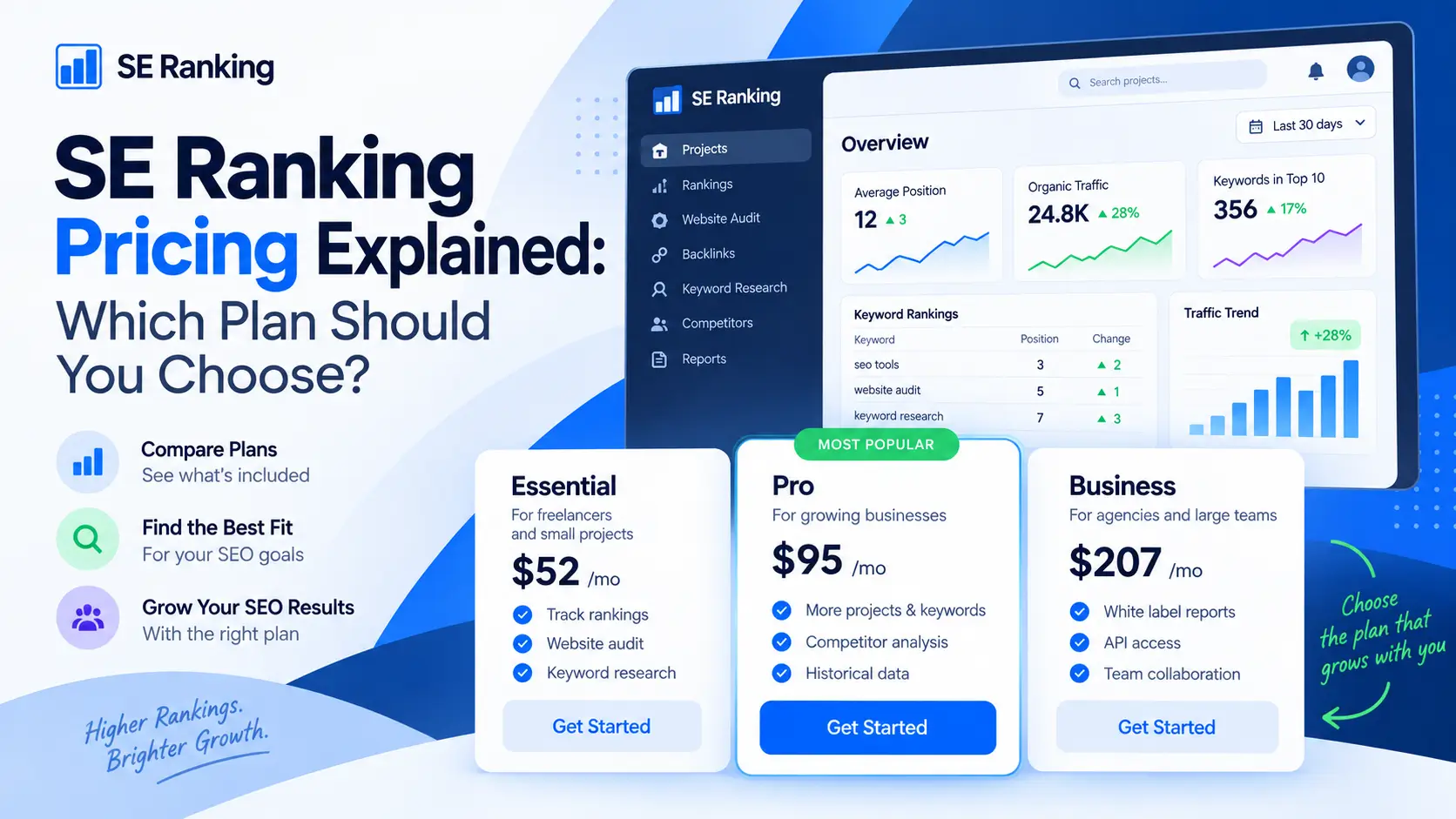
A strong next step if you want to optimize articles after finding keywords in Mangools. - SE Ranking Review
Helpful if you want a broader agency-friendly SEO platform with audits, reporting, rank tracking, and competitor research. - Best Alternatives to Surfer for SEO Content
Useful if you want to compare content optimization tools after choosing keywords.


Comments 4