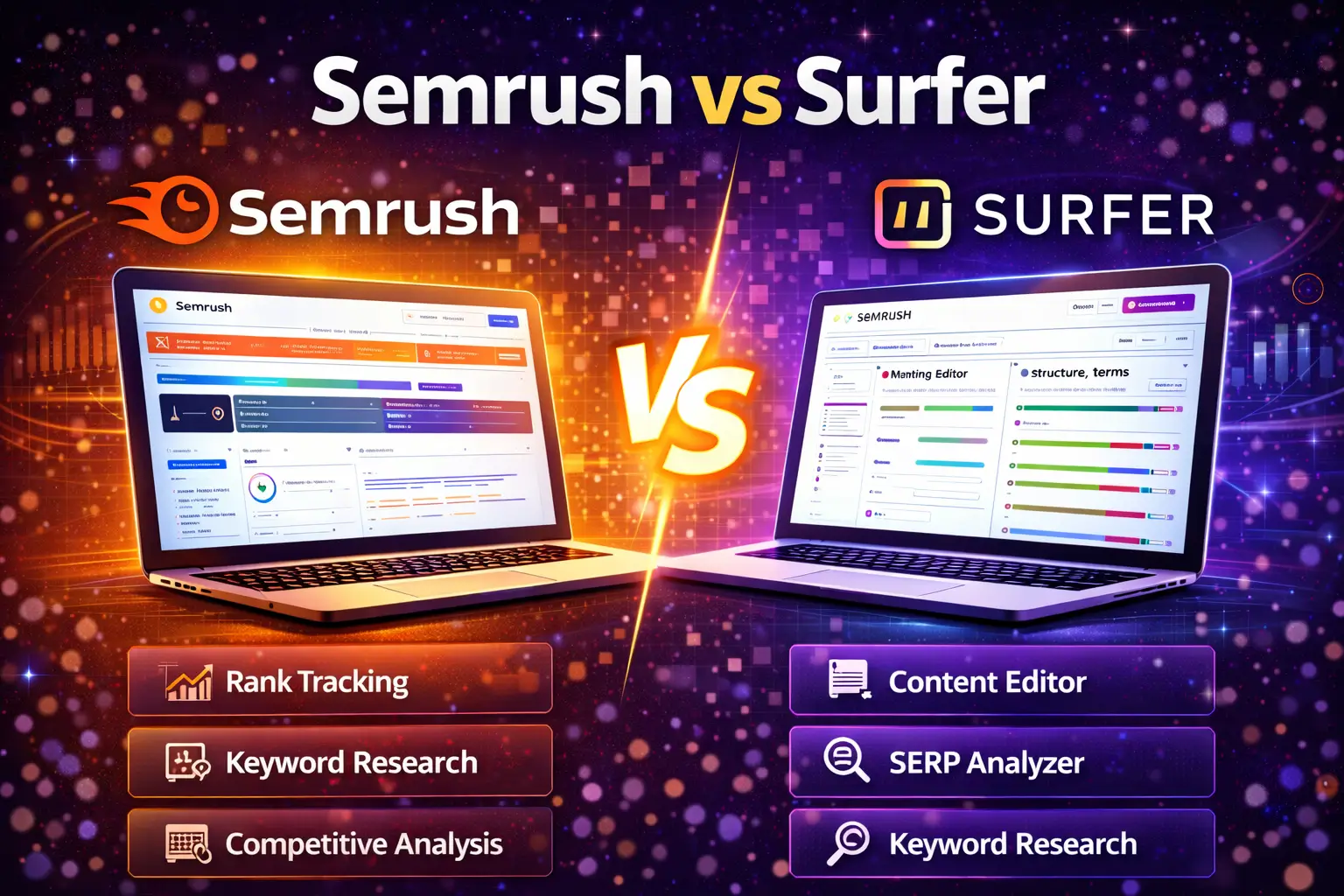
Semrush vs Surfer
📌 In This Guide
- What Semrush vs Surfer really means
- Why the difference matters
- The positioning of each tool
- The AI battle: Surfer AI vs ContentShake
- Entity density and NLP analysis
- AI visibility tracking
- Topic clusters and content planning
- ROI and startup budget decisions
- On-page vs off-page strength
- The integration workflow
- Data quality in competitive English-language markets
- Deal breakers
- Semrush vs Surfer FAQ
- Final thoughts
Introduction
The clearest difference between Semrush and Surfer is this: Semrush is the database giant for research and strategy, while Surfer is the content scalpel for turning one article into a stronger ranking candidate. That is the core decision.
Many people compare these tools as if they do the same job.
They do not.
Semrush is built for search research, competitive intelligence, backlinks, keyword discovery, and broader AI visibility tracking. Surfer is built to help you shape, optimize, and improve content at the page level.
If you choose the wrong one, you usually waste money.
If you choose the right one, or combine both the right way, your workflow gets much stronger.
🔍 What Semrush vs Surfer Really Means
A lot of comparison articles ask the wrong question.
The better question is not:
Which tool is better overall?
The better question is:
Which job do you actually need solved first?
Direct answer
Semrush is better for research, planning, off-page analysis, and AI visibility tracking. Surfer is better for content optimization, page-level structure, and turning drafts into stronger search assets.
That is the cleanest way to understand Semrush vs Surfer SEO.
If your biggest problem is:
- finding opportunities
- researching a niche
- analyzing backlinks
- tracking AI visibility
Semrush usually makes more sense.
If your biggest problem is:
- improving one article
- optimizing structure
- increasing topic coverage
- making content more extraction-friendly
Surfer usually makes more sense.
🚀 Why the Difference Matters
The most effective way to compare Semrush and Surfer is to understand the outcome each one is built to produce.
Semrush helps you answer:
- What should we target?
- What is the market doing?
- Which competitors are winning?
- Where are the backlink gaps?
- Are we showing up in AI visibility reports?
Surfer helps you answer:
- How do we make this article stronger?
- Which subtopics are missing?
- How should this page be structured?
- How do we improve content depth and entity coverage?
- How do we make the page easier to summarize and reuse?
The clearest strategic difference
Semrush is a strategy and intelligence platform. Surfer is an execution and optimization platform.
That is why they feel so different in daily use.
🧭 The Positioning of Each Tool
Semrush: The Database Giant
Semrush feels like the database giant.
Its strength is not elegance at the article level.
Its strength is breadth.
It is built to help teams:
- research keywords
- map competitors
- analyze backlinks
- explore market opportunities
- Monitor AI visibility
- connect SEO to a wider marketing workflow
If you want to understand a niche before writing anything, Semrush usually gives you more context.
Surfer: The Content Scalpel
Surfer feels like the content scalpel.
Its strength is not market breadth.
Its strength is page precision.
It is built to help teams:
- analyze live SERPs
- Optimize a page against ranking patterns
- improve structure
- increase NLP-style topical coverage
- refine content into something more competitive
If you already know the topic and want to make one article better, Surfer usually feels sharper.
Comparison table: Positioning
| Positioning question | Semrush | Surfer |
|---|---|---|
| Core identity | The database giant | The content scalpel |
| Main strength | Research and strategic breadth | Page-level optimization |
| Best used for | Planning, auditing, tracking, backlinks | Writing, optimizing, refreshing content |
| Best team fit | Agencies, broader SEO teams, multi-tool workflows | Content teams, editors, niche site operators |
| Best outcome | Better decisions before publishing | Better execution after deciding what to publish |
🤖 The AI Battle: Surfer AI vs ContentShake
This is one of the most practical comparisons.
Semrush has ContentShake, while Surfer has Surfer AI.
Both help with AI-assisted writing, but they do not feel the same.
Surfer AI
Surfer AI feels more tied to content structure and optimization.
It works best when your goal is:
- writing a search-focused draft
- improving topical coverage
- aligning with page-level optimization logic
- making content more extraction-friendly
It tends to feel closer to the optimization workflow.
ContentShake
ContentShake feels more like a content ideation and drafting assistant connected to Semrush’s broader research environment.
It works best when your goal is:
- turning keyword and audience insight into ideas
- moving from topic discovery to draft faster
- building content around larger SEO workflows
It tends to feel more strategic at the front end.
Which one feels more human?
There is no universal winner here.
The most effective answer is this:
The tool that feels more human after editing is usually the one that gave you the better structure before writing.
In practice:
- Surfer AI often feels stronger for an SEO-shaped structure
- ContentShake often feels stronger for ideation plus workflow speed
Which one is better for entity inclusion?
Surfer usually has the clearer advantage here.
That is because its optimization environment is more tightly centered on page-level coverage and structural completeness.
If your goal is to build a page that becomes more citeable in AI Overviews or answer engines, Surfer often feels more useful at the article level.
Comparison table: Surfer AI vs ContentShake
| Comparison point | Surfer AI | ContentShake |
|---|---|---|
| Best use case | Turn one article into a stronger ranking candidate | Move from topic discovery to draft faster |
| Main strength | Optimization-shaped draft creation | Research-connected content ideation |
| Better for entities | Usually stronger | Good, but less surgical |
| Better for structure | Usually stronger | Good for speed and workflow |
| Better for content planning | Moderate | Usually better when paired with Semrush research |
| Best fit | Writers and content optimizers | SEO teams that want drafting inside a broader system |
🧠 Entity Density and NLP Analysis
This is where Surfer has had a strong historical advantage.
Surfer has built much of its reputation around helping users analyze the live top-ranking SERP and improve topical coverage at the page level.
That matters because AI SEO increasingly rewards:
- entity clarity
- context completeness
- extraction-friendly content
- structured coverage of subtopics
Why entity density matters
Entity density is not about stuffing terms.
It is about making sure your page clearly covers:
- the main concept
- the related concepts
- the practical subtopics
- the supporting context
That is what makes a page feel complete.
Why Surfer often feels stronger here
Surfer is better known for helping users engineer a page around what top-ranking pages are already covering.
The most effective way to describe it is this:
Semrush helps you find the battle. Surfer helps you sharpen the weapon.
If you want to make a page more like a citation magnet for AI systems, Surfer often feels more useful because it pushes you toward:
- stronger structure
- better entity-based SEO
- more complete subtopic handling
- cleaner on-page depth
Comparison table: NLP and entity density
| Question | Semrush | Surfer |
|---|---|---|
| Better for large-scale topic discovery | Yes | Moderate |
| Better for page-level entity density | Moderate | Strong |
| Better for live SERP-based article shaping | Moderate | Strong |
| Better for “citation magnet” page engineering | Good | Usually stronger |
| Better for broad research before writing | Strong | Moderate |
📈 AI Visibility Tracking
This is where Semrush clearly pulls ahead.
Surfer helps you improve a page so it has a better chance of appearing in AI-driven answer environments.
Semrush helps you measure whether that actually happened.
That is a huge difference.
Why this matters
The clearest way to think about it is simple:
- Surfer helps you optimize for AI visibility
- Semrush helps you verify AI visibility
If you care about:
- AI Overviews
- AI mentions
- answer-layer visibility
- brand presence across prompts
- share of the answer
Semrush is much stronger.
Comparison table: AI visibility role
| AI visibility task | Semrush | Surfer |
|---|---|---|
| Track AI mentions | Strong | Limited |
| Track AI visibility trends | Strong | Limited |
| Improve content structure for AI reuse | Good | Strong |
| Optimize a single page for AI-friendly formatting | Moderate | Strong |
| Measure whether you actually appear in AI answers | Strong | Weak |
This is why Semrush is often the better choice if the question is:
How do I know whether we are showing up in AI search at all?
🧩 Topic Clusters and Content Planning
Both tools can support topic clusters, but they do it differently.
Semrush and topic research
Semrush is usually stronger at the research layer.
It helps you:
- Discover keyword clusters
- understand subtopics
- map competitors
- explore related opportunities
- Plan a niche more broadly
This makes it better for drawing the map.
Surfer and content planning
Surfer is more useful once the cluster already exists and you want to optimize content inside it.
It helps you:
- Sharpen a topic page
- improve structure
- refine supporting pages
- make cluster pages more complete
Which one is better for topical authority?
The clearest answer is:
Semrush is usually better for planning topical authority. Surfer is usually better for improving the pages that build it.
Comparison table: Topic clusters
| Topic cluster task | Semrush | Surfer |
|---|---|---|
| Discover a new niche map | Strong | Moderate |
| Find related keyword opportunities | Strong | Moderate |
| Build one better cluster page | Good | Strong |
| Improve article-level cluster support | Moderate | Strong |
| Build a better cluster page | Strong | Moderate |
💸 ROI and the Smart Budget Question
This is the question many startups and small teams actually care about:
If you only have $150, should you buy Semrush for research or Surfer for content quality?
The answer depends on your bottleneck.
Buy Semrush first if:
- You do not yet know what to target
- Your niche map is weak
- You need competitor research
- You need backlink data
- You want AI visibility tracking
- Your content strategy is still fuzzy.
Buy Surfer first if:
- You already know the topics
- Your content exists, but underperforms
- Your main problem is page quality
- You need stronger on-page optimization
- You want to improve the article structure fast
The clearest ROI takeaway
If your biggest problem is not knowing what to write, buy Semrush first. If your biggest problem is that your existing content is weak, buy Surfer first.
That is the smart-budget answer.
🔗 On-Page vs Off-Page Strength
This is another core difference.
Surfer is heavily on-page.
Semrush covers both on-page and off-page much better.
Why this matters
You can build the best page in the world with Surfer and still struggle if:
- competitors have stronger links
- Your domain lacks authority
- Your backlink profile is weak
- The niche is highly competitive
That is where Semrush matters more.
Comparison table: On-page vs off-page
| SEO layer | Semrush | Surfer |
|---|---|---|
| Keyword research | Strong | Moderate |
| Backlink analysis | Strong | Weak |
| Competitive domain analysis | Strong | Weak |
| Page structure optimization | Good | Strong |
| On-page content shaping | Good | Strong |
| Off-page SEO decision support | Strong | Weak |
The biggest mistake is thinking Surfer can replace backlink intelligence.
It cannot.
🛠️ The Integration Workflow
This is how professionals often use the two tools together.
Step 1: Use Semrush for discovery
Start with:
- keyword research
- competitor analysis
- backlink analysis
- cluster mapping
- opportunity selection
Step 2: Move the chosen page into Surfer
Then use Surfer for:
- content shaping
- entity coverage
- structure improvement
- on-page completeness
- refresh workflows
Step 3: Track outcomes back in Semrush
Then go back to Semrush for:
- visibility monitoring
- position tracking
- AI visibility review
- backlink gap analysis
- next-round opportunity decisions
The clearest professional takeaway
The most effective workflow is often Semrush for strategy, Surfer for execution, and Semrush again for verification.
That is a strong professional setup.
🌍 Data Quality in Competitive English-Language Markets
If your target market is English-speaking, the comparison becomes much clearer.
Semrush in English-language markets
Semrush is stronger when you need broad market visibility across competitive English-language niches.
It is especially useful for:
- large keyword datasets
- competitor mapping
- backlink intelligence
- topic discovery at scale
- multi-country research across the US, UK, Canada, and Australia
This makes Semrush the stronger choice when your main goal is strategic coverage across a wide SEO landscape.
Surfer in English-language markets
Surfer is stronger when the target keyword is already chosen, and your next goal is to improve one page to compete in a live SERP.
It is especially useful for:
- optimizing article structure
- improving entity coverage
- aligning content with top-ranking pages
- making content more extraction-friendly
- tightening one page until it becomes more competitive
This makes Surfer the stronger choice when your main challenge is execution, not discovery.
Practical takeaway
The clearest way to think about this in competitive English-language markets is:
- Semrush is stronger for market-wide SEO research and competitive intelligence
- Surfer is stronger for page-level optimization in already-defined target markets
⚠️ The Deal Breakers
A strong comparison needs honesty.
Surfer deal breakers
- Credits and scaling costs can become painful for high-volume teams
- It is not a backlink tool
- It does not replace broad research or full SEO reporting
- It can encourage over-optimization if used blindly
Semrush deal breakers
- The interface can feel heavy and complex
- Many teams pay for more breadth than they actually use
- It can be overwhelming for founders or solo users
- It is not as sharp as Surfer for article-by-article optimization
The clearest honesty point
Surfer’s biggest weakness is scale cost and limited off-page depth. Semrush’s biggest weakness is complexity and the risk of paying for features you may not use.
🎯 Featured Snippet and AI Citation Potential
This is where Surfer becomes very attractive.
Its structural guidance helps make content easier to:
- scan
- summarize
- compare
- reuse
That matters for:
- featured snippets
- answer boxes
- AI summaries
- RAG-style retrieval environments
Why Surfer helps here
The clearest advantage of Surfer is that it pushes writers toward:
- clearer structure
- tighter heading logic
- stronger entity density
- more extraction-friendly content
- better comparison flow
That makes a page easier for humans to read and easier for machines to summarize.
But Semrush still matters here
Semrush helps answer the second question:
Did the page actually gain visibility after those changes?
That is why the strongest answer is not always one or the other.
Sometimes the best answer is both.
❓ Semrush vs Surfer FAQ
1. Is Semrush better than Surfer?
Not overall. Semrush is better for research, backlinks, and AI visibility tracking. Surfer is better for content optimization.
2. Which is better for AI SEO?
Semrush is better for tracking AI visibility. Surfer is better for making a page more extraction-friendly and citation-ready.
3. Which tool should a startup buy first?
If the startup does not know what to target, Semrush usually makes more sense. If the startup already has content and needs better page quality, Surfer usually makes more sense.
4. Is Surfer enough on its own?
It can be enough for content optimization, but it is usually not enough for a full SEO strategy because it does not replace backlinks or broad research tools.
5. Is Semrush enough on its own?
For many teams, yes. But teams that care deeply about article-level optimization may still want something sharper like Surfer.
6. Which is better for topic clusters?
Semrush is better for planning the cluster. Surfer is better for refining the pages inside it.
7. Which is better for featured snippets and AI summaries?
Surfer usually helps more at the page level because of structure and content shaping.
8. Which is better in competitive English-language markets?
Semrush is stronger for broader keyword and market research. Surfer is stronger for live SERP-based page optimization once the target is clear.
🧠 Final Thoughts
The clearest way to think about Semrush vs Surfer is this:
Semrush tells you what matters. Surfer helps you execute on it.
If your main need is:
- research
- backlinks
- AI visibility tracking
- market intelligence
- topic discovery
Choose Semrush.
If your main need is:
- article optimization
- entity density
- extraction-friendly content
- page structure
- on-page improvement
Choose Surfer.
If you can afford both, the smartest workflow is often:
- Semrush for research
- Surfer for optimization
- Semrush for tracking and validation
That is the strongest long-term setup.
Recommended Next Reads
- Semrush Review. (New Review)
- Surfer SEO Review
- AI SEO vs Traditional SEO
- How to Track AI Visibility
- How to Get Cited by AI
🚀 CTA
If your workflow is weak at the strategy layer, start with Semrush. If your workflow is weak at the page layer, start with Surfer. If you want the strongest setup, use both in sequence.


Comments 4