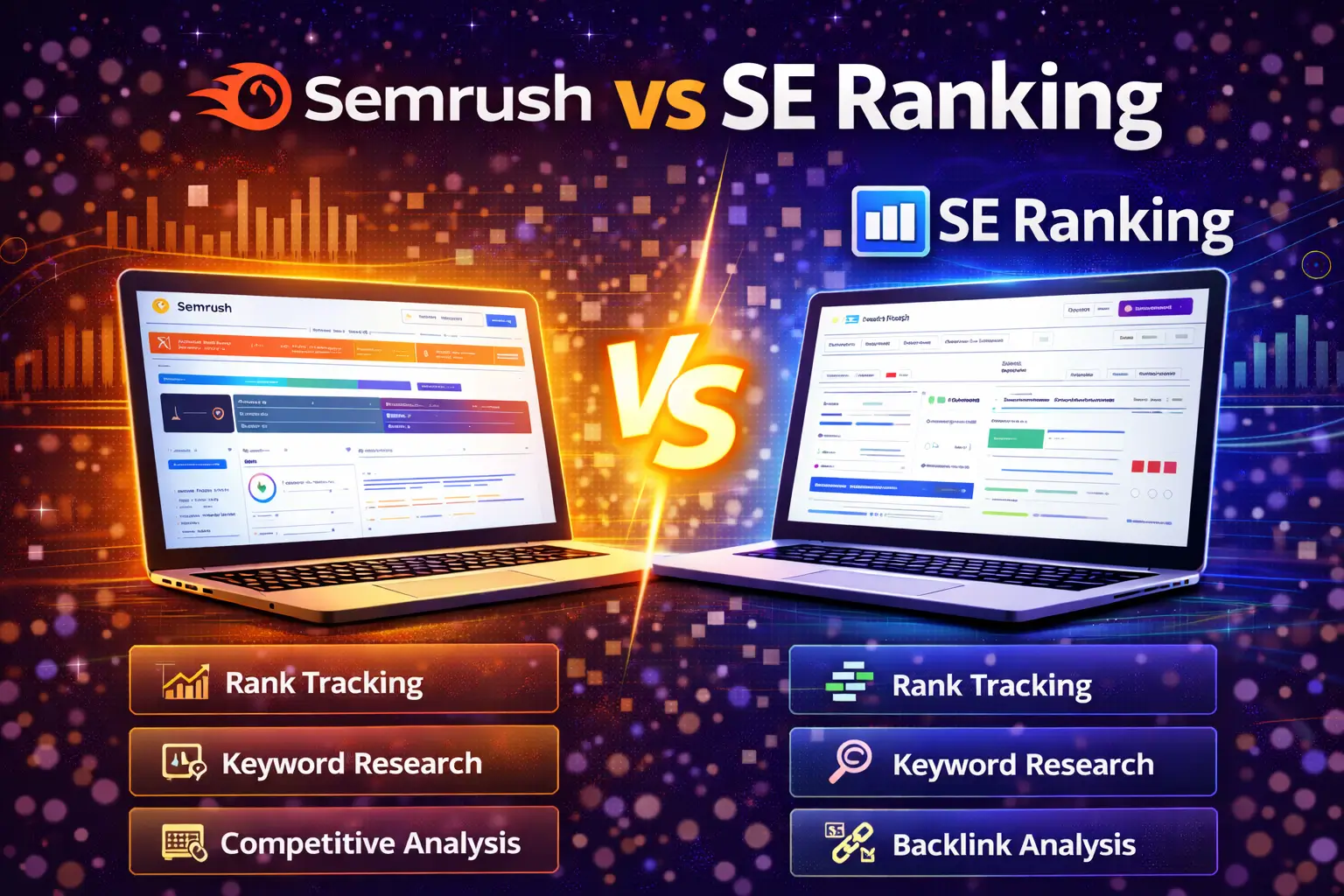
Semrush vs SE Ranking
📌 In This Guide
- What Semrush vs SE Ranking really means
- Why the difference matters
- Framing the audience for each tool
- The AI tracking war
- Pricing and ROI
- Ease of use and learning curve
- Backlink database depth
- Reporting for clients
- Topic research and topical authority
- Historical SERP and audit depth
- Integrations and workflow
- Support and day-to-day usability
- Social media and extra toolkits
- Negative SEO and risk monitoring
- The final decision flow
- Semrush vs SE Ranking FAQ
- Final thoughts
Introduction
The clearest difference between Semrush and SE Ranking is this: Semrush is the integrated giant for broader SEO intelligence, while SE Ranking is the smart alternative built for leaner teams that want strong core SEO workflows without the heavier platform overhead. That is the real comparison.
Many buyers still reduce this decision to price.
That is too shallow.
The better question in 2026 is:
Which platform gives me the right depth of data, the right workflow, and the right AI-era visibility tools for the kind of business I actually run?
That is what this comparison answers.
🔍 What Semrush vs SE Ranking Really Means
This is not just a comparison between two SEO tools.
It is a comparison between two different operating models.
Direct answer
Semrush is better for broader research, competitive intelligence, off-page analysis, and enterprise-style marketing workflows. SE Ranking is better for leaner SEO teams that want strong day-to-day execution, easier onboarding, and better ROI on core SEO tasks.
That is the simplest way to think about Semrush or SE Ranking.
If your biggest problem is:
- large-scale research
- competitor intelligence
- backlink depth
- AI visibility tracking
- multi-team marketing workflows
Semrush usually makes more sense.
If your biggest problem is:
- daily rank tracking
- agency reporting
- project execution
- usability
- budget efficiency
SE Ranking usually makes more sense.
🚀 Why the Difference Matters
The most effective way to compare these tools is not to ask which one has more features.
The better question is:
Which one fits the way your team actually works?
This matters because SEO software is not judged only by feature count.
It is judged by:
- data quality
- speed of execution
- reporting clarity
- AI-era relevance
- learning curve
- return on investment
The clearest strategic difference
Semrush is built for breadth. SE Ranking is built for balance.
That is why the decision often comes down to company type more than feature lists.
🧭 Framing the Audience for Each Tool
This is one of the most important parts of the article.
These tools are not aimed at exactly the same buyer.
Semrush: The Enterprise-Leaning Platform
Semrush feels more natural for:
- larger agencies
- marketing departments
- in-house SEO teams at bigger brands
- companies that need multiple tool layers in one ecosystem
It is the better fit when you need:
- broad competitive research
- deeper backlink analysis
- AI visibility tracking
- content, SEO, and social workflows inside one system
- more cross-functional marketing coverage
SE Ranking: The Smart Alternative
SE Ranking feels more natural for:
- growing agencies
- freelancers
- niche site owners
- consultants
- lean in-house teams
It is the better fit when you need:
- daily SEO operations
- strong rank tracking
- practical reporting
- simpler workflows
- lower operational friction
Comparison table: Audience fit
| Audience question | Semrush | SE Ranking |
|---|---|---|
| Best for | Broader teams and enterprise-style workflows | Lean agencies, consultants, and niche operators |
| Core appeal | Breadth and data scale | Balance, usability, and ROI |
| Better for | Large strategic SEO environments | Fast execution and practical SEO operations |
| Best team size | Medium to large | Solo to mid-sized |
| Buying logic | Pay more for broader ecosystem | Pay smarter for core workflow value |
🤖 The AI Tracking War
This is where the comparison becomes very modern.
Both tools now understand that search is no longer limited to traditional rankings.
Semrush and AI visibility
Semrush is stronger when your goal is:
- broader AI visibility tracking
- competitor comparison in AI search
- prompt-level AI presence analysis
- answer-layer visibility monitoring
It feels deeper and more analytical.
The clearest strength of Semrush here is that it helps you understand not only whether you show up, but how your visibility compares with competitors across AI-driven discovery environments.
SE Ranking and AIO tracking
SE Ranking is compelling because it makes AI search monitoring feel more approachable.
It is easier to understand quickly, and its AI tracking experience feels more operational and less overwhelming.
The clearest strength of SE Ranking here is simplicity.
It helps you move from:
- “What is this feature?”
to - “Okay, I can actually use this today.”
Which one is easier?
SE Ranking usually feels easier to use. Semrush usually feels deeper to analyze.
That is the real AI tracking tradeoff.
Comparison table: AI tracking
| AI tracking task | Semrush | SE Ranking |
|---|---|---|
| Depth of AI visibility analysis | Stronger | Good |
| Simplicity of use | Moderate | Stronger |
| Competitor AI comparison | Stronger | Good |
| First-time usability | Moderate | Stronger |
| Best fit | Teams that want deeper insights | Teams that want faster adoption |
💰 Pricing and ROI
This is one of the biggest reasons buyers compare these tools.
But the right pricing conversation is not:
Which one is cheaper?
The better question is:
Which one gives me more useful output for the kind of SEO work I actually do?
Pricing note
Prices and plans may change over time. Always check the official website for the latest details.
The real pricing difference
Semrush usually asks you to pay for broader ecosystem value.
SE Ranking usually asks you to pay for practical core SEO value.
That is why this comparison is really about ROI, not raw cost.
ROI comparison table
| ROI question | Semrush | SE Ranking |
|---|---|---|
| Better for broad marketing value | Strong | Moderate |
| Better for SEO-specific value per dollar | Moderate | Strong |
| Better for lean agency budgets | Moderate | Strong |
| Better for large-team ecosystem needs | Strong | Moderate |
| Better for straightforward core SEO workflows | Good | Strong |
The clearest ROI takeaway
Semrush usually wins on platform breadth. SE Ranking often wins on cost-to-workflow efficiency.
That is why SE Ranking becomes very attractive for smaller agencies and freelancers.
🖥️ Ease of Use and Learning Curve
This section matters more than people admit.
A powerful tool with a heavy interface can still slow a team down.
Semrush user experience
Semrush often feels:
- powerful
- broad
- data-rich
- intimidating for beginners
- heavier at first use
That is not a flaw by itself.
But it does mean the learning curve is real.
SE Ranking user experience
SE Ranking often feels:
- cleaner
- more intuitive
- easier to adopt quickly
- more beginner-friendly
- more operationally focused
The clearest difference is simple:
Semrush feels like a command center. SE Ranking feels like a practical workstation.
Comparison table: Learning curve
| UX question | Semrush | SE Ranking |
|---|---|---|
| Easier for beginners | Moderate | Strong |
| Better for fast onboarding | Moderate | Strong |
| Better for advanced users who want breadth | Strong | Good |
| Lower training friction | Moderate | Strong |
| Better for “start working in minutes” | Moderate | Strong |
🔗 Backlink Database Depth
This is one area where honesty matters.
Semrush is stronger here.
The clearest reason is that broader platforms with heavier backlink investment tend to give deeper off-page visibility, especially for larger sites and more competitive link environments.
Where Semrush is stronger
Semrush is better for:
- deeper backlink discovery
- broader off-page competitive analysis
- toxic link workflows
- more advanced link-level intelligence
Where SE Ranking is still useful
SE Ranking is still useful for:
- practical backlink monitoring
- medium-scale link research
- day-to-day SEO operations
- agencies that do not need the deepest possible off-page dataset
The clearest backlink takeaway
Semrush is usually the better choice if backlink depth is central to your strategy. SE Ranking is often enough if backlink analysis is important but not your main bottleneck.
📊 Reporting for Clients
This is a major decision point for agencies.
Semrush reporting
Semrush reporting is strong, especially when the client relationship needs:
- broader marketing dashboards
- more complex reporting layers
- integration with a wider tool stack
SE Ranking reporting
SE Ranking has a strong reputation for client-friendly reporting because it feels:
- cleaner
- easier to customize
- easier to brand
- more intuitive for white-label workflows
The clearest advantage of SE Ranking here is presentation plus usability.
Comparison table: Reporting for agencies
| Reporting question | Semrush | SE Ranking |
|---|---|---|
| White-label friendliness | Good | Strong |
| Ease of customization | Good | Strong |
| Better for broader dashboards | Strong | Moderate |
| Better for agency-style recurring reports | Good | Strong |
| Better for visually clean client reports | Good | Strong |
🧩 Topic Research and Topical Authority
This matters because modern SEO is no longer about one isolated page.
It is about niche coverage.
Semrush and topic research
Semrush is stronger when you want:
- broader topic mapping
- competitor-led niche discovery
- keyword expansion at scale
- larger strategic planning
That makes it better for drawing the map.
SE Ranking and topic execution
SE Ranking is useful when you already understand the niche and want to:
- execute faster
- manage projects more simply
- keep content and rank workflows connected
The clearest topical authority takeaway
Semrush is usually better for building the map of the niche. SE Ranking is usually better for operating inside that map without heavy platform friction.
🕰️ Historical SERP and Technical Audit Depth
This section matters most for advanced SEOs.
Semrush and historical depth
Semrush is more compelling when the goal is:
- understanding SERP change over time
- reviewing competitive movement historically
- analyzing patterns after large updates
- doing deeper professional diagnosis
That kind of historical view is more valuable to analysts and experienced SEOs than to beginners.
Technical audit comparison
Semrush often feels deeper in explanation.
SE Ranking often feels faster and more approachable.
Comparison table: Audit and historical depth
| Technical question | Semrush | SE Ranking |
|---|---|---|
| Deeper analysis | Strong | Good |
| Faster practical use | Good | Strong |
| Better for advanced diagnosis | Strong | Moderate |
| Better for simpler daily audits | Good | Strong |
| Better for experienced SEO analysts | Strong | Good |
🔌 Integrations and Workflow
Integrations matter because SEO does not happen in isolation.
Semrush workflow
Semrush is stronger when you want connections to:
- broader marketing workflows
- Looker Studio-style reporting environments
- cross-channel operations
- a wider business stack
SE Ranking workflow
SE Ranking is stronger when the goal is:
- simpler SEO execution
- less setup friction
- faster client workflow adoption
- practical agency operations
The clearest workflow takeaway
Semrush is better for broader integration depth. SE Ranking is better for simpler operational flow.
🤝 Support and Day-to-Day Usability
This is harder to measure than features, but it matters.
The clearest practical difference is not necessarily “better support” in the abstract.
It is how easy the platform makes daily work feel.
Semrush in daily use
Semrush can feel heavier because:
- there is more to learn
- there are more reports
- there is more platform depth
SE Ranking in daily use
SE Ranking often feels easier in daily agency work because:
- the interface is simpler
- the workflow is clearer
- the platform feels less overloaded
The clearest support-related takeaway
The tool that feels easier to use daily often feels like it has better support, even before a support ticket is sent.
That is an underrated point.
📣 Social Media and Extra Toolkits
This is one area where Semrush clearly offers more breadth.
If you care about:
- social media planning
- broader content marketing workflows
- cross-channel toolkit value
Semrush becomes much more attractive.
SE Ranking is more focused.
That can be good or bad depending on your needs.
The clearest toolkit takeaway
Semrush wins if you want more than SEO. SE Ranking wins if you mostly want SEO without extra platform weight.
🛡️ Negative SEO and Risk Monitoring
This section matters for teams that care about link risk and off-page protection.
Semrush is stronger here because it has more mature workflows around:
- toxic link analysis
- backlink health review
- link-risk awareness
SE Ranking can still help with backlink monitoring, but if negative SEO protection and toxic-link workflows matter deeply, Semrush usually has the stronger position.
The clearest protection takeaway
If off-page risk monitoring matters a lot to you, Semrush usually gives you the stronger safety layer.
🧭 The Final Decision Flow
This is the part many readers actually want most.
Choose Semrush if you are:
- a larger agency
- a marketing team that needs broader tool coverage
- an SEO team that cares deeply about backlink intelligence
- a business that needs wider competitive and AI visibility analysis
- a team that can justify more depth and more complexity
Choose SE Ranking if you are:
- a freelancer
- a growing agency
- a niche site owner
- a consultant who wants strong daily SEO workflows
- a team that values ROI, simplicity, and faster adoption
The clearest decision rule
Choose Semrush for breadth and depth. Choose SE Ranking for balance and efficiency.
That is the smartest summary.
❓ Semrush vs SE Ranking FAQ
1. Is Semrush better than SE Ranking?
Not for everyone. Semrush is broader and deeper. SE Ranking is often better on usability and ROI for smaller teams.
2. Which is better for agencies?
It depends on the agency. Larger agencies often benefit more from Semrush. Smaller and growing agencies often get more practical value from SE Ranking.
3. Which is better for AI tracking?
Semrush is usually deeper for AI visibility analysis. SE Ranking is often easier to use for everyday AI tracking workflows.
4. Which is better for backlinks?
Semrush is usually stronger for backlink database depth and off-page analysis.
5. Which is easier to use?
SE Ranking is usually easier for beginners and faster to adopt.
6. Which is better for reporting?
SE Ranking is often stronger for clean, agency-style client reporting. Semrush is stronger for broader reporting depth.
7. Which is better value for money?
SE Ranking often offers better ROI for smaller teams. Semrush often offers better value when you need a broader ecosystem.
8. Should I choose Semrush or SE Ranking for a niche site?
For many niche site owners, SE Ranking is usually the more practical starting point.
🧠 Final Thoughts
The clearest way to think about Semrush vs SE Ranking is this:
Semrush is the integrated giant. SE Ranking is the smart alternative.
If your priority is:
- broader data
- deeper backlinks
- more AI visibility analysis
- larger-scale strategic SEO
choose Semrush.
If your priority is:
- better usability
- faster onboarding
- practical agency workflows
- stronger SEO ROI
choose SE Ranking.
That is the real decision.
Recommended Next Reads
- SE Ranking Review (New Review)
- Semrush Review
- Semrush vs Surfer
- Best AI Keyword Research Tools Tested
- How to Track AI Visibility
🚀 CTA
If your workflow needs bigger-platform breadth, choose Semrush. If your workflow needs smarter efficiency and stronger core SEO value, choose SE Ranking.
Comments 4