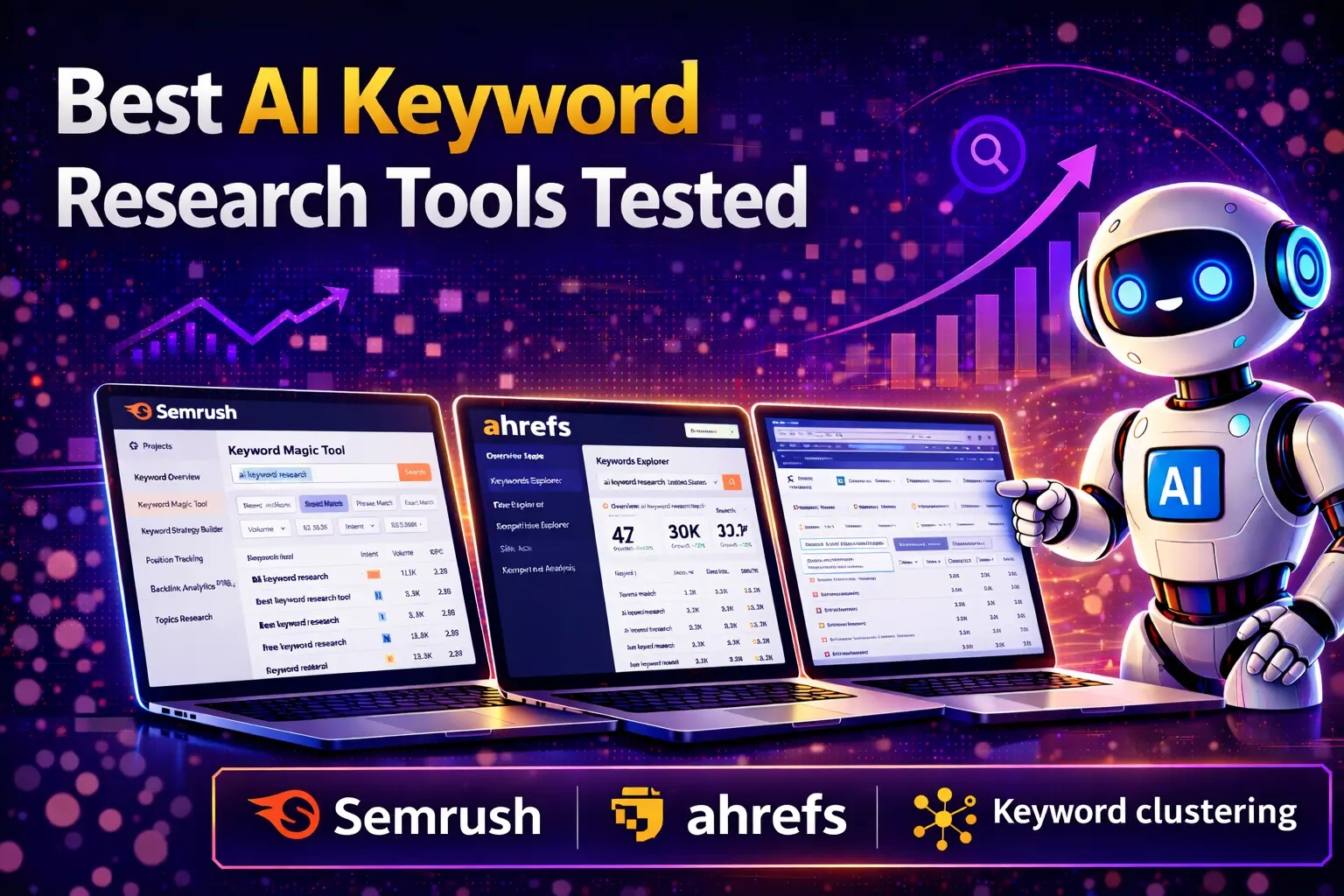
Best AI Keyword Research Tools
📌 In This Guide
- What AI keyword research tools are
- Why AI keyword research matters
- How we evaluated these tools
- Data intelligence tools
- Generative intent tools
- Keyword clustering tools
- Topical authority and entity mapping tools
- Zero-click and AI keyword risk
- Budget vs professional workflows
- CMS and GSC integrations
- Common mistakes when choosing AI keyword research tools
- Best AI keyword research tools FAQ
- Final thoughts
Introduction
The best AI keyword research tools do more than find search volume. They help you map intent, build topic clusters, identify entity gaps, and choose keywords that can win both clicks and AI citations. That is what keyword research looks like now.
Old-school keyword research was mostly about:
- search volume
- keyword difficulty
- CPC
- SERP competition
That still matters.
But in 2026, the strongest AI keyword research tools will also help with:
- AI Overviews keyword research
- GEO keyword research
- topical authority planning
- real-time SERP analysis
- entity-based SEO
- long-tail conversational queries
- zero-click risk
That is why this topic is no longer just about “finding keywords.” It is about building a smarter search strategy.
🔍 What AI Keyword Research Tools Are
AI keyword research tools help you discover, organize, and prioritize search opportunities using a mix of:
- search data
- SERP analysis
- clustering
- entity mapping
- intent signals
- AI-assisted pattern recognition
Direct Answer
AI keyword research tools are platforms that help you find better keyword opportunities, map intent more deeply, cluster related queries, and turn keyword lists into topical authority plans that work for both traditional search and AI search.
The clearest shift is this:
- old tools mostly found keywords
- Modern tools help you build a search strategy
That is why the best AI keyword research tools are now part of:
- SEO strategy
- GEO planning
- content clustering
- AI-ready content systems
🚀 Why AI Keyword Research Matters
The most effective keyword research in 2026 is not just about finding traffic.
It is about finding:
- traffic potential
- citation potential
- topic gaps
- answer opportunities
- cluster opportunities
- zero-click risk
That matters because Google no longer rewards isolated pages as easily as before.
The strongest sites now win by covering a niche with:
- clear topical depth
- related supporting pages
- answer-focused content
- strong internal linking
- entity consistency
This is where AI keyword research tools become much more valuable than flat keyword lists.
What modern keyword research must answer
A strong keyword workflow now needs to answer:
- Is this keyword worth targeting?
- What is the real search intent?
- Is this keyword likely to trigger AI Overviews?
- Does this keyword lead to clicks or zero-click answers?
- Can this keyword support a topic cluster?
- Which entities should appear in the content?
- Which pages should link together?
That is why search intent tools, keyword clustering tools, and topical authority tools now matter so much.
🧪 How We Evaluated These Tools
A trustworthy article needs a clear methodology.
I am not going to pretend this list comes from a fake “20 tools tested on 5 sites” experiment if that did not happen.
So this guide uses a practical editorial evaluation framework.
Evaluation criteria
Each tool was judged based on:
- keyword discovery depth
- intent mapping quality
- support for AI Overviews keyword research
- clustering strength
- topical authority planning
- entity-based SEO usefulness
- real-time or near-real-time SERP dependence
- zero-click risk usefulness
- workflow fit for freelancers vs teams
- integration with publishing or analytics workflows
What matters most in 2026
The clearest pattern is that the best tools now do at least one of these extremely well:
- large-scale keyword discovery
- semantic question discovery
- topic clustering
- entity mapping
- AI visibility-aware keyword planning
That is why this list is organized by type of intelligence, not by one flat ranking.
🧠 Data Intelligence Tools
These are the tools you use when the problem is scale.
They are best when you need:
- niche discovery
- competitor intelligence
- broad keyword expansion
- SERP-wide opportunity mapping
Semrush
Semrush is one of the strongest AI keyword research tools when your goal is broad research and strategy.
It is especially useful for:
- large keyword datasets
- keyword gap analysis
- AI prompt opportunity research
- competitor mapping
- niche exploration
- AI visibility tracking around prompts and brands
The clearest strength of Semrush is not just keyword volume.
It is strategic breadth.
If your question is:
What is happening across this entire niche?
Semrush is often one of the best answers.
Ahrefs
Ahrefs is another top-tier choice for large-scale keyword research.
It is especially strong for:
- keyword discovery
- topic grouping
- parent topic logic
- content gap analysis
- web-wide search opportunity discovery
The clearest strength of Ahrefs is how quickly it helps you move from a keyword to a broader topic map.
Comparison table: Data intelligence tools
| Tool | Best for | Main strength | Weakness | Best fit |
|---|---|---|---|---|
| Semrush | Broad strategy and AI-aware research | Large database, competitive intelligence, AI visibility support | Can feel broad and complex | Agencies, strategists, growth teams |
| Ahrefs | Keyword discovery and topic grouping | Strong keyword explorer and clustering logic | Less AI-visibility-oriented than Semrush | SEO strategists, publishers, researchers |
🤖 Generative Intent Tools
These tools are not always classic keyword tools, but they are now useful for discovering:
- conversational queries
- answer intent
- question patterns
- content gaps AI systems care about
Perplexity
Perplexity is not a classic keyword tool.
But it is useful for generative intent discovery.
It helps you surface:
- How questions are asked naturally
- What AI systems summarize first
- Which angles keep appearing in answer layers
- What missing context users still need
The clearest way to use Perplexity is not for raw keyword volume.
It is for:
- intent mapping
- answer-style phrasing
- zero-click behavior understanding
- information gap discovery
That makes it useful in GEO keyword research.
Also Asked-stylee question tools
Tools built around question expansion are useful when your target audience searches in natural language.
They help with:
- PAA-style branching
- long-tail question research
- voice-style phrasing
- answer-first content planning
Comparison table: Generative intent tools
| Tool | Best for | Main strength | Weakness | Best fit |
|---|---|---|---|---|
| Perplexity | Generative intent and answer discovery | Great for natural-language research and information gaps | Not a classic keyword database | GEO strategists, content planners |
| Question-based tools | Long-tail and PAA logic | Great for question trees and answer intent | Limited broader SEO metrics | Writers, SEOs building FAQ and answer content |
🧩 Keyword Clustering Tools
Keyword clustering is now one of the most important layers of keyword research.
Google rewards topic depth, not just isolated keyword targeting.
Ahrefs clustering logic
Ahrefs is strong here because it helps you group related queries into topic patterns more quickly.
That makes it more useful for:
- cluster planning
- parent topic decisions
- pillar page mapping
- topical authority building
Keyword Insights / clustering-first tools
Dedicated keyword clustering tools are useful when your workflow depends on:
- grouping thousands of keywords
- building niche maps
- deciding which queries belong on one page
- separating pillar pages from support pages
Why clustering matters
The clearest reason clustering matters is simple:
Google does not want one article. It wants evidence that your site understands the whole topic.
That is why keyword clustering tools are now central to topical authority.
Comparison table: Keyword clustering tools
| Tool | Best for | Main strength | Weakness | Best fit |
|---|---|---|---|---|
| Ahrefs | Topic grouping inside broader research | Strong parent-topic and cluster logic | Less workflow-specific than clustering-first tools | SEO strategists |
| Keyword clustering tools | Building niche maps at scale | Best for organizing thousands of keywords | Often less useful for research breadth | Agencies, publishers, niche site builders |
🧬 Topical Authority and Entity Mapping Tools
This is where keyword research moves beyond phrases and into concepts.
InLinks
InLinks is useful because it helps turn keyword ideas into an entity-based SEO strategy.
It is useful for:
- entity mapping
- semantic relationships
- internal linking
- topic graph thinking
- structured topical planning
The clearest value of InLinks is that it helps you think in concepts, not just keyword strings.
MarketMuse
MarketMuse is useful when your goal is to build deeper topical authority.
It helps with:
- topic modeling
- content gap analysis
- authority mapping
- content planning at the topic level
Why this matters
Modern keyword research is no longer just about terms.
It is about turning a keyword into a knowledge structure.
For example, a technical article about AI search may need related entities like:
- RAG
- vector search
- AI Overviews
- retrieval
- grounding
- citations
That is how entity-based SEO tools improve relevance.
Comparison table: Entity and authority tools
| Tool | Best for | Main strength | Weakness | Best fit |
|---|---|---|---|---|
| InLinks | Entity mapping and semantic internal linking | Strong entity-based SEO support | Less useful for raw volume discovery | Semantic SEOs, technical publishers |
| MarketMuse | Topic depth and authority planning | Strong topic modeling and gap analysis | Higher complexity for casual users | Serious editorial teams, authority builders |
🎯 AI Eligibility, Citable Keywords, and Information Gaps
This is one of the biggest changes in keyword research.
Not every keyword is equally useful in the AI era.
Some keywords are more likely to:
- trigger AI Overviews
- produce zero-click summaries
- create citation opportunities
- reveal information gaps AI still needs filled
What AI-eligible keywords often look like
They often involve:
- definitions
- comparisons
- frameworks
- best-tool queries
- how-to questions
- layered informational intent
These are often the best keywords for:
- SEO for AI answers
- GEO keyword research
- answer-first content
What citable keywords often look like
Citable keywords tend to create opportunities for:
- direct answers
- structured comparisons
- short quotable blocks
- reusable summaries
- evidence of expertise
The clearest takeaway is this:
The best AI keyword research tools help you find not just high-volume keywords, but high-utility keywords.
⚠️ AI Difficulty and Zero-Click Risk
Traditional keyword difficulty is no longer enough.
Now you also need to think about:
- AI answer competition
- zero-click risk
- answer-layer domination
- click suppression
Why this matters
Some keywords may have:
- good search volume
- manageable traditional difficulty
- strong topical relevance
But still be poor targets if the AI layer answers them fully and leaves no click opportunity.
That is why zero-click keyword judgment matters.
What to look for
The best tools here help indirectly by showing:
- SERP features
- AI Overview likelihood
- informational saturation
- CTR risk patterns
- high-impression / low-click opportunities
The clearest warning
A keyword can look easy in traditional SEO and still be hard to win profitably if the answer layer absorbs most of the value.
🔮 Predictive Keyword Research
The most successful publishers do not only chase what is popular now.
They look for what will matter next.
What predictive keyword research means
It means finding:
- rising subtopics
- emerging terms
- new phrasing patterns
- category shifts
- future questions before they become crowded
Which tools help most here
- Semrush helps through broad topic discovery and trend-oriented research workflows
- Perplexity helps by revealing how emerging questions are phrased in real language
- Ahrefs helps by surfacing new topic relationships and cluster opportunities
The clearest strategic takeaway is this:
The best keyword strategy is not only reactive. It is predictive.
🔌 Google Search Console and Quick Wins
A keyword tool that ignores your real site data is incomplete.
That is why Google Search Console still matters.
Why GSC matters in keyword research
It helps surface:
- low-hanging opportunities
- high-impression pages
- weak-CTR queries
- pages are already close to ranking well
- quick-win refresh targets
The best workflow
Use a keyword research tool to discover opportunities.
Then use GSC to validate:
- where your site is already relevant
- Which pages deserve updates
- Which terms are close to winning
The most effective strategy often combines:
- external market data
- internal site data
That is how keyword research becomes realistic instead of theoretical.
🔌 CMS and Workflow Integration
Workflow fit matters more than many teams expect.
A tool may be powerful, but if it slows down publishing, it becomes less useful in real life.
What matters here
The strongest tools are easier to use when they connect well to:
- WordPress
- Google Docs
- content editors
- internal linking workflows
- publishing teams
Practical takeaway
- WordLift matters more if your workflow is WordPress-heavy and schema-aware
- Semrush matters more if your workflow is broader and research-first
- Surfer-style optimization tools matter more when publishing and optimization are tightly connected
- InLinks matters more when internal linking and entity structure are central to the workflow
💰 Budget vs Professional Workflows
The right question is not:
Which tool is best overall?
The better question is:
Which tool makes sense for your budget and stage?
Budget-friendly options
For freelancers and lean teams, the best starting points often include:
- Google Keyword Planner
- Perplexity for intent discovery
- Ahrefs Webmaster Tools or lighter research workflows
- question-based research tools
Professional options
For agencies and advanced teams, the strongest options usually include:
- Semrush
- Ahrefs
- InLinks
- MarketMuse
- clustering-first tools
- optimization tools paired with research tools
Price vs performance table
| Tool type | Budget fit | Best for | Performance angle |
|---|---|---|---|
| Google Keyword Planner | Low-cost / free | Early-stage keyword discovery | Good starting point, limited depth |
| Perplexity | Low-cost/free | Intent and answer discovery | Strong for generative phrasing and information gaps |
| Semrush | Professional | Broad keyword and AI-aware strategy | Strongest for scale and market mapping |
| Ahrefs | Professional | Topic grouping and keyword discovery | Strong for clustering and opportunity mapping |
| InLinks / MarketMuse | Low-cost/flexible | Entities and topical authority | Strong for concept-level strategy |
The clearest budget takeaway
- Choose Semrush if you need a broad professional strategy
- Choose Ahrefs if cluster logic is central
- Choose Perplexity if you want answer-intent discovery
- Choose InLinks or MarketMuse if entity-based SEO is the real priority
🌍 Arabic Data Coverage for Bilingual Teams
Because your main target market is foreign, this is not the core of the article.
But it still matters for bilingual publishers.
Practical view
For teams working in Arabic plus English:
- Semrush is usually the stronger choice for broader regional database coverage and market mapping
- Ahrefs is still strong, but many bilingual teams prefer Semrush first when the Arabic market breadth matters alongside global workflows
Why this matters
If you publish in both English and Arabic, data quality affects:
- keyword confidence
- cluster planning
- market prioritization
- content targeting accuracy
The clearest takeaway is this:
For foreign-first publishers, this section is optional. For bilingual publishers, it becomes strategic.
⚠️ Common Mistakes When Choosing AI Keyword Research Tools
1. Treating all keyword tools as the same
They are not. Some are discovery tools. Some are clustering tools. Some are entity tools.
2. Focusing only on search volume
That misses AI eligibility, citation value, and zero-click risk.
3. Ignoring topical authority
The biggest mistake is targeting isolated keywords with no cluster strategy.
4. Ignoring entity-based SEO
Modern search understands concepts, not just strings.
5. Skipping real site data
If you ignore Google Search Console, you miss real quick wins.
6. Using AI to generate keywords without validating them
Keyword suggestions still need judgment.
❓ Best AI Keyword Research Tools FAQ
1. What are the best AI keyword research tools right now?
The strongest options usually include Semrush, Ahrefs, Perplexity, InLinks, MarketMuse, and clustering-first tools, depending on your workflow.
2. Which tool is best for topical authority?
Ahrefs, MarketMuse, and clustering tools are especially useful for building topical authority.
3. Which tool is best for AI Overviews keyword research?
Semrush and Perplexity-style workflows are especially useful when you want to evaluate answer-layer and AI-eligibility opportunities.
4. Which tool is best for entity-based SEO?
InLinks and MarketMuse are especially useful when your goal is to turn keywords into concepts and semantic relationships.
5. Which tool is best for freelancers?
Budget-friendly workflows often start with Google Keyword Planner, Perplexity, and lighter research tools before moving into bigger paid platforms.
6. Which tool is best for long-tail conversational keywords?
Question-based tools and Perplexity are especially useful for discovering natural-language and voice-style queries.
7. What matters more now: keyword difficulty or AI difficulty?
Both matter, but AI difficulty and zero-click risk are becoming much more important.
8. Do these tools replace human strategy?
No. The best tools help you think better, but they do not replace editorial judgment.
9. Why does keyword clustering matter so much now?
Google rewards topic depth and niche coverage more than isolated keyword targeting.
10. What is the best starting point for most teams?
Start by identifying your bottleneck: discovery, clustering, entity mapping, or zero-click risk. Then choose the tool that solves that first.
🧠 Final Thoughts
The best AI keyword research tools are no longer just databases.
They are strategic systems.
They help you:
- discover opportunities
- map intent
- build clusters
- improve topical authority
- reduce zero-click waste
- create more citable contentplans
The clearest way to choose is simple:
- Choose Semrush for broad data intelligence
- Choose Ahrefs for keyword discovery and clustering logic
- Choose Perplexity for generative intent and information gaps
- Choose InLinks for entity-based SEO
- Choose MarketMuse for topical authority depth
And remember the biggest shift of all:
Modern keyword research is not just about what people search for. It is about what search systems need to trust, summarize, and cite your content.
Recommended Next Reads
- Best AI Content Optimization Tools
- AI SEO vs Traditional SEO
- How to Track AI Visibility
- What Is GEO?
- How to Get Cited by AI
Comments 4