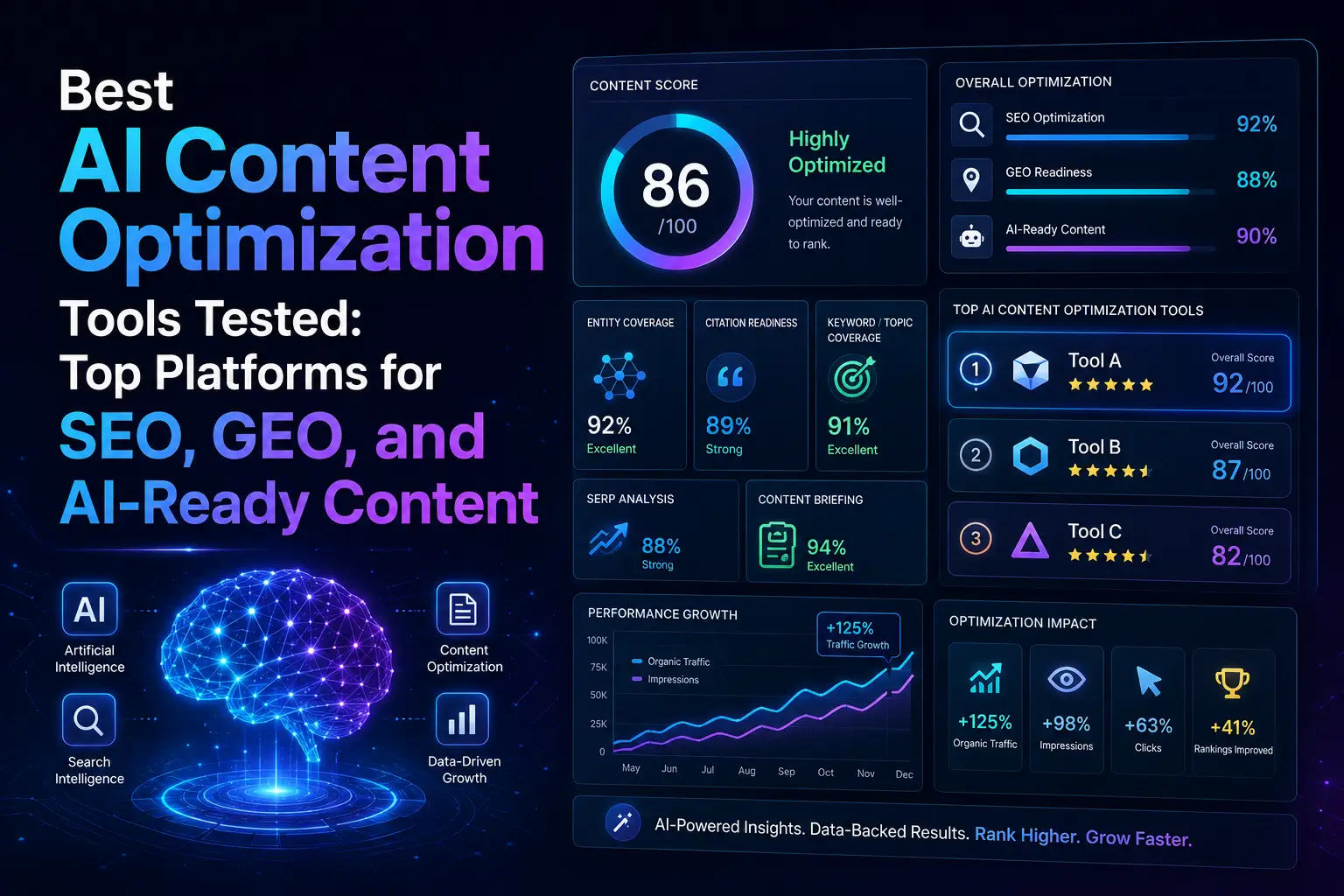
Best AI Content Optimization Tools
📌 In This Guide
- What AI content optimization tools are
- Why AI content optimization matters
- How we evaluated these tools
- Semantic optimizers
- AEO and GEO tools
- Structure optimizers
- Price vs performance
- CMS and workflow integration
- Common mistakes when using AI content optimization tools
- Best AI content optimization tools FAQ
- Final thoughts
Introduction
The best AI content optimization tools do not just help you rank. They help you create clearer, more structured, more entity-rich content that is easier for both Google and AI systems to trust, extract, and cite. That is the real shift in 2026.
A few years ago, content optimization tools were mainly about keyword usage and on-page SEO.
Now the bar is higher.
The strongest AI SEO tools also help with:
- GEO optimization
- AEO structure
- entity coverage
- internal linking
- extraction-friendly formatting
- AI-ready content workflows
This matters because content now needs to perform in two places at once:
- traditional search results
- AI-generated answers
That is why the best content optimization software is no longer just about ranking. It is about visibility across search and answer layers.
🔍 What AI Content Optimization Tools Are
AI content optimization tools help you improve a page after the topic is chosen.
They are designed to make content:
- more complete
- more structured
- more relevant
- easier to extract
- easier to trust
- easier to cite
Direct answer
AI content optimization tools are platforms that help you improve content quality, structure, entity coverage, and answer readiness so pages can perform better in both traditional search and AI-driven search environments.
The clearest way to think about them is this:
- Keyword tools help you choose the topic
- Content optimization tools help you shape the page
- AI visibility tools help you measure whether that page is actually showing up in answer engines
That is why AI content optimization tools now sit at the center of AI SEO workflows.
🚀 Why AI Content Optimization Matters
The most effective content in 2026 is not just “SEO-friendly.”
It is also:
- extraction-friendly
- answer-ready
- entity-rich
- structurally clean
- useful for AI summaries
This is where older optimization thinking falls short.
Repeating keywords is not enough.
The clearest signal of modern content quality is not keyword density. It is whether the page helps AI systems understand:
- What is the topic
- Which entities matter
- Which answer blocks are reusable
- How the content should be interpreted
That is why GEO optimization tools and AEO tools are no longer optional for serious publishers.
What these tools improve
The best AI content optimization tools help with:
- semantic relevance
- entity-based SEO
- direct answers
- schema support
- content structure
- internal linking
- topic completeness
- readability for AI systems
That is how they improve both rankings and citation potential.
🧪 How We Evaluated These Tools
A trustworthy comparison needs a clear methodology.
I am not going to pretend this list comes from a fake “20 tools tested on 5 sites” experiment if that did not happen.
So here is the practical evaluation framework used for this guide.
Evaluation criteria
Each tool was judged based on:
- how well it improves content quality
- How well does it support entity-based SEO
- whether it helps with GEO optimization
- whether it supports AEO-style direct answers
- How strong is the structure guidance
- whether it uses live or current SERP signals
- How useful is it for internal linking
- How practical the pricing feels
- how well it fits real publishing workflows
What matters most in 2026
The clearest trend is that the best tools are no longer just keyword helpers.
They are content systems.
They help teams create content that is:
- easier to rank
- easier to update
- easier to connect internally
- easier to cite in AI answers
That is the real benchmark.
🧠 Semantic Optimizers
This category focuses on tools that improve semantic relevance, topical completeness, and entity coverage.
These are usually the best AI content optimization tools for teams that want stronger entity-based SEO.
Surfer
Surfer remains one of the strongest semantic optimization tools because it is built around live SERP analysis and page-level shaping.
The most effective reason to use Surfer is not speed.
It is precision.
Surfer helps with:
- page-level content optimization
- entity-rich coverage
- on-page structure
- internal linking support
- extraction-friendly formatting
It is especially strong when the target keyword is already chosen, and your next task is to make one page better.
Frase
Frase is one of the most interesting AI content optimization tools because it blends semantic optimization with AEO and GEO-style workflows.
It is particularly useful for:
- direct-answer structure
- answer-ready outlines
- research-based briefs
- dual SEO + GEO optimization
- AI visibility-aware workflows
The clearest reason Frase stands out is that it helps turn content into something more citable, not just more optimized.
Semrush Content Toolkit
Semrush is broader than Surfer or Frase, but its content toolkit still deserves a place here.
It is useful for:
- content ideation
- AI-assisted drafting
- SEO optimization
- readability support
- WordPress and Google Docs export workflows
For teams already using Semrush, it can be a practical bridge between research and publishing.
Comparison table: Semantic optimizers
| Tool | Best for | Strength | Weakness | Best fit |
|---|---|---|---|---|
| Surfer | Page-level semantic SEO | Strong live SERP-based optimization and entity shaping | Less useful for broad planning than larger suites | Writers, niche publishers, content teams |
| Frase | Semantic SEO + AEO/GEO | Strong direct-answer and citeable content workflow | Can feel broader than beginners need | AI SEO teams, content strategists |
| Semrush Content Toolkit | Research-to-draft workflow | Strong integration with broader SEO research | Less surgical than Surfer for page shaping | Teams already inside Semrush |
🎯 AEO and GEO Tools
This category matters more every year.
If a tool cannot support GEO optimization or answer-layer visibility thinking, it becomes much less useful in modern workflows.
WordLift
WordLift is one of the clearest AEO and GEO tools because it focuses on entities, structured data, and machine readability.
Its biggest differentiator is not traditional content scoring.
It is schema automation and semantic enrichment.
That makes it valuable for:
- schema SEO
- entity markup
- automated structured data
- machine-readable content layers
- WordPress-based SEO workflows
The clearest reason WordLift matters is that it helps turn content into something machines can interpret more easily.
That matters for both search engines and AI systems.
Frase
Frase also fits here because it helps with:
- direct answers
- FAQ-style optimization
- answer intent
- GEO-style structure
- AI visibility-aware optimization
Frase is one of the few tools that feels naturally aligned with both AEO and GEO.
Comparison table: AEO/GEO tools
| Tool | Best for | GEO value | AEO value | Best fit |
|---|---|---|---|---|
| WordLift | Schema and entity layer | Strong | Moderate to strong | WordPress publishers, schema-first teams |
| Frase | Answer-ready content | Strong | Strong | Content teams building citeable pages |
🧱 Structure Optimizers
This category matters because AI systems like well-organized content.
The clearer the structure, the easier the extraction.
Clearscope
Clearscope remains one of the strongest structure optimizers.
Its core advantage is not flashy AI.
It is editorial clarity.
It helps teams improve:
- structure
- readability
- topical focus
- internal linking opportunities
- content organization
The clearest signal of Clearscope’s strength is that it feels editorial, not noisy.
That makes it especially useful for:
- content teams
- enterprise publishers
- brands with stricter editorial standards
Surfer
Surfer also deserves a place here because its article-level structure guidance is one of the reasons it performs well in AI-ready content workflows.
It helps shape:
- H2 logic
- subtopic coverage
- comparison sections
- FAQ placement
- extraction-friendly formatting
Comparison table: Structure optimizers
| Tool | Best for | Structure guidance | Internal linking support | Best fit |
|---|---|---|---|---|
| Clearscope | Editorial structure and polish | Strong | Strong | Enterprise and editorial teams |
| Surfer | SEO-shaped page structure | Strong | Strong | Operators optimizing one page at a time |
🧬 Entity Density vs Keyword Density
This is one of the biggest mindset shifts in content optimization.
Old-school optimization often focused too much on repeating terms.
Modern AI SEO focuses more on entity coverage.
Why entity density matters more
The strongest pages in 2026 do not just repeat a target keyword.
They clearly connect the main topic to related entities.
For example, in a technical article about AI search, useful entities may include:
- RAG
- vector search
- AI Overviews
- retrieval
- structured data
- citations
- answer engines
That improves relevance in a more meaningful way.
What are the best tools for
The best AI content optimization tools now help you identify:
- missing concepts
- missing subtopics
- missing entities
- weak context
- poor structural signals
That is much more useful than keyword repetition.
The clearest practical takeaway
The best modern optimization tools improve entity density, not just keyword density.
That is what makes them more relevant for AI search optimization.
🧠 RAG Quality and Real-Time SERP Signals
One of the strongest distinctions between tools is where their optimization advice comes from.
Some tools feel fresher because they rely more heavily on:
- live SERP data
- current competitor analysis
- real-time topic patterns
Others feel more static.
Why this matters
The clearest signal of useful advice is freshness.
A content tool is more valuable when it reflects the current search environment, not an old model of what used to rank.
Who benefits here
- Surfers tend to feel stronger when live SERP shaping is the priority
- Frase is strong when research and AI-ready briefing matter
- Clearscope is strong when structured editorial optimization matters
- WordLift is different because its value is more semantic and schema-driven than SERP-driven
💰 Price vs Performance
The right pricing question is not:
Which tool is the cheapest?
The better question is:
Which tool gives the best output for the kind of publishing workflow you actually run?
Pricing note
Prices and plans may change over time. Always check the official website for the latest details.
Price vs performance table
| Tool | Pricing position | Performance angle | Best for |
|---|---|---|---|
| Surfer | Mid-range | Strong value if you optimize content actively and often | Freelancers, niche site owners, lean content teams |
| Frase | Lower entry pricing than some premium tools | Strong value if you want SEO + GEO in one workflow | Content strategists, AI SEO teams |
| Clearscope | Premium | Stronger fit for editorial teams that want polish and consistency | Enterprises, serious editorial brands |
| WordLift | Specialized pricing model | Strong if schema and semantic enrichment are central to your stack | WordPress publishers, structured-data-focused teams |
| Semrush Content Toolkit | Added value inside a broader ecosystem | Best when paired with Semrush research and planning | Teams already using Semrush |
The clearest ROI takeaway
- Choose Surfer if your budget is closer to freelancer level and page optimization is your bottleneck
- Choose Clearscope if your budget is larger and editorial quality is the main priority
- Choose Frase if you want one of the strongest value blends of content optimization plus GEO workflow
- Choose WordLift if structured data and machine readability are central to your strategy
🔌 CMS and Workflow Integration
This is more important than many teams realize.
A tool may be powerful, but if it adds friction to publishing, it becomes less useful in the real world.
Why CMS integration matters
The most effective tools save time not only through advice but through workflow fit.
That is why integrations with:
- WordPress
- Google Docs
- browser-based editors
- export workflows
matter so much.
Strong integration patterns
- Semrush Content Toolkit is useful if you want export-friendly content creation inside a broader SEO system.
- WordLift is especially relevant for WordPress-heavy workflows because schema and semantic layers sit close to the CMS.
- Surfer works well when your workflow revolves around content production and optimization.n
- Clearscope fits editorial teams with established publishing processes
The clearest takeaway is simple:
The best tool is not just the one with the best advice. It is the one your team will actually use consistently.
🔗 Smart Internal Linking
Internal linking is now more important because it helps build topical authority across the site, not just within one page.
The strongest tools here do more than suggest a keyword match.
They suggest links based on context and meaning.
Why this matters
Contextual linking improves:
- crawl efficiency
- topic understanding
- user navigation
- entity relationships
- site-wide authority signals
Who stands out
- Surfer is strong because it supports automatic internal linking logic tied to topical understanding
- Clearscope is strong because it offers AI-backed internal linking opportunities that support authority and structure
- WordLift adds value by enriching semantic relationships at the content layer
The most effective internal linking tools do not just connect pages.
They help connect ideas.
⚠️ Common Mistakes When Using AI Content Optimization Tools
1. Treating the tool like a writer instead of an editor
The tool should help shape content, not replace judgment.
2. Chasing scores instead of usefulness
A high score is not the same as a strong page.
3. Ignoring the human layer
The clearest difference between average content and strong content is still experience, judgment, and specificity.
4. Over-automating content
Optimization does not mean full automation.
The best tools still need a human in the loop.
5. Ignoring structure
AI systems reward extraction-friendly content.
Large text walls still hurt.
❓ Best AI Content Optimization Tools FAQ
1. What are the best AI content optimization tools right now?
The strongest options right now usually include Surfer, Frase, Clearscope, WordLift, and Semrush Content Toolkit, depending on your workflow.
2. Which tool is best for entity-based SEO?
Surfer and Frase are especially strong for entity-based SEO because they help improve semantic coverage and answer-level relevance.
3. Which tool is best for GEO optimization?
Frase and WordLift stand out more clearly for GEO-oriented workflows because of their focus on answer readiness, AI visibility, and schema or structure support.
4. Which tool is best for content structure?
Clearscope is one of the strongest structure optimizers, especially for teams that value editorial clarity.
5. Which tool is best for WordPress publishers?
WordLift deserves extra attention for WordPress because of its schema automation and semantic SEO workflow.
6. Which tool is best for freelancers?
Surfer often gives freelancers the clearest value if article-level optimization is the main bottleneck.
7. Do these tools replace human editing?
No. The best results still come from human review, original experience, and critical thinking.
8. What matters more now: keyword density or entity density?
Entity density matters more. Modern AI SEO rewards topic clarity and contextual completeness more than repetitive keyword use.
9. Do these tools help with AI citations?
Yes, indirectly. They help create cleaner, more extractable, and more citable content.
10. What is the best starting point for most teams?
Start by identifying your bottleneck: research, structure, semantic coverage, schema, or workflow speed. Then choose the tool that solves that first.
🧠 Final Thoughts
The best AI content optimization tools are no longer just SEO helpers.
They are systems for building content that is:
- clearer
- more structured
- more trustworthy
- more entity-rich
- more useful for both search engines and AI systems
If your goal is:
- stronger semantic SEO
- better GEO optimization
- more extraction-friendly content
- better internal linking
- stronger answer-layer visibility
Then the right content optimization tool can make a real difference.
The clearest way to choose is simple:
- Choose Surfer for page-level optimization
- choose Frase for SEO + GEO content workflows
- Choose Clearscope for editorial structure and polish
- Choose WordLift for schema and semantic enrichment
- Choose Semrush Content Toolkit if you want optimization inside a broader SEO system
And remember the most important rule:
The tool is an assistant. The winning content still needs a human in the loop.
Recommended Next Reads
- Best AI SEO Tools Tested
- How to Optimize for AI Search
- What Is GEO?
- What Is AEO?
- How to Get Cited by AI
Comments 4