Introduction
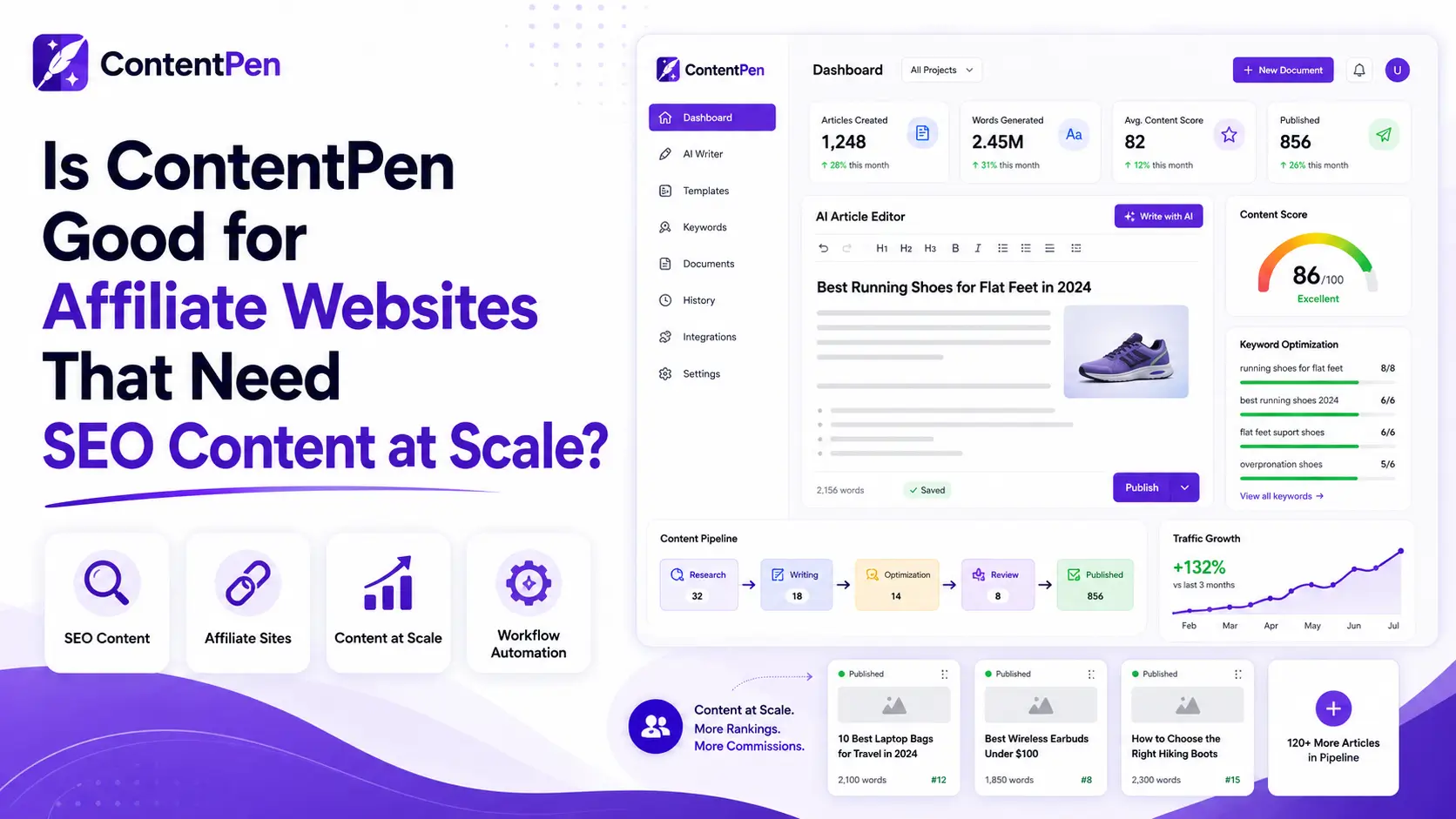
ContentPen is good for affiliate websites that need SEO content at scale, especially for informational articles, topical clusters, content refreshes, and internal linking. It should not be used to auto-publish product reviews or comparison pages without human testing, original media, editorial judgment, and affiliate disclosure.
Affiliate websites need volume.
But volume alone does not build trust.
A site can publish 100 AI-generated posts and still fail if the content sounds generic, repeats competitors, or recommends products the publisher has never used.
That is why ContentPen works best when it is used as a content production system, not as a fully automatic affiliate publishing machine.
It can help with:
- How-to articles.
- What-is articles.
- glossary pages.
- topical clusters.
- supporting content.
- content refreshes.
- internal links.
- SEO and AEO structure.
- content decay workflows.
- bulk article drafts.
But affiliate content has two different layers:
- Informational content helps users learn.
- Transactional content helps users choose and buy.
You can automate more of the first layer.
You should carefully review the second layer.
⚡ Quick Verdict
ContentPen is a strong fit for affiliate websites that need scalable informational SEO content, topical coverage, and internal linking. It is riskier for reviews, “best X” articles, and product comparisons unless a human adds original testing, screenshots, pros and cons, affiliate links, and clear buying advice.
| Affiliate Content Type | Should You Use ContentPen? | Best Workflow |
|---|---|---|
| What-is articles | Yes | Use bulk generation, then edit |
| How-to guides | Yes | Use ContentPen for structure and coverage |
| Glossary content | Yes | Use templates and review accuracy |
| Topic cluster support posts | Yes | Use bulk generation carefully |
| Product reviews | Use with caution | Use for outline and first draft only |
| Best X for Y articles | Use with caution | Add original testing and comparison tables |
| Product A vs Product B | Use with caution | Add real experience and screenshots |
| Money pages | Human-led | Use ContentPen only as an assistant |
| Content refreshes | Yes | Use decay and CTR insights |
| Internal linking | Yes, but review | Check topical silos before publishing |
Best ContentPen Plan for Affiliate Sites
| Affiliate Site Type | Best Plan |
|---|---|
| New niche site | Starter |
| Growing affiliate blog | Premium |
| Multiple affiliate sites | Agency |
| Seasonal content push | Pay-As-You-Go credits |
| Small affiliate agency | Agency |
| Review-only website | Premium or Agency with strict editorial review |
The clearest takeaway is this: ContentPen can help affiliate sites scale faster, but the human editor must protect the pages that directly influence buying decisions.
📚 Recommended Reads
- ContentPen Review: Is This AI Blog Writer Worth It?
- ContentPen Pricing for Bloggers and Agencies: Which Plan?
- Best AI Article Writing Tools Tested for SEO This Year
- KoalaWriter Review: Is This AI SEO Writer Worth It?
- Best AI SEO Tools Tested for Bloggers and Affiliate Sites
📌 In This Guide
1. 🧠 What Makes Affiliate SEO Content Different?
2. ✅ Where ContentPen Works Best for Affiliate Sites
3. ⚠️ Where ContentPen Needs Human Review
4. 🧩 Informational vs Transactional Affiliate Content
5. 🚀 Bulk Generation for Top-of-Funnel Content
6. 💸 Why Product Reviews Need Information Gain
7. 🧠 Information Gain Overlay for Affiliate Sites
8. 🔗 Internal and External Link Automation
9. 🧱 How to Build Affiliate Topic Silos
10. 📊 Content Refresh, Decay, and CTR Opportunities
11. 💰 ContentPen Plans for Affiliate Scaling
12. 🧮 Credit Optimization for Niche Site Networks
13. 🛡️ Affiliate SEO Safety Checklist
14. ❓ FAQ
15. 🏁 Final Verdict
16. 📚 Recommended Next Reads
🧠 What Makes Affiliate SEO Content Different?
Affiliate SEO content must help users make decisions, not only answer keywords. Search engines and AI answer systems are more skeptical of pages that recommend products without real experience, original evidence, or clear editorial reasoning.
A normal informational blog post can explain a topic.
An affiliate page must usually do more.
It needs to answer:
- Which product is best?
- Who is it best for?
- Who should avoid it?
- What are the weaknesses?
- What did the reviewer actually check?
- How does it compare with alternatives?
- Is the recommendation biased?
- Are affiliate links disclosed?
- Is the advice still current?
- Does the page add anything new?
This is where many AI-generated affiliate sites fail.
They publish pages that look complete but contain:
- repeated product descriptions
- generic pros and cons
- no original screenshots
- no real testing
- no price verification
- no product limitations
- no clear buying criteria
- no unique conclusions
ContentPen can help create the structure.
But the human publisher must add credibility.
✅ Where ContentPen Works Best for Affiliate Sites
ContentPen works best for affiliate websites when the goal is to create structured informational content, build topical coverage, refresh old posts, and connect articles through internal links.
Strong Use Cases
| Use Case | ContentPen Fit | Why |
|---|---|---|
| How-to guides | Strong | Needs structure, steps, and topical coverage |
| What-is articles | Strong | Good for definitions and AEO answers |
| Beginner guides | Strong | Useful for simple educational content |
| Glossary pages | Strong | Repeatable format works well |
| Supporting cluster articles | Strong | Good for covering long-tail topics |
| Content refreshes | Strong | Helpful for updating decaying articles |
| Internal linking | Strong with review | Can connect related articles |
| Product reviews | Moderate | Needs human testing |
| Best tools list | Moderate | Needs editorial judgment |
| Product comparisons | Moderate | Needs real evidence |
Why ContentPen Helps with Scale
Affiliate sites often need many supporting pages before money pages perform well.
For example, a smart pet products site may need articles about:
- Automatic feeders.
- Smart litter boxes.
- Pet cameras.
- GPS trackers.
- water fountains.
- separation anxiety.
- apartment pets.
- Pet feeding schedules.
- camera placement.
- cleaning and maintenance.
ContentPen can help generate these supporting posts faster.
Then those pages can internally link to commercial pages such as:
- Best Smart Pet Feeders for Cats
- Best Pet Cameras for Apartments
- Automatic Feeder vs Smart Feeder
- Petlibro vs Wopet
This is where ContentPen can create real leverage.
⚠️ Where ContentPen Needs Human Review
ContentPen should not be used to publish affiliate money pages automatically. Reviews, comparisons, and “best” articles need human judgment, original evidence, product-specific details, and clear buying recommendations.
High-Risk Affiliate Pages
Be careful with:
- Product reviews.
- Best X for Y articles.
- Product A vs Product B pages.
- Alternatives articles.
- Discount pages.
- Pricing pages.
- Buyer guides.
- Comparison tables.
- Product roundups.
- High-commission pages.
These pages influence buying decisions.
If they look generic, they may fail to rank, fail to convert, or damage trust.
What AI Drafts Usually Miss
AI-generated affiliate reviews often miss:
- Real product experience.
- original photos.
- actual screenshots.
- shipping details.
- setup difficulty.
- customer support experience.
- refund limitations.
- long-term use.
- small product annoyances.
- personal buying advice.
A good affiliate review should feel like someone actually used the product.
🧩 Informational vs Transactional Affiliate Content
Do not treat every affiliate article the same inside ContentPen. Use more automation for informational articles and more human editing for transactional articles.
Informational Content
Informational content includes:
- What is X?
- How does X work?
- How to choose X.
- X benefits.
- X problems.
- X mistakes.
- X setup guide.
- X maintenance guide.
- X glossary.
- X for beginners.
These articles are top-of-funnel.
They help the site build topical authority.
They are usually safer for bulk generation because they focus on education rather than direct product recommendations.
Transactional Content
Transactional content includes:
- Best X for Y.
- X review.
- X alternatives.
- X vs Y.
- Cheapest X.
- X pricing.
- X coupon.
- X comparison.
- Is X worth it?
- Which X should you buy?
These are bottom-of-funnel pages.
They need more trust.
Recommended Workflow
| Content Type | ContentPen Role | Human Role |
|---|---|---|
| Informational article | Full first draft | Edit, fact-check, add links |
| How-to guide | Draft and structure | Add examples and screenshots |
| Glossary page | Draft definitions | Check accuracy |
| Product review | Outline and first draft | Add testing, photos, verdict |
| Best list | Structure and criteria | Choose products and explain why |
| Comparison | Draft framework | Add real pros, cons, and tradeoffs |
| Money page | Assistant only | Human-led review and decision |
🚀 Bulk Generation for Top-of-Funnel Content
ContentPen’s bulk generation is best used for top-of-funnel affiliate content where the site needs topical coverage across many long-tail questions, not for publishing unreviewed money pages.
Good Bulk Generation Targets
Use bulk generation for:
- Beginner guides.
- how-to articles.
- problem-solution posts.
- definition articles.
- setup guides.
- maintenance guides.
- comparison support posts.
- informational cluster pages.
- long-tail questions.
- seasonal educational posts.
Example Affiliate Cluster
For a site about AI SEO tools, ContentPen could help create supporting posts such as:
| Cluster Topic | Bulk Article Idea |
|---|---|
| AI content tools | What Is AI Content Optimization? |
| Internal linking | How Internal Links Help SEO |
| AI visibility | What Is GEO in SEO? |
| Content audits | How to Find Content Decay |
| Keyword research | How to Find Low-Competition Keywords |
| On-page SEO | How to Optimize H2 Headings |
| Affiliate SEO | How to Build Affiliate Topic Clusters |
These articles support commercial pages without making direct buying claims.
Why This Works
Bulk informational content helps:
- Fill topical gaps.
- support money pages.
- answer long-tail queries.
- create internal link paths.
- build authority around a niche.
- reduce dependence on one commercial page.
- create more entry points for users.
Bulk Generation Warning
Do not publish 50 articles without review.
Check:
- Accuracy.
- originality.
- intent match.
- headings.
- internal links.
- external links.
- affiliate relevance.
- duplication.
- formatting.
- AI tone.
Scale should not mean careless publishing.
💸 Why Product Reviews Need Information Gain
Affiliate reviews need information gain because AI can easily summarize public product pages, but it cannot honestly invent your experience, screenshots, tests, comparisons, or editorial conclusions.
What Thin Affiliate Reviews Look Like
A thin affiliate review often has:
- Product description copied from the vendor.
- generic feature list.
- generic pros and cons.
- no original media.
- no personal experience.
- no clear testing method.
- no real comparison.
- no audience-specific recommendation.
- no mention of weaknesses.
- no reason to trust the verdict.
This type of content is weak for both search engines and readers.
What Strong Affiliate Reviews Include
A stronger affiliate review includes:
- Original screenshots.
- product photos.
- videos.
- test notes.
- setup experience.
- real limitations.
- pricing checks.
- comparison criteria.
- clear recommendations.
- who should avoid it.
- affiliate disclosure.
- updated facts.
ContentPen’s Best Role in Reviews
Use ContentPen for:
- SERP analysis.
- outline creation.
- question discovery.
- first draft.
- structure.
- headings.
- SEO scoring.
- internal links.
- content gaps.
- AEO formatting.
Then add human evidence before publishing.
🧠 Information Gain Overlay for Affiliate Sites
An Information Gain Overlay is the human layer added after the AI draft. It makes the article more useful by adding original testing, screenshots, product experience, opinion, comparisons, and buying advice.
Add These After ContentPen Drafts
| Overlay Element | Why It Matters |
|---|---|
| Original screenshots | Proves real use |
| Product photos | Adds credibility |
| Short video clips | Shows real experience |
| Personal testing notes | Adds information AI cannot guess |
| Pros and cons table | Forces real trade-offs |
| Pricing screenshots | Helps with accuracy |
| Setup steps | Shows practical experience |
| Buyer-fit verdict | Improves conversions |
| “Who should avoid it” section | Builds trust |
| Affiliate disclosure | Supports transparency |
Example: Weak vs Strong Affiliate Section
Weak:
This tool is great for bloggers because it helps create SEO content faster.
Stronger:
After testing the article workflow, the strongest benefit was the speed of outline creation. The weakest point was that product comparison sections still needed manual editing because the draft sounded too neutral and did not include enough real buying judgment.
The second version sounds human because it includes a trade-off.
Required Human Additions for Reviews
Before publishing a review, add:
- What you tested.
- How you tested it.
- screenshots.
- product limits.
- real pricing check.
- comparison table.
- personal recommendation.
- affiliate disclosure.
- update date.
- clear final verdict.
Do Not Let AI Invent Experience
Never ask ContentPen or any AI writer to invent:
- Real test results.
- screenshots.
- personal use.
- customer support experience.
- product defects.
- private statistics.
- fake case studies.
- fake expert quotes.
Use placeholders instead:
Add original screenshot here.
Add real pricing test here.
Add your personal verdict here.
🔗 Internal and External Link Automation
ContentPen’s auto internal and external linking can save time for affiliate sites, especially when a sitemap is connected. However, every suggested link should be reviewed for topical relevance, anchor quality, commercial intent, and silo alignment.
Why Internal Linking Matters for Affiliate Sites
Affiliate websites depend on internal links because they help:
- Connect supporting content to money pages.
- Strengthen topic clusters.
- Distribute authority.
- Help users move toward buying pages.
- Improve crawl discovery.
- Reduce orphan pages.
- Clarify content relationships.
- Support topical silos.
How to Review ContentPen Internal Links
Before publishing, check:
- Does the link support the same topic silo?
- Is the anchor natural?
- Does the destination page match the context?
- Is the link helpful for the reader?
- Are too many links pointing to one money page?
- Are important support articles linked?
- Is the same exact-match anchor repeated?
- Are old or weak pages being promoted?
- Are links added too aggressively?
- Does the link graph look editorial?
Example Silo Review
For a smart pet site:
| Source Article | Good Internal Link | Bad Internal Link |
|---|---|---|
| How Smart Feeders Work | Best Smart Feeders for Cats | Best Dog GPS Trackers |
| Pet Camera Setup Guide | Best Pet Cameras for Apartments | Smart Litter Box Review |
| Cleaning an Automatic Litter Box | Best Self-Cleaning Litter Boxes | Best Cat Water Fountains |
The bad links may still be pet-related, but they do not support the same search journey.
External Links
External links should point to:
- Official product pages.
- documentation.
- Credible studies.
- Manufacturer specifications.
- Reliable publications.
- Government or academic sources when relevant.
Avoid linking to direct competitors unless there is a clear editorial reason.
Affiliate Links
Do not rely on automatically suggested generic links for money pages.
Use:
- Correct affiliate tracking links.
- Proper disclosure.
- Clean URL management.
- Link cloaking only where compliant.
- Nofollow or sponsored attributes where appropriate.
- Product-specific destination pages.
🧱 How to Build Affiliate Topic Silos
ContentPen works best when affiliate sites use topic silos instead of random article production. A silo connects educational pages, comparison pages, reviews, and buying guides around one clear topic.
Simple Affiliate Silo Structure
| Page Type | Example |
|---|---|
| Pillar page | Best AI SEO Tools Tested This Year |
| Supporting guide | What Is AI SEO? |
| How-to article | How to Use AI for Keyword Research |
| Problem article | Why AI Content Fails to Rank |
| Review page | Surfer SEO Review |
| Comparison page | Surfer vs Frase |
| Alternative page | Surfer Alternatives |
| Transactional page | Best AI SEO Tools for Bloggers |
How ContentPen Helps
ContentPen can support the silo by creating:
- top-of-funnel guides.
- definitions.
- how-to articles.
- supporting articles.
- content updates.
- internal links.
- topic coverage.
- AEO structure.
- AI images.
- CMS-ready drafts.
Human Editor’s Job
The editor should decide:
- Which page is the pillar.
- Which pages are support articles.
- Which pages are money pages.
- Which links point upward.
- Which anchors are safe.
- Which articles need testing evidence.
- Which pages need affiliate links.
- Which pages should not be overlinked.
Do not let the tool create a random link network without silo logic.
📊 Content Refresh, Decay, and CTR Opportunities
ContentPen is especially useful for affiliate sites with existing content because it can help identify decaying articles, CTR opportunities, and quick wins that may be easier than publishing new pages.
Good Refresh Candidates
Look for pages with:
- Deep impressions but low CTR.
- Declining clicks.
- Outdated prices.
- Old product screenshots.
- Missing alternatives.
- weak intro answer.
- Missing FAQs.
- Outdated pros and cons.
- broken affiliate links.
- weak internal links.
Refresh Workflow
Use this process:
- Connect performance data.
- Identify decaying articles.
- check the current SERP.
- update product facts.
- improve the first 50 words.
- Add comparison tables.
- refresh screenshots.
- update affiliate links.
- improve internal links.
- Republish carefully.
Why Refreshes Are Valuable
For affiliate sites, updating old content can be more profitable than creating new content because the page may already have:
- impressions.
- backlinks.
- rankings.
- affiliate clicks.
- user history.
- internal links.
- topical relevance.
- existing trust signals.
ContentPen can speed up the refresh process, but a human must verify product facts.
💰 ContentPen Plans for Affiliate Scaling
For affiliate websites, the best ContentPen plan depends on publishing volume, number of sites, workspaces, users, and whether you need content decay insights.
| Plan | Monthly Price | Annual Price | Articles / Month | Best Affiliate Use |
|---|---|---|---|---|
| Starter | $39/month | $27/month | 10 | Testing one new niche site |
| Premium | $79/month | $55/month | 30 | Growing one or two affiliate sites |
| Agency | $199/month | $139/month | 100 | Managing multiple niche sites or clients |
Starter for Affiliate Sites
Starter is best if:
- You have one site.
- You publish up to 10 articles.
- You are testing the niche.
- You do not need multiple users.
- You do not need bulk generation.
Starter is not ideal for serious scaling because it lacks the workflow features affiliate sites need after the first stage.
Premium for Affiliate Sites
Premium is best if:
- You publish 15–30 articles monthly.
- You need bulk generation.
- You manage up to 3 workspaces.
- You want analytics.
- You need content decay and CTR opportunities.
- You are building topical silos.
For most affiliate publishers, Premium is the best practical starting point.
Agency for Affiliate Sites
Agency is best if:
- You manage a niche site network.
- You run several affiliate brands.
- You have editors or assistants.
- You need unlimited workspaces.
- You need unlimited users.
- You can use up to 100 articles monthly.
Agency has the lowest subscription cost per article, but only if you actually use the volume.
🧮 Credit Optimization for Niche Site Networks
If you manage several affiliate websites, the Agency plan is usually more cost-efficient than buying many small packs. Pay-As-You-Go credits are better for temporary content spikes, not permanent monthly production.
Cost Per Article by Subscription
| Plan | Articles / Month | Monthly Billing Cost / Article | Annual Billing Cost / Article |
|---|---|---|---|
| Starter | 10 | $3.90 | $2.70 |
| Premium | 30 | $2.63 | $1.83 |
| Agency | 100 | $1.99 | $1.39 |
Pay-As-You-Go Packs
| Pack | Price | Credits | Cost Per Article |
|---|---|---|---|
| Small pack | $29 | 10 articles | $2.90 |
| Medium pack | $99 | 50 articles | $1.98 |
| Large pack | $199 | 150 articles | $1.33 |
When to Use Pay-As-You-Go
Use PAYG credits when:
- You have a seasonal push.
- You need extra articles once.
- You are launching a new silo.
- A client asks for a one-time batch.
- You do not want to upgrade permanently.
- Your monthly plan has enough users and workspaces.
When to Upgrade Instead
Upgrade when you need:
- More workspaces.
- More users.
- Bulk generation.
- analytics.
- Content decay features.
- CTR decline opportunities.
- Consistent monthly volume.
PAYG credits add article volume.
They do not replace workflow features.
🛡️ Affiliate SEO Safety Checklist
ContentPen can help scale affiliate SEO content, but every affiliate site needs an editorial safety layer. The goal is to scale useful content, not publish generic pages faster.
Before Publishing Informational Content
Check:
- Is the answer correct?
- Is the introduction direct?
- Are headings clear?
- Are entities used naturally?
- Are sources credible?
- Are links relevant?
- Is the article connected to a silo?
- Does it avoid keyword stuffing?
- Is the article useful without affiliate links?
- Does it answer the search intent?
Before Publishing Reviews or Comparisons
Check:
- Did you test the product?
- Are original screenshots included?
- Are prices current?
- Are pros and cons specific?
- Is the verdict clear?
- Are affiliate links correct?
- Is there a disclosure?
- Are competitors compared fairly?
- Are weaknesses explained?
- Would a reader trust the recommendation?
Pages That Should Never Be Fully Automated
Avoid full automation for:
- Product reviews.
- best product lists.
- affiliate comparison pages.
- financial product pages.
- health product pages.
- legal services.
- expensive software recommendations.
- safety-related products.
- anything requiring first-hand testing.
- pages where wrong advice can harm users.
Safe Workflow
Use this process:
- Generate the draft.
- Review the outline.
- Check the facts.
- Add original evidence.
- improve headings.
- Add screenshots.
- Review internal links.
- Add affiliate links.
- add disclosure.
- publish in batches.
- monitor performance.
- update regularly.
❓ FAQ
1. Is ContentPen good for affiliate websites?
Yes. ContentPen is good for affiliate websites that need scalable informational content, topic clusters, internal links, and content refreshes. It should be used carefully for reviews and buying guides.
2. Can ContentPen write affiliate reviews?
ContentPen can draft affiliate reviews, but it should not be the final source of truth. A human should add original testing, screenshots, product experience, pros and cons, and affiliate links.
3. Is ContentPen safe for AI affiliate content at scale?
It can be safe when used with human editing, fact-checking, original evidence, and controlled publishing. It is risky to use for auto-publishing large volumes of generic reviews.
4. What type of affiliate content should I automate?
Automate more of the informational content, such as how-to guides, what-is articles, glossary posts, and supporting topic cluster content. Review commercial content manually.
5. Should I use ContentPen for “Best X” articles?
Use it for the outline, SERP research, and first draft. Add real product selection criteria, testing notes, comparison tables, screenshots, and personal recommendations before publishing.
6. Does ContentPen support internal linking?
Yes. ContentPen can place contextual internal and external links based on your sitemap and content context. You should review every important link before publishing.
7. Which ContentPen plan is best for affiliate sites?
Premium is best for most growing affiliate sites. Agency is better for niche site networks, small agencies, and teams managing several sites.
8. Are Pay-As-You-Go credits useful for affiliate sites?
Yes. PAYG credits are useful for seasonal campaigns, one-time topic cluster launches, or extra content volume without upgrading the monthly subscription.
9. Can ContentPen help with content decay?
Yes. Premium and Agency plans include content decay, CTR decline, and quick-win opportunities that can help affiliate sites refresh old posts.
10. Can AI-generated affiliate content rank?
AI-assisted content can rank when it is accurate, useful, original, well-structured, and edited by humans. Thin, generic, or fake-experience affiliate content is much weaker.
11. Should I publish ContentPen articles without editing?
No. Every article should be reviewed. Reviews, comparisons, and money pages need especially strong human editing and original proof.
12. Is ContentPen better for bloggers or agencies?
ContentPen works for both. Bloggers benefit from Premium’s content workflow, while small agencies and niche site networks benefit more from Agency’s article volume, workspaces, and users.
🏁 Final Verdict
ContentPen is good for affiliate websites that need SEO content at scale, but only when used with the right content strategy.
Use ContentPen heavily for:
- Informational posts.
- topic clusters.
- how-to guides.
- what-is articles.
- supporting content.
- content refreshes.
- internal linking.
- AEO-ready structure.
Use ContentPen carefully for:
- reviews.
- comparisons.
- best-product lists.
- alternatives pages.
- pricing pages.
- high-commission affiliate content.
For affiliate sites, the best workflow is:
ContentPen for scale → human editor for trust → original proof for information gain → affiliate links for monetization → performance tracking for updates
The Premium plan is the best choice for most growing affiliate websites because it includes 30 articles, bulk generation, analytics, content decay, CTR opportunities, and multiple workspaces.
The Agency plan is better if you manage several affiliate sites or clients and can use 100 articles per month.
Pay-As-You-Go credits are useful for temporary content expansion, especially when launching new silos or seasonal campaigns.
The clearest takeaway is this: ContentPen can help affiliate websites scale informational SEO content, but profitable affiliate pages still need human testing, original media, honest recommendations, and careful link control.

Comments 4