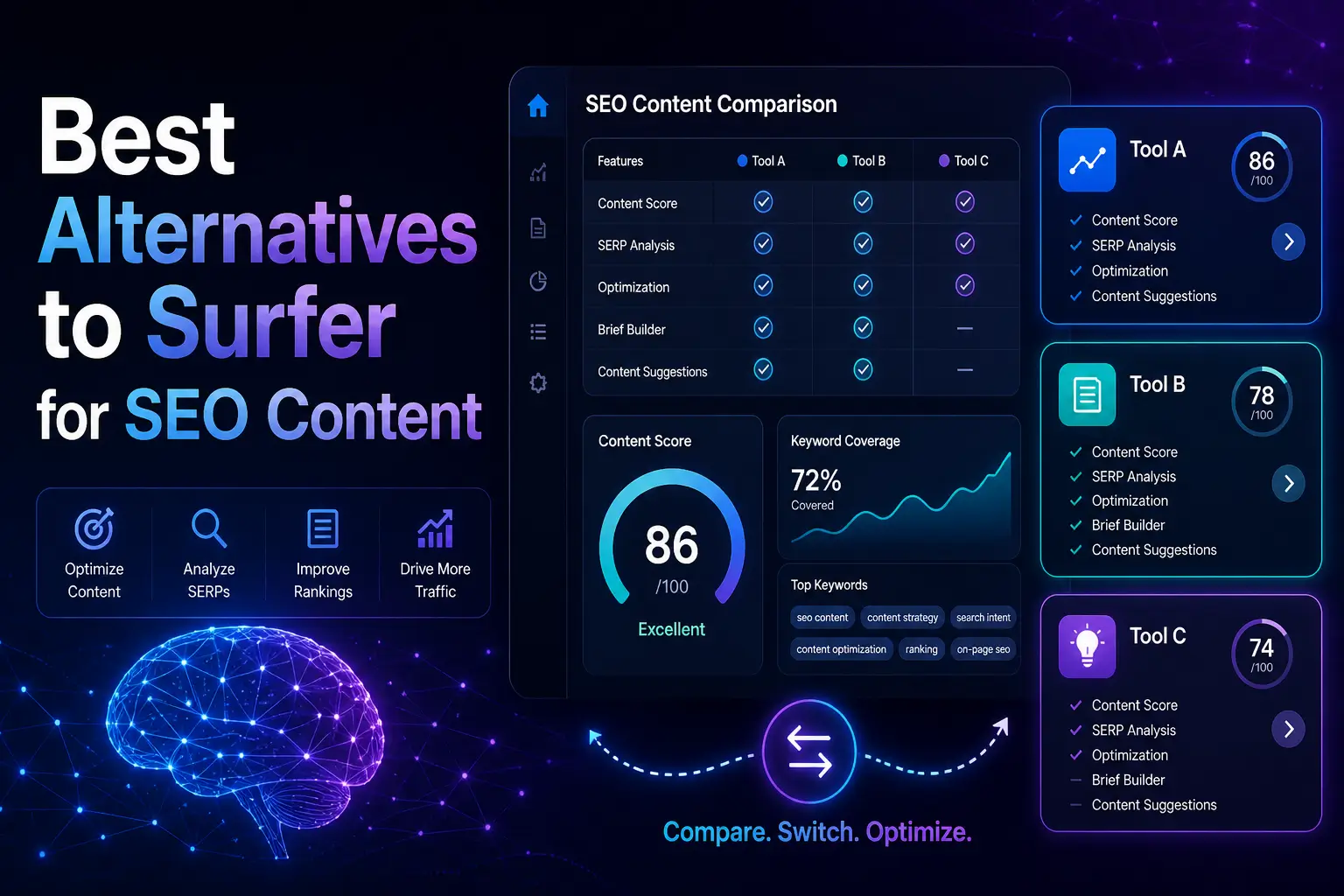
Best Alternatives to Surfer for SEO Content
⚡ The Speed Verdict
| Use Case | Best Alternative | Why I’d Pick It |
|---|---|---|
| Best for budget | NeuronWriter | Strong NLP-style optimization at a much lower entry price |
| Best for briefs and speed | Frase | Fast research, content briefs, and question-led outlines |
| Best for professional content quality | Clearscope | Clean editorial workflow and strong semantic guidance |
| Best for content scaling | Jasper / Writesonic | Better for brand voice, AI drafts, and higher content volume |
| Best for agencies | SE Ranking | Broader SEO platforms with reporting, audits, and rank tracking |
| Best for topical authority | MarketMuse | Stronger content inventory and topic-gap analysis |
📌 In This Guide
- Why you may want an alternative to Surfer
- How I evaluated these tools
- Best alternatives to Surfer by use case
- Practical test scenario
- AEO and GEO readiness
- Keyword stuffing vs entity-based optimization
- AI content humanization
- Workflow integrations and live SERP analysis
- ROI, multilingual SEO, and community trust
- Pros and cons of each tool
- The exit logic
- FAQ
- Final thoughts
Introduction
The best alternative to Surfer for SEO content depends on your workflow. Choose NeuronWriter for budget optimization, Frase for fast briefs, Clearscope for premium editorial quality, Jasper or Writesonic for scaling, and SE Ranking or Semrush if you need a broader SEO platform.
Surfer is still a strong SEO content optimization tool.
I would not replace it just because another tool is cheaper. I would replace it only if another tool solves a specific problem better.
For example, a freelancer in the US, UK, or Canada may care most about cost per article. A content team may care more about the Google Docs workflow. An agency may need reporting, rank tracking, and client-ready dashboards. A SaaS brand may care more about answer-engine visibility and content that can appear in AI search results.
That is why this guide is not a generic feature list.
It is a decision guide.
🔍 Why Look for a Surfer Alternative?
Surfer is good at page-level optimization.
It helps you compare your content against the current SERP and improve the page around ranking signals.
But Surfer is not the perfect fit for every content workflow.
You may need an alternative if:
- The monthly cost feels too high
- You publish many articles every month
- You need faster content briefs
- You want a stronger editorial workflow
- You need reporting for clients
- You want broader SEO tools in one platform
- You care about AEO and GEO readiness
- Your writers work mainly in Google Docs or WordPress
Direct Answer
You should look for a Surfer alternative if your main problem is cost, content scale, briefs, agency reporting, topical authority, or AI-search readiness rather than simple page-level optimization.
The best tool is not the one with the longest feature list.
It is the one that removes the biggest constraint in your content workflow.
💡 Pro-Tip: Don’t replace Surfer because another tool looks cheaper. Replace it only if the alternative improves your real workflow: budget, briefs, scale, reporting, team adoption, or topical authority.
🧪 How I Evaluated These Alternatives
I evaluated these tools as if I were choosing a real SEO content stack for a site targeting competitive US, UK, and Canadian search results.
I looked at:
- semantic optimization quality
- content brief quality
- search intent analysis
- entity coverage
- AEO readiness
- AI writing quality
- Google Docs and WordPress workflow
- live SERP research
- content refresh support
- team and agency fit
- cost per useful article
I also looked at tradeoffs.
Some tools are cheaper but require more editing. Some are expensive but better for teams. Some are great for briefs but weaker for scoring. Others are excellent all-in-one SEO platforms, but less focused than Surfer as a pure content editor.
That difference matters.
🧩 Best Alternatives to Surfer for SEO Content
1. NeuronWriter
NeuronWriter is the best budget alternative to Surfer for many freelancers, niche site owners, and small publishers.
It gives you content scoring, NLP-style recommendations, competitor analysis, AI writing support, and optimization guidance at a lower entry point than many premium content tools.
What I like most is the value.
NeuronWriter is not the most polished tool in this list. The interface does not feel as premium as Clearscope, and it may not be ideal for larger editorial teams.
But if your goal is to improve semantic coverage and content structure without paying premium prices, it is very hard to ignore.
What I liked:
- Strong price-to-value ratio
- Useful NLP-style recommendations
- Good fit for freelancers and small sites
- Practical for semantic coverage and content scoring
What I did not like:
- Interface feels less modern than premium tools
- Not ideal for large editorial teams
- Reporting and workflow depth are limited compared with enterprise tools
I would use it if you need:
Affordable semantic optimization for a small site, niche site, affiliate site, or freelance SEO workflow.
I would not use it if you need:
Enterprise reporting, advanced collaboration, polished editorial workflow, or deep content governance.
✍️ 2. Frase
Frase is one of the best alternatives if your main bottleneck is research and brief creation.
Surfer is stronger when you already have a draft and want to optimize it. Frase is stronger when you need to understand what the article should answer before writing.
That makes it useful for teams that need:
- content briefs
- question research
- SERP summaries
- FAQ planning
- AEO-friendly outlines
- faster first drafts
What stands out to me is how naturally Frase fits into answer-led content.
For articles targeting AI Overviews, featured snippets, or question-heavy searches, Frase can help shape the structure before the writer starts drafting.
What I liked:
- Fast content brief creation
- Strong question-led research
- Useful for AEO-friendly outlines
- Good for writers who need direction before drafting
What I did not like:
- Not the deepest technical SEO platform
- Not always the strongest pure content scoring tool
- Final drafts still need strong human editing
I would use it if you need:
Fast briefs, question-led structure, search intent research, and AEO-friendly content planning.
I would not use it if you need:
A strict Surfer-style optimizer focused mainly on content scoring and SERP term matching.
🏢 3. Clearscope
Clearscope is the strongest premium alternative for professional editorial teams.
It feels cleaner and more mature than many content optimization tools. I like it because it supports writers without forcing them to chase an awkward checklist.
Clearscope is especially strong when you care about:
- editorial quality
- semantic relevance
- writer-friendly recommendations
- Google Docs workflow
- WordPress workflow
- team adoption
This is not the cheapest Surfer alternative.
But for agencies, B2B brands, media companies, and enterprise content teams, the extra cost can make sense because the workflow is smoother and more editorially friendly.
What I liked:
- Clean editorial experience
- Strong semantic guidance
- Good fit for teams and agencies
- Strong Google Docs and WordPress workflow
What I did not like:
- Expensive for small publishers
- Not a full SEO suite with backlinks, audits, and rank tracking
- May be too much for solo users
I would use it if you need:
Premium content optimization for a team that values quality, semantic clarity, and writer adoption.
I would not use it if you need:
The cheapest possible Surfer replacement or an all-in-one SEO platform.
🚀 4. Jasper
Jasper is not a direct Surfer replacement.
It is a better fit when your problem is content production, campaign workflow, and brand voice.
I would use Jasper when the main question is not “How do we optimize one article?” but “How do we produce more content without losing brand consistency?”
That matters for brands that publish:
- blog posts
- landing pages
- comparison pages
- email campaigns
- product-led content
- social content tied to SEO campaigns
Jasper’s biggest strength is human-centric brand control.
Its biggest limitation is that you still need SEO data and content optimization around it.
What I liked:
- Strong brand voice control
- Good for scalable marketing content
- Useful beyond SEO blog posts
- Better for brand consistency than generic AI writers
What I did not like:
- Not a pure SEO content optimizer
- Needs SEO data support around it
- Can be overkill if you only need article optimization
I would use it if you need:
Brand-consistent content at scale across blogs, landing pages, campaigns, and marketing assets.
I would not use it if you need:
A direct Surfer replacement with SERP-based scoring and detailed optimization recommendations.
🤖 5. Writesonic
Writesonic is a strong alternative if you want content production plus AI search visibility workflows.
It is moving beyond basic AI writing. It now positions itself around AI search visibility, GEO, content refresh, and content that can rank in Google and get cited by AI systems.
That makes it interesting for teams thinking beyond classic SEO.
If your strategy includes AI Overviews, ChatGPT visibility, Perplexity citations, and content refresh, Writesonic is worth considering.
What I liked:
- Strong content scaling workflow
- Useful AI visibility positioning
- Good fit for content refresh and GEO workflows
- Broader than a basic AI writing tool
What I did not like:
- Still needs human editing and fact-checking
- May feel excessive if you only need content scoring
- Higher-tier AI visibility features can increase cost
I would use it if you need:
Fast content production, AI visibility workflows, and a platform that thinks beyond traditional Google rankings.
I would not use it if you need:
A lightweight content score editor for a few blog posts per month.
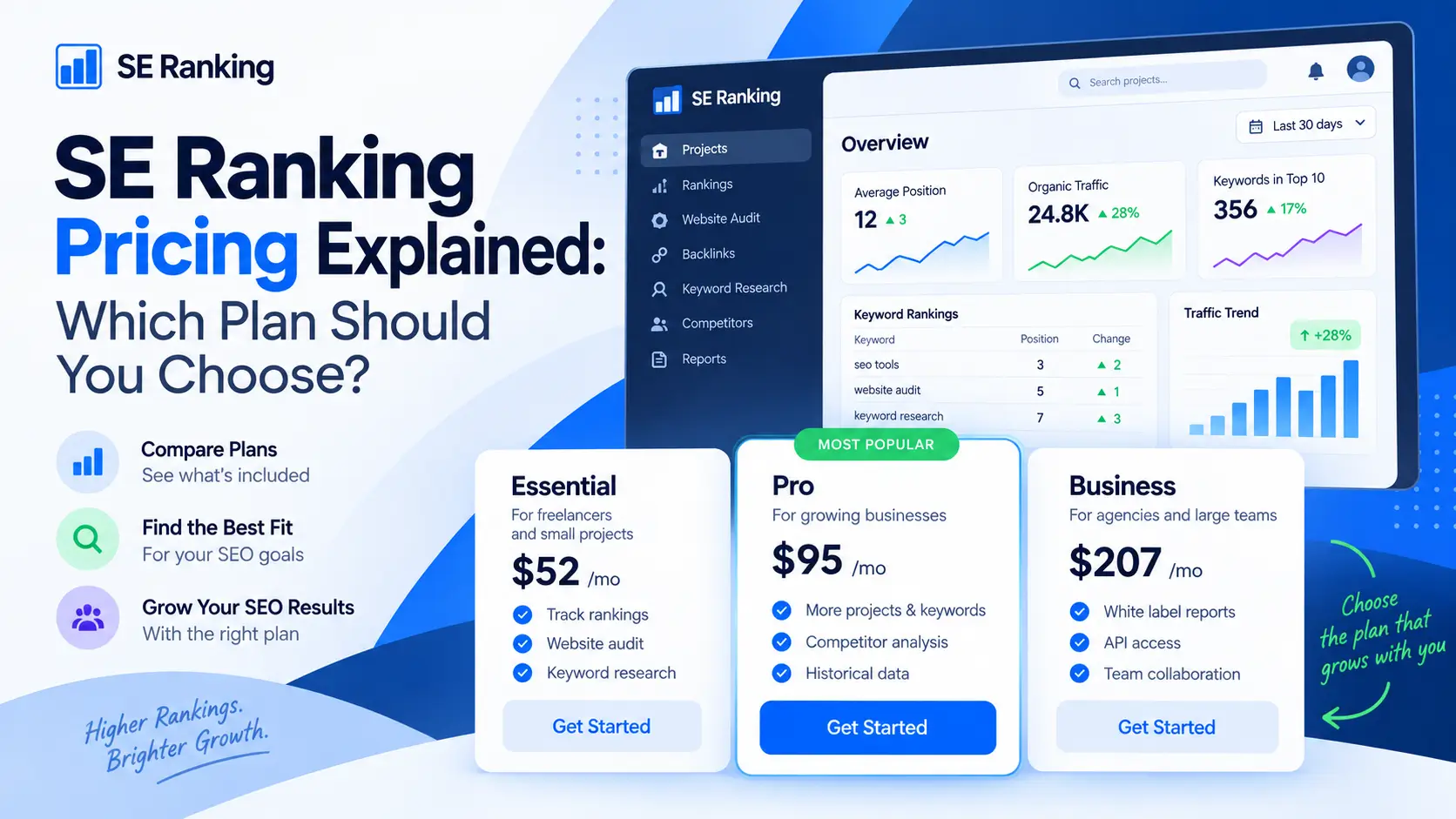
📊 6. SE Ranking
SE Ranking is the best alternative if Surfer feels too narrow.
It combines rank tracking, keyword research, audits, reporting, competitive analysis, and content workflows in one platform.
That makes it a strong fit for agencies and small teams that do not want separate subscriptions for every SEO task.
It may not beat Surfer at Surfer’s exact core job, but it can be a better business decision if you need a wider SEO toolkit.
What I liked:
- Strong all-in-one value
- Good fit for agencies and client workflows
- Rank tracking, audits, reporting, and content support in one place
- Useful when content is only one part of your SEO process
What I did not like:
- Not as specialized as Surfer for pure content optimization
- Content workflows may feel less focused than dedicated editors
- Add-ons can increase the total cost
I would use it if you need:
A broader SEO platform for agency, client, or multi-site workflows.
I would not use it if you need:
A dedicated content editor with the deepest possible page-level writing guidance.
🧠 7. Semrush
Semrush is not a simple Surfer alternative.
It is a broader SEO operating system.
I would consider Semrush if your content strategy needs to connect with:
- keyword research
- competitor analysis
- site audits
- rank tracking
- backlink data
- content planning
- AI visibility
- reporting
This makes Semrush valuable when content is part of a larger SEO strategy.
For a solo writer, it may be too much. For an agency, SaaS company, or growth team, it may replace several separate tools.
What I liked:
- Broad SEO data ecosystem
- Strong competitor research
- Useful for agencies and growth teams
- Better when the content strategy needs more than a content editor
What I did not like:
- Can feel heavy if you only want content optimization
- More expensive than lightweight alternatives
- The learning curve is higher than the focused tools
I would use it if you need:
A full SEO suite where content optimization connects with keyword research, audits, reporting, and competitive intelligence.
I would not use it if you need:
A simple, low-cost content optimization tool only.
🗺️ 8. MarketMuse
MarketMuse is the best alternative when your goal is topical authority, not just optimizing one article.
Surfer helps improve a page. MarketMuse helps you understand the broader content ecosystem.
That matters when you want to know:
- where your site is weak
- Which topics need support
- Which content should be refreshed
- where authority gaps exist
- Which content should be created next
I would not choose MarketMuse for quick, cheap article optimization.
I would choose it for strategy.
What I liked:
- Strong topical authority analysis
- Useful content inventory workflows
- Good for strategic refresh and planning
- Better for building topic clusters than optimizing one page only
What I did not like:
- More advanced and expensive
- Not ideal for quick one-off article optimization
- Better for content strategy teams than beginners
I would use it if you need:
A strategic platform for topical authority, content inventory, and authority gap analysis.
I would not use it if you need:
A cheap Surfer replacement for a handful of blog posts.
📊 Practical Test Scenario: How I Would Compare These Tools
I do not recommend inventing fake case studies.
So here is the honest version: this is the practical test I would run before choosing a Surfer alternative.
I would take 12 articles currently ranking between positions 8 and 20.
These are ideal test pages because they already have relevance but need stronger optimization.
Then I would split them into groups.
| Test Group | Workflow |
|---|---|
| Group A | Refresh pages with Surfer |
| Group B | Refresh pages with NeuronWriter, Frase, or Clearscope |
| Baseline | Record clicks, impressions, CTR, average position, and target keyword movement |
| Changes | Update headings, entities, FAQs, direct answers, internal links, and title tags.. |
| Tracking window | Measure results after 30–60 days |
What I Would Measure
I would not only measure ranking.
I would measure:
- semantic relevance
- missing entities added
- search intent alignment
- direct answer quality
- content score movement
- CTR improvement
- internal link improvement
- impressions after republishing
That is how I would build a real E-E-A-T case study.
Not by saying, “I tested it, and it worked,” but by showing the baseline, the changes, and the outcome.
💡 Pro-Tip: A small, honest test with 6–12 URLs is more credible than a huge claim with no data. If you want trust, show the process before you show the result.
🧠 Topical Authority: Which Alternatives Go Beyond One Page?
Surfer is strong at article-level optimization.
But if your site needs to own a topic, you need more than one optimized article.
You need:
- topic clusters
- supporting articles
- internal links
- refreshed old content
- comparison pages
- definitions
- FAQs
- authority pages
Best Tools for Topical Authority
| Tool | Topical Authority Strength |
|---|---|
| MarketMuse | Best for content inventory and authority gaps |
| Semrush | Best for connecting topical planning with SEO data |
| SE Ranking | Best value for broader SEO planning and tracking |
| Frase | Best for question-led supporting content |
| NeuronWriter | Best for affordable article-level semantic coverage |
My editorial opinion is simple.
If you want one article to improve, use a content optimizer. If you want the whole site to become stronger, use a topical planning tool.
🤖 AEO and GEO Readiness
AEO and GEO matter because SEO content is no longer competing only for blue links.
It is also competing for:
- AI Overviews
- ChatGPT answers
- Perplexity citations
- voice-style answers
- featured snippets
A good Surfer alternative should help you create content that is easier to extract and quote.
What AEO-ready content needs
AEO-ready content usually includes:
- direct answers
- short definitions
- question-based headings
- comparison tables
- clear entities
- practical examples
- concise summaries
Best AEO-ready alternatives
Frase is strong for question-led briefs.
Clearscope is strong for clean editorial optimization.
NeuronWriter is strong for semantic completeness.
Writesonic is strong if you care about GEO and AI visibility workflows.
🧬 Keyword Stuffing vs Entity-Based Optimization
This is where many writers misuse optimization tools.
Bad optimization says:
“Repeat this keyword more.”
Good optimization says:
“Cover the concept more completely.”
That is the difference between keyword stuffing and entity-based optimization.
For example, if you are writing about SEO content optimization, strong content may need to mention:
- search intent
- semantic SEO
- content scoring
- topic clusters
- AEO
- internal links
- content refresh
- SERP analysis
- entities
Not because you are stuffing terms.
Because those concepts help explain the topic properly.
My Rule
If a recommendation makes the article less useful, ignore it.
Tools should support editorial judgment, not replace it.
✍️ AI Content Humanization
AI writing quality matters, but not because you want to avoid editing.
You should edit every AI-assisted article.
The real question is how much editing the draft needs before it becomes credible.
My practical view
Jasper is strongest for brand voice.
Writesonic is stronger for production speed and AI search workflows.
Frase is stronger for research and structure.
Clearscope is stronger for improving human-written drafts.
For safe, human-centric content, I would use AI for structure, then add human judgment, examples, screenshots, fact-checking, and clear recommendations.
That is how the content stops feeling generic.
🔌 Workflow Integration
Workflow integration is not a minor feature.
It affects whether your writers actually use the tool.
A tool can be powerful, but if it forces writers to copy and paste across five windows, the team may stop using it properly.
Strong workflow fits
Clearscope is strong for Google Docs and WordPress workflows.
Frase is useful for research-to-brief workflows.
Jasper is useful for marketing teams that care about brand voice.
SE Ranking is useful when content sits inside a broader SEO workflow.
⚡ Live SERP Analysis
SEO content changes fast.
The SERP you optimized for six months ago may not be the SERP you face today.
A good alternative should help you understand:
- current ranking pages
- current search intent
- current content format
- current competing sections
- current questions and subtopics
For this, Frase, Clearscope, NeuronWriter, SE Ranking, and Semrush can all support SERP-informed workflows in different ways.
The key question is not just whether the tool pulls SERP data.
The key question is whether it helps you make better editorial decisions from that data.
💰 ROI Factor: Cost per Useful Article
Do not judge these tools only by the monthly price.
Judge them by cost per useful article.
A tool that costs more may be cheaper if it saves editing time, improves briefs, and helps writers publish stronger pages faster.
A cheap tool can become expensive if every article needs heavy manual repair.
What I would calculate
Before choosing, I would ask:
- How many articles will we publish monthly?
- How many refreshes will we do monthly?
- How many writers need access?
- Does the tool reduce editing time?
- Does it replace another platform?
- Does it help with post-publish monitoring?
- Does it improve ranking or conversion potential?
For a solo publisher, NeuronWriter may deliver the best ROI.
For a professional editorial team, Clearscope may justify the cost.
For an agency, SE Ranking or Semrush may be the smarter business decision.
Pricing note: Tool prices and plan limits can change, so always verify current pricing before buying.
📈 Content Auditing After Publishing
Publishing is not the finish line.
A serious SEO content workflow should track whether pages decay over time.
Useful post-publish features include:
- tracked topics
- content inventory
- GSC-style performance signals
- rank movement
- content refresh alerts
- competitor change detection
Strong fits
MarketMuse is strong for content inventory and authority gaps.
SE Ranking is useful for rank tracking, audits, and reporting.
Semrush is strong for broader SEO monitoring.
NeuronWriter can work well for smaller teams that want GSC-informed content workflows.
🌍 Multilingual SEO
Multilingual SEO is not just translation.
It requires understanding search intent, entities, grammar, and local SERP behavior in each market.
For US, UK, and Canadian audiences, English-language performance is usually the priority. But if your business also targets Spanish-speaking US audiences, French-speaking Canadian audiences, or European markets, multilingual support becomes more important.
What to check
- Supported languages
- Localized SERP data
- NLP quality in your target language
- Writer workflow
- Human editing needs
- Entity recommendations
Some tools perform very well in English but become less reliable in languages with more complex grammar or different search behavior.
🗣️ Community Trust
Community feedback matters.
Before choosing a Surfer alternative, I would check:
- G2 reviews
- Reddit discussions
- SEO community threads
- YouTube walkthroughs
- agency case studies
A landing page tells you what the tool wants to be.
The community tells you how the tool behaves in real workflows.
✅ Pros and Cons of the Leading Alternatives
1. NeuronWriter
Pros
- Strong budget value
- Useful semantic optimization
- Good for freelancers, niche sites, and small teams
Cons
- Interface feels less modern than premium tools
- Not the strongest choice for enterprise workflows
2. Frase
Pros
- Fast content briefs
- Strong question research
- Useful for an AEO-friendly structure
Cons
- Not the deepest content scoring tool
- Final drafts still need strong human editing
3. Clearscope
Pros
- Excellent editorial experience
- Strong semantic guidance
- Good Google Docs and WordPress workflow
Cons
- Expensive for small publishers
- Not a full SEO suite
4. Jasper
Pros
- Strong brand voice
- Good for marketing teams
- Useful for scalable human-centric content
Cons
- Not a direct Surfer-style optimizer
- Needs SEO data support around it
5. Writesonic
Pros
- Strong content scaling
- Useful GEO and AI visibility positioning
- Good for refresh and AI-search workflows
Cons
- Requires careful editing and fact-checking
- Higher-tier AI visibility features can increase cost
6. SE Ranking
Pros
- Strong all-in-one value
- Good for agencies and client workflows
- Includes rankings, audits, reporting, and content support
Cons
- Not as specialized as Surfer for pure content optimization
- Better if you need the broader platform
7. Semrush
Pros
- Very broad SEO ecosystem
- Strong competitive research
- Good for agencies and serious SEO teams
Cons
- Can feel heavy for content-only users
- More expensive than lightweight alternatives
8. MarketMuse
Pros
- Excellent for topical authority
- Strong content inventory and authority gap analysis
- Useful for strategic content planning
Cons
- More advanced and expensive
- Not ideal for quick article-level optimization
🧭 The Exit Logic
| If Your Main Need Is… | Choose |
|---|---|
| Lowest-cost semantic optimization | NeuronWriter |
| Fast briefs and question-led content | Frase |
| Premium semantic SEO quality | Clearscope |
| Brand voice and content scaling | Jasper |
| Content scaling plus GEO workflows | Writesonic |
| Agency-friendly all-in-one SEO | SE Ranking |
| Broad SEO data and competitive research | Semrush |
| Topical authority and content inventory | MarketMuse |
Final Recommendation
If you want the best budget alternative, choose NeuronWriter.
If you want the strongest premium semantic SEO workflow, choose Clearscope.
If you want fast briefs, choose Frase.
If you need content scaling, choose Jasper or Writesonic.
If you run an agency, choose SE Ranking.
If you need a broad SEO ecosystem, choose Semrush.
If you are building topical authority, choose MarketMuse.
The best Surfer alternative is not the tool with the most features.
It is the tool that removes the biggest bottleneck in your SEO content workflow.
❓ Best Alternatives to Surfer for SEO Content FAQ
1. What is the best alternative to Surfer for SEO content?
The best alternative depends on your workflow. NeuronWriter is best for budget users, Clearscope for premium teams, and SE Ranking for agencies.
2. What is the cheapest strong Surfer alternative?
NeuronWriter is one of the strongest budget-friendly alternatives for semantic optimization and content scoring.
3. What is the best Surfer alternative for briefs?
Frase is one of the best options for fast content briefs, research, and AEO-friendly outlines.
4. What is the best Surfer alternative for agencies?
SE Ranking is a strong fit for agencies because it combines content tools with rank tracking, audits, reporting, and client workflows.
5. What is the best alternative for content scaling?
Jasper and Writesonic are stronger for scaling content production, especially when brand voice or AI search workflows matter.
6. Which alternative is best for semantic SEO?
Clearscope is one of the strongest premium options. NeuronWriter is a strong, budget-friendly semantic SEO alternative.
7. Can these tools help with AI Overviews?
Yes, especially if you use them to improve answer structure, entity coverage, summaries, tables, and direct definitions.
8. Should I replace Surfer completely?
Not always. Keep Surfer if it works for your workflow. Replace it only if another tool better solves your cost, scale, team, or strategy problem.
🏁 Final Thoughts
The strongest Surfer alternatives are not identical.
They solve different problems.
NeuronWriter is the value pick.
Frase is the brief and research pick.
Clearscope is the premium semantic SEO pick.
Jasper and Writesonic are the scaling picks.
SE Ranking is the agency value pick.
Semrush is the full SEO ecosystem pick.
MarketMuse is the topical authority pick.
If I had to give one final rule, it would be this:
Choose NeuronWriter for savings, Clearscope for quality, Frase for briefs, Jasper or Writesonic for scale, SE Ranking for agencies, and MarketMuse for topical authority.
Recommended Next Reads
- Surfer Alternatives
- Frase vs Surfer
- Semrush vs Surfer
- Best AI Content Optimization Tools
- Best AI Tools Tested for Content Refresh


Comments 4