SEO Title
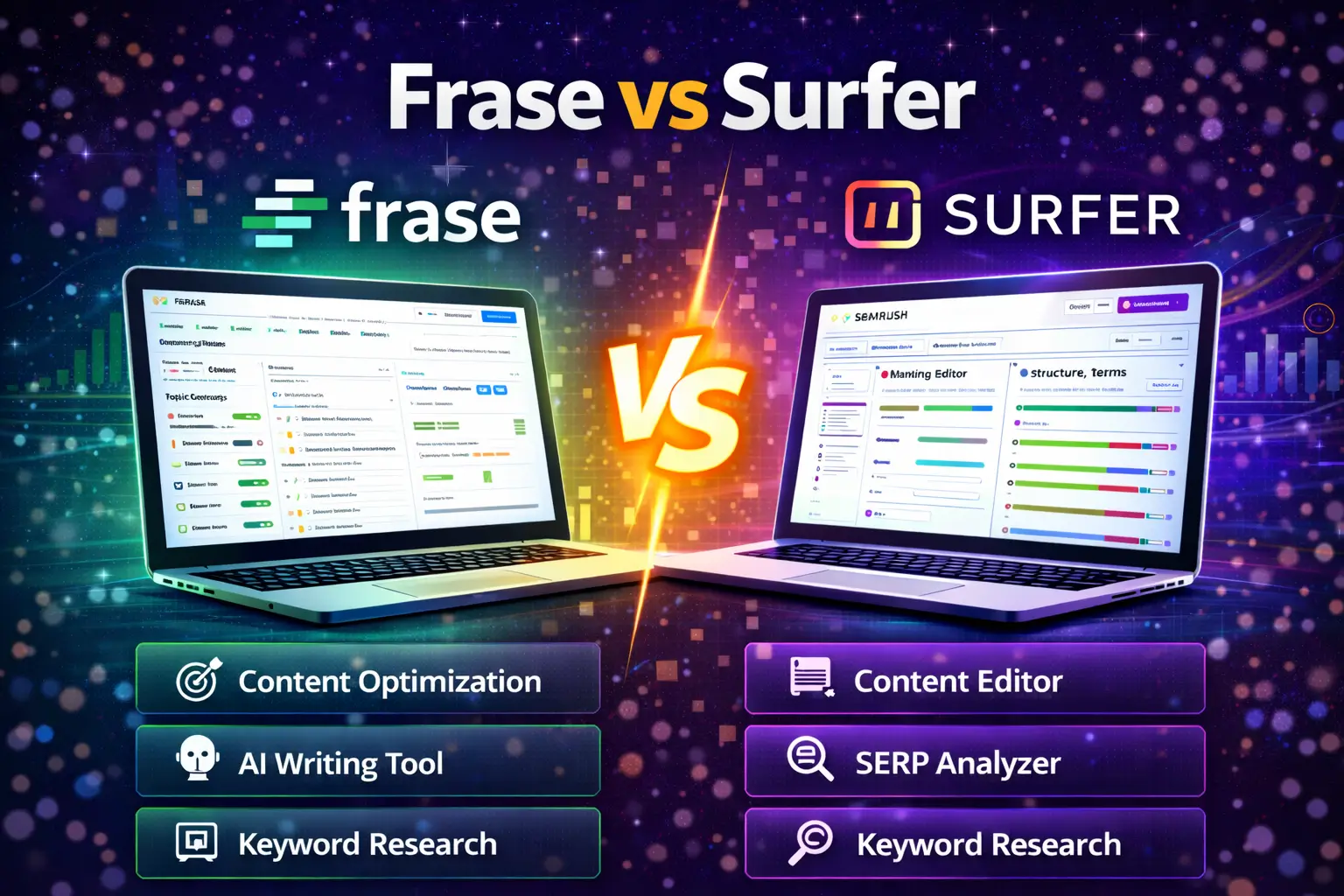
Frase vs Surfer: Which One Is Better for AI SEO, AEO, and Content Optimization?
Meta Description
Compare Frase vs Surfer across content briefs, AI writing, AEO, entity optimization, workflow speed, rank tracking, integrations, and ROI to choose the right tool for your content strategy.
Primary Keyword
Frase vs Surfer
Secondary Keywords
- Frase vs Surfer SEO
- Frase or Surfer
- Frase AI vs Surfer AI
- AEO tools
- AI content optimization tools
- entity-based SEO
- content briefs
- AI visibility
- rank tracking
- internal linking tools
Slug
frase-vs-surfer
Frase vs Surfer
📌 In This Guide
- What Frase vs Surfer really means
- Why the difference matters
- Frase vs Surfer at a glance
- The core identity of each tool
- The AI battle: Frase AI vs Surfer AI
- Why Frase is stronger for AEO
- NLP, entities, and topical coverage
- Workflow and time savings
- Rank tracking and site-level optimization
- User experience and ease of use
- Score accuracy and the danger of score obsession
- Pricing, credits, and budget strategy
- Integrations and publishing workflow
- Multilingual support for global teams
- Internal linking and topical authority
- Content strategy beyond SEO
- Product updates and future readiness
- The smart combination workflow
- Frase vs Surfer FAQ
- Final thoughts
Introduction
The clearest difference between Frase and Surfer is this: Frase helps you figure out what needs to be answered, while Surfer helps you engineer the page that answers it best. That is the real comparison.
Many people treat Frase vs Surfer SEO like a simple feature battle.
It is not.
These tools solve different content problems.
Frase is stronger when your bottleneck is:
- research
- questions
- answer intent
- content briefs
- semantic direction
Surfer is stronger when your bottleneck is:
- optimization
- structure
- SERP alignment
- page-level entity coverage
- final article competitiveness
If you understand that difference early, the choice becomes much easier.
🔍 What Frase vs Surfer Really Means
The wrong question is:
Which tool is better overall?
The better question is:
Which stage of the workflow is slowing you down right now?
Direct answer
Frase is better for research, semantic answers, and answer-first content planning. Surfer is better for optimization, page structure, and turning an article into a stronger ranking candidate.
That is the cleanest way to think about Frase or Surfer.
If your biggest problem is not knowing:
- what people ask
- what your article should answer
- how to build a brief
- how to improve answer coverage
Frase usually makes more sense.
If your biggest problem is:
- making an article more competitive
- improving structure
- increasing entity coverage
- matching top-ranking patterns
Surfer usually makes more sense.
🚀 Why the Difference Matters
The most effective comparison is not feature vs feature.
It is outcome vs outcome.
Frase helps you answer:
- What should this article cover?
- Which questions matter most?
- What kind of direct answers should appear?
- How should the brief be structured?
- What is the semantic shape of the topic?
Surfer helps you answer:
- How do we make this page stronger?
- Which subtopics are missing?
- How should the structure change?
- How do we improve extraction-friendly content?
- How do we push this article closer to page-one quality?
The clearest strategic difference
Frase is stronger at understanding the content problem. Surfer is stronger at optimizing the content asset.
That is why advanced teams often end up using both.
⚖️ Frase vs Surfer at a Glance
| Category | Frase | Surfer |
|---|---|---|
| Core identity | Semantic answers tool | Statistical analysis tool |
| Best for | Research, briefs, and answer-first content planning | Page-level optimization and SERP alignment |
| Main strength | Tells you what questions to answer | Tells you how to shape the page to compete |
| Better for writing from scratch | Yes | Moderate |
| Better for optimizing an existing article | Moderate | Yes |
| Better for AEO | Stronger | Good |
| Better for entity-based SEO at page level | Good | Stronger |
| Better for topic research | Stronger | Moderate |
| Better for content scoring and structure tuning | Moderate | Stronger |
| Better for rank-oriented optimization | Moderate | Stronger |
| Better for beginners | Usually easier | More technical |
| Better for advanced SEO operators | Good | Stronger |
| Internal linking support | Good | Stronger |
| Best budget fit | Better for research-first users | Better for optimization-first users |
Quick verdict
| If you need… | Best choice |
|---|---|
| Smarter briefs and question-based research | Frase |
| Better article optimization and SERP matching | Surfer |
| Stronger AEO workflow | Frase |
| Stronger page-level entity shaping | Surfer |
| Easier starting point for writers | Frase |
| Stronger final optimization before publishing | Surfer |
🧭 The Core Identity of Each Tool
Frase: The Semantic Answers Tool
Frase feels like a semantic answers platform.
Its strength is not just AI writing.
Its strength is helping you figure out:
- what people ask
- what the content should answer
- how to build stronger briefs
- how to create more answer-ready pages
The clearest way to describe Frase is this:
Frase tells you what needs to be answered.
That is why it feels especially strong for:
- AEO tools workflows
- question-first planning
- semantic content briefs
- content strategy beyond SEO
Surfer: The Statistical Analysis Tool
Surfer feels more like a statistical analysis tool.
Its strength is not broad market discovery.
Its strength is page precision.
It helps you:
- analyze the live SERP
- compare against top-ranking pages
- optimize structure
- improve entity coverage
- refine content until it becomes more competitive
The clearest way to describe Surfer is this:
Surfer tells you how to shape the page so it competes.
That is why it often feels more technical.
🤖 The AI Battle: Frase AI vs Surfer AI
This is one of the most practical parts of the comparison.
Both tools offer AI-assisted workflows, but they create value in different ways.
Frase AI
Frase AI is stronger when you want:
- faster research
- smarter content briefs
- better answer planning
- semantic direction before writing
- question-led drafting
Frase often feels more useful in the early stage because it brings together:
- People Also Ask patterns
- question research
- semantic context
- content briefs
- answer-first drafting logic
Surfer AI
Surfer AI is stronger when you want:
- an SEO-shaped article draft
- stronger structural alignment
- more complete coverage of ranking patterns
- better optimization before publishing
- page-level competitiveness
Surfer often feels more like a content optimization engine than a content discovery engine.
Which one feels more human?
There is no universal winner.
The most effective answer is this:
Frase often gives you the stronger thinking layer. Surfer often gives you the stronger structure layer.
In practice:
- Frase AI is often better for smart first-draft direction
- Surfer AI is often better for producing an optimization-shaped draft
Which one is better for entities?
Surfer usually has the clearer edge in page-level entity shaping.
Frase is stronger at surfacing what the page should answer.
Surfer is stronger at helping the page feel statistically competitive.
Comparison table: Frase AI vs Surfer AI
| Comparison point | Frase AI | Surfer AI |
|---|---|---|
| Best use case | Build smarter briefs and answer-first drafts | Build optimization-first drafts |
| Main strength | Questions, semantic direction, answer planning | Structure, SERP alignment, article competitiveness |
| Better for first-draft thinking | Strong | Moderate |
| Better for page-level optimization | Moderate | Strong |
| Better for answer-first planning | Strong | Moderate |
| Better for final article shaping | Moderate | Strong |
🎯 Why Frase Is Stronger for AEO
If this article has one clear winner in one category, it is this:
Frase is the stronger AEO tool.
That is because Frase naturally pushes you toward:
- direct answers
- FAQ structure
- answer-first outlines
- question coverage
- short, reusable sections
Why this matters
AEO is not just about ranking.
It is about becoming the answer.
Frase is better at helping you write:
- direct answer paragraphs
- zero-click-ready sections
- snippet-friendly definitions
- content blocks that are easier to summarize
The clearest practical advantage
The clearest advantage of Frase is that it helps create pages that feel answer-ready before optimization even begins.
That is a real advantage in:
- featured snippets
- answer boxes
- AI summaries
- zero-click environments
- SEO for AI answers
🧠 NLP, Entities, and Topical Coverage
This is where the tools diverge more clearly.
How Surfer handles entities
Surfer is stronger when you want page-level optimization built around what already ranks.
It tends to feel more:
- statistical
- structured
- coverage-driven
- optimization-focused
That is why Surfer often feels better when your goal is to engineer a page into something more citation-friendly and extraction-friendly.
How Frase handles entities
Frase tends to approach content through:
- questions
- topics
- answer relationships
- semantic logic
- content completeness
It feels less like “include these exact phrases” and more like “make sure this page answers the topic space properly.”
The clearest difference
Surfer is usually stronger at page-level entity optimization. Frase is usually stronger at topic coverage through semantic answers and question logic.
Comparison table: NLP and entities
| Question | Frase | Surfer |
|---|---|---|
| Better for semantic question coverage | Strong | Moderate |
| Better for page-level entity-based SEO | Moderate | Strong |
| Better for answer relationships between topics | Strong | Moderate |
| Better for SERP-shaped content tuning | Moderate | Strong |
| Better for “citation magnet” page engineering | Good | Usually stronger |
⏱️ Workflow and Time Savings
This is where the decision becomes very practical.
Scenario 1: You are writing from scratch
If you are starting from zero, Frase is usually faster.
That is because it helps more with:
- research
- answer discovery
- question collection
- brief creation
- semantic direction
Scenario 2: You already have the article
If the draft already exists and your next goal is to improve it, Surfer is usually more precise.
That is because it is stronger at:
- refining structure
- increasing topical completeness
- improving optimization signals
- pushing the page closer to page-one quality
The clearest workflow takeaway
If you want to write from scratch, Frase is usually faster in research. If you want to improve a page that already exists, Surfer is usually more precise.
Efficiency table
| Task | Frase | Surfer | Faster choice |
|---|---|---|---|
| Researching questions for a new article | Strong | Moderate | Frase |
| Building a content brief | Strong | Moderate | Frase |
| Improving an old article | Moderate | Strong | Surfer |
| Tightening page structure | Moderate | Strong | Surfer |
| Adding answer blocks and FAQ logic | Strong | Good | Frase |
| Final optimization before publishing | Moderate | Strong | Surfer |
📈 Rank Tracking and Site-Level Optimization
This is an area where Surfer is stronger than many people assume.
It is no longer just a content editor.
Surfer now has:
- Content Audit
- AI Tracker
- Rank Tracker
- workflow-level monitoring features
That gives it a broader role than many older comparisons admit.
Why this matters
The clearest reason this matters is that Surfer can now function more like a content-focused SEO advisor for the site, not just a single-page optimizer.
It helps with:
- refreshing old pages
- spotting re-optimization opportunities
- monitoring ranking movement
- improving content workflows across a domain
Frase in this area
Frase is broader than a single editor too, especially with:
- research
- AI visibility
- content opportunities
- semantic workflows
But if the question is specifically about page refreshes and rank-oriented content audits, Surfer usually feels stronger.
🖥️ User Experience and Ease of Use
This matters more than many comparisons admit.
A tool can be powerful and still feel frustrating.
Frase user experience
Frase usually feels:
- simpler
- easier for writers
- more natural for research-first workflows
- more beginner-friendly
Its interface tends to feel more answer-first than score-first.
Surfer user experience
Surfer usually feels:
- more technical
- more numerical
- more score-driven
- more optimization-heavy
That is not a flaw by itself.
But it does mean some users feel pressure from:
- percentages
- optimization thresholds
- score chasing
- overly technical signals
The clearest UX difference
Frase is often easier for beginners and content strategists. Surfer is often better for users who are comfortable with technical optimization signals.
🎯 Score Accuracy and the Danger of Score Obsession
This is one of the most important parts of the article.
The biggest warning
A high score in Surfer does not guarantee a number one ranking.
That is one of the most important truths in content optimization.
Surfer’s score is useful, but it is still a model.
It is not Google.
How Frase differs here
Frase usually feels less obsessed with one number and more focused on:
- topic coverage
- semantic completeness
- answer logic
- brief quality
That makes the workflow feel more editorial and less gamified.
The clearest practical advice
Use both tools as guidance.
Do not let either tool replace judgment.
That is how you avoid writing robotic content that scores well but performs poorly.
💰 Pricing, Credits, and Budget Strategy
This is where the decision becomes personal.
Frase for freelancers and lean teams
Frase is often easier to justify if your workflow depends on:
- research
- content briefs
- answer planning
- semantic coverage
- question-based writing
It often feels like the better budget choice for solo creators or lean strategists who need one tool to think with.
Surfer for operators and agencies
Surfer is often easier to justify if your workflow depends on:
- active page optimization
- article refreshes
- content audits
- rank-linked improvements
- more technical SEO content operations
But credit usage can become a real pain for scaling teams.
Budget strategy table
| Team type | Better first choice | Why |
|---|---|---|
| Freelancer starting from scratch | Frase | Better for briefs, questions, and semantic planning |
| Freelancer optimizing existing content | Surfer | Better for page-level improvement |
| Small agency with many content refreshes | Surfer | Better for repeated optimization workflows |
| Content strategist or editor-led team | Frase | Better for answer-first planning |
| Team using both research and optimization heavily | Both | Best when combined |
The clearest budget takeaway
Choose Frase if your bottleneck is strategy and answer coverage. Choose Surfer if your bottleneck is optimization and competitive page execution.
🔌 Integrations and Publishing Workflow
This matters because not everyone writes inside the core platform.
Frase integrations
Frase works well for workflows around:
- Google Docs
- WordPress
- browser-based research
- export and publishing support
That makes it useful for people who prefer to draft outside the tool interface.
Surfer integrations
Surfer is also strong here.
It works well with:
- Google Docs
- WordPress
- browser workflows
- publishing support
- optimization-focused writing workflows
Which is better for Google Docs?
If your workflow depends heavily on Google Docs, both are usable.
But Surfer often feels slightly stronger when your goal is to preserve optimization feedback directly inside the drafting process.
Which is better for WordPress?
Both support WordPress workflows, but Surfer often feels more execution-oriented while Frase feels more research-to-draft oriented.
🌍 Multilingual Support for Global Teams
Because the target market here is international, this is the more useful version of the language discussion.
Frase for multilingual teams
Frase is stronger if your workflow depends on:
- multilingual research
- answer-first planning
- semantic coverage across markets
- question-based strategy in multiple geographies
Surfer for multilingual teams
Surfer is stronger when your goal is:
- optimizing pages in multiple markets
- aligning with local SERPs
- improving extraction-friendly structure across languages
- tuning live page competitiveness
The clearest multilingual takeaway
Frase feels stronger for multilingual strategy and research. Surfer feels stronger for multilingual page optimization.
🔗 Internal Linking and Topical Authority
Internal linking is no longer just a small SEO task.
It is part of how you build site-wide authority.
Surfer and internal linking
Surfer is stronger here because it supports more active internal linking workflows tied to content optimization and page relationships.
That helps with:
- cluster support
- site structure
- semantic relevance
- content refreshes
Frase and internal linking
Frase supports internal-link-aware workflows through briefs and content planning, but its strength still feels more semantic and strategic than execution-first.
The clearest difference
Surfer is usually stronger for active internal linking execution. Frase is stronger for planning what the content ecosystem should cover.
That is important for topical authority.
📚 Content Strategy Beyond SEO
Frase deserves extra credit here.
It is not just a content optimization tool.
It is also a market research tool.
That is because it helps surface:
- People Also Ask questions
- semantic opportunities
- real audience questions
- content gaps
- topic angles
Why this matters
The clearest reason Frase often wins on strategy is that it helps answer:
What should we create, and what should that content actually answer?
That is a bigger question than on-page optimization alone.
Surfer is better once that strategic choice is already made.
🔄 Product Updates and Future Readiness
This is another meaningful comparison.
Frase
Frase has been moving more aggressively toward:
- semantic SEO
- GEO workflows
- AI visibility
- answer-first planning
- semantic content operations
Surfer
Surfer has been moving more aggressively toward:
- AI tracking
- rank tracking
- content audits
- content execution systems
- stronger page-level optimization workflows
The clearest future-facing takeaway
Frase is innovating faster around semantic answers, AEO, and research-first workflows. Surfer is innovating faster around optimization systems and page execution at scale.
Both are moving quickly.
The better choice depends on which future matters more to you.
🛠️ The Smart Combination Workflow
This is the real pro tip.
If you can use both, the ideal workflow is simple.
Step 1: Use Frase for research and answers
Start with Frase to:
- collect questions
- identify what must be answered
- build the brief
- map answer intent
- create a stronger semantic foundation
Step 2: Use Surfer for optimization
Then move into Surfer to:
- refine structure
- improve entity coverage
- align with the live SERP
- strengthen extraction-friendly content
- prepare the article for publishing
The clearest pro tip
Use Frase for research and answer design. Use Surfer for optimization and final page shaping.
That is the smartest combination workflow for many advanced teams.
❓ Frase vs Surfer FAQ
1. Is Frase better than Surfer?
Not overall. Frase is usually better for research, briefs, and AEO-style planning. Surfer is usually better for optimization, structure, and page-level competitiveness.
2. Which is better for AI SEO?
Both are useful, but in different ways. Frase is stronger for semantic answers and answer-first planning. Surfer is stronger for extraction-friendly content and page-level optimization.
3. Which is better for beginners?
Frase is usually easier for beginners and content strategists. Surfer often feels more technical because of its numbers and score-driven interface.
4. Which is better for improving an existing article?
Surfer is usually the better choice if the article already exists and your goal is to make it more competitive.
5. Which is better for writing from scratch?
Frase is usually faster at the research and brief stage when starting from zero.
6. Which is better for AEO?
Frase is usually the stronger AEO tool because it naturally supports direct answers, question-first outlines, and answer-ready structure.
7. Which is better for topic coverage?
Frase is stronger for semantic topic coverage. Surfer is stronger for competitive page-level coverage.
8. Should I use both?
If budget allows, yes. Frase for research and answer planning, then Surfer for final optimization, is a very strong workflow.
🧠 Final Thoughts
The clearest way to think about Frase vs Surfer is this:
Frase helps you understand what should be answered. Surfer helps you turn that answer into a more competitive page.
If your biggest need is:
- research
- content briefs
- answer-first planning
- semantic direction
- AEO support
choose Frase.
If your biggest need is:
- page optimization
- structure
- entity density
- content audits
- article refinement
choose Surfer.
If you want the strongest workflow, use both:
- Frase for research
- Surfer for optimization
That is the smartest path for teams that want both strategy and execution.
Recommended Next Reads
- Best AI Content Optimization Tools Tested
- Semrush vs Surfer
- AI SEO vs Traditional SEO
- How to Optimize for AI Search
- How to Get Cited by AI
🚀 CTA
If your main problem is knowing what your content should answer, start with Frase. If your main problem is making a page more competitive, start with Surfer. If you want the strongest setup, combine them.


Comments 4