ContentPen for Bloggers and Affiliate Sites: Is It Worth It?
🚀 Introduction
ContentPen is worth considering for bloggers and affiliate site owners who need to produce, optimize, refresh, and publish content more consistently. Its biggest value is not automatic writing alone. It is the workflow: keyword research, SERP analysis, AI drafting, SEO and GEO scoring, linking, images, publishing, and content refresh opportunities.
This matters because affiliate sites rarely fail only because they cannot generate text.
They struggle because the full publishing process becomes slow:
- Finding realistic keywords.
- Planning article clusters.
- Reviewing search intent.
- Creating outlines.
- Writing first drafts.
- Adding internal links.
- Updating old content.
- Publishing consistently.
- Monitoring results.
ContentPen aims to reduce that friction.
This article focuses specifically on whether ContentPen is useful for bloggers and affiliate site owners. For a broader feature-by-feature analysis, read the main ContentPen Review: Is This AI Blog Writer Worth It?
⚡ Quick Verdict
ContentPen is a strong option for bloggers and affiliate marketers who want a more organized AI SEO content workflow.
It can help speed up research, drafting, optimization, internal linking, CMS publishing, and content refreshes. However, it should not be treated as an autopilot system. Raw AI drafts still need careful editing, fact-checking, original examples, and genuine product research.
| Question | Quick Answer |
|---|---|
| Best for | Bloggers, affiliate site owners, niche publishers, freelancers, and small content teams. |
| Strongest feature | End-to-end blog workflow from keyword research to CMS publishing. |
| Biggest advantage | It reduces the number of tools and manual steps needed to publish content consistently. |
| Biggest drawback | AI-generated articles still need human editing and original insight. |
| Best use case | Informational support content, topical clusters, comparison outlines, content refreshes, and internal linking. |
| My verdict | ContentPen is worth testing if content production speed is your main bottleneck. |
| I would use ContentPen if you need | I would not use ContentPen if you need |
|---|---|
| Faster informational article drafts | Fully automated publishing without review |
| More consistent affiliate support content | Fake hands-on product experience |
| SEO and GEO optimization in one workflow | Deep backlink research |
| Automated internal and external links | Advanced technical SEO crawling |
| CMS publishing without repeated copying and formatting | Enterprise-level keyword clustering |
| Content refresh opportunities | A guaranteed traffic-growth tool |
| A practical workflow for multiple content clusters | One tool that replaces every specialist platform |
The clearest takeaway is this: ContentPen can help you publish faster, but the strongest affiliate sites still win through useful content, honest recommendations, smart keyword targeting, and human editing.
📚 Recommended Reads
- ContentPen Review: Is This AI Blog Writer Worth It?
- Best AI SEO Tools Tested for Bloggers and Affiliate Sites
- KoalaWriter Review: Is This AI SEO Writer Worth It?
- NeuronWriter Review: Is This Budget-Friendly SEO Content Optimizer Worth It?
- GetGenie Review: Is This WordPress AI SEO Content Tool Worth It?
📌 In This Guide
- Why ContentPen Can Be Useful for Bloggers and Affiliate Sites
- How ContentPen Fits Into an Affiliate SEO Workflow
- Best ContentPen Use Cases for Bloggers
- Best ContentPen Use Cases for Affiliate Site Owners
- ContentPen Features That Matter Most for Affiliate SEO
- ContentPen Pricing and Value
- Real-World Evidence: What External Sources Show
- ContentPen Pros and Cons for Bloggers and Affiliate Sites
- When I Would Use ContentPen
- When I Would Not Use ContentPen
- ContentPen Alternatives
- My Practical 30-Day ContentPen Workflow
- Common Mistakes When Using ContentPen
- FAQ
- Final Verdict: Is ContentPen Worth It for Bloggers and Affiliate Sites?
- Recommended Next Reads
🧠 Why ContentPen Can Be Useful for Bloggers and Affiliate Sites
Bloggers and affiliate site owners often have limited time, limited budgets, and large content plans.
They need to publish enough useful content to build topical authority without sacrificing quality.
That is difficult when every article requires many separate steps.
A typical affiliate article workflow may involve:
- Keyword research.
- SERP analysis.
- Competitor review.
- Outline planning.
- First-draft writing.
- Product research.
- Internal linking.
- SEO optimization.
- Image selection.
- WordPress formatting.
- Publishing.
- Future updates.
ContentPen brings several of these steps into one platform.
This does not remove the need for specialist tools.
For example, Ahrefs may still be stronger for backlink research. Screaming Frog may still be better for technical crawling. Keyword Insights may be better for large-scale clustering. Link Whisper may be stronger if internal linking is your only priority.
But ContentPen can reduce tool-switching for the core blogging workflow.
That makes it attractive for users who need to publish more consistently.
⚙️ How ContentPen Fits Into an Affiliate SEO Workflow
ContentPen works best when used as a production assistant, not as a strategy replacement.
A practical affiliate SEO workflow could look like this:
- Choose a realistic keyword.
- Confirm the search intent manually.
- Review the SERP and competitors.
- Build an outline.
- Use ContentPen to create a first draft.
- Add real product details.
- Add honest pros and cons.
- Add pricing notes.
- Include original screenshots when available.
- Improve internal links.
- Review SEO and GEO scoring.
- Publish to your CMS.
- Monitor the article in Google Search Console.
- Refresh the article when information changes.
This workflow matters because affiliate content needs trust.
A reader searching for a product recommendation does not want generic AI text. The reader wants help making a decision.
The most effective affiliate content answers practical questions:
- Who should buy this product?
- Who should avoid it?
- What are the biggest drawbacks?
- How does it compare with alternatives?
- Is the price justified?
- What should the buyer know before purchasing?
- What changed recently?
- Is there a cheaper or better option?
ContentPen can help create the framework.
Your editorial work makes the article trustworthy.
📝 Best ContentPen Use Cases for Bloggers
ContentPen can support several blogging workflows.
1. Informational Blog Posts
Informational articles are one of the strongest use cases.
Examples include:
- How-to guides.
- Beginner guides.
- Educational articles.
- Frequently asked questions.
- Topic definitions.
- Troubleshooting content.
- Evergreen resources.
- Step-by-step tutorials.
These posts help build topical authority and bring readers to your website before they are ready to buy.
2. Topic Cluster Support Content
A blogger should not publish random articles without a structure.
ContentPen can help organize supporting posts around a pillar topic.
For example, a smart pet products website could build a cluster around automatic feeders:
- Best automatic pet feeders.
- How automatic pet feeders work.
- Are automatic feeders safe for cats?
- How often should you clean an automatic feeder?
- Automatic feeder vs gravity feeder.
- Best feeder for wet food.
- Best feeder for multi-cat households.
The pillar page targets the main buying intent.
The supporting content answers smaller questions and links internally to the main guide.
3. Old Content Refreshes
Publishing new articles is not always the fastest way to grow.
Older pages may already have impressions, rankings, and backlinks.
ContentPen can help identify pages that need attention, such as:
- Articles are losing clicks.
- Posts with declining CTR.
- Pages close to page one.
- Content with outdated sections.
- Posts missing important subtopics.
- Articles with weak internal linking.
Refreshing an existing article may be more valuable than publishing another thin page.
4. FAQ-Style Articles
FAQ articles can target long-tail questions and support AI search visibility.
Examples include:
- Tool pricing questions.
- Feature questions.
- Comparison questions.
- Trial and refund questions.
- Beginner questions.
- Use-case questions.
- Alternative questions.
These articles can also support your main review pages through internal links.
5. Content Repurposing
After publishing a strong blog post, marketers often need supporting content.
ContentPen can help generate ideas for:
- Social media posts.
- Email summaries.
- FAQ blocks.
- Meta descriptions.
- Short promotional copy.
- Additional supporting posts.
The final copy still needs review, but the drafting process becomes faster.
🧲 Best ContentPen Use Cases for Affiliate Site Owners
Affiliate sites have specific content needs.
ContentPen is most useful when it supports the full content ecosystem rather than only money pages.
1. Informational Support Content
Affiliate sites need informational content around commercial pages.
For example, a review of a smart litter box may be supported by articles such as:
- How often should you clean an automatic litter box?
- Are automatic litter boxes safe for kittens?
- Can two cats share one automatic litter box?
- What size litter box does a large cat need?
- How to reduce litter box odor in an apartment.
These articles can attract long-tail traffic and internally link to the buying guide.
2. Review Article Drafts
ContentPen can help structure review articles.
A useful review outline may include:
- Quick verdict.
- Best use cases.
- Key features.
- Pricing.
- Pros and cons.
- Limitations.
- Alternatives.
- Who should use it?
- Who should avoid it?
- Final recommendation.
However, never claim that you tested a tool or product unless you genuinely did.
AI can draft the structure.
It cannot create an authentic experience.
3. Comparison Article Outlines
Comparison articles attract readers with stronger purchase intent.
Examples include:
- Tool A vs Tool B.
- Product A vs Product B.
- Premium option vs budget option.
- Best option for beginners.
- Best option for apartments.
- Best option for small teams.
ContentPen can help create a first outline and identify important comparison criteria.
You should still verify every detail manually.
4. Buying Guide Support
Buying guides need useful filters.
For example:
- Price range.
- Product size.
- Ease of use.
- Maintenance requirements.
- Subscription fees.
- Warranty.
- App compatibility.
- Best use case.
- Main drawback.
- Who should avoid it?
ContentPen can help structure the article, but your recommendations should remain specific and honest.
5. Internal Linking Toward Money Pages
Affiliate sites need a clear internal linking strategy.
Informational pages should link naturally toward:
- Review articles.
- Comparison posts.
- Best-product lists.
- Category guides.
- High-value money pages.
- Supporting informational content.
ContentPen’s automated internal linking can reduce manual work.
Still, review every suggested link.
Relevance matters more than link count.
🛠️ ContentPen Features That Matter Most for Affiliate SEO
🔎 Keyword Research and SERP Analysis
ContentPen includes keyword research and SERP analysis.
These features help users:
- Identify primary keywords.
- Find secondary keywords.
- Review competing pages.
- Understand article depth.
- Find content gaps.
- Improve topic coverage.
- Avoid writing without search intent.
This is useful for a streamlined workflow.
However, manual SERP review remains important.
A tool can summarize the SERP, but you should still look at the actual ranking pages.
📊 SEO and GEO Scoring
ContentPen includes live SEO scoring and GEO-focused optimization.
SEO scoring helps users improve traditional search relevance.
GEO scoring helps users think about content clarity for AI-powered search and answer systems.
Useful improvements may include:
- Better direct answers.
- Clearer headings.
- Stronger topic coverage.
- Easier-to-extract information.
- Helpful FAQ sections.
- Structured explanations.
- Relevant entities.
- Improved source quality.
Do not optimize only for a score.
The article should remain useful for humans.
🔗 Automated Internal and External Links
ContentPen can add internal and external links automatically.
For affiliate sites, this can help:
- Connect content clusters.
- Reduce orphan pages.
- Support money pages.
- Improve crawl paths.
- Add useful references.
- Save editorial time.
The biggest risk is blind approval.
Every link should be relevant, natural, and useful.
🖼️ AI Images and Media
ContentPen includes AI image support.
This can help with:
- Informational blog visuals.
- Social graphics.
- Supporting illustrations.
- Topic explanations.
- Visual breaks in long articles.
For product reviews, official screenshots, and genuine product photos are usually stronger than generic AI images.
Use AI images where they add value.
Do not use them as a substitute for product evidence.
🚀 CMS Publishing
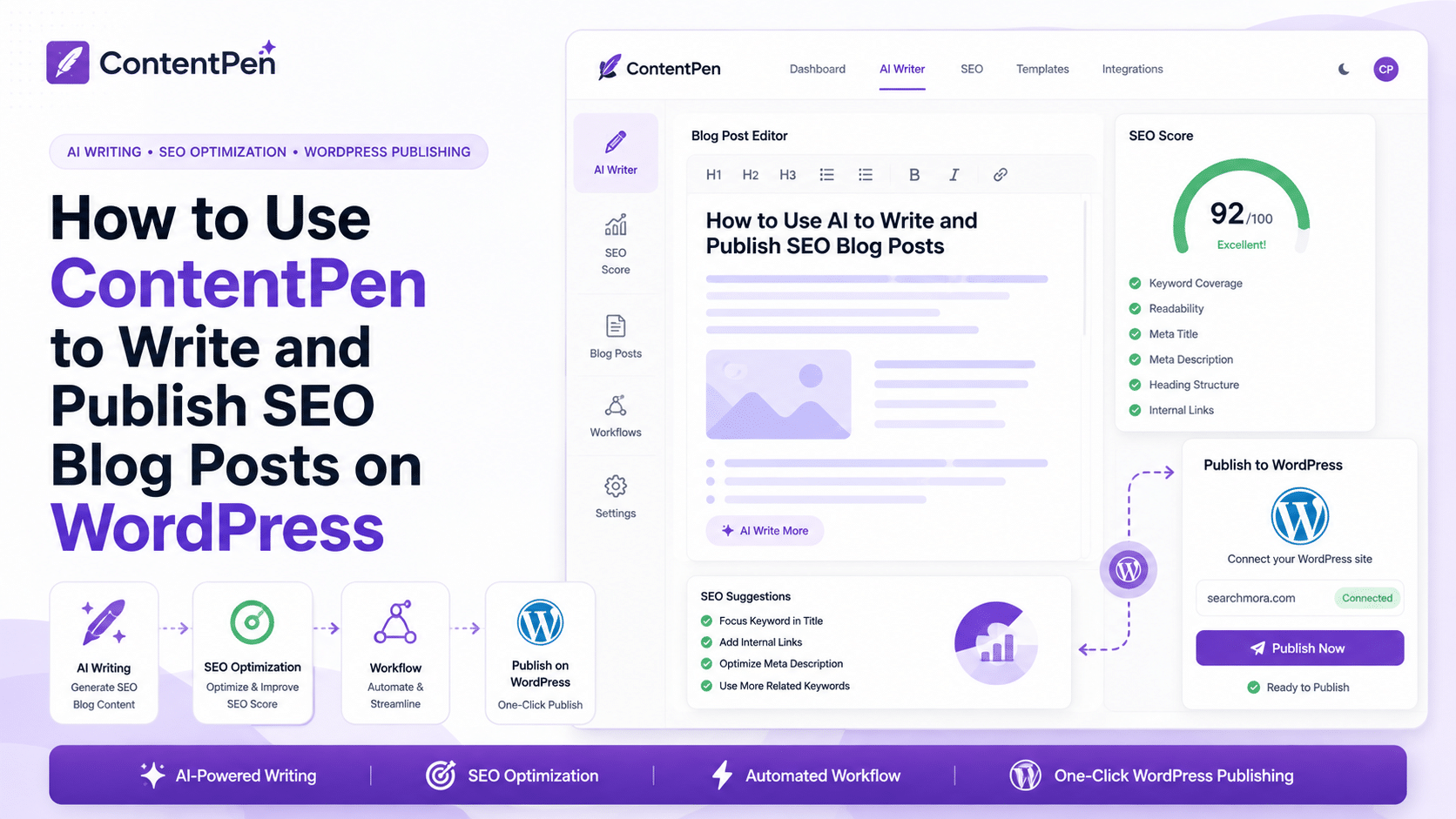
ContentPen supports direct publishing to CMS platforms such as WordPress.
This can reduce:
- Copying and pasting.
- Reformatting.
- Image handling.
- Repeated manual setup.
- Publishing delays.
Always review the live page after publishing.
Check:
- Mobile formatting.
- Headings.
- Links.
- Images.
- Metadata.
- Tables.
- Affiliate disclosures.
- CTA buttons.
🔄 Content Refresh Opportunities
Higher plans include content performance and refresh-related features.
These can help identify:
- Content decay.
- CTR declines.
- Quick-win articles.
- Pages worth updating.
- Search Console-based opportunities.
This is especially useful for established blogs.
A mature site often has more value hidden in old content than in another batch of new articles.
💰 ContentPen Pricing and Value
ContentPen offers content platform plans for different publishing volumes.
At the time of writing, the standard monthly prices are:
| Plan | Monthly Price | Annual Monthly Equivalent | Articles per Month | Best For |
|---|---|---|---|---|
| Starter | $39/month | $27/month billed annually | 10 | Bloggers testing the workflow |
| Premium | $79/month | $55/month billed annually | 30 | Affiliate site owners, freelancers, and small businesses |
| Agency | $199/month | $139/month billed annually | 100 | Agencies and higher-volume content teams |
| Custom | Custom pricing | Custom pricing | Custom | Brands needing tailored limits |
Prices may change over time, so always check the current pricing page before subscribing.
Here is how I would think about value:
| User Type | Best Starting Point | Why |
|---|---|---|
| New blogger | Starter or trial | Test whether the workflow saves time before committing. |
| Established blogger | Premium | Useful for regular publishing and content refresh workflows. |
| Affiliate site owner | Premium | Strong balance of volume, bulk features, and analytics. |
| Freelancer | Premium | Suitable for several active content projects. |
| Small agency | Agency | Higher volume, workspaces, and team access. |
| Large content team | Custom | Better when limits and integrations need customization. |
The strongest pricing question is not:
“Is ContentPen cheap?”
The better question is:
“Will it save enough time and improve enough content to justify the monthly cost?”
For users publishing one article every few months, probably not.
For users publishing and refreshing content every week, the value becomes clearer.
📊 Real-World Evidence: What External Sources Show
ContentPen is a newer platform, and I did not find a credible independent case study with clearly documented before-and-after traffic numbers that I would confidently present as proof.
That is worth stating clearly.
The available external evidence supports the workflow, not guaranteed ranking results.
External source: Capterra’s ContentPen software listing and the WordPress Plugin Directory.
Capterra describes ContentPen as an AI-based blogging platform designed to automate parts of the workflow from keyword research to publication. The listing highlights features related to SEO and GEO optimization, competitor analysis, content generation, multilingual support, CMS publishing, and performance tracking.
The WordPress Plugin Directory also describes ContentPen as an AI-powered writing assistant for creating, optimizing, and publishing SEO-friendly blog content. It highlights a multi-step workflow that includes brand analysis, keyword selection, topic research, drafting, optimization, and publishing.
| Evidence Point | What It Means for Users |
|---|---|
| External software listing | Supports ContentPen’s position as an end-to-end blogging workflow platform. |
| WordPress Plugin Directory presence | Confirms that WordPress publishing is a real part of the workflow. |
| SEO and GEO optimization mentioned externally | Supports its relevance for traditional and AI-powered search workflows. |
| Content generation and publishing support | Confirms that the platform aims to reduce manual production steps. |
| No strong independent traffic case study found | Users should test ContentPen on their own site instead of expecting guaranteed growth. |
For bloggers and affiliate marketers, the fair conclusion is simple:
ContentPen may save time and simplify content operations.
It does not replace strategy, editing, authority, or patience.
✅ ContentPen Pros and Cons for Bloggers and Affiliate Sites
✅ Pros
| Pro | Why It Matters |
|---|---|
| End-to-end workflow | Helps move from keyword research to publishing faster. |
| SEO and GEO scoring | Useful for traditional search and AI-driven discovery workflows. |
| Keyword research and SERP analysis | Adds planning before drafting. |
| Automated internal links | Helps support topic clusters and money pages. |
| CMS publishing | Saves formatting and publishing time. |
| Content refresh features | Useful for established sites with older articles. |
| Bulk article generation on higher plans | Helpful for consistent publishing workflows. |
| AI images | Adds visual support for informational posts. |
| Knowledge base on higher plans | Helps improve brand consistency. |
❌ Cons
| Con | Why It Matters |
|---|---|
| Drafts still need editing | Raw AI content can be generic, repetitive, or inaccurate. |
| No guaranteed rankings | SEO results still depend on quality, authority, links, and competition. |
| Affiliate content needs genuine insight | AI cannot replace honest product testing or original screenshots. |
| Not a full SEO suite | You may still need tools for backlinks, audits, and advanced tracking. |
| Advanced features require higher plans | Analytics and refresh workflows are not available on every plan. |
| Specialist tools may be stronger | Dedicated tools can offer deeper optimization, clustering, or crawling. |
| Limited independent case-study evidence | Buyers should test the workflow before scaling usage. |
✅ When I Would Use ContentPen
I would use ContentPen if I needed:
- A faster path from keyword idea to published article.
- More consistent informational support content.
- Better topic cluster production.
- AI-assisted outlines and first drafts.
- Automated internal linking.
- WordPress publishing support.
- SEO and GEO scoring.
- Content refresh ideas.
- A more organized content workflow.
- Fewer disconnected tools.
For a growing affiliate site, ContentPen becomes especially useful when the bottleneck is production.
It helps the team move faster.
❌ When I Would Not Use ContentPen
I would not use ContentPen if I needed:
- Fully automated content with no editing.
- Genuine product experience without real testing.
- Deep backlink analysis.
- Technical SEO crawling.
- Enterprise keyword clustering.
- Advanced SEO reporting.
- Digital PR workflows.
- Conversion optimization.
- A free, unlimited writing tool.
- Guaranteed ranking results.
The biggest mistake is expecting AI automation to replace trust.
It cannot.
🔁 ContentPen Alternatives
ContentPen is useful for end-to-end AI blogging workflows, but another tool may be a better fit for a specific bottleneck.
| Visit Website | Tool | Best For | Why Choose It Instead of ContentPen |
|---|---|---|---|
| Visit Review | KoalaWriter | Fast AI SEO drafts | Better if your main priority is producing affiliate and niche-site article drafts quickly. |
| Visit Website | NeuronWriter | Budget content optimization | Better if you already have drafts and need deeper semantic SEO scoring. |
| Visit Website | Frase | SERP research and briefs | Better if your main priority is research-heavy content planning. |
| Visit Review | Jasper | Brand-focused marketing content | Better for brand voice, marketing campaigns, and broader content teams. |
| Visit Website | GetGenie | WordPress-native AI content | Better if you want AI writing directly inside WordPress. |
| Visit Review | Surfer SEO | Premium content optimization | Better if advanced SERP-based content scoring matters more than publishing automation. |
| Visit Review | WriterZen | Keyword clustering and planning | Better if keyword organization is your main bottleneck. |
| Visit Website | Link Whisper | Internal linking | Better if your site mainly needs internal linking improvements. |
The clearest alternative decision is simple:
- Choose ContentPen for workflow breadth.
- Choose KoalaWriter for faster drafts.
- Choose NeuronWriter for deeper optimization.
- Choose WriterZen for clustering.
- Choose Link Whisper for internal links.
- Choose GetGenie for a WordPress-first workflow.

🧪 My Practical 30-Day ContentPen Workflow
A 30-day test is the fairest way to decide whether ContentPen is worth paying for.
Week 1: Build One Topic Cluster
Choose one content category.
For example:
- Smart pet feeders.
- AI SEO tools.
- Internal linking tools.
- Local SEO tools.
- WordPress plugins.
Create a list of:
- One pillar page.
- Three supporting informational articles.
- One comparison article.
- One FAQ article.
Week 2: Create and Edit Drafts
Use ContentPen to create first drafts.
Then manually improve:
- Accuracy.
- Search intent.
- Examples.
- Titles.
- Headings.
- Tables.
- Internal links.
- Calls to action.
- Affiliate disclosures.
- Product claims.
Week 3: Publish and Connect the Cluster
Publish the strongest pages.
Add internal links:
- From support content to the pillar page.
- From the pillar page to support articles.
- From informational content to commercial pages.
- From older relevant posts to new content.
Week 4: Refresh Existing Content
Choose two older pages.
Improve:
- Titles.
- Introductions.
- Outdated sections.
- Internal links.
- FAQ questions.
- Content depth.
- Screenshots.
- Calls to action.
Then track results in Google Search Console for the following 60–90 days.
The final question is not:
“How many articles did ContentPen generate?”
The better question is:
“Did ContentPen help me publish better content more consistently without lowering quality?”
⚠️ Common Mistakes When Using ContentPen
1. Publishing Raw AI Drafts
AI output is a starting point.
Edit every article carefully.
2. Writing Without Search Intent
A good draft cannot fix the wrong page type.
Review the SERP before publishing.
3. Claiming Fake Product Experience
Never say you tested a tool or product unless you genuinely did.
Trust matters.
4. Approving Every Internal Link Automatically
Review every link for relevance.
More links are not always better.
5. Ignoring Older Content
Do not publish endlessly while old pages decline.
Refresh important articles.
6. Choosing a Plan Based Only on Article Limits
Consider whether you need analytics, refresh workflows, bulk generation, or multiple workspaces.
7. Relying on SEO Scores Alone
A score is a guide.
Helpful content is the goal.
8. Expecting Instant Results
SEO takes time.
Evaluate rankings, impressions, and clicks over 60–90 days.
❓ FAQ
1. Is ContentPen good for bloggers?
Yes. ContentPen can help bloggers research topics, generate drafts, improve SEO and GEO scoring, add links, publish to WordPress, and refresh older articles faster.
2. Is ContentPen good for affiliate sites?
Yes. ContentPen can help affiliate site owners create informational support content, structure review drafts, plan comparison articles, add internal links, and update old posts. Human editing and genuine product research remain essential.
3. Can ContentPen write product reviews?
ContentPen can draft the structure of a product review, but it cannot replace a genuine product experience. You should verify every claim and add original screenshots, comparisons, and buying guidance when possible.
4. Does ContentPen support WordPress?
Yes. ContentPen supports direct CMS publishing workflows, including WordPress publishing.
5. Does ContentPen help with internal linking?
Yes. ContentPen can automate internal link placement based on relevance and site structure. Every suggested link should still be reviewed manually.
6. How much does ContentPen cost?
At the time of writing, ContentPen costs $39/month for Starter, $79/month for Premium, and $199/month for Agency. Annual billing reduces the monthly equivalent. Prices may change, so check the official pricing page before subscribing.
7. Is ContentPen better than KoalaWriter?
ContentPen may be better if you want research, optimization, links, publishing, and refresh workflows in one platform. KoalaWriter may be better if your main priority is fast AI SEO drafts.
8. Is ContentPen better than NeuronWriter?
ContentPen is better for end-to-end content production. NeuronWriter is usually better if your main need is deeper semantic content optimization.
9. Does ContentPen guarantee rankings?
No. ContentPen can improve workflow speed and content organization, but rankings depend on search intent, quality, authority, backlinks, internal links, technical SEO, competition, and consistent execution.
🏁 Final Verdict: Is ContentPen Worth It for Bloggers and Affiliate Sites?
ContentPen is worth considering for bloggers and affiliate site owners who want a faster, more organized way to research, create, optimize, refresh, and publish content.
Its biggest advantage is workflow consolidation.
Instead of using separate platforms for every stage, users can bring keyword research, SERP analysis, drafting, SEO scoring, GEO optimization, linking, images, publishing, and refreshing ideas into one content workflow.
That can save time.
But ContentPen is not a shortcut to authority.
It will not replace product testing, editorial judgment, original screenshots, honest recommendations, internal linking strategy, or patient SEO execution.
My final recommendation is simple:
Use ContentPen if your main bottleneck is publishing and refreshing useful content consistently.
Skip ContentPen if you want fully automated content with no editing, deep technical SEO, or specialist-level backlink analysis.
For affiliate site owners, the strongest use case is not generating hundreds of generic reviews.
It is building useful content clusters that support real buying guides and commercial pages.
The clearest takeaway is this: ContentPen can make your workflow faster, but your editorial quality is what makes the content worth ranking.
📚 Recommended Next Reads
- ContentPen Review: Is This AI Blog Writer Worth It?
- Best AI SEO Tools Tested for Bloggers and Affiliate Sites
- KoalaWriter Review: Is This AI SEO Writer Worth It?
- NeuronWriter Review: Is This Budget-Friendly SEO Content Optimizer Worth It?
- GetGenie Review: Is This WordPress AI SEO Content Tool Worth It?


Comments 4