Best AI Tools Tested for E-commerce SEO: Product Pages, Schema, AI Visibility, and Scalable Optimization
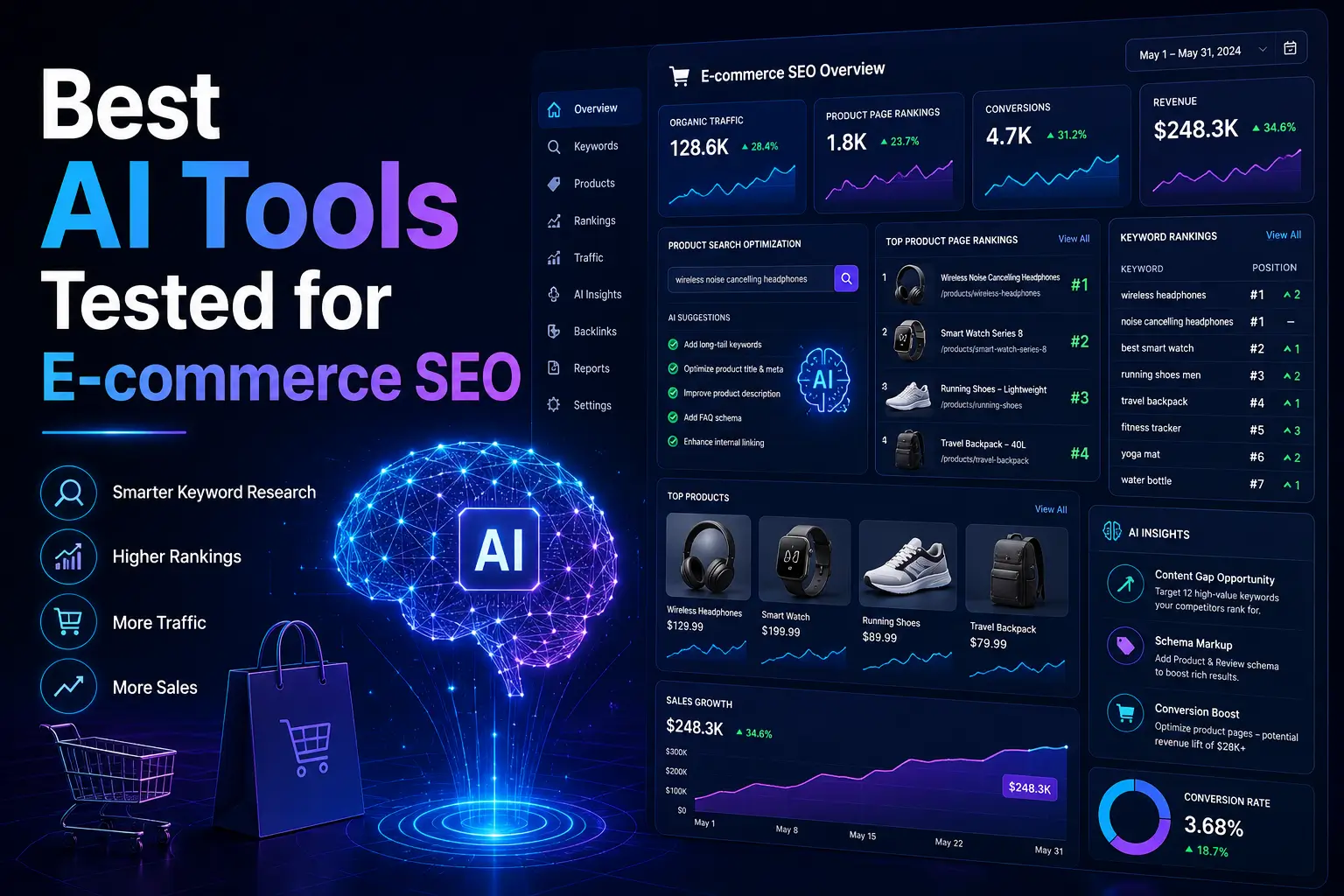
The best AI tools for e-commerce SEO help online stores improve product pages, category pages, product schema, internal linking, bulk description generation, review insights, and AI visibility. The goal is not to generate more product text. The goal is to build clearer, more useful, better-structured store pages that can rank, convert, and be understood by search and AI systems.
✨ Introduction
E-commerce SEO is harder than regular blog SEO.
A store needs more than helpful articles. It needs optimized product pages, category pages, collection pages, product schema, image SEO, internal links, reviews, filters, product feeds, and scalable content workflows.
That is where AI tools can help.
The right AI SEO tools can speed up keyword research, rewrite product descriptions, improve category page copy, detect technical issues, generate schema ideas, analyze customer reviews, optimize internal links, and identify content gaps across large product catalogs.
But there is a risk.
If you use AI only to mass-generate product descriptions, you can create thin, repetitive, low-value content. That is not a strong long-term SEO strategy.
A better approach is to use AI as an optimization assistant. Let tools help with structure, research, scale, review insights, quality control, and workflow speed — then use human editing to make sure the final page is accurate, useful, and conversion-focused.
This guide breaks down the best AI tools tested for e-commerce SEO, where each tool fits, what each one does well, and how to build a practical SEO stack for your online store.
⚡ Quick Verdict
AI tools are most useful for e-commerce SEO when they solve a specific workflow problem: product schema, category optimization, product descriptions, internal linking, technical audits, review analysis, image optimization, affiliate tracking, originality checks, local SEO, or AI visibility tracking.
The strongest setup is usually not one tool. It is a small stack.
| Use Case | Best Tool |
|---|---|
| Best overall e-commerce SEO platform | Semrush |
| Best all-in-one affordable SEO platform | SE Ranking |
| Best SEO research and competitor analysis | Ahrefs |
| Best long-tail keyword research | LowFruits or Mangools KWFinder |
| Best category content optimization | Surfer SEO, Frase, or NeuronWriter |
| Best WooCommerce product schema | Rank Math |
| Best advanced schema platform | Schema App |
| Best bulk product content drafting | ChatGPT, Jasper, Writesonic, Agility Writer, or ContentPen |
| Best internal linking | Link Whisper |
| Best technical SEO audits | Screaming Frog or Sitebulb |
| Best SEO automation | Alli AI, Search Atlas, OTTO SEO |
| Best AI visibility tracking | Profound, Semrush AI Visibility Toolkit, Promptwatch, RankScale, or OtterlyAI |
| Best originality and AI content checks | Originality.ai |
| Best local e-commerce SEO | Localo or Local Falcon |
| Best affiliate tracking for stores | Tapfiliate |
| Best free starting stack | Google Search Console, GA4, Merchant Center, and Rich Results Test |
My practical recommendation: start with technical SEO, schema, product data, and category pages before scaling AI-generated product descriptions. Product content matters, but structure, data quality, internal links, and trust signals often matter just as much for e-commerce SEO.
📚 Recommended Reads
- Best AI SEO Tools Tested This Year
- Best AI Visibility Tools Tested
- How to Optimize for AI Search
- AI SEO vs Traditional SEO
- What Is GEO?
📌 In This Guide
1. 🛒 What Makes AI Tools Useful for E-commerce SEO?
2. 🧰 Best AI Tools Tested for E-commerce SEO
3. 🧩 Best AI Tools by E-commerce SEO Use Case
4. 🏷️ Product Schema and Structured Data Tools
5. 🤖 AI Visibility Tools for E-commerce SEO
6. 🧱 Recommended E-commerce SEO Stack
7. 📊 E-commerce SEO Tool Comparison Table
8. ⚠️ Common E-commerce SEO Tool Mistakes
9. ❓ FAQ
🛒 What Makes AI Tools Useful for E-commerce SEO?
A good AI tool for e-commerce SEO should help you improve store visibility without creating low-quality, repetitive product pages.
Online stores often face problems that normal blogs do not:
- Hundreds or thousands of product pages
- Duplicate product descriptions
- Thin category pages
- Missing product schema
- Poor internal linking
- Faceted navigation issues
- Outdated product information
- Weak review usage
- Poor image optimization
- Product variants that create SEO confusion
- Product pages with no unique value
AI tools can help with these problems, but only when used carefully.
A useful e-commerce SEO tool should help you:
- Find product and category keywords
- Improve product descriptions
- Optimize category pages
- Add structured product information
- Identify technical issues
- Improve internal links
- Analyze customer reviews
- Create better buying guides
- Refresh old product pages
- Track AI search visibility
- Check originality and content quality
- Scale content without losing accuracy
The biggest mistake is thinking AI can fully replace e-commerce SEO judgment.
It cannot.
AI can speed up work, but your store still needs accurate product data, clear descriptions, helpful comparison content, strong category pages, good user experience, and trustworthy information.
🧰 Best AI Tools Tested for E-commerce SEO
1. Semrush
Semrush is one of the strongest overall platforms for e-commerce SEO because it covers keyword research, competitor analysis, technical audits, content planning, rank tracking, and AI visibility.
It is especially useful for online stores that need a complete SEO workflow instead of one narrow tool.
Best For
- E-commerce brands
- Shopify stores
- WooCommerce stores
- SEO teams
- Agencies
- Larger product catalogs
- Stores competing in difficult niches
What It Does Well
Semrush helps you understand how competitors get traffic, which keywords matter, and where your store has gaps.
For e-commerce SEO, I would use Semrush to:
- Find product and category keywords
- Analyze competitor category pages
- Discover comparison and buying-guide topics
- Audit technical SEO issues
- Track rankings
- Monitor competitors
- Find content gaps
- Review backlink opportunities
- Track AI visibility signals
It is a strong platform when SEO is a serious growth channel for your store.
Pros
- Strong keyword research
- Good competitor analysis
- Useful technical audits
- Helpful for category and content planning
- Can support AI visibility workflows
- Good fit for agencies and teams
Cons
- Can be expensive for small stores
- May feel overwhelming for beginners
- Some features may be more than a small store needs
- Requires a clear workflow to get full value
I Would Use It If You Need:
A serious all-in-one SEO and visibility platform for an online store.
I Would Not Use It If You Need:
A cheap tool only for writing product descriptions.
Why It Stands Out
Semrush stands out because e-commerce SEO is not only about content writing. Stores also need audits, competitors, rankings, category research, product opportunities, and visibility tracking.
Go to Semrush
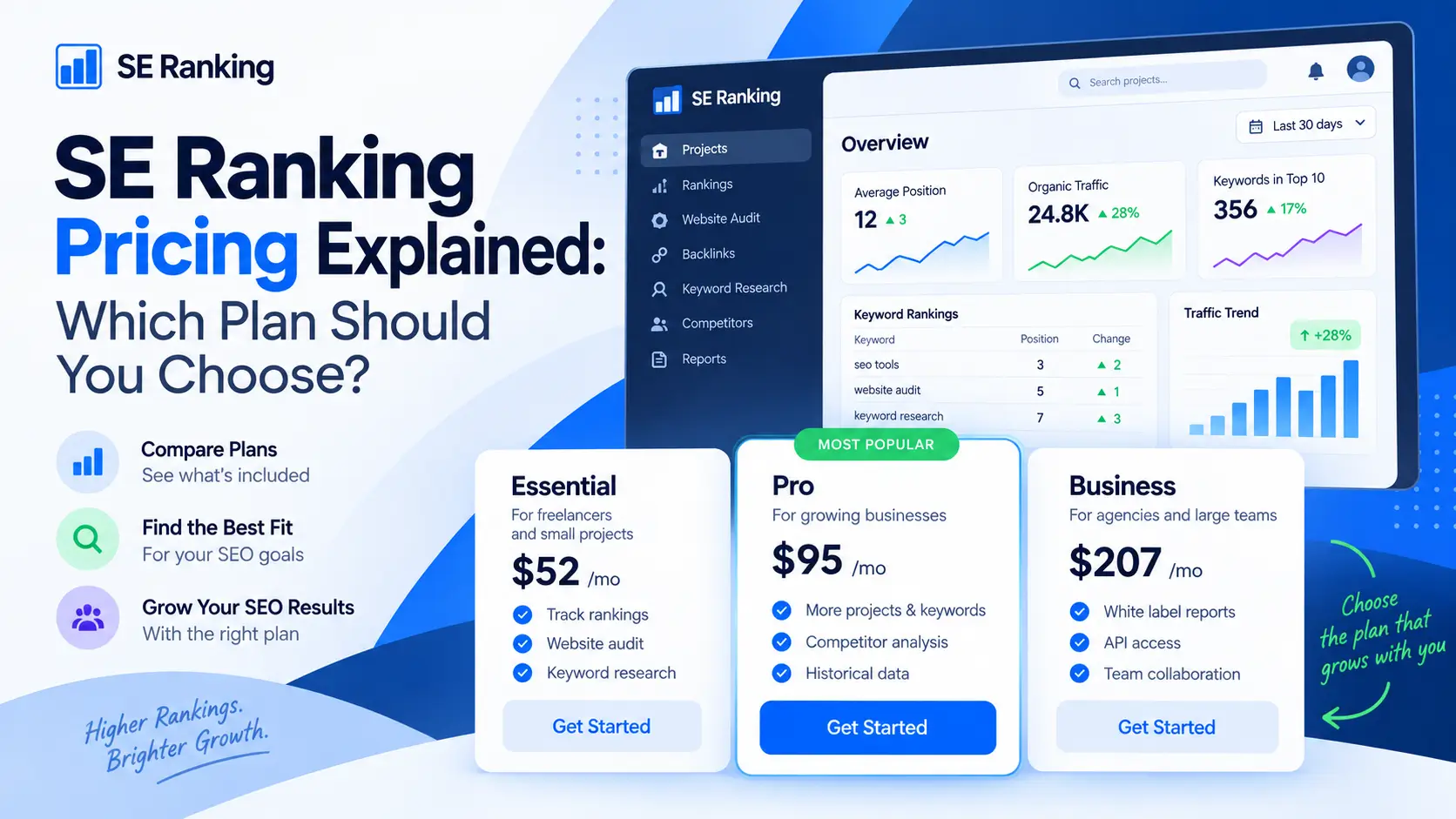
2. SE Ranking
SE Ranking is a strong all-in-one SEO platform for e-commerce teams that want keyword research, rank tracking, audits, competitor analysis, and reporting without jumping immediately into the highest-cost SEO suites.
It is especially useful for small to mid-sized stores, agencies, and teams that want a balanced SEO platform.
Best For
- Budget-conscious e-commerce teams
- Small and mid-sized stores
- Agencies
- Rank tracking
- Competitor monitoring
- SEO reporting
What It Does Well
SE Ranking helps store owners and SEO teams manage core SEO tasks in one place.
For e-commerce SEO, I would use it to:
- Track product and category rankings
- Monitor competitors
- Run website audits
- Research keywords
- Build reports
- Track SEO progress over time
It can be a practical alternative if Semrush feels too expensive or too advanced for your current stage.
Pros
- More accessible than some enterprise SEO tools
- Good rank tracking
- Useful site audits
- Helpful competitor monitoring
- Strong fit for small teams and agencies
Cons
- May not have the same depth as Semrush or Ahrefs in every area
- Still requires SEO experience
- Not mainly an AI writing tool
- Best when paired with content optimization tools
I Would Use It If You Need:
An affordable all-in-one SEO platform for e-commerce tracking, audits, and competitor monitoring.
I Would Not Use It If You Need:
The deepest enterprise SEO data or advanced AI visibility intelligence.
Why It Stands Out
SE Ranking stands out because many stores need a serious SEO platform, but not every store can justify a high-cost enterprise stack.
Go to SE Ranking
3. Ahrefs
Ahrefs is one of the best tools for e-commerce keyword research, competitor research, backlink analysis, and content gap discovery.
It is not mainly an AI writing tool, but it is still extremely useful for AI-assisted e-commerce SEO because it helps you choose better targets before creating or optimizing pages.
Best For
- SEO professionals
- Affiliate e-commerce sites
- Product comparison sites
- Store owners focused on research
- Teams that care about competitor and backlink data
What It Does Well
Ahrefs helps you find which products, categories, and comparison topics are worth targeting.
For e-commerce SEO, I would use Ahrefs to:
- Research product keywords
- Find category page opportunities
- Analyze competitor traffic
- Discover “best,” “vs,” and “alternative” topics
- Find backlink gaps
- Study competitor buying guides
- Prioritize pages with realistic ranking potential
Ahrefs is especially useful if your store competes in a market where backlinks and authority matter.
Pros
- Strong keyword data
- Excellent competitor research
- Useful backlink analysis
- Good for finding content gaps
- Strong for category and comparison research
Cons
- Not a product description generator
- Can be expensive for small stores
- Best paired with a content optimization or writing tool
- May be too advanced for complete beginners
I Would Use It If You Need:
A research-first tool for choosing better e-commerce SEO opportunities.
I Would Not Use It If You Need:
A tool that directly edits product pages or writes all content for you.
Why It Stands Out
Ahrefs is valuable because many e-commerce SEO failures start with choosing the wrong keywords. Ahrefs helps reduce that risk.
Go to Ahrefs
4. Mangools KWFinder
Mangools KWFinder is a practical keyword research tool for stores that need simpler keyword discovery without the complexity of a full enterprise SEO suite.
It is useful for finding long-tail product categories and buying-intent keywords.
Best For
- Smaller e-commerce stores
- Beginners
- Long-tail keyword research
- Product niche research
- Blog and buying-guide ideas
What It Does Well
KWFinder helps users discover keyword opportunities that may be easier to target than broad competitive terms.
For e-commerce SEO, I would use it to find:
- Product-specific long-tail keywords
- Category keyword variations
- “Best product for” queries
- Question keywords
- Low-competition buying guide ideas
- Niche product opportunities
It is especially useful when you want a simpler workflow than Semrush or Ahrefs.
Pros
- Beginner-friendly
- Good for long-tail keywords
- Useful for niche stores
- Cleaner interface than many advanced tools
- Practical for content planning
Cons
- Not a full e-commerce SEO platform
- Less advanced competitor data than larger suites
- Not a technical audit tool
- Needs pairing with optimization and analytics tools
I Would Use It If You Need:
A simple keyword research tool for finding product and category opportunities.
I Would Not Use It If You Need:
A full SEO platform with audits, rank tracking, AI visibility, and backlink analysis.
Why It Stands Out
Mangools KWFinder stands out because many small stores need keyword clarity before they need a complex SEO command center.
Go to Mangools KWFinder
5. LowFruits
LowFruits is useful for finding low-competition keyword opportunities, especially for smaller sites and niche e-commerce blogs.
It can help stores find underserved topics where weaker pages already rank.
Best For
- Niche e-commerce sites
- Affiliate stores
- Small blogs supporting product pages
- Long-tail SEO
- Low-competition keyword discovery
What It Does Well
LowFruits is helpful when you need realistic ranking opportunities.
For e-commerce SEO, I would use it to find:
- Low-competition buying guide keywords
- Product comparison opportunities
- Niche questions
- Weak SERPs
- Long-tail content ideas
- Informational posts that support product pages
This is especially valuable for newer stores that cannot compete immediately for broad category keywords.
Pros
- Good for low-competition keyword research
- Useful for small sites
- Practical for niche content planning
- Helps avoid overly competitive keywords
- Good fit for affiliate-style e-commerce content
Cons
- Not a full SEO suite
- Not a product schema tool
- Not a technical crawler
- Needs pairing with content and analytics tools
I Would Use It If You Need:
Low-competition keyword ideas for e-commerce content and buying guides.
I Would Not Use It If You Need:
A full platform for audits, rank tracking, content optimization, and AI visibility.
Why It Stands Out
LowFruits stands out because many e-commerce sites fail by targeting keywords that are too competitive too early.
Go to LowFruits
6. Surfer SEO
Surfer SEO is one of the best tools for optimizing product category pages, buying guides, comparison pages, and supporting blog content.
It is not the first tool I would use for thousands of short product descriptions, but it is strong for important SEO landing pages that need better structure and topical coverage.
Best For
- Category pages
- Buying guides
- Comparison posts
- Product collection pages
- Affiliate content
- Content teams that need guided optimization
What It Does Well
Surfer helps you compare your content against top-ranking pages and improve topical coverage.
For e-commerce SEO, I would use it for:
- Category page copy
- “Best product” articles
- Product comparison pages
- Buyer guides
- Collection page introductions
- Supporting blog posts
- Content refreshes
It is useful when you want to improve an important page before publishing or updating it.
Pros
- Strong content editor
- Useful for on-page optimization
- Helpful for category and guide content
- Easy for writers to follow
- Good for content refresh workflows
Cons
- Can encourage over-optimization if used blindly
- Not built specifically for product feeds
- Not ideal for huge bulk product catalogs by itself
- Requires human editing
I Would Use It If You Need:
Better content optimization for category pages, buying guides, and commercial SEO pages.
I Would Not Use It If You Need:
A technical e-commerce SEO crawler or product schema tool.
Why It Stands Out
Surfer is useful because category pages and buying guides often need more than keywords. They need structure, clarity, and complete topic coverage.
Go to Surfer SEO
7. Frase
Frase is a strong research-to-brief tool for e-commerce content teams that need better outlines, answer-focused pages, and AI-search-friendly content.
It can help build content that answers buyer questions more clearly.
Best For
- E-commerce content teams
- SaaS-commerce brands
- Affiliate stores
- Buying guides
- FAQ-driven product content
- GEO and AEO workflows
What It Does Well
Frase is useful when you need to understand what competitors cover and turn that research into a structured brief.
For e-commerce SEO, Frase can help with:
- Product buying guides
- Category page briefs
- FAQ sections
- Comparison content
- Answer-focused content
- Content refreshes
- GEO/AEO-friendly structure
It is especially helpful when shoppers ask specific questions before buying.
Pros
- Strong research workflow
- Helpful for briefs and outlines
- Good for answer-focused content
- Useful for FAQ development
- Works well for commercial content planning
Cons
- Not a full SEO suite
- Not a product schema tool
- Needs editorial review
- May be too much for very small stores
I Would Use It If You Need:
A tool for turning product and category research into better briefs and answer-friendly pages.
I Would Not Use It If You Need:
A technical audit tool or a full e-commerce platform plugin.
Why It Stands Out
Frase is strong for e-commerce SEO because shoppers often search with questions. Frase helps you build content that answers those questions clearly.
Go to Frase
8. NeuronWriter
NeuronWriter is a budget-friendly content optimization tool that can help e-commerce teams improve category pages, buying guides, and commercial blog content.
It is often used as a lower-cost alternative to premium content optimization platforms.
Best For
- Budget-conscious stores
- Affiliate e-commerce sites
- Category page optimization
- Buying guides
- Smaller content teams
What It Does Well
NeuronWriter helps optimize content based on competing pages and related terms.
For e-commerce SEO, I would use it to improve:
- Collection pages
- Category content
- Buying guides
- Product comparison posts
- FAQ sections
- Existing pages with weak topical coverage
It is useful when you want content scoring and optimization guidance without paying for a more expensive platform.
Pros
- Affordable
- Useful content optimization workflow
- Good for smaller sites
- Practical for affiliate-style content
- Helpful for content refreshes
Cons
- Interface may feel less polished than premium tools
- Not a technical SEO crawler
- Not a schema tool
- Recommendations still need human judgment
I Would Use It If You Need:
A lower-cost content optimization tool for the e-commerce category and guides content.
I Would Not Use It If You Need:
A full SEO suite, product feed tool, or advanced AI visibility platform.
Why It Stands Out
NeuronWriter stands out because many e-commerce sites need optimization help but cannot justify expensive tools immediately.
Go to NeuronWriter
9. Rank Math
Rank Math is one of the most practical SEO plugins for WooCommerce stores, especially when product schema and on-page SEO are priorities.
For WordPress and WooCommerce users, Rank Math can help manage SEO titles, meta descriptions, schema markup, breadcrumbs, sitemaps, and other on-page SEO elements.
Best For
- WooCommerce stores
- WordPress websites
- Product schema
- On-page SEO
- Store owners who want plugin-based SEO control
What It Does Well
Rank Math is useful for managing product-level SEO settings inside WordPress.
For e-commerce SEO, I would use Rank Math to help with:
- Product schema
- SEO titles and descriptions
- Breadcrumbs
- Canonical settings
- XML sitemaps
- Basic on-page optimization
- WooCommerce SEO settings
It is especially useful for store owners who want better structured data without manually writing JSON-LD for every product.
Pros
- Good fit for WooCommerce
- Useful schema features
- Easy to manage inside WordPress
- Helpful for titles and metadata
- Practical for small and mid-sized stores
Cons
- WordPress/WooCommerce focused
- Not a full competitor research platform
- Schema still needs testing
- An incorrect setup can create structured data issues
I Would Use It If You Need:
A WooCommerce-friendly SEO plugin with product schema and on-page SEO controls.
I Would Not Use It If You Need:
A Shopify SEO app or enterprise schema management platform.
Why It Stands Out
Rank Math stands out because product schema is not optional for serious e-commerce SEO. It helps WooCommerce stores manage that layer more easily.
Go to Rank Math
10. Schema App
Schema App is a stronger option for teams that need advanced structured data management beyond basic plugin settings.
It is useful for larger stores, complex websites, and teams that want more control over schema markup.
Best For
- Larger e-commerce stores
- Enterprise SEO teams
- Complex schema needs
- Multi-template websites
- Brands that need structured data governance
What It Does Well
Schema App helps manage structured data at a more advanced level.
For e-commerce SEO, structured data can support:
- Product information
- Price
- Availability
- Reviews
- Ratings
- Breadcrumbs
- Organization details
- FAQs
- Shipping and return details were applicable
This can help search systems understand product pages more accurately.
Pros
- Advanced structured data support
- Better for complex websites
- Useful for enterprise workflows
- Helps manage schema at scale
- Stronger than basic manual schema setups
Cons
- May be too advanced for small stores
- More expensive than simple plugins
- Requires structured data knowledge
- Not a keyword research tool
I Would Use It If You Need:
Advanced structured data management for a larger or more complex e-commerce site.
I Would Not Use It If You Need:
A simple free plugin for a small WooCommerce store.
Why It Stands Out
Schema App stands out because schema can become difficult at scale. Larger stores often need more control than a basic plugin can provide.
Go to Schema App
11. ChatGPT
ChatGPT can be useful for e-commerce SEO when used as a drafting, rewriting, ideation, and workflow assistant.
It should not be used to blindly mass-publish product descriptions. That is where many stores go wrong.
Best For
- Product description drafts
- Category page ideas
- FAQ generation
- Review summarization
- Content refresh support
- Meta description variations
- Brief creation
What It Does Well
ChatGPT is flexible.
For e-commerce SEO, I would use it to:
- Rewrite manufacturer descriptions
- Create first drafts of product descriptions
- Generate FAQ ideas
- Summarize customer reviews
- Create comparison tables
- Draft category page introductions
- Suggest internal link opportunities
- Turn product features into benefit-driven copy
But every output should be edited.
Product content must be accurate. If an AI tool invents a feature, size, material, compatibility detail, or warranty claim that can damage trust and conversions.
Pros
- Very flexible
- Useful for bulk drafting
- Helpful for brainstorming
- Good for turning features into benefits
- Can support many content workflows
Cons
- Can generate inaccurate details
- Needs careful editing
- Can produce generic copy
- Not an SEO platform by itself
- Not connected to your live product data unless integrated carefully
I Would Use It If You Need:
A flexible AI assistant for drafting and improving e-commerce content.
I Would Not Use It If You Need:
A tool that automatically guarantees accurate product data or SEO performance.
Why It Stands Out
ChatGPT stands out because it can support many small e-commerce SEO tasks, but its value depends heavily on your prompts, inputs, and editing process.
Go to ChatGPT
12. Jasper
Jasper is a strong AI writing platform for brands that need more controlled marketing copy, product descriptions, and campaign content.
It is more structured than a simple chatbot workflow and can be useful for teams that care about brand voice.
Best For
- E-commerce brands
- Marketing teams
- Product description workflows
- Ad copy
- Email copy
- Brand voice consistency
- Content repurposing
What It Does Well
Jasper is useful when your store needs repeatable content production with a more consistent voice.
For e-commerce SEO, it can help with:
- Product descriptions
- Category page copy
- Landing page content
- Email campaigns
- Ad copy
- Social captions
- Content repurposing
- Brand voice workflows
It is strongest when paired with SEO research and human editing.
Pros
- Good for brand voice
- Useful for marketing teams
- Speeds up drafting
- Helpful for content repurposing
- More structured than basic AI drafting
Cons
- Not a full SEO platform
- Needs research input
- Can still produce generic content
- May be unnecessary for very small stores
I Would Use It If You Need:
A branded AI writing workflow for product and marketing content.
I Would Not Use It If You Need:
Keyword research, technical audits, schema, or AI visibility tracking.
Why It Stands Out
Jasper stands out because e-commerce content is not only SEO copy. Stores also need branded products, email, and campaign content.
Go to Jasper
13. Agility Writer
Agility Writer can help e-commerce teams create long-form SEO content around product categories, buying guides, comparisons, and supporting blog posts.
It is more relevant for content-heavy stores than for pure product data management.
Best For
- Buying guides
- Affiliate e-commerce content
- Product comparison articles
- Supporting blog content
- Content scaling
What It Does Well
Agility Writer can help speed up long-form content production.
For e-commerce SEO, I would use it for:
- “Best product” articles
- Comparison posts
- Buyer guides
- Category support content
- Informational articles that link to product pages
It should still be paired with keyword research, product accuracy checks, and editorial review.
Pros
- Useful for long-form content production
- Good for affiliate-style articles
- Helps scale supporting content
- Can speed up content workflows
Cons
- Not a product schema tool
- Not a technical SEO crawler
- Needs fact-checking and editing
- Can create generic content if inputs are weak
I Would Use It If You Need:
Long-form e-commerce SEO content at scale.
I Would Not Use It If You Need:
Product feed management, structured data, or technical SEO audits.
Why It Stands Out
Agility Writer stands out for stores and affiliate sites that need supporting content around commercial product topics.
Go to Agility Writer
14. ContentPen
ContentPen is another AI content tool that can support e-commerce blogs, product guides, and SEO content workflows.
It is useful when you want to produce content drafts faster while still controlling quality through editing.
Best For
- E-commerce blogs
- Buying guides
- Informational SEO content
- Content refreshes
- Product-support articles
What It Does Well
ContentPen can help create or refresh SEO-focused content that supports product and category pages.
For e-commerce SEO, it can help with:
- Blog drafts
- Comparison outlines
- Category support articles
- Product education content
- FAQ-style content
- Content refresh workflows
Pros
- Useful for SEO content drafting
- Good for supporting articles
- Helps speed up production
- Can support product education
Cons
- Needs human editing
- Not a full SEO suite
- Not a schema tool
- Not a substitute for product expertise
I Would Use It If You Need:
AI-assisted e-commerce content drafts and supporting blog content.
I Would Not Use It If You Need:
A dedicated product data, schema, or technical SEO solution.
Why It Stands Out
ContentPen stands out as a practical AI writing option for stores that need more supporting content around their products and categories.
Go to ContentPen
15. Link Whisper
Link Whisper is a practical internal linking tool for WordPress websites and WooCommerce stores.
Internal linking is important for e-commerce SEO because many product pages are buried deep inside the site’s architecture.
Best For
- WordPress stores
- WooCommerce stores
- Affiliate e-commerce sites
- Blogs supporting product pages
- Internal linking workflows
What It Does Well
Link Whisper helps suggest internal links between related pages.
For e-commerce SEO, I would use it to improve links between:
- Blog posts and product pages
- Buying guides and category pages
- Category pages and supporting articles
- Product comparison pages and related products
- Informational articles and commercial pages
This can help users discover relevant pages and help search systems understand relationships across your site.
Pros
- Useful internal link suggestions
- Good for WordPress and WooCommerce
- Helps improve content architecture
- Can support product and category visibility
- Saves time compared with manual linking
Cons
- WordPress focused
- Suggestions still need review
- Not a full SEO platform
- Not useful if your site has a poor content structure
I Would Use It If You Need:
A faster way to improve internal links across a WooCommerce or content-heavy e-commerce site.
I Would Not Use It If You Need:
A Shopify app, technical crawler, or keyword research tool.
Why It Stands Out
Link Whisper stands out because internal linking is often ignored in e-commerce SEO, even though it can help category, product, and guide pages work together.
Go to Link Whisper
16. Alli AI
Alli AI is an SEO automation platform that can help teams implement optimization changes faster across websites.
For e-commerce SEO, it may be useful when a store has many pages and needs more automation around on-page improvements.
Best For
- Larger websites
- SEO automation
- Agencies
- Stores with many URLs
- Teams that need faster implementation
What It Does Well
Alli AI can support SEO automation workflows that would otherwise require manual page-by-page edits.
For e-commerce SEO, this may help with:
- On-page SEO updates
- Optimization recommendations
- Scaling changes across templates
- Managing large-page workflows
- Speeding up implementation
Pros
- Useful for SEO automation
- Good for larger sites
- Helps reduce manual implementation work
- Practical for agencies and teams
Cons
- Not ideal for beginners
- Automation needs careful review
- Not a replacement for strategy
- May be too much for small stores
I Would Use It If You Need:
A way to automate and scale SEO implementation across many e-commerce pages.
I Would Not Use It If You Need:
A simple product description writer or beginner SEO plugin.
Why It Stands Out
Alli AI stands out because e-commerce SEO often fails at implementation, not strategy. Automation can help when used carefully.
Go to Alli AI
17. Search Atlas OTTO SEO
Search Atlas and OTTO SEO are useful for teams interested in SEO automation, technical recommendations, and faster implementation workflows.
For e-commerce websites, this can be relevant when many products, categories, and support pages need optimization.
Best For
- SEO automation
- Agencies
- Multi-page websites
- Technical SEO workflows
- Teams that want faster optimization actions
What It Does Well
Search Atlas OTTO SEO can help identify and implement SEO recommendations in a more automated way.
For e-commerce SEO, I would consider it for:
- Technical SEO fixes
- On-page recommendations
- Content optimization workflows
- Large-scale SEO implementation
- Agency-managed sites
Pros
- Strong automation angle
- Useful for scaling SEO tasks
- Good fit for agencies
- Can reduce manual implementation work
Cons
- Requires careful oversight
- Not a pure e-commerce tool
- Not every recommendation should be accepted blindly
- Maybe advanced for smaller stores
I Would Use It If You Need:
An SEO automation layer for a larger e-commerce site or agency workflow.
I Would Not Use It If You Need:
A simple keyword tool, schema plugin, or product writing assistant.
Why It Stands Out
Search Atlas OTTO SEO stands out because optimization at scale is one of the hardest parts of e-commerce SEO.
Go to Search Atlas OTTO SEO
18. Screaming Frog SEO Spider
Screaming Frog is not usually described as an AI tool, but it is one of the most useful technical SEO tools for e-commerce websites.
Large stores often need crawling, auditing, and technical diagnosis more than they need another writing tool.
Best For
- Technical SEO
- Large catalogs
- Agencies
- E-commerce audits
- Duplicate content checks
- Metadata audits
What It Does Well
Screaming Frog crawls your website and helps identify SEO issues at scale.
For e-commerce SEO, it can help find:
- Missing titles
- Duplicate meta descriptions
- Broken links
- Redirect chains
- Canonical issues
- Thin pages
- Missing H1 tags
- Indexability issues
- Crawl depth problems
- Poor internal linking
- Product page errors
This is very useful for large stores with many URLs.
Pros
- Excellent technical crawling
- Great for large sites
- Useful for audits
- Helps identify SEO issues at scale
- Strong agency workflow tool
Cons
- More technical than beginner tools
- Not a writing tool
- Requires interpretation
- Can feel intimidating for non-technical users
I Would Use It If You Need:
A technical SEO crawler for product pages, category pages, and large e-commerce sites.
I Would Not Use It If You Need:
A simple AI writer or content optimization editor.
Why It Stands Out
Screaming Frog stands out because scaling content without technical quality control can create a messy e-commerce site. Crawling helps you catch problems early.
Go to Screaming Frog
19. Originality.ai
Originality.ai is useful for checking AI-generated or AI-assisted content before publishing, especially if your store uses AI to create product descriptions, category copy, or blog content.
It should not be treated as the only quality check, but it can support editorial review.
Best For
- AI-assisted content workflows
- Editorial review
- Product content quality control
- Affiliate e-commerce sites
- Content teams
What It Does Well
Originality.ai can help teams review content for originality and potential AI-generated patterns.
For e-commerce SEO, I would use it before publishing:
- Product description batches
- Buying guides
- Comparison content
- Category page copy
- Affiliate review content
- AI-assisted blog posts
The bigger point is not to “pass a detector.” The goal is to avoid generic, repetitive, low-value content.
Pros
- Useful editorial quality control layer
- Helpful for AI-assisted content teams
- Can support originality checks
- Good for agencies and publishers
Cons
- Detection tools are not perfect
- Should not replace human editing
- Does not measure product accuracy
- Not an SEO optimizer by itself
I Would Use It If You Need:
An additional quality-control layer for AI-assisted e-commerce content.
I Would Not Use It If You Need:
A tool that guarantees content quality or search rankings.
Why It Stands Out
Originality.ai stands out because scaling AI content without quality control can create serious SEO and trust problems.
Go to Originality.ai
20. Tapfiliate
Tapfiliate is not a traditional SEO tool, but it can be relevant for e-commerce brands using affiliates, creators, or partners to drive traffic and product discovery.
Affiliate programs can support SEO indirectly through brand awareness, partner content, reviews, and referral growth.
Best For
- E-commerce affiliate programs
- Partner marketing
- Creator campaigns
- Referral tracking
- Brands using external promoters
What It Does Well
Tapfiliate helps businesses manage affiliate and referral tracking.
For e-commerce growth, it can support:
- Affiliate links
- Partner tracking
- Commission management
- Referral campaigns
- Creator partnerships
- Performance reporting
This is useful if your store wants to grow beyond organic search alone.
Pros
- Useful for affiliate tracking
- Supports partner marketing
- Good for e-commerce brands
- Helps manage referrals and commissions
Cons
- Not an SEO tool by itself
- Does not optimize product pages
- Needs an affiliate strategy
- Works best when partners produce high-quality traffic
I Would Use It If You Need:
A way to track affiliate and partner-driven e-commerce traffic.
I Would Not Use It If You Need:
Keyword research, content optimization, schema, or technical SEO.
Why It Stands Out
Tapfiliate stands out because e-commerce visibility is not only about Google. Partner content and affiliate promotion can support discovery and conversions.
Go to Tapfiliate
21. Localo
Localo is useful for local businesses that sell products online and offline, such as local retailers, pet stores, furniture stores, clinics with products, or specialty shops.
It focuses more on local SEO than classic e-commerce SEO, but it can be valuable for stores with physical locations.
Best For
- Local stores
- Retail businesses
- Google Business Profile optimization
- Local product discovery
- Local SEO workflows
What It Does Well
Localo can help local businesses improve visibility in local search.
For e-commerce SEO, it is useful when your store also depends on local shoppers.
Use it for:
- Google Business Profile optimization
- Local ranking tracking
- Local competitor insights
- Store location visibility
- Local search improvements
Pros
- Good for local SEO
- Helpful for physical stores
- Useful for local visibility
- Practical for small businesses
Cons
- Not for pure online-only stores
- Not a product schema tool
- Not a product description writer
- Best for location-based businesses
I Would Use It If You Need:
Local SEO support for a store with a physical location.
I Would Not Use It If You Need:
A pure e-commerce SEO suite for online-only product pages.
Why It Stands Out
Localo stands out because many e-commerce businesses also rely on local discovery, not only national search rankings.
Go to Localo
22. Local Falcon
Local Falcon is another strong option for local rank tracking and map visibility.
It is useful for stores that depend on local search visibility around specific geographic areas.
Best For
- Local retailers
- Multi-location stores
- Local SEO teams
- Map pack tracking
- Physical stores with online catalogs
What It Does Well
Local Falcon helps track how a business appears in local search across different map points.
For e-commerce and retail SEO, it can help you understand:
- Local visibility by area
- Competitor map presence
- Google Business Profile performance
- Location-based ranking changes
- Local demand patterns
Pros
- Strong local rank tracking
- Useful for map visibility
- Good for multi-location stores
- Helpful for local SEO reporting
Cons
- Not useful for online-only stores
- Not a product content tool
- Not a technical e-commerce crawler
- Focused on local search
I Would Use It If You Need:
Local map visibility tracking for retail stores or local e-commerce businesses.
I Would Not Use It If You Need:
Product schema, content optimization, or AI visibility tracking across AI tools.
Why It Stands Out
Local Falcon stands out because local e-commerce and retail visibility can change dramatically by location.
Go to Local Falcon
23. Google Search Console, GA4, Merchant Center, and Rich Results Test
These are not paid AI SEO tools, but they are essential for e-commerce SEO.
Before adding more tools, every store should have a strong free data foundation.
Best For
- All e-commerce websites
- Beginners
- Shopify stores
- WooCommerce stores
- SEO audits
- Product visibility tracking
- Structured data testing
What They Do Well
These free tools help you understand real performance and product visibility.
Use them to track:
- Search impressions
- Clicks
- Queries
- Indexed pages
- Product-rich result eligibility
- Product feed issues
- User behavior
- Conversions
- Structured data problems
Google Search Console shows what users search before finding your pages.
GA4 helps you understand user behavior and conversions.
Merchant Center helps manage product data for shopping-related visibility.
Rich Results Test helps validate structured data.
Pros
- Free
- Essential for real data
- Useful for product and search visibility
- Helps validate structured data
- Important for every store
Cons
- Not a full SEO suite
- Requires manual analysis
- Not a content writing tool
- Data can feel fragmented
I Would Use It If You Need:
A reliable free foundation for e-commerce SEO performance, product data, and structured data validation.
I Would Not Use It If You Need:
A single dashboard that handles research, writing, optimization, and AI visibility automatically.
Why It Stands Out
These tools stand out because paid tools are less useful if your basic data foundation is weak.
Go to Google Search Console
🧩 Best AI Tools by E-commerce SEO Use Case
Choosing tools by use case is easier than choosing based on hype.
| E-commerce SEO Need | Best Tools |
|---|---|
| Find product keywords | Semrush, Ahrefs, SE Ranking, Mangools KWFinder |
| Find low-competition topics | LowFruits, KWFinder, Ahrefs |
| Analyze competitors | Semrush, Ahrefs, SE Ranking |
| Optimize category pages | Surfer SEO, Frase, NeuronWriter |
| Generate product description drafts | ChatGPT, Jasper, Writesonic, Agility Writer, ContentPen |
| Add product schema | Rank Math, Schema App |
| Improve internal links | Link Whisper |
| Audit product pages | Screaming Frog, Sitebulb |
| Automate SEO improvements | Alli AI, Search Atlas OTTO SEO |
| Track AI visibility | Profound, Semrush AI Visibility Toolkit, Promptwatch, RankScale, OtterlyAI |
| Analyze customer reviews | Yotpo, Reviews.io, Loox |
| Improve product images | ShortPixel, Imagify |
| Check originality | Originality.ai |
| Local e-commerce SEO | Localo, Local Falcon |
| Affiliate tracking | Tapfiliate |
| Validate structured data | Google Rich Results Test |
| Monitor real search performance | Google Search Console |
| Manage product data | Google Merchant Center |
The best e-commerce SEO stack depends on your platform, catalog size, budget, and workflow.
A small WooCommerce store does not need the same stack as a marketplace with 50,000 products.
🏷️ Product Schema and Structured Data Tools
Product schema is one of the most important parts of e-commerce SEO.
Structured data helps search systems understand product information more accurately.
For product pages, structured data can support details such as:
- Product name
- Image
- Price
- Availability
- Reviews
- Ratings
- Brand
- SKU
- Shipping details
- Return policy
- Breadcrumbs
Schema does not guarantee rich results, but missing or incorrectly structured data can limit how clearly search systems understand your products.
Best Product Schema Tools
| Tool | Best For | Why It Helps |
|---|---|---|
| Rank Math | WooCommerce stores | Adds and manages schema inside WordPress. |
| Schema App | Advanced structured data | Better for complex or enterprise schema needs. |
| Yoast WooCommerce SEO | WooCommerce SEO basics | Helps manage WooCommerce SEO elements. |
| Shopify structured data apps | Shopify stores | Helps add or improve product markup. |
| Google Rich Results Test | Testing schema | Checks whether structured data is eligible for rich results. |
| Google Search Console | Monitoring issues | Shows structured data and product result issues when detected. |
Product Schema Tips
Use product schema carefully.
Make sure your structured data matches the visible content on the page. Do not mark up fake reviews, incorrect prices, unavailable products as available, or hidden content.
For e-commerce SEO, accuracy is critical.
A good product page should have:
- Accurate product name
- Clear images
- Correct price
- Current availability
- Real reviews, if available
- Clear shipping or return details
- Helpful product description
- Internal links to related products or categories
Schema supports the page. It does not replace useful content.
🤖 AI Visibility Tools for E-commerce SEO
AI visibility is becoming more important for e-commerce brands.
Users may ask AI tools questions like:
- “Best running shoes for flat feet”
- “Best smart feeders for cats”
- “Best budget standing desk”
- “Which skincare brand is best for sensitive skin?”
- “Compare Brand A vs Brand B”
- “What are the best products for small apartments?”
If your brand does not appear in these answers, you may lose awareness before the shopper reaches Google or Amazon.
Best AI Visibility Tools for E-commerce
| Tool | Best For | Why It Helps |
|---|---|---|
| Profound | Larger brands | Tracks how brands appear in AI answers. |
| Semrush AI Visibility Toolkit | SEO teams | Connects AI visibility with SEO workflows. |
| Promptwatch | AI visibility monitoring | Helps monitor prompts and AI answer presence. |
| RankScale | AI search performance tracking | Useful for tracking visibility across AI search workflows. |
| OtterlyAI | AI search monitoring | Tracks mentions, citations, prompts, and competitors. |
| Peec AI | Marketing teams | Useful for AI search analytics and competitor visibility. |
| Ahrefs Brand Radar | Research teams | Helps analyze brand visibility across AI search data. |
| Manual tracking | Beginners | Free way to start testing prompts manually. |
What E-commerce Brands Should Track
For e-commerce AI visibility, track more than rankings.
Monitor:
- Brand mentions
- Product mentions
- Competitor mentions
- Product category prompts
- Buyer-intent prompts
- Citations
- Sentiment
- Accuracy of product descriptions
- Which sources do AI tools cite
- Whether AI recommends competitors instead of you
One important limitation: many AI visibility tools are stronger at brand-level tracking than product-level or SKU-level tracking. For large stores, that matters.
If your catalog has thousands of SKUs, you may need a more specialized workflow to track product-level AI visibility.
🧱 Recommended E-commerce SEO Stack
You do not need every tool at once.
The right stack depends on your stage.
1. Beginner E-commerce SEO Stack
- Google Search Console
- GA4
- Google Merchant Center
- Google Rich Results Test
- ChatGPT
- Rank Math for WooCommerce or a Shopify SEO app
- Mangools KWFinder or LowFruits for simple keyword research
This stack is enough for a small store starting with basic SEO.
2. WooCommerce SEO Stack
- Rank Math
- Google Search Console
- GA4
- Google Merchant Center
- Link Whisper
- Screaming Frog
- ChatGPT or Jasper
- NeuronWriter or Surfer SEO for category and guide content
- Originality.ai for content quality checks
This works well for WordPress stores that need content, schema, internal linking, and quality control.
3. Shopify SEO Stack
- Shopify SEO apps
- Google Search Console
- GA4
- Google Merchant Center
- Semrush, Ahrefs, or SE Ranking
- Surfer SEO, Frase, or NeuronWriter
- ChatGPT, Jasper, Agility Writer, or ContentPen
- Image optimization app
- Tapfiliate if affiliate tracking is part of your growth strategy
This works well for stores that rely on product, category, collection, and partner-driven visibility.
4. Scaling E-commerce SEO Stack
- Semrush
- Ahrefs
- Screaming Frog
- Surfer SEO
- Frase
- Schema App
- Search Atlas OTTO SEO or Alli AI
- Profound, Promptwatch, RankScale, or OtterlyAI
- Review platform
- Product feed management workflow
- Originality.ai
This is better for larger stores, agencies, or brands with serious organic revenue goals.
5. Enterprise E-commerce SEO Stack
- Semrush
- Ahrefs
- Schema App
- Screaming Frog or Sitebulb
- Profound
- Search Atlas OTTO SEO
- Alli AI
- Internal BI dashboards
- Product information management system
- Feed management platform
- Content optimization platform
- Review analytics platform
- AI visibility monitoring platform
Enterprise e-commerce SEO is less about one tool and more about clean systems.
📊 E-commerce SEO Tool Comparison Table
| Tool | Best For | Main Strength | Main Limitation |
|---|---|---|---|
| Semrush | Overall e-commerce SEO | Keywords, competitors, audits, AI visibility | Can be expensive |
| SE Ranking | Affordable all-in-one SEO | Rank tracking, audits, reports | Less deep than some premium suites |
| Ahrefs | SEO research | Competitor and backlink analysis | Not a writing tool |
| Mangools KWFinder | Simple keyword research | Long-tail keyword discovery | Not a full SEO suite |
| LowFruits | Low-competition keywords | Finds weaker SERPs | Narrower use case |
| Surfer SEO | Content optimization | Category and guide optimization | Not technical SEO |
| Frase | Briefs and answer content | Research-to-brief workflow | Not product schema |
| NeuronWriter | Budget content optimization | Affordable optimization workflow | Needs editorial judgment |
| Rank Math | WooCommerce schema | Product schema and on-page SEO | WordPress focused |
| Schema App | Advanced schema | Structured data at scale | More advanced setup |
| ChatGPT | Flexible drafting | Product and FAQ drafts | Needs careful editing |
| Jasper | Brand copy | Branded product and marketing content | Not SEO research |
| Agility Writer | Long-form content | Buying guides and affiliate content | Needs fact-checking |
| ContentPen | SEO content drafts | Supporting articles and refreshes | Not technical SEO |
| Link Whisper | Internal links | WordPress internal linking | Suggestions need review |
| Alli AI | SEO automation | Scalable implementation | Advanced for small stores |
| Search Atlas OTTO SEO | SEO automation | Automated optimization workflows | Requires oversight |
| Screaming Frog | Technical SEO | Crawling and audits | Technical learning curve |
| Originality.ai | Content quality control | Originality and AI content checks | Not a ranking tool |
| Profound | AI visibility | AI answer monitoring | Better for larger brands |
| Promptwatch | AI visibility tracking | Prompt and AI mention monitoring | Needs a prompt strategy |
| RankScale | AI search tracking | AI visibility performance | Not a full SEO suite |
| Localo | Local e-commerce SEO | Local visibility support | Not for online-only stores |
| Local Falcon | Local rank tracking | Map visibility tracking | Local SEO focused |
| Tapfiliate | Affiliate tracking | Partner and referral tracking | Not an SEO optimizer |
| Google tools | Free data | Search, product, and schema insights | Manual analysis needed |
⚠️ Common E-commerce SEO Tool Mistakes
1. Generating Product Descriptions Without Editing
AI can draft product descriptions quickly, but publishing them without review is risky.
Product pages need accurate information. Always check:
- Product features
- Sizes
- Materials
- Compatibility
- Shipping claims
- Warranty information
- Availability
- Use cases
Generic or inaccurate AI descriptions can hurt trust and conversions.
2. Ignoring Product Schema
Many stores focus on descriptions but ignore structured data.
That is a mistake.
Product schema helps search systems understand your products more clearly. Make sure your product markup is accurate, complete, and tested.
3. Optimizing Product Pages but Ignoring Category Pages
Category pages often have stronger SEO potential than individual product pages.
A strong category page can target broader commercial keywords and guide users to the right products.
Do not ignore:
- Collection page copy
- Category introductions
- Buying guidance
- FAQs
- Internal links
- Filter management
- Related categories
4. Forgetting Internal Links
Many stores bury important products and categories too deeply.
Internal links help users and search systems discover your best pages.
Use blog posts, buying guides, comparison pages, and category pages to link naturally to relevant products.
5. Tracking Rankings but Ignoring AI Visibility
Traditional rankings still matter, but AI-generated answers are becoming part of product discovery.
Track whether AI tools mention your brand, competitors, products, or category pages for high-intent prompts.
6. Using Too Many Tools Without a Workflow
Buying more tools does not automatically improve SEO.
Start with your biggest bottleneck.
If your issue is technical SEO, start with audits. If your issue is product schema, fix structured data. If your issue is weak category content, use content optimization tools.
7. Ignoring Review and UGC Data
Customer reviews are full of useful language.
They can reveal:
- Pain points
- Benefits
- Objections
- Use cases
- Product comparisons
- Common questions
- Words customers actually use
Use review insights to improve product pages, FAQs, buying guides, and comparison content.
8. Creating Thin AI Content at Scale
More pages do not always mean more traffic.
If AI helps you create hundreds of thin, repetitive pages, that can hurt quality.
Use AI to improve usefulness, not just volume.
9. Ignoring Product Feed Quality
Product data matters.
If your product titles, images, categories, prices, availability, or feed attributes are poor, your shopping visibility can suffer.
Keep product data clean and consistent.
10. Skipping Originality and Quality Checks
If you use AI for e-commerce content, do not publish without quality control.
Use human editing and, when useful, originality tools like Originality.ai to reduce the risk of repetitive, generic, or low-value content.
❓ FAQ
1. What are the best AI tools for e-commerce SEO?
The best AI tools for e-commerce SEO depend on your workflow. Semrush, SE Ranking, and Ahrefs are strong for research. Surfer SEO, Frase, and NeuronWriter are useful for content optimization. Rank Math and Schema App help with schema. ChatGPT, Jasper, Agility Writer, and ContentPen help with content drafts. Profound, Promptwatch, RankScale, and OtterlyAI can support AI visibility tracking.
2. Can AI tools write product descriptions?
Yes, AI tools can draft product descriptions, but you should always edit them. Product descriptions must be accurate, specific, helpful, and aligned with the actual product. Do not publish AI-generated product descriptions without review.
3. What is the best tool for product schema?
For WooCommerce stores, Rank Math is a practical option. For more advanced structured data needs, Schema App is a stronger choice. You should also use the Google Rich Results Test to validate structured data.
4. Do e-commerce sites need AI visibility tools?
Not every small store needs AI visibility tools immediately. However, brands in competitive categories should start tracking whether they appear in AI-generated answers, especially for product recommendations, comparisons, and buyer-intent prompts.
5. Are AI SEO tools safe for product pages?
AI SEO tools are safe when used carefully. The risk comes from publishing inaccurate, generic, or low-value AI content. Use AI to assist research, drafting, optimization, and review — not to replace quality control.
6. What is the best free stack for e-commerce SEO?
A strong free starting stack includes Google Search Console, GA4, Google Merchant Center, Google Rich Results Test, and manual AI prompt testing. You can add paid tools later when you know your biggest bottleneck.
7. Should I optimize product pages or category pages first?
Start with the pages that have the strongest SEO and revenue potential. For many stores, category pages and collection pages are more important than individual product pages because they target broader commercial keywords.
8. Can AI tools help with customer reviews?
Yes. AI tools can summarize reviews, identify common complaints, extract customer language, and find FAQ ideas. This can improve product descriptions, comparison content, and buying guides.
9. What is the biggest e-commerce SEO mistake with AI?
The biggest mistake is using AI to create large amounts of generic product content without adding accuracy, experience, product details, review insights, or human editing.
10. Which tools are best for small e-commerce sites?
For small stores, a practical stack could include Google Search Console, GA4, Merchant Center, Rank Math or a Shopify SEO app, Mangools KWFinder or LowFruits, ChatGPT, and NeuronWriter.
✅ Final Verdict
The best AI tools for e-commerce SEO are not just writing tools.
They help online stores improve the full SEO system: keywords, category pages, product pages, product schema, technical audits, internal links, review insights, product data, originality checks, local visibility, affiliate tracking, and AI visibility.
For most stores, I would start with a simple stack:
- Google Search Console
- GA4
- Google Merchant Center
- Rich Results Test
- One SEO research tool
- One content optimization tool
- One schema solution
- One AI writing assistant
- One internal linking workflow
Then add SEO automation, originality checks, affiliate tracking, local SEO tools, or AI visibility tracking when your store actually needs them.
If you use AI carefully, it can make e-commerce SEO faster and more scalable.
If you use it blindly, it can create thin content, inaccurate product pages, and a messy store experience.
The best approach is clear: use AI to support better e-commerce SEO decisions, not to replace them.
📚 Recommended Next Reads
- Best AI SEO Tools Tested This Year
- Best AI Visibility Tools Tested
- How to Optimize for AI Search
- AI SEO vs Traditional SEO
- What Is GEO?
Comments 4